Franz Falkenau, Peter Schrader, Benjamin Schneider, Benjamin Wingert, Mehmet Kürümlüoglu (2026). A transformation model on how to start a Metaverse Use Case. In: Metaverse, Virtual Environments and Game Design. AHFE Open Access, vol. 217, pp. 50–56. https://doi.org/10.54941/ahfe1007653
This paper presents a transformation model designed to assist organizations in initiating their journey into Metaverse Use Cases. In order to have a human centric approach, the model articulates a structured path along a multitude of questions which shall guide organizations to start a successful Use Case in the Metaverse. The questions are categorized in five different areas. Organization goals, organization prerequisites, requirements to the Metaverse and the technology around it, implementation of the Use Case itself and a learning phase. It encourages the organisations to emphasize on getting started right away and integrate feedback loops for learning from the current development at every step of the journey. To help organizations to find those collaboration opportunities, a survey was derived based on the transformation model. It aims to validate the structured approach of the model and guide organizations through four of the five different transformation areas. At the end organizations receive recommendations for support for their Use Case through companies, academia, public of non-profit projects and other means. Building on these insights, the transformation model helps to democratize access to Metaverse initiatives by providing a practical roadmap that can be adopted across diverse organizations and industry sectors. By foregrounding cross-sector partnerships, the approach reduces barriers to entry and accelerates capability development. The accompanying survey further strengthens this framework by translating qualitative guidance into actionable recommendations for industry, academia, and public or nonprofit partners.
The requirements of organizations entering the Metaverse have already been examined in publications (Rohleder, 2024; Schrader, 2024). Many organizations or looking for experienced competitors, because new value will only be generated through interdisciplinary and cross-organizational collaboration. Organizations first need better information about marketable Metaverse applications, assistance with legal and ethical assessment of their use, exchange platforms, skilled workers, financial support, external evaluation and assessment of the quality of Metaverse applications, as well as exchange with universities and research institutions. In addition, according to organizations, there is currently a lack of practical applications, mature Received February 18, 2026; Revised March 29, 2026; Accepted April 14, 2026; Available online July 20, 2026
A Transformation Model on How to Start a Metaverse Use Case 51 technologies, and standards. Low-threshold offerings are needed to identify solutions for these needs and help organizations get started in the Metaverse. One of those offerings can be well structured model on how to start with a Metaverse Use Case. This paper will explore one approach to define such a model to help guide organizations for future projects.
In addition, a survey was conducted which aims to validate the structured approach of the transformation model. The relation between the survey results and the transformation model will be discussed in the second part of this paper.
The development of the transformation model and survey were part of a research project funded by the Ministry of Economic Affairs, Labour and Tourism of Baden-Württemberg (Germany). It is based on the previous study “CyberLänd - Opportunities of the Metaverse for companies in Baden- Württemberg (Germany)” - with one of the key findings being that, in order to build large scale Metaverse Use Cases, organizations in the area are reliant on cross-organizational collaboration and support (Hölzle, 2023).
STATE OF THE ART Development and introduction of (Industrial) Metaverse Use Cases require a structured approach. To identify relevant literature, a literature review was conducted. The following search string was used to query scopus database (“transformation model” OR “human-centered-design” OR “industrial application” OR “framework” or “assessment”) AND (“metaverse”). The query resulted in 59 papers, from which 15 papers were selected based on screening of the abstract and keywords. After analysis of the documents 5 were selected and are described in the following paragraphs. Additional papers were added based on the expertise of the authors as well as sources cited by the identified papers. The search was conducted on February 3rd, 2026. When implementing new technologies several aspects of an organization has to be considered. Schneider et al. (Schneider, 2024) analysed several frameworks and developed a framework for the context of digital transformation, with a focus on advanced systems engineering. Relevant dimensions to be considered are the products, the company’s strategy, the processes, production capabilities, methods and tools, organizational structures and people inside the organization. They describe several subcategories, detailing the relevant focus points for each dimension. This highlights the fact that transformation targets all aspects of a organization and is not only a technical topic.
Guo et al. (Guo, 2024) describe several aspects of the Industrial Metaverse. They identify three key propositions (1) Human-In-The-Loop interaction & value creation, (2) real-virtual symbiosis, (3) sustainable digital economy. These set the focus on a value-oriented, immersive participation and on-site experience. They also state the importance of a standardized economic system. They see several enablers for the Metaverse multi-field adaptive system modeling, smart perception and low-latency networking, immersive cyber-physical interaction, flexible orchestrated computing in the cloud,
fog and edge, lifecycle management of industrial data and industrial digital economy. These enablers are categorized differently but are quite similar to the ones defined by Hölzle et al. (Hölzle, 2023), which focused on converging technologies and thereby enabling Metaverse applications. The technologies are Extended Reality (XR), edge computing, network technology, blockchain technology, content creation, mapping and localization, Internet of Things (IoT) and robotic, and Artificial Intelligence (AI). They also identified key drivers and challenges for adoption of Metaverse Use Cases. The main challenges identified are high investments, unclear benefits, missing knowledge and regulatory challenges.
Bellavista et al. (Bellavista, 2025) analyze and describe Metaverse implementations from a technical viewpoint, focusing on enabling dataflows between the real world (humans and technology/hardware) and the Industrial Metaverse. Krimpas et al. (Krimpas, 2025) analyze Industrial Metaverse applications with a focus on challenges and opportunities. Web 4.0 is identified as a critical framework for the functionalities of the Metaverse. They also identify challenges such as privacy risks, cybersecurity and complexity of maintaining real-time synchronization. On the other hand, they identify several application fields such as manufacturing, healthcare and education.
In summary, the adoption of Metaverse Use Cases in an organization requires attention to several different aspects. These have been identified consistently in several publications. Although the publications lay different focuses, the results are quite similar. There are central technical, organizational and personal challenges as well as opportunities that have to be overcome and realized. Based on the literature review conducted no framework for the systematic implementation of Metaverse approaches in organizations could be identified. Therefore, the following chapter suggests a framework that has been developed and tested during the course of a funded project in 2025.
TRANSFORMATION MODEL In development workshops for Use Cases in the digital industry, several approaches can be considered. One of those approaches is to ask a set of guiding questions in order to help organize the journey through the Use Case development for the organization and to clarify key challenges that the organization will be facing during the development process, as well as their own strengths and weaknesses in that process, similar to approaches like the SWOT Analysis (Hill, 1997). A set of these guiding questions was used as basis for the transformation model. It shows a circular approach with an intermediate learning phase. The definition and order of the topics of the model was derived from a set of guiding questions shown below. The questions themselves are derived from well-established business model development procedures like the Customer Value proposition (Osterwalder, 2014) or the Business Model Navigator (Gassmann, 2014).
Who is my target group?
What can I offer?
What benefits will that bring me or my customers?
What technology do I need for that?
What Know How do I need for that technology?
Is my IT infrastructure sufficient to support my idea?
Do I have the data needed for my Use Case?
Are there any legal or Security Challenges?
What does it cost me?
What is my ROI?
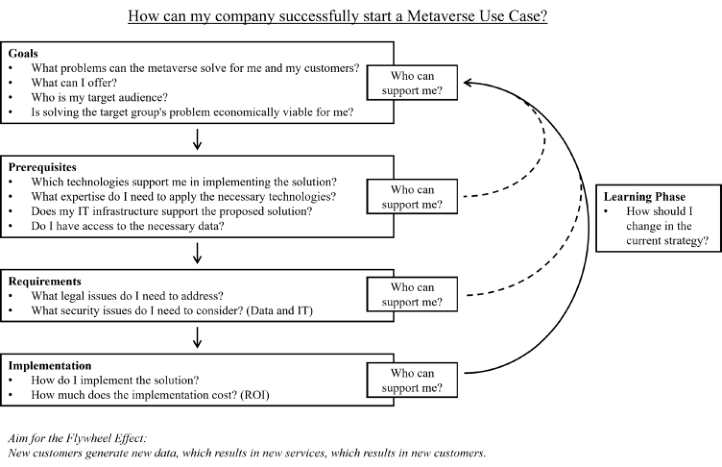
The questions and learnings from the business model development procedures where then clustered into five different categories and visualized to condense it into an easy-to-understand transformation model. The complete model is shown in Figure 1.
Figure 1: Transformation model (Fraunhofer IPA and IAO, 2025).
Before starting with the model there should be an Initiation Phase. In order to focus on a human centric design process, it is important to identify who is involved in the problem that needs to be solved and who is involved in the solution of that problem. Both not only for individuals but also for domains or entire hierarchy levels of the organization.
The model starts with establishing the goals of the organization for a potential Use Case. Each of the guiding questions should be treated as the name suggests – as a guide and involves several sub-questions to be considered. For example:
Question: “What problems can the Metaverse solve for me or my customer?” o “Am I the provider or the user of a Metaverse application to solve the problem?”
o “What is the pain me or my customer has right now” o “What are the gains I get from solving the problem?” o “What have I tried to solve the problem yet?”
Consider that for each different persona in the organization the detailed questions may differ when going through the transformation model. Hence there shall be no fixed set of sub-questions for every persona, but a dynamic discussion of the people involved in the project around each guiding question.
In the second category the organization should check what their current prerequisites are in order to solve the problem established in the first phase. The third phase builds in the results and asks what the requirements from the organization for the project are – for example: “Do I need an on-premise solution to satisfy data security concerns?” or “Do I register a trademark for my solution?” The fourth category answers question about the implementation itself.
While all of the transformation categories might be answered by the organization itself, the centre of the transformation model is the key question for every category: “Who can support me?” Which is both to be seen as who can support the organization in answering the sub-questions of the category and who can support the organization in the solution of these questions.
At every step there should be a feedback loop to the fifth category: The learning phase. At every iteration the key question, who can support the organization, should be answered proactively by contacting relevant consultants, technology provider, non-profits, government agencies, digitalization initiatives, academia and others, to build know-how and find the right people in order to solve the underlying problem. During the learning phase the current strategy should adapted according to the insight the supporters can provide.
The entire procedure through the transformation model should aim to satisfy the Flywheel Effect: New customers generate new data, which result in new services which result in new customers. Predominantly in scenarios which involve a Metaverse application designed for external customer use.
SURVEY Based on the transformation model described in the previous chapter a survey was designed to help organizations find collaboration opportunities in the relevant technological or legal fields. It aims to validate the structured approach of the transformation model and guide organizations through four of the five different transformation areas. At the end organizations receive recommendations for support for their Use Case through companies, academia, public of non-profit projects and other means. Furthermore, the survey aims to present practical approaches that help ease the entry for organizations into practical approaches and add concrete value.
The survey was conducted online and offline with participants across different fields of expertise, including construction, the service sector, healthcare, retail, information technology businesses, creative businesses, manufacturing and others. The size of the companies includes small, medium
A Transformation Model on How to Start a Metaverse Use Case 55 and large enterprises. The survey was conducted with 392 people with 269 of the answers being evaluated afterwards.
The structure and results of the survey were discussed in great detail in an earlier publication (Falkenau, 2025) and have shown that the goals and the problems in the implementation of Metaverse projects are consistent with previous studies and surveys conducted by the Fraunhofer Society and other institutions (Hölzle, 2023; Klöß 2025). The company representatives surveyed currently see themselves primarily confronted with challenges in digital transformation, competitive pressure, high costs, and the need for innovation in the sense of new market services. From the participants’ point of view, the key challenges in exploiting the potential of the Industrial Metaverse consist of identifying suitable Use Cases for the organization, including determining their economic viability. Further challenges include compliance with legal frameworks and the expertise required to implement and operate a Metaverse solution. The primary goals pursued by entering the Metaverse are process optimization, improving the customer experience, promoting innovation, and developing new business models.
Organizations see great potential and are showing considerable interest in the Metaverse but are currently still searching for an economically viable entry point. The initial focus is on solutions for increasing efficiency. New service offerings and associated business models follow at a distance. In the context of the Industrial Metaverse, respondents see great potential in the incremental optimization of existing services. Digital and continuously available data are the basis for every Metaverse use case here (Falkenau, 2025). The survey results show that organizations need a structured approach in order to guide them through the start of a Metaverse journey. Exactly that need can be filled by using the described transformation Model.
CONCLUSION
Extensive literature already exists around the problems and challenges when starting with Metaverse Use Cases but there is a lack of structure models to formulize the approach when starting a project for organizations of different industrial sectors. The transformation model presented in this publication attempts to close this gap. The model combines well-established approaches from business model development and consulting workshops with the knowledge of Metaverse-specific details through previous studies and projects. Thus, it focuses on cross-sector collaboration and the need to identify partners in an Metaverse-ecosystem.
Previous studies show that although great opportunities and potentials are forecast in the Metaverse, organizations lack the know-how and technology convergence needed to develop large scale Metaverse Use Cases on their own. The transformation model described in this publication, as well as the conducted survey and automated recommendations do not replace extensive personal work when starting a new Metaverse project but provide a low- level entry point for organizations of different sizes and backgrounds. The great interest in the survey across organizations in the area and the positive
feedback validates the need for a structured approach for starting such Use Cases. Especially if it includes collaboration opportunities across different industry sectors for small and medium sized enterprises.
ACKNOWLEDGMENT
Project funded by the Ministry of Economic Affairs, Labour and Tourism of Baden-Württemberg (Germany).
REFERENCES
Bellavista, P. et al. (2025) “The Metaverse in Smart Industrial Environments: from Vision to Proof-of-Concept”, International Conference on Metaverse Computing, Networking and Applications (MetaCom) (doi: 10.1109/ MetaCom65502.2025.00073) Falkenau, F. et al. (2025) “Metaverse Checks – Ergebnisse der Kurzumfrage zum
Einstieg in virtuelle Welten” (doi: 10.24406/publica-6681) Gassmann, O.; Frankenberger, K.; Csik, M. (2014) “The business model navigator.
55 models that will revolutionise your business.” Harlow England, New York: Pearson Education Limited Guo et al. (2024) “Industrial metaverse towards Industry 5.0: Connotation, architecture, enablers, and challenges” Hournal of Manufacturing Systems, Volume 76, pp. 25–42. Hill, T.; Westbrook, R. (1997) “SWOT analysis: It’s time for a product recall” Long
Range Planning, 30, pp. 46–52. Hölzle, K. et al. (2023) “CyberLänd. Potenziale des Metaverse für Unternehmen in Baden-Württemberg” (doi: 10.24406/publica-2135) Klöß, S. (2025) “Der aktuelle Stand des Metaverse“ Website: https://www.bitkom.
org/Bitkom/Publikationen/Der-aktuelle-Stand-des-Metaverse Krimpas, G.A. et al. (2025) “Metaverse: Industrial Applications – challenges and opportunities” Procedia CIRP, Volume 136, pp. 55–60 (doi: https://doi. org/10.1016/j.procir.2025.08.012) Osterwalder, A.; Pigneur, Y.; Bernarda, G. et al. (2014) “Value proposition design.
How to create products and services customers want.” Hoboken: John Wiley & Sons Rohleder, B. (2024) “Auf dem Weg ins Metaverse – wo steht die deutsche Wirtschaft?“ Website: https://www.bitkom.org/sites/main/files/2024-07/240711Bitkom-Charts- Meta-versefinal.pdf (accessed: 01.12.2025) Schneider, B. et al. (2024) “Advanced Systems Engineering Assessment - Advanced
Systems Engineering Assessment - Individually configuring and introducing ASE in industry”, wt Werkstattstechnik online, Fraunhofer Publica (doi: 10.37544/1436- 4980-2024-06-11) Schrader, P. et al. (2024) “Next Stop Metaverse: Opportunities and Barriers of AI-based Virtual Worlds for Companies” Portland International Conference on Management of Engineering and Technology (PICMET), Portland, OR, USA, 04.08.2024 - 08.08.2024, S. 1-12 (doi: 10.23919/PICMET64035.2024.10653234)
LISTED IN THE AHFE DIGITAL BOOKSTORE CATALOGUE
Explore the complete digital volume
Metaverse, Virtual Environments and Game Design
Read this individual research paper free through the original publisher, or explore the full digital proceedings book.
ISBN 978-1-964867-93-9
Explore this ISBN in the AHFE Bookstore ↗Listed in the July 2026 bookstore catalogue; search by ISBN to confirm current availability · Digital book purchase optional