Person-centered care is proposed as a principle that values each care recipient as an individual (Kitwood et al. 1992). In nursing care, it is necessary to provide high-quality individualized care based on a deep understanding of the narrative, which is the life story of each care recipient, including their life background and values (Guendouzi et al. 2015). However, it is not easy for busy care workers to practice individualized care according to the person-centered care principle. Fragments of narratives are typically gathered during initial assessments when users start using nursing care services and through daily conversations. Unfortunately, these narratives are often underutilized in actual care practices. This issue arises from various factors, including challenges on the care recipient side, such as difficulty in self-disclosure due to dementia and inadequate rapport, and challenges on the care worker side, such as heavy workloads and variability in communication skills among care workers.Our goal is to collect and structure narrative fragments from care recipients, organize their life background, values, and characteristics related to their thinking and behavior, and then develop tools to effectively utilize this information in caregiving settings. This paper proposes a narrative utilization ecosystem to enhance the quality of nursing care services by implementing and disseminating these tools to care workers. By incorporating narratives into care services, we aim to improve the rapport between care workers and care recipients, encourage further self-disclosure from care recipients, and facilitate the collection of additional narratives. This approach is expected to create a virtuous cycle within the ecosystem. In this paper, we will describe the components of this ecosystem, including the aspects where care workers can leverage their interpersonal skills and the areas where technologies such as AI and robots can enhance efficiency in the future.In this study, to collect narrative fragments, we conducted an experiment in which a person with dementia walked and talked with a care worker in familiar areas where he had lived or visited in the past. During the experiment, we gethered narrative fragments by asking him to recount past episodes based on the scenery he saw while walking and the questions posed by the care worker. In this case study, we, along with the care workers, analyzed narrative fragments from the conversations during the experiment, generated interpretive stories, and attempted to understand his past episodes. Through this analysis, we uncovered his memories of his father, who was a train driver, from the narrative fragments shared at the site of the railroad tracks. Additionally, from the narrative fragments shared while looking at the river scenery, we understood his memories of playing in the river and his recollections of his mother, who was a good swimmer. In this paper, we also analyze the reasons why narratives are not effectively utilized in nursing care settings and discuss the requirements for providing better care services as a team by sharing narratives among care workers.Kitwood, T., Bredin, K. (1992). Towards a theory of dementia care: Personhood and well-being, Ageing and Society, 12(3), 269-287.Guendouzi, J., Davis, B., Maclagan, M. (2015). Expanding Expectations for Narrative Styles in the Context of Dementia. Topics in Language Disorders. 35. 237-257. 10.1097/TLD.0000000000000061.
The government of Japan estimated that the number of elderly people with dementia will be 5.84 million by 2040. Dementia is a category of brain diseases, causing a long-term, gradual decrease in the capacity to think and remember. There are various types of dementia, including Alzheimer’s disease, vascular dementia, dementia with Lewy bodies, frontotemporal dementia, Huntington’s disease, Korsakoff’s syndrome, and Creutzfeldt- Jakob disease. The two most common types of dementia are Alzheimer’s disease and vascular dementia, constituting 70–85% of all cases. Even if
Narrative Utilization Ecosystem for Person-Centered Care 287
they have dementia, for independent living, they should be supported to use their remaining abilities rather than being helped by doing something instead (Strikwerda-Brown et al., 2019). To use their remaining abilities, it is important to empathize with what they value and empower them. To understand their sense of values, focusing on their narratives, i.e., the background and stories of their lives, is a rational approach (Guendouzi et al., 2015). Even if their memories are partially lost, they are likely to recall the things they cherished in their lives. Care workers will be able to use those things to provide support.
It is necessary to provide high-quality individualized nursing care based on a deep understanding of narrative, which is the life story of each care recipient, including their life background and values. However, it is not easy for busy or novice care workers to practice individualized care. Scerri reported that workshops based on an appreciative-inquiry approach improved staff attitudes and facilitated change leading to a number of improvements in the quality of care of patients with dementia (Scerri et al., 2019). However, care workers often experience psychological burden in labor shortage situations because they have to quickly finish their assigned tasks with few staff. They may prioritize the efficiency of their tasks over understanding the feelings of the care recipient. That is, care workers may act in a self-protective way at work as a result of perceived psychological and workload burdens (Ihara et al., 2023).
Our goal is to collect and structure narrative fragments from care recipients, organize their life background, values, and characteristics related to their thinking and behavior, then develop tools to effectively use this information in caregiving settings. This paper proposes a narrative utilization ecosystem to enhance the quality of nursing care services by implementing and disseminating these tools to care workers.
PERSON-CENTERED CARE In health care, a user-centered approach is often used to satisfy each patient’s demands (Pais, 2020; MacCaull et al., 2010). The COPM (Canadian Occupational Performance Measure) is an evidence-based outcome measure designed to capture a client’s self-perception of performance in everyday living and is used in many countries (Carswell et al., 2004). However, high work efficiency will be more prioritized than this user-centered approach at care sites.
Person-centered care was introduced by Kitwood (Kitwood et al., 1992) as one principle to deeply understand each patient. The notion of personhood in the principle means that each person should be accepted as his/her being in terms of the social relationship even though strange behaviors caused by dementia might be present. Person-centered care is used in limited health care fields (Håkansson et al., 2019), and its practical framework is called DCM, Dementia Care Mapping (University of Bradford). The framework is used in many case studies (Brooker, 2005). However, it is not easy to operate under the framework at care sites due to there being too many operations in the DCM cycle.
ISSUES ADDRESSED As mentioned above, it is not easy for busy or novice care workers to practice individualized care in accordance with the person-centered care principle. Fragments of narratives are typically gathered during initial assessments when users start using nursing care services and through daily conversations. Unfortunately, these narratives are often underutilized in actual care practices. This issue arises from various factors, including challenges on the care recipient side, such as difficulty in self-disclosure due to dementia and inadequate rapport, and challenges on the care worker side, such as heavy workloads and variability in communication skills among care workers.
By incorporating narratives into care services, we aim to improve the rapport between care workers and care recipients, encourage further self- disclosure from care recipients, and facilitate the collection of additional narratives. This approach is expected to create a virtuous cycle within the ecosystem. In this paper, we describe the components of this ecosystem, including the aspects from which care workers can leverage their interpersonal skills and the areas where technologies such as AI and robots can enhance efficiency in the future.
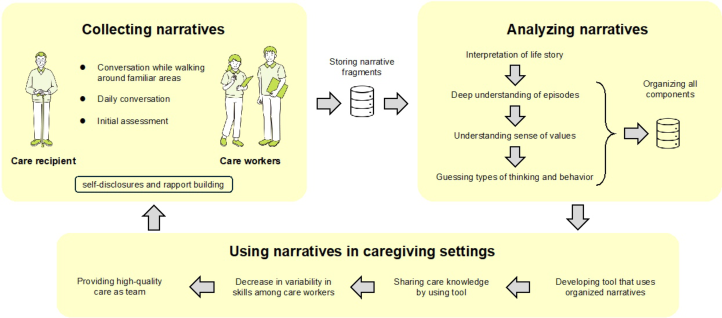
NARRATIVE UTILIZATION ECOSYSTEM Narrative is an effective approach to dementia care (Heersmink, 2022; Hughes, 2014; Randall, 2016). A life story book is a tool that has the potential of enabling digital reminiscence interventions (Elfrink, 2023). Our ecosystem consists of three main components; collecting narratives, analyzing them, and using them in caregiving settings (See Figure 1). Note that this ecosystem is defined within a context of interaction between a care recipient and care workers although there have been studies on the ecosystem of social context by many stakeholders (Begley et al., 2023; Burn et al., 2023).
Figure 1: Narrative utilization ecosystem.
Narrative Utilization Ecosystem for Person-Centered Care 289
Collecting Narratives Fragments of narratives are typically gathered during an initial assessment when a user starts using nursing care services. The assessment is conducted by filling out a form based on interviews with the user and/or his/her family. However, most items on the form are for filling in basic attributes such as a hobby or hometown, and there are not necessarily enough fields to fill in details about past episodes and the values behind them. Daily conversations are also a typical means of collecting narrative fragments. However, due to memory loss caused by dementia, the fragments that can be obtained from conversations inside nursing facilities are limited. It is also difficult for care workers to take notes of words the care recipient says. On the other hand, when talking while walking in a familiar place, the care recipient can sense the surrounding atmosphere in addition to visual and auditory stimulation. Therefore, it is possible to collect narrative fragments that cannot be obtained just by looking at photographs inside the facility. Narrative fragments from such various means are collected manually or automatically and are stored. Both speech-recognition and transcription technologies have the potential to automatically collect narrative fragments, but privacy issues remain a challenge.
Analyzing Narratives The narrative analysis component involves interpreting life stories by relating fragments collected in various situations. The utterances of people with dementia are scattered, and it is necessary to combine fragments to explore various possible interpretations. The incomplete episodes told by people with dementia can be understood more deeply by interpreting their life stories. A deep understanding of the episode makes it easier to understand the values behind it. Being able to understand values has the advantage of making it easier to guess the care recipient’s thought patterns and motivations for their behaviors during daily care. Organizing and storing these components (life stories, episodes, values, tendencies of thought and behavior) may help improve the quality of care.
Using Narratives in Caregiving Settings To use narratives in caregiving settings, it is effective to develop tools that use the organized narratives to provide advices to care workers. For novice care workers using these tools is equivalent to having experienced care workers share their expertise. Improving the quality of work of novice care workers will reduce dispersion in care worker skills and contribute to raising the quality of care provided as a team. High-quality care that takes care recipients’ values into account increases their satisfaction with care. As a result, a rapport between the care recipient and the care worker is built, promoting self-disclosure and making it possible to collect more narrative fragments.
CASE STUDY One effective way to get people with dementia to talk about their past episodes is to have conversations while walking around familiar places (Odzakovic et al., 2020). To collect narrative fragments, we conducted an experiment in which a person with dementia walked and talked with a care worker in familiar areas where he had lived or visited in the past. During the experiment, we gathered narrative fragments by asking the person to recount past episodes on the basis of the scenery he saw while walking and the questions posed by the care worker. In this case study, we, along with the care workers, analyzed narrative fragments from the conversations during the experiment, generated interpretive stories, and attempted to deeply understand his past episodes. For details of the preparation of the experiment, see our previous paper (Ihara et al., 2024).
Values of Going Out for People With Dementia For people with dementia, going outside is necessary not only for physical health by walking but also for maintaining social connections. Such physical activities may help maintain their cognitive function (Weuve et al., 2004). Restricting their opportunities to go out to prevent them from going missing will hinder their ability to live independently. However, when people with cognitive impairment go out, their lives are at risk because they may have an unexpected accident or not be able to return home and having to spend the night outdoors.
There are various related studies regarding going out of people with dementia. Motealleh analyzed outdoor natural landscape design in a residential aged care facility (Motealleh et al., 2019). Ward investigated the relationship between dementia and places through a five-year study (Ward et al., 2022). Regarding assistive technologies for people with dementia, Tseng developed a system to examine the accuracy and efficiency of patient wayfinding (Tseng et al., 2022). As a study from the user perspectives, Bartlett analyzed how people with dementia experienced and dealt with vulnerability when outdoors (Bartlett et al., 2019). Though an indoor analysis, Weber’s study examined preferences in nursing-home patients (Weber et al., 1978). However, there is no case study on collecting narratives in an experiment where a person with dementia walks around familiar areas.
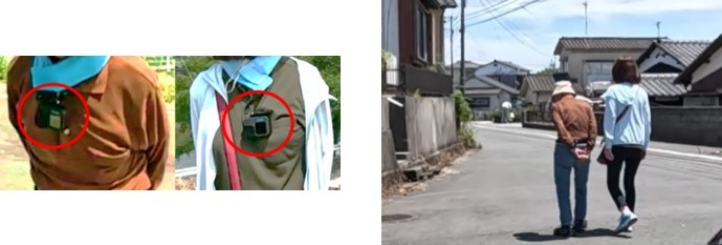
Narratives-Collection Experiment We conducted an experiment to collect the utterances of a person with dementia while walking in a familiar area as a preliminary trial. In the experiment, he and an accompanying care worker wore a video camera and walked along a pre-prepared route, recording what they saw and what they said in video files (See Figure 2).
There are various risks in conducting an experiment of walking outdoors with a person with dementia. We identified the risks through an assessment by three dementia care experts working at a nursing care facility (Ihara et al., 2024). We conducted a risk check using Google Street View and walked the expected route of the experiment to understand the risks on-site. The subject
Narrative Utilization Ecosystem for Person-Centered Care 291
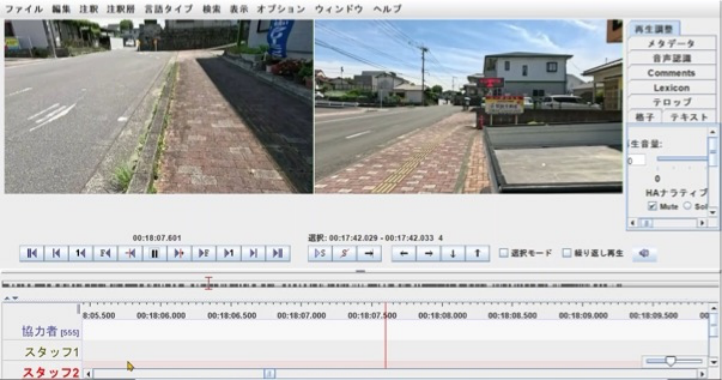
was an elderly man who used Living Aeru, a nursing care facility in Omuta City, Japan, who had Alzheimer’s type dementia and was certified as requiring care level 2 on a five-point scale in Japan (5 is the highest level of care required). Although he has lived in Omuta City for a long time, he often goes out alone and gets lost and needs to be rescued. For the experiment, we obtained permission from the RIKEN Ethics Review Committee (permit number: Wako 2024-04), gave informed consent to him and his family in advance, and obtained their consent to cooperate in the experiment. The duration of the conversation recorded in the video files was 70 minutes. The utterances by the subject and the accompanying care worker were transcribed and annotated into the video files using the annotation tool ELAN (Max Planck Institute for Psycholinguistics). Figure 3 shows a screenshot of the annotation, and Table 1 shows the category and frequency of the subject’s utterances.
Figure 2: Narratives-collection experiment (right: walking in familiar area, left: wearing video camera).Figure 3: Annotating transcribed utterances using ELAN.Table 1. Category and frequency of subject’s utterances.
Table available in the original PDF paper.
Category of Utterance Frequency Example Short response 84 Yeah. Unable to understand location or route 33 I don’t understand. Old memories 19 I was swimming here. Able to understand location or route 11 There were company houses here. Impressions about empty houses 9 No one lives here anymore. Looking for someone to ask directions 4 Is there anyone somewhere? Checking surrounding scenery 3 What is that? Consideration for accompanying care worker 2 Can you still walk?
Interpretation of Life Story The subject’s utterances obtained in the experiment included the statements regarding empty houses in town, lost coal mine trains, and playing in the river, which were important narrative fragments. By combining those fragments with additional fragments narrated by care workers based on their daily caregiving episodes, interpretations of his life story were created. An example of the interpretation was that he felt something strange about a quiet town with many empty houses in comparison with the crowded streets with many playing children in the past when the mining industry was still active. Another example was that his father, who was a mining train driver, responded by blowing the whistle to his waving to the train, but the train is no longer there. If we interpret the first episode pragmatically, we can understand his feeling of “I feel lonely because the bustling town is gone” behind his comment that “There are many empty houses.” Regarding the second episode, his remark, “It’s because that train is gone,” while pointing at the remains of the railroad tracks, suggests that he feels “it’s disappointing that the train that gave me so many fun memories is gone.”
DISCUSSION
Collecting Narratives While Walking Around Familiar Areas Collecting narrative fragments while walking around a familiar area has two effects. The first is that a person with dementia can feel not only visual and auditory stimulation but also the presence and atmosphere of his/her surroundings such as the presence of many empty houses and the absence of people. The second is to reminisce about the past by speaking using pointing gestures and commands, such as saying “that” while pointing to the railroad tracks. These findings suggest the possibility of obtaining narrative fragments that cannot be obtained by looking at old photographs or by having conversations during daily care in nursing facilities. Conversations while walking around familiar areas are effective in collecting narrative fragments from people with dementia who have difficulty remembering the past.
Narrative Fragments From Several Situations In addition to conversations while walking around familiar areas, narrative fragments can also be obtained during assessments at the beginning of using
Narrative Utilization Ecosystem for Person-Centered Care 293
nursing care services and during daily care. Integrating narrative fragments acquired during walking in familiar areas, initial assessments, and daily care facilitates the generation of interpretive stories and understanding of life backgrounds. We had already obtained the fragment that the subject’s father was a coal-mining train driver through the initial assessment, and the care worker had already obtained the fragment that when he waved at the train, his father responded with a whistle through the daily care work. In addition to these acquired narratives, we obtained an additional fragment in this experiment from his remark that “the train is gone”at a familiar location, a railroad track.
Deep Understanding Through Pragmatics Pragmatics is a field of linguistics that attempts to read from the context not only the literal and superficial meaning of words but also the implicit meaning that the speaker originally intended to convey. Applying pragmatics to the interpretation story of “There are many empty houses, and I feel strange about the situation where I don’t pass each other” enables a deep understanding of his life background of “I feel lonely because the liveliness of the town has been lost.” By applying pragmatics to the interpretive story, “When I waved to the train that my father was driving, my father responded by blowing the whistle,” we can more easily empathize with his feelings of “I am sad that the train that brought me memories with my father is gone.”
Virtuous Cycle of Ecosystem If we understand the above considerations on the basis of our ecosystem, narrative fragments are collected through interactions (e.g., conversations) between care recipients and care workers, their analysis generates interpretive stories, and life background is understood. This series of steps leads to a deep understanding of the care recipient. This deep understanding makes it easier to estimate the care recipient’s thoughts and behavior. By developing tools that use organized expertise and implementing them in caregiving settings, the response skills of novice care workers will be improved. Therefore, care workers can work as a team to provide empathetic care to care recipients, and the rapport between care recipients and care workers will improve. That rapport elicits further self-disclosure from the care recipients and allows for the collection of additional narrative fragments.
Toward Implementation of the Ecosystem Expertise possessed by skilled care workers is generally difficult to externalize, but when novice care workers use a tool (e.g., smartphone application or assistive robot) that uses narratives, it is equivalent to using the expertise of skilled care workers. Although such a tool is valuable, we have not yet considered its implementation and operation. There are three important issues facing the operation of such a tool. The first is the collection of narrative fragments in busy caregiving settings. One possible approach is to record and transcribe conversations during meetings to share information among care workers. Narrative fragments are collected by asking the meeting
participants to introduce successful and unsuccessful care episodes that day, as well as caregiving actions taken and care recipients’ reactions to those actions. The second issue is to automatically organize the collected fragments so that they can be used to understand values and estimate thoughts and behaviors. One approach to addressing this issue is the use of artificial intelligence (AI).One idea is to have AI learn the five petals of person-centered care: comfort, attachment, inclusion, occupation, and identity, then have it learn narratives of each care recipient. The third issue is presentation of AI advice to care workers. It is important to design request input to AI and advice output from AI as an interface that can be accepted by care workers performing daily nursing care tasks.
CONCLUSION
We proposed a narrative utilization ecosystem to enhance the quality of nursing care services. We described the components of the ecosystem as well as a case study on the conversation-while-walking experiment to collect narratives. This study has three contributions: proposing an ecosystem for using narratives in caregiving settings, demonstrating the usefulness of collecting narratives by walking in familiar areas, and analyzing the ecosystem through a case study. This case study is a trial experiment with one care recipient, and future experiments will need to be conducted with more care recipients. It is important that the ecosystem be designed to meet the needs of both care recipients and care workers. The narratives collected in this experiment can be useful for care workers in estimating the motivation and destination of a care recipient’s outing and may be used as a basis for making decisions when monitoring people with dementia going out or searching for them if they are missing. In other words, the ecosystem is valuable not only for understanding people with dementia but also for reducing the work burden on care workers. Future work will include considering the requirements for creating a virtuous cycle as an ecosystem by distinguishing between components of our narrative utilization ecosystem that should be carried out by care workers and components that can be replaced with technology.
ACKNOWLEDGMENT
We would like to thank the employees of the nursing facility Living Aeru for cooperating in the experiment.
REFERENCES
Bartlett, R., Brannelly, T. (2019). On being outdoors: How people with dementia experience and deal with vulnerabilities. Social Science & Medicine. 235. 10.1016/j.socscimed.2019.05.041. Begley, E., Gibb, M., Kelly, G., Keogh, F., Timmons, S. (2023). Model of Care for
Dementia in Ireland. Tullamore: National Dementia Services. Brooker, D. (2005). Dementia Care Mapping: A Review of the Research Literature; The Gerontologist, 45, Issue suppl_1, pp. 11–18. doi: 10.1093/geront/45.suppl_1.11.
Narrative Utilization Ecosystem for Person-Centered Care 295
Burn, E., Needham, C. (2023). What does the concept of an ecosystem offer to social care? A narrative review of the ecosystem literature. Centre for Care Working Paper 2, Circle, Sheffield: University of Sheffield. Carswell, A., McColl, M. A., Baptiste, S., Law, M., Polatajko, H., Pollock, N.
(2004). The Canadian Occupational Performance Measure: A Research and Clinical Literature Review, Canadian Journal of Occupational Therapy, 71(4), pp. 210–222. doi: 10.1177/000841740407100406. Elfrink, T. (2023). Exploring Life Story Books in Dementia Care: The potential of digital reminiscence interventions. [PhD Thesis–Research UT, graduation UT, University of Twente]. University of Twente. https://doi.org/10.3990/1. 9789036558143 Guendouzi, J., Davis, B., Maclagan, M. (2015). Expanding Expectations for
Narrative Styles in the Context of Dementia. Topics in Language Disorders. 35, pp. 237–257. 10.1097/TLD.0000000000000061. Håkansson Eklund, J., Holmström, I. K., Kumlin, T., Kaminsky, E., Skoglund, K., Höglander, J., et al. (2019). “Same same or different?” A review of reviews of person-centered and patient-centered care, Patient Educ. Couns., 102(1), pp. 3–11. doi: 10.1016/j.pec.2018.08.029. Heersmink, R. (2022). Preserving Narrative Identity for Dementia Patients: Embodiment, Active Environments, and Distributed Memory. Neuroethics 15, 8. https://doi.org/10.1007/s12152-022-09479-x Hughes, T. (2014). Stories of professional care: Narrative analysis of accounts from
people with dementia. Prof Doc Thesis University of East London School of Psychology. https://doi.org/10.15123/PUB.4063 Ihara, M., Tokunaga, H., Nakashima, T., Saruwatari, S., Goto, H., Umezaki, Y., and Motoe, M. (2023). Facilitating Empathy for Care Recipients—Analyzing Care Behaviors Towards Person-Centered Care. Design, User Experience, and Usability. HCII 2023. Lecture Notes in Computer Science. Vol. 14034. Springer, Cham. https://doi.org/10.1007/978-3-031-35705-3_26 Ihara, M., Tokunaga, H., Nakashima, T., Goto, H., Umezaki, Y., Minato, T.,
Nakamura, Y., and Saruwatari, S. (2024). Towards Narrative-Based Technology to Assist People with Dementia When Outing, Human Systems Engineering and Design (IHSED 2024): Future Trends and Applications, vol. 158, pp. 1–10 (Proc of IHSED 2024). Kitwood, T., Bredin, K. (1992). Towards a theory of dementia care: Personhood and well-being, Ageing and Society, 12(3), pp. 269–287. MacCaull, W., Jewers, H., Latzel, M. (2010). Using an interdisciplinary approach
to develop a knowledge-driven careflow management system for collaborative patient-centred palliative care, In: Proceedings of the 1st ACM International Health Informatics Sympo-sium (IHI ‘10), pp. 507–511, ACM, New York, NY, USA. doi: 10.1145/1882992.1883073. Max Planck Institute for Psycholinguistics, The Language Archive, Nijmegen, The Netherlands: ELAN, https://archive.mpi.nl/tla/elan (Last accessed at October 20, 2024). Motealleh, P., Moyle, W., Jones, C., Dupre, K. Creating a dementia-friendly
environment through the use of outdoor natural landscape design intervention in long-term care facilities: A narrative review. Health Place. 2019 Jul;58:102148. doi: 10.1016/j.healthplace.2019.102148. Epub 2019 Jun 18. PMID: 31220798. Odzakovic, E., Hellström, I., Ward, R., Kullberg, A. ‘Overjoyed that I can go outside’: Using walking interviews to learn about the lived experience and meaning of neighbourhood for people living with dementia. Dementia. 2020;19(7): 2199–2219. doi: 10.1177/1471301218817453.
Pais, S. (2020). Integrating Patient-Generated Wellness Data: A User-Centered Approach, In: Proceedings of the Australasian Computer Science Week Multiconference (ACSW ‘20), Article 35, pp. 1–8, ACM, New York, NY, USA. doi: 10.1145/3373017.3373052. Randall, W. (2016). Narrative Environments for Narrative Care: The Need to
Honor People’s Stories. International Journal of Human Caring. 20, pp. 1–4. 10.20467/1091-5710-20.3.142. Scerri, A., Innes, A., Scerri, C. (2019). Using appreciative inquiry to implement person-centred dementia care in hospital wards. Dementia (London, England), 18(1), pp. 190–209. https://doi.org/10.1177/1471301216663953 Strikwerda-Brown, C., Grilli, M. D., Andrews-Hanna, J., & Irish, M. (2019). “All
is not lost” Rethinking the nature of memory and the self in dementia. Ageing research reviews, 54, 100932. https://doi.org/10.1016/j.arr.2019.100932 Tseng, W. S., Fang, J. (2022). “A Device Designed to Improve Care and Wayfinding Assistance for Elders with Dementia” Sustainability 14, No. 17: 11076. https: //doi.org/10.3390/su141711076 University of Bradford: Dementia Care Mapping, https://www.bradford.ac.uk/dem
entia/training-consultancy/ (Last accessed at October 25, 2024). Ward, R., Rummery, K., Odzakovic, E., Manji, K., Kullberg, A., Clark, A., Campbell, S. Getting lost with dementia: Encounters with the time-space of not knowing. Health Place. 2022 Nov;78:102940. doi: 10.1016/j.healthplace.2022.102940. Epub 2022 Nov 17. PMID: 36403420. Weber, R. J., Brown, L. T., Weldon, J. K. (1978). Cognitive maps of environmental knowledge and preference in nursing home patients. Experimental Aging Research, 4(3), 157–174. https://doi.org/10.1080/03610737808257141 Weuve, J., Kang, J. H., Manson, J. E., Breteler, M. M. B., Ware, J. H., Grodstein, F.
Physical Activity, Including Walking, and Cognitive Function in Older Women. JAMA. 2004;292(12):1454–1461. doi: 10.1001/jama.292.12.1454.
LISTED IN THE AHFE DIGITAL BOOKSTORE CATALOGUE
Explore the complete digital volume
Intelligent Human Systems Integration (IHSI 2025): Integrating People and Intelligent Systems
Read this individual research paper free through the original publisher, or explore the full digital proceedings book.
ISBN 978-1-964867-36-6
Explore this ISBN in the AHFE Bookstore ↗Listed in the July 2026 bookstore catalogue; search by ISBN to confirm current availability · Digital book purchase optional