Masayuki Ihara, Hiroko Tokunaga, Tomomi Nakashima, Hiroki Goto, Yuuki Umezaki, Takashi Minato, Yutaka Nakamura, Shinpei Saruwatari (2024). Towards narrative-based technology to assist people with dementia when going out. In: Human Systems Engineering and Design (IHSED2024): Future Trends and Applications. AHFE Open Access, vol. 158, pp. 43–52. https://doi.org/10.54941/ahfe1005527
This paper introduces an experimental design for collecting narratives and utilization of them based on person-centered care (Kitwood et al, 1992) as a preliminary study toward using narratives in technology to assist people with dementia when going out. One of the issues in dementia care is balancing risk management and independent living support. The act of going out is important for independent living, but dementia increases risks when going out, such as inability to return home by oneself. A typical behavior of people with dementia is to try to get home even though they are home, then go out and get lost. They may recognize other places where they have lived in the past as their current home. In other words, they may recognize their past selves as their current selves. Although there are previous studies on analyzing wayfinding by people with dementia (Sheehan et al, 2006), there is no research that collects and uses narratives in technology. We focused on organizing narratives by era on the basis of changes in their living environments in the past, and using these to assist them when they go out.We propose a narrative framework that organizes the location of one’s home in each era, the people and things that were cherished at the time, and episodes. Understanding the location of people with dementia’s past home and the things they cherished can help predict the purpose and destination of their outings. However, such narrative components are not necessarily known and need to be obtained from people with dementia, their family, or care workers. One effective way to get people with dementia to talk about the past episodes is to have conversations while walking around familiar places.For the safety of the “conversations while walking” experiments, we identified various risks when people with dementia go out. The identification was conducted through an assessment by three dementia care experts working at a nursing care facility (3rd, 4th and 5th authors of this paper). We assessed four categories: general risks for the elderly, risks specific to people with dementia, risks to themselves while going out, and risks to themselves after returning home. The number of risks extracted in each category were 9, 10, 8, and 8, respectively. For example, the roadside risk was identified as one of the general risks for the elderly. The cognition for the current situation was identified as one of the risks specific to people with dementia. We also conducted a risk check using Google Street View and an experimenter walking on-site to confirm the expected route in preparation for the outing experiment.The narratives collected in future experiments are planned for use in assistive technologies such as robots. As principles in designing patient-technology and care-worker-technology interactions, we consider the five petals of person-centered care: comfort, attachment, inclusion, occupation, and identity, in addition to human dignity and support for independent living. Future work will include conducting narrative collection experiments and analyzing results as well as detailed interaction design. Kitwood, T. and Bredin, K. (1992). Towards a theory of dementia care: Personhood and well-being, Ageing and Society, Vol.12, No.3, pp.269-287.Sheehan, B., Burton, E. and Mitchell, L. (2006). Outdoor wayfinding in dementia. Dementia: The International Journal of Social Research and Practice. Vol.5, pp.271-281.
In Japan, a total of 18,709 people with dementia were reported missing in 2022 (The Japan Times, 2023). The act of going out is important for their independent living, but dementia increases risks when walking outside, such as inability to return home by oneself. A typical behavior of people with dementia is to try to get home even though they are home, then go out and get lost. They may recognize other places where they have lived in the past as their current home. Another example is to go out following their past habitual behavior, such as daily commuting, and forget the purpose
of going out on their way. These typical behaviors suggest that they may recognize their past selves as their current selves. To assist them when they go out, we focused on organizing narratives by era on the basis of changes in their living environments in the past. One issue for narrative organization is how to collect their narratives that are useful for them guessing the purpose and destination of their outing. We introduces an experimental design for collecting narratives from conversations while walking around their familiar places toward using the narratives in technology to assist in their outings.
ISSUES ADDRESSED One of the issues in dementia care is balancing risk management and independent living support. For people with dementia, going outside is necessary not only for physical health by walking but also for maintaining social connections. Such physical activities may help maintain their cognitive function (Weuve et al., 2004). Restricting their opportunities to go out to prevent them from going missing will hinder their ability to live independently. However, when people with cognitive impairment go out, their lives are at risk because they may have an unexpected accident or not be able to return home and having to spend the night outdoors. If they go missing, their family or care workers will have to search for them, placing a burden on those around them. Support for people with dementia to go out is necessary for both people with dementia and those around them.
RELATED WORKS There have been studies on analyzing wayfinding by people with dementia, as shown in Marquardt’s survey (Marquardt, 2011). Sheehan analyzed landmarks as signs in wayfinding (Sheehan et al., 2006). Motealleh analyzed outdoor natural landscape design in a residential aged care facility (Motealleh et al., 2019). Hilton investigated the role of visual attention through eye-tracking and engagement of attentional resources in age-related route- learning deficits (Hilton et al., 2020). Ward investigated the relationship between dementia and places through a five-year study (Ward et al., 2022). Regarding assistive technologies for people with dementia, Tseng developed a system to examine the accuracy and efficiency of patient wayfinding (Tseng et al., 2022). Virtual reality technologies are also used for navigating people with dementia (Davis et al., 2016; Allison et al., 2016). As a study from user’s perspectives, Bartlett analyzed how people with dementia experienced and dealt with vulnerability when outdoors (Bartlett et al., 2019). Though an indoor analysis, Weber’s study examined preferences in nursing-home patients (Weber et al., 1978). Haugen introduced case analyses on homesickness for people with dementia (Haugen, 2020).
From the viewpoint of person-centered care (Kitwood et al., 1992), when designing technologies to help people with dementia go out, they should be supported to use their remaining abilities rather than being helped by doing something instead (Strikwerda-Brown et al., 2019). To use their remaining abilities, it is important to empathize with what they value and empower
Towards Narrative-Based Technology to Assist People With Dementia When Outing 45
them. To understand their sense of values, focusing on their narratives, i.e., the background and stories of their lives, is a rational approach (Guendouzi et al., 2015). Even if their memories are partially lost, they are likely to recall the things they cherished in their lives. Care workers will be able to use those things to provide support such as wayfinding. However, such narratives are not necessarily known and need to be obtained from people with dementia, their families, or care workers. One effective way to get them to talk about their past episodes is to have conversations while walking around familiar places (Odzakovic et al., 2020). For the safety of the “conversations while walking” experiments, we need to identify various risks when people with dementia go out (Bantry et al., 2015). This paper introduces the results of identifying risks in advance of conducting an experiment in which we go out with people with dementia and collect their narratives. The preparations made for the experiment are also introduced as the experimental design.
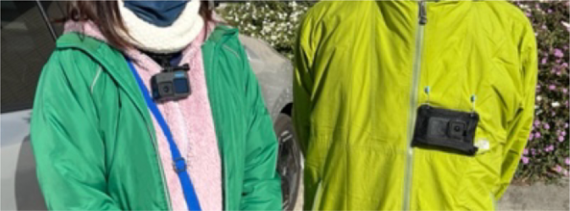
OUTLINE OF NARRATIVE-COLLECTION EXPERIMENTS We have a plan for experiments in which we will collect the utterances of a person with dementia and a care worker when they are walking outdoors and have conversations. The areas they walk are places where the person with dementia has lived or has often visited. The places may include a location of their past home, a park where they played in their childhood, a store they often visited, etc. In these experiments, they and the care worker wear a video camera (Figure 1) and walk along a pre-prepared route, recording what they see and what they say in video files. Their walking trajectory is also recorded using the Global Positioning System (GPS). These experiments not only record what problems the person with dementia had while looking at what scenery but also reveal past episodes related to the scenery through dialogues with the accompanying care worker.
Figure 1: Wearing a video camera to record utterances and scenery.
EXPERIMENTAL DESIGN Extracting Risks in Outdoor Walking Experiments
There are various risks in conducting an experiment of walking outdoors with a person with dementia. We identified the risks through an assessment by three dementia care experts working at a nursing care facility (3rd, 4th
and 5th authors of this paper). These experts wrote down possible risks on sticky notes during three 1-hour workshops. They assessed four categories: general risks for the elderly, risks specific to people with dementia, risks to themselves while going out, and risks to themselves after returning home.
According to the principle of person-centered care, people with dementia should be respected for their dignity and individual lifestyle just as healthy people should. In the assessment, we considered that the actions and motivations of people with dementia are not inherently problematic, just like those of healthy people. We identified risks to healthy elderly people and those derived from dementia as separate categories. The number of risks extracted in each category were 9, 10, 8, and 8, respectively. We present the extraction results and countermeasures for the first two categories only in this paper, i.e., general risks to the elderly and the risks specific to people with dementia.
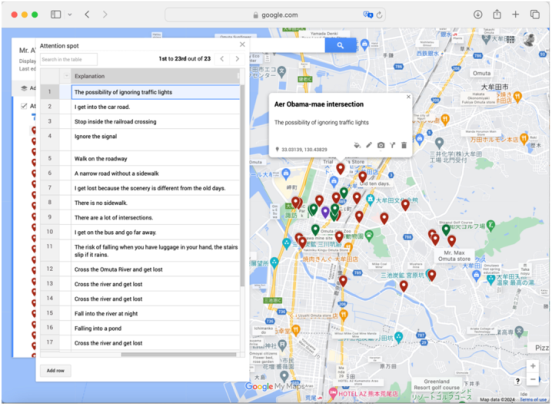
General Risks to Healthy Elderly As shown in Table 1, the extracted general risks to the healthy elderly are roadside, traffic accident, health condition, injury, excretion, money management, emergency contact, lost belongings, and missing. Regarding the roadside risk, it is important to identify dangerous areas in advance to avoid falling into gutters or rivers. Creating a hazard map is also an effective measure to prevent encountering or causing a traffic accident.
Figure 2: Hazard map for safe experiments.
Figure 2 shows the hazard map we created through discussion with care workers at the nursing facility. This hazard map alerts us to various risks to safely carry out experiments in which we walk outdoors with the elderly. For example, there is the risk of ignoring a traffic light at an intersection with little traffic, the risk of stopping at a railroad crossing, or the risk of getting into a traffic accident on a narrow road without a sidewalk.
Towards Narrative-Based Technology to Assist People With Dementia When Outing 47
Table 1. General risks for healthy elderly and countermeasures.
Table available in the original PDF paper.
Risk Remarks Countermeasures
Identify dangerous areas in advance
Roadside
Falling into gutter or river
Unable to identify dangerous areas
Create hazard map
Traffic accident
Get into traffic accident
Cause traffic accident Health condition
Heatstroke
Dehydration
Check health condition a few days before experiment
Check vitals with smart watch
Recommend drinking water Injury
Falling down
Assess knee function, need for cane, footwear
Assessed by family doctor or care worker in charge
Prepare emergency contact information, transportation to hospital, family consent, and insurance coverage
Excretion
Frequent urge to urinate
Check location of toilet in advance
Go to toilet every time there is one during experiment Money management
Not being able to pay by oneself
Keep contact card in bag in case of trouble
Emergency contact
Unable to make call in case of emergency
Accompanied by experienced care worker Lost belongings
Lose belongings brought
Participate in experiment without holding anything in hands
Accompanying care worker keeps an eye on belongings.
Wear GPS
Family consent
Missing
Not being able to return home
Family is worried about lack of communication
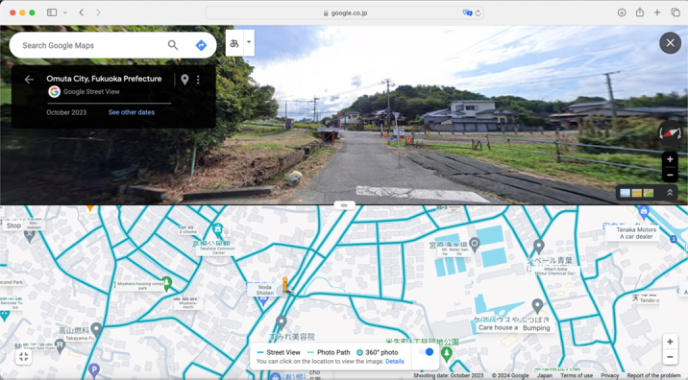
We also conducted a risk check using Google Street View (See Figure 3). The image in Figure 3 shows a scene of an area where an elderly subject would have played as a child. A walking route for the experiment is planned in advance, mainly in areas familiar to the subject, and Google Street View is used to check the route for any dangerous spots.
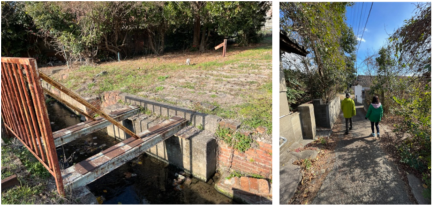
Experimenters, including the care worker who accompanies the subject in the experiment, refer to the risk check results by Google Street View and walk the expected route of the experiment to understand the risks on-site (See Figure 4). By walking and checking on-site, it is possible to identify the risk of dangerous gutters with only partial fences, as shown in Figure 4. Additionally, on-site confirmation is an important preparation for the experiment to specifically identify the risks of small paths and three- dimensional terrain such as steep slopes those cannot be seen using Google Street View.
Figure 3: Risk checks using Google Street View.Figure 4: Risk checks by walking on-site.
During the experiment, the subjects may deviate from the route we had planned. Walking on-site in advance makes it easier to estimate which path they will take and deviate from the expected route at intersections. For estimating such route deviations, on-site inspections are better than using Google Street View, as they allow for easier spatial understanding.
Risks Specific to People With Dementia
Table 2 shows the extracted risks specific to people with dementia. The extracted risks are cognition for situation, auditory perception, visit due to misidentification, memory loss, gap between memory and present, traffic accident, money management, inability to request assistances, clothing inappropriate for the climate, and, going out at night. Cognition for the current situation is a typical problem. People with dementia are unable to properly understand the surrounding situation, are unable to understand where they are, forget the route they took, and forget the purpose of going out. Regarding the gap between memory and present, they may feel like being in another world because landscape and geography are different from the past. This is one of the reasons why they get lost.
Towards Narrative-Based Technology to Assist People With Dementia When Outing 49
In addition to risk checks during the on-site walking by experimenters in advance„ we also check for old buildings along the route and identify landmarks that might prompt subjects to talk about their past episodes as well as position measurement using GPS. Data sets of GPS measurements, landmarks in the scene, and episodes may contribute to identifying their significant objects associated with the location. These are expected to be useful in estimating their motives and destinations for going out.
Table 2. Risks specific to people with dementia and countermeasures.
Table available in the original PDF paper.
Risk Remarks Countermeasures Cognition for situation
Accompanying care worker assists as needed.
Unable to properly understand surrounding situation
Unable to understand where they are
Forget route they took
Forget purpose of going out and be unable to achieve it Auditory perception
Cannot hear surrounding environmental sounds
Do not notice car horn
Establish criteria for discontinuing experiment, such as exceeding area boundaries, abnormal emotional states, and not following staff instructions
Visit due to misidentification
Accompanying staff stops them.
Cause trouble by repeatedly entering same store
Cause trouble by entering someone’s home
Wear GPS
Memory loss
Go missing due to memory loss Gap between memory and present
Ask them in advance for information about places to stop by
Understand how much they know about place to stop by
Because landscape and geography are different from past, feel like being in another world and get lost
Assumptions and misunderstandings
Know in advance about traffic violations in their daily life
Traffic accident
Traffic rule violation
Ignore traffic lights
Walk on road instead of sidewalk
Do not stop by store during experiment
Money management
Unable to shop because they do not have money
Unable to shop because they cannot calculate
Steal because they cannot shop Inability to request assistances
Wear GPS
Keep help card with contact information in their bag
Do not know how to ask for help
Cannot find anyone to rely on, so they keep walking far away
Less likely to feel tired or anxious
Clothing inappropriate for weather
Not wearing clothes appropriate for temperature of day
Accompanying staff advises them.
Prepare communication system in case they feel unwell Going out at night
No sense of time
Follow usual dementia care
NARRATIVES FOR ASSISTIVE TECHNOLOGIES The narratives collected in future experiments are planned for use in assistive technologies such as robots. One key approach to using narratives is to organize collected narrative data by era. This is because people with dementia may sometimes act by thinking that their past selves are their present selves. Table 3 shows an example of organizing narratives by era. It is desirable to include the location of their home in their time period, as many of the problems in which they go missing are caused by their behavior in trying to return home. The organized narratives should also include places frequently visited in each era. The organization should include not only important places but also people who were important in each era, such as family and friends, because elderly people are more likely to feel lonely thus go out to meet them.
Table 3. Example of organized narratives.
Table available in the original PDF paper.
Era Location of
People and things home cherished Place to visit frequently
Description a town People None (Wife) Description aa supermarket Living alone after wife’s death (present)
GPS a.gpx Thing Beer GPS aa.gpx Picture aa.jpg Picture a.jpg Episode Going out to buy beer
Description Parents’ home
Living with wife after marriage
Description b town People Wife and parents
GPS bb.gpx
GPS b.gpx Thing Life with family
Picture bb.jpg
Picture b.jpg Episode Visited parents with wife :
Description cc park
Elementary school student
Description c town People Friends to play with GPS c.gpx Thing Park GPS cc.gpx
Picture cc.jpg
Picture c.jpg Episode Played every day even after dark
The organized narratives are expected to be referred to by assistive technologies when people with dementia are lost. They can be used both for wayfinding and as a reminder of the purpose of going out. These narratives can also be applied not only to the technology used by people with dementia but also to that used by their care workers. By using narrative-based assistive technology, care workers can guess the motivation and destination of missing people with dementia and search for them more efficiently and quickly.
To develop these assistive technologies, it is necessary to effectively design interactions between people with dementia and technology, and between care workers and technology. In designing these interactions, we consider
Towards Narrative-Based Technology to Assist People With Dementia When Outing 51
the five petals of person-centered care: comfort, attachment, inclusion, occupation, and identity, in addition to human dignity and support for independent living. For example, assistive robots should understand what kind of comfort people with dementia seek when they go out and should behave in a way that does not hinder their inclusion in the local community. Assistive robots that mediate between care workers and people with dementia should understand the remaining abilities of people with dementia then provide recommendations to care workers to encourage them to play a role in society.
Another perspective for designing assistive technology is to use comments from care workers who accompany people with dementia in experiments. A data set consisting of three elements: (1) in what situation, (2) what the care worker said, and (3) how the person with dementia reacted, will be useful in designing the interactions considering the cognitive state. In other words, it is possible that the skills of excellent care workers acquired through daily care work can be externalized and implemented in assistive technologies. A set of landmarks referenced by care workers during the experiment and episodes told therein can also be used to design assistive technology.
CONCLUSION
We introduced an experimental design for collecting narratives and using them on the basis of person-centered care as a preliminary study toward using narratives in technology to assist people with dementia when going out. The contribution of this study is a set of risks and countermeasures extracted during experimental preparation, which can be used for safe guidance with assistive technology. Future work will include conducting narrative-collection experiments and analyzing the results as well as designing patient-technology and care-worker-technology interactions in detail.
ACKNOWLEDGMENT
We would like to thank the employees of the nursing facility “Living Aeru” for cooperating in the experiment preparation.
REFERENCES
Allison, S. L., Fagan, A. M., Morris, J. C., Head, D. (2016). Spatial Navigation in Preclinical Alzheimer’s Disease. Journal of Alzheimer’s disease: JAD, 52(1), 77–90. https://doi.org/10.3233/JAD-150855 Bantry White, E., Montgomery, P. Supporting people with dementia to walkabout
safely outdoors: development of a structured model of assessment. Health Soc Care Community. 2016 Jul; 24(4): 473–84. doi: 10.1111/hsc.12226. Epub 2015 Mar 27. PMID: 25817065. Bartlett, R., Brannelly, T. (2019). On being outdoors: How people with dementia experience and deal with vulnerabilities. Social Science & Medicine. 235. 10.1016/j.socscimed.2019.05.041. Davis R, Ohman J. Wayfinding in ageing and Alzheimer’s disease within a virtual
Guendouzi, J., Davis, B., Maclagan, M. (2015). Expanding Expectations for Narrative Styles in the Context of Dementia. Topics in Language Disorders. 35. 237–257. 10.1097/TLD.0000000000000061. Haugen, I. (2020). Homesickness for People with Dementia. 10.1007/978-981-15-
0406-8_4. Hilton, C., Miellet, S., Slattery, T., Wiener, J. (2020). Are age-related deficits in route learning related to control of visual attention?. Psychological Research. 84. 10.1007/s00426-019-01159-5. Kitwood, T., Bredin, K. (1992). Towards a theory of dementia care: Personhood and
well-being, Ageing and Society, 12(3), 269–287. Marquardt G. Wayfinding for people with dementia: a review of the role of architectural design. HERD. 2011 Winter;4(2): 75–90. doi: 10.1177/193758671100400207. PMID: 21465436. Motealleh, P., Moyle, W., Jones, C., Dupre, K. Creating a dementia-friendly environment through the use of outdoor natural landscape design intervention in long-term care facilities: A narrative review. Health Place. 2019 Jul;58:102148. doi: 10.1016/j.healthplace.2019.102148. Epub 2019 Jun 18. PMID: 31220798. Odzakovic, E., Hellström, I., Ward, R., Kullberg, A. ‘Overjoyed that I can go
outside’: Using walking interviews to learn about the lived experience and meaning of neighbourhood for people living with dementia. Dementia. 2020;19(7): 2199–2219. doi: 10.1177/1471301218817453 Sheehan, B., Burton, E., Mitchell, L. (2006). Outdoor wayfinding in dementia.
Dementia: The International Journal of Social Research and Practice. Vol. 5, pp. 271–281. Strikwerda-Brown, C., Grilli, M. D., Andrews-Hanna, J., & Irish, M. (2019). “All is not lost” Rethinking the nature of memory and the self in dementia. Ageing research reviews, 54, 100932. https://doi.org/10.1016/j.arr.2019.100932 The Japan Times. (2023, June 22). Dementia-related missing person cases doubled
over past 10 years, Retrieved July 1, 2024 from https://www.japantimes.co.jp/n ews/2023/06/22/national/social-issues/dementia-missing-persons-double-report/ Tseng, W. S., Fang, J. (2022). “A Device Designed to Improve Care and Wayfinding Assistance for Elders with Dementia” Sustainability 14, no. 17: 11076. https: //doi.org/10.3390/su141711076 Ward, R., Rummery, K., Odzakovic, E., Manji, K., Kullberg, A., Clark, A., Campbell, S. Getting lost with dementia: Encounters with the time-space of not knowing. Health Place. 2022 Nov;78:102940. doi: 10.1016/j.healthplace.2022.102940. Epub 2022 Nov 17. PMID: 36403420. Weber, R. J., Brown, L. T., Weldon, J. K. (1978). Cognitive maps of environmental
knowledge and preference in nursing home patients. Experimental Aging Research, 4(3), 157–174. https://doi.org/10.1080/03610737808257141 Weuve, J., Kang, J. H., Manson, J. E., Breteler, M. M. B., Ware, J. H., Grodstein, F.
Physical Activity, Including Walking, and Cognitive Function in Older Women. JAMA. 2004;292(12):1454–1461. doi: 10.1001/jama.292.12.1454
LISTED IN THE AHFE DIGITAL BOOKSTORE CATALOGUE
Explore the complete digital volume
Human Systems Engineering and Design (IHSED2024): Future Trends and Applications
Read this individual research paper free through the original publisher, or explore the full digital proceedings book.
ISBN 978-1-964867-34-2
Explore this ISBN in the AHFE Bookstore ↗Listed in the July 2026 bookstore catalogue; search by ISBN to confirm current availability · Digital book purchase optional