Md Abul Kalam Siddike, Jens Neuhüttler (2024). Towards Cognitive Service Systems–a framework for conceptualizing AI-supported value co-creation. In: The Human Side of Service Engineering. AHFE Open Access, vol. 143, pp. 63–74. https://doi.org/10.54941/ahfe1005084
Service systems are evolving from traditional service systems to smart service systems to cognitive service systems based on the evolution of technological capabilities. However, humans in service systems might change work or life situations, have cognitive capabilities, and suffer from bounded rationality. In addition, humans face acute problems like knowledge burden, half-life of information, and being flooded by data, information, as well as knowledge. To overcome these problems, traditionally humans learn and acquire skills, knowledge, and experience through entrepreneurship and innovations. But modern technologies like AI, generative AI, and IoT usher a new horizon to overcome those problems through the harmonious interactions between humans and generative AI. In this research, we propose a framework of cognitive service systems that focuses on the following aspects: Humans interact with generative AI harmoniously and consider these technologies as assistants, collaborators, coaches, and mediators in the cognitive service system. Therefore, the proposed model of cognitive service system is described by developing a hierarchical topology of tools, assistants, collaborators, coaches, and mediators (TACCM), which ultimately expands the evolution of service systems with the co-evolution of technological capabilities. Practically, the TACCM topology supports humans regardless of industries and their professions, race, creed, and gender to co-create value through harmonious interactions with technologies.
A service system is the configuration of people, technologies, organizations, and shared information that interact over time for the co-creation of value (Spohrer et al., 2008). Service systems are evolving from traditional service systems to smart service systems to cognitive service systems based on the evolution of technological capabilities (Spohrer, Siddike, and Kohda, 2017). However, humans in service systems have limitations of lifespan, and cog- nitive capabilities, and suffer from bounded rationality (Simon, 1997). In addition, humans face acute problems such as knowledge load (Jones, 2005), information half-life (Arbesman, 2013), and being flooded by data, infor- mation, and knowledge. To overcome these problems, humans traditionally learn and acquire skills, knowledge, and experience through entrepreneurship
and innovation (Spohrer and Siddike, 2018). However, modern technolo- gies such as generative AI open a new horizon to overcome these problems through the harmonious interactions between humans and generative AI (Siddike et al., 2017; Spohrer et al., 2017).
Nowadays, new technologies, including AI, and generative AI, augment the capabilities of humans to become smarter or wiser (Norman, 2023; 1993; Siddike et al., 2017). In the past, machines augmented the physical strength and capabilities of humans. But today, for example, generative AI such as ChatGPT, Google Bard, and others augment human capabilities in multiple ways. In addition, technologies like cognitive computing and sensor technolo- gies are beginning to augment human capabilities in specific ways (Spohrer, Siddike, and Kohda, 2017). This augmentation of human capabilities was called for by the American engineer and inventor, and the early computer and Internet pioneer Douglas Engelbart (Spohrer and Siddike, 2018). To some extent, researchers have predicted that these technological capabilities will become more advanced and augment human capabilities such as weak telepathy, weak immortality, and weak colonization (Lenat, 2016).
In the service system, humans interact harmoniously with these tech- nologies to co-create value (Siddike and Kohda, 2018a; 2018b; 2018c). Previously, researchers described how humans interact with different AI- based cognitive assistants (CAs) for the creation of value. Some of them discussed that reliability, attractiveness, and emotional attachment play the most significant role in influencing humans to interact with CAs. In addi- tion, they also explained the relative advantages, and trustworthiness of using the work of CAs as a mechanism to evolve these AI-based technolo- gies as actors in the service systems (Siddike and Kohda, 2018; Siddike and Kohda, 2019; Siddike et al., 2021). Previously, Spohrer, Siddike, and Kohda (2017) described the evolution of the service system in which they predicted that most people would have CAs as a form of intelligence augmentation, embedded in smartphones or equivalent technologies such as wearables and the physical environment. Later, researchers described CAs as representing both the evolution of technological capability as well as the evolution of social trust (Spohrer and Siddike, 2018). However, they never described or developed any framework for cognitive service systems. Only recently, some researchers conceptualized cognitive service systems and developed a refer- ence framework for developing cognitive service systems (Feike, Neuhüttler, and Kutz, 2023).
Therefore, in the presented research paper, we provide a broader evolu- tionary view of technological capabilities by conceptualizing cognitive service systems from the perspective of AI-supported human interaction. This evo- lution of augmentation and support extends from cognitive tools to personal assistants to collaborators to coaches, and ultimately to cognitive media- tors. In the first step, a conceptualization of cognitive service systems is proposed and described by developing a hierarchical topology of tools, assis- tants, collaborators, coaches, and mediators (TACCM), which ultimately extends the evolution of service systems with the co-evolution of techno- logical capabilities and their support of human interaction. In practice, the
Towards Cognitive Service Systems–A Framework 65
TACCM topology supports the systematic design of value co-creating inter- actions between humans supported by technologies. The following chapters are organized as follows: Section 2 describes the chosen research approach; Section 3 introduces the evolution of service systems; Section 4 explores the nature of cognitive service systems; Section 5 introduces the TACCM hierar- chical topology; and Section 6 concludes the paper with discussion and future research directions.
RESEARCH APPROACH To understand the evolution of service systems with the evolution of tech- nological capabilities, a deep understanding of the related literature is very important. As an initial attempt, we conducted a detailed literature review. Specifically, we reviewed the literature on “service science”, “service sys- tems”, “service ecosystem”, “service-dominant (S-D) logic”, “institutional arrangements”, “cognitive services”, “trusted AI”, “service science in the era of AI”, “smart service systems”, and “wise service systems” from a multidis- ciplinary point of view, as this provides a broad view of the cognitive service system concept. We searched different databases, namely Web of Science, Scopus, and others. In addition, we also searched in Google Scholar.
We selected those pieces of literature that were related to the current research purpose. Then, we conceptualized the brief “evolution of service systems”, followed by “cognitive service systems”. Finally, we proposed and elaborated a theoretical framework of tools, assistants, collaborators, coaches, and mediators (TACCM) topology as the evolution of technological capabilities.
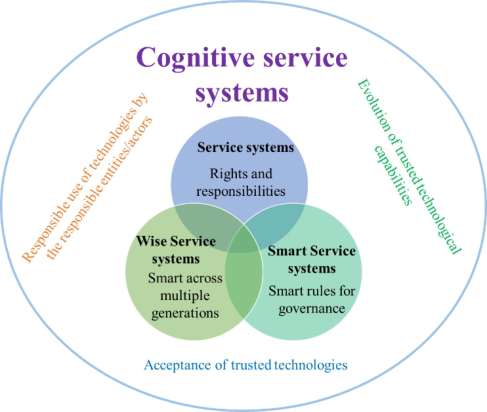
SERVICE SYSTEMS EVOLUTION Service systems evolve from traditional service systems to smart service sys- tems to cognitive service systems based on the evolution of technological capabilities (see Figure 1) (Spohrer, Siddike, and Kohda, 2017). In this evolu- tion, first of all, a service system is an evolving ecology of responsible actors that interact and change over time to co-create value for each actor (Spohrer and Maglio, 2008; 2009; Maglio and Spohrer, 2013). In service systems, people and organizations with rights and responsibilities, as well as tech- nologies and shared information with no rights and responsibilities, are the four main types of resources (Spohrer and Maglio, 2009; Spohrer, Kwan, and Fisk, 2014).
Only people, organizations, and nations have rights and responsibilities in service systems that function as governance mechanisms to control and coor- dinate value-creating interactions (Spohrer and Maglio, 2009). In the same alignment, a smart service system is a self-detecting, self-diagnosing, self- correcting, self-monitoring, self-replicating, or self-controlling system that interacts with humans and other service entities (National Science Founda- tion, 2014; Demirkan, Spohrer, and Badinelli, 2019; Lim and Maglio, 2019; Neuhüttler, Ganz, and Spath, 2019). Moreover, in smart service systems data is used to adapt interactions and offerings to a context or needs in specific
66 Siddike and Neuhüttler
situations (Neuhüttler et al., 2020a; 2020b). The interactions in smart ser- vice systems are precisely defined by smart rules and regulations (Demirkan, Spohrer, and Badinelli, 2019). Finally, a wise service system is a smart system in which people use smart technologies for the creation of value (Siddike et al., 2017; Spohrer et al., 2017). The term wisdom refers to prudent and holistic value creation across generations in order to create lasting value based on experience.
Figure 1: An evolutionary view of cognitive service systems.
All service system entities are cognitive system entities, and all cogni- tive system entities are physical-symbolic system entities (Newell and Simon, 1976). To be a service system entity, one must be able to have rights and responsibilities in the social sense that people have rights and responsibili- ties, companies have rights and responsibilities, and nations have rights and responsibilities (Spohrer and Maglio, 2008; 2009). As of today, AI, generative AI, and other advanced technologies do not have rights and responsibilities in the service systems. However, humans, organizations, and nations as ser- vice system entities/actors have rights and responsibilities and use or own those technologies (Spohrer et al., 2022). As a result, a cognitive service sys- tem is a system in which cognitive technologies are owned or used by the responsible entities/actors. In the cognitive service systems, these cognitive technologies could potentially advance more and more trusted capabilities (i.e., tools, assistants, collaborators, coaches, mediators) to augment/enhance the capabilities of (people, businesses, and nations) that all types of service system entities (Spohrer and Siddike, 2017; Spohrer et al., 2022). Finally, these technologies will be accepted by the people in our society based on their advanced capabilities of technologies (i.e. explainability, fairness, ethics, emotional attachments, ownership, rights, and responsibilities).
Towards Cognitive Service Systems–A Framework 67
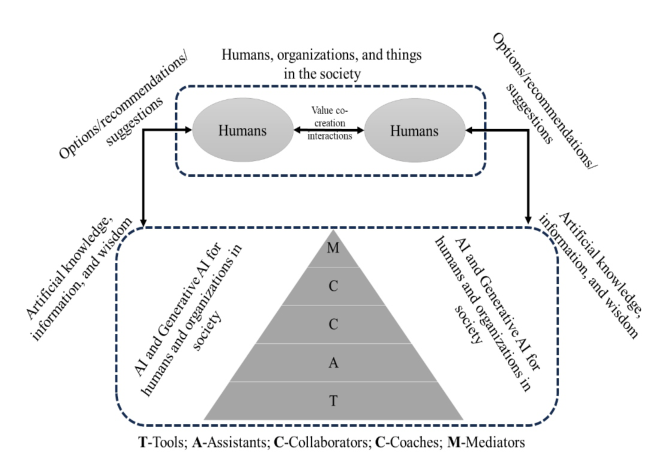
A FRAMEWORK FOR COGNITIVE SERVICE SYSTEMS In this paper, we define a cognitive service system as a system in which humans have cognitive assistants (CAs) that offer appropriate options, rec- ommendations, and suggestions by observing, understanding, and capturing the contexts, situations, environments, and culture that help humans make smart/wise decisions to solve complex problems more efficiently and effec- tively (Siddike et al., 2021; Siddike and Kohda, 2019; Siddike and Kohda, 2018a; 2018b; 2018c; Siddike et al., 2018a; Siddike et al., 2018b; Spohrer, 2016; Spohrer and Banavar, 2015). Here, CAs are AI, generative AI, and IoT-based technologies that are enabled by large data sets and highly speedy computers, providing humans and organizations with high-quality options, recommendations, and suggestions that make them better data-driven deci- sions (Spohrer, 2016; Spohrer and Banavar, 2015). In addition, CAs can augment human knowledge, capabilities, and expertise by understanding the context, situations, and environments with depth and clarity (Siddike et al., 2018a; Siddike et al., 2018b). Furthermore, human problem-solving capabil- ities are significantly augmented by the harmonious interactions with CAs. ChatGPT, Google Bard, Scribe, AlphaCode, GitHub Copilot, DuetAI, and others are notable examples of CAs. Cognitive service systems help the next generation to build and rebuild from scratch (Spohrer and Siddike, 2018). In cognitive service systems, CAs have the mighty power to generate insights from trillions of unstructured and structured data, process the data, and pro- vide accurate recommendations, options, and suggestions for humans and organizations which augment humans’ intelligence, knowledge, capabilities, and expertise that ultimately enhance humans’ performance (Siddike et al., 2018a; Siddike et al., 2018b). In addition, CAs can also observe, under- stand, and grasp humans’ contexts, situations, environments, and culture through harmonious interactions with them (Siddike and Kohda, 2018). As a result, CAs have the data, information, knowledge, intelligence, and wisdom about humans and their situations, contexts, and culture which are termed “artificial information, knowledge, and wisdom” in this paper (Siddike and Kohda, 2018; Siddike et al., 2017). In the cognitive service systems, CAs can potentially progress from tools to assistants to collaborators to coaches to mediators and be perceived differently depending on the role that they play in the cognitive service systems (see Figure 2).
On the other hand, humans have skills, knowledge, and experience that are acquired by sensing the real-world environment, using knowledge and experi- ences. Humans’ recommendations are based on their experience, knowledge, and skills to solve complex problems (Siddike et al., 2017). In this way, humans and machines collaborate harmoniously and generating win-win value co-creation for individuals and the common good. In a cognitive ser- vice system, win-win value co-creation goes beyond individuals and includes policies for the common good as well as humans, organizations, and societal aspects (Spohrer and Siddike, 2018; Siddike et al., 2021; Siddike and Spohrer, 2018). In the cognitive service systems, CAs (AI, generative AI, and other advanced technologies) can potentially progress from tools to assistants to
68 Siddike and Neuhüttler
collaborators to coaches to mediators and be perceived differently depend- ing on the role that they play in the cognitive service systems (Spohrer and Siddike, 2018). First of all, as an assistant, CAs provide humans with a vast amount of real-world data and information. Secondly, as a collaborator, CAs can support humans with a huge amount of knowledge by understanding spe- cific situations and contexts. Thirdly, as a coach, these technologies support humans with high-quality knowledge to improve the cognition, intelligence, and capabilities of humans. Fourthly, as a mediator, CAs facilitate humans with value co-creation interactions and capability co-elevation at multiple scales. Finally, CAs in cognitive service systems augment human cognition, intelligence, and capabilities which ultimately enhances human performance (Spohrer and Siddike, 2018).
Figure 2: A framework for structuring cognitive service systems.
Tools As a tool, CAs can analyze vast amounts of structured and unstructured data to provide valuable insights for supporting humans, organizations, and society in making informed decisions (Siddike et al., 2017). In addition, as tools, these technologies process and manipulate data, enable various tasks, and facilitate human interactions by playing a crucial role in the informa- tion processing journey, from handling raw data to providing more advanced capabilities (Spohrer, 2016). Furthermore, as tools, these technologies could take care of repetitive tasks, freeing up more time for humans and organiza- tions to focus on more complex and creative aspects of their work (Siddike and Kohda, 2018). Finally, as tools, these AI and generative AI technolo- gies are versatile technological components, able to process and automate to support and serve as the foundational building blocks for more advanced
Towards Cognitive Service Systems–A Framework 69
systems to enhance efficiency and capabilities across different domains and professions (Spohrer, 2016). Simply, as a tool, these technologies assist humans in automating routine tasks, personalizing user experiences, opti- mizing resource allocation, and enabling predictive analytics for strategic planning (Siddike and Kohda, 2018; Spohrer, Siddike, and Kohda, 2017). Creative content generation acts as a cocreator simply to schedule appoint- ments, answer queries, and receive personalized recommendations (Siddike and Kohda, 2018). As a tool, it supports organizations for customer segmen- tation and targeted marketing by optimizing sales strategies and improving customer satisfaction. Broadly, as a tool, these technologies could support people in society for urban planning, optimizing space utilization, energy efficiency, and environmental sustainability (Walk et al., 2023).
Tools Data and information (as a tool will be able to process trillions of data and information) Assistant Knowledge (as an assistant cognitive mediator will have more knowledge about people) Collaborator Understanding (as a collaborator can understand people’s situations and culture, and conditions more than we) Coach Wisdom (as a coach can help our next generation build and re-build from scratch) Mediator Advisor learning and wisdom (facilitate value co-creation and capability co-elevation interactions between entities at multiple scales)
Assistants As assistants, AI, generative AI, and future more sophisticated technologies provide valuable support for humans, organizations, and overall society in different domains. Simply, as assistants, these technologies provide proactive information, and task assistance, and enhance creativity in content generation by making information and creativity more accessible. It provides personal- ized information, automates tasks, and so on (Spohrer and Siddike, 2018). They can range from virtual assistants that aid with daily tasks to more specialized systems, such as AI-driven creative collaborators or future tech- nologies acting as personal aides in transportation or healthcare. The key characteristics of assistants include proactive support, task automation, per- sonalization, context understanding, continuous learning, and versatility in their applications (Siddike and Kohda, 2018). Assistants take initiative by providing timely and relevant information, recommendations, and solutions without waiting for explicit requests. They automate routine tasks, simplify- ing processes and allowing individuals to focus on more complex or creative aspects of their work (Siddike et al., 2018). Assistants tailor their support
70 Siddike and Neuhüttler
to individual preferences, learning from interactions to deliver personal- ized and context-aware assistance. These systems understand the context of user interactions, ensuring that their assistance aligns with the specific needs and goals of individuals or organizations. Assistants continuously learn and adapt, refining their capabilities over time based on user feedback, changing preferences, and evolving requirements (Siddike et al., 2018).
Collaborators Collaborators are intelligent systems that work together with humans, orga- nizations, and society. They actively contribute to shared goals by providing insights, creative ideas, and efficient solutions in areas such as research, creativity, decision-making, and problem-solving (Siddike et al., 2021). Col- laborators, in the context of AI, Generative AI, and future advanced AI technologies, are intelligent systems that actively engage in cooperative efforts with humans, organizations, and society to contribute to collective knowl- edge creation, problem-solving, and creative endeavours (Siddike and Kohda, 2018). These systems work alongside individuals, enhancing their capabil- ities, offering insights, and fostering a synergistic partnership for mutual benefit (Siddike et al., 2018a; 2018b).
Coaches Coaches in the context of AI, Generative AI, and future advanced AI tech- nologies are intelligent systems designed to provide personalized guidance, feedback, and support to individuals, organizations, and society (Siddike and Kohda, 2018; Siddike et al., 2021). These systems leverage their capabilities to assist in skill development, decision-making, and learning processes, aim- ing to enhance performance, understanding, and overall well-being (Siddike et al., 2018a). As coaches, these technologies offer tailored advice and guid- ance based on individual needs, preferences, and learning styles (Spohrer and Siddike, 2018). In addition, they assist in the development of skills by providing targeted exercises, feedback, and strategies for improvement. Furthermore, as coaches, these technologies promote ongoing learning and adaptation, helping individuals stay updated and relevant in their respective domains. Also, they offer constructive feedback, highlighting strengths and areas for improvement to facilitate continuous growth. More importantly, as coaches, these technologies adapt to the evolving needs and progress of individuals, ensuring that their guidance remains relevant over time (Siddike et al., 2018a; 2018b).
Mediators Mediators in the context of AI, Generative AI, and future advanced AI tech- nologies are intelligent systems that facilitate communication, understanding, and resolution of interactions between individuals, organizations, or societal elements (Spohrer and Siddike, 2018). They act as intermediaries, leveraging their capabilities to mediate conflicts, enhance collaboration, and foster har- monious interactions among diverse entities (Siddike et al., 2018a; 2018b).
Towards Cognitive Service Systems–A Framework 71
In the case of Communication Facilitation, Mediators enhance communica- tion by interpreting and conveying information effectively between different parties. Conflict Resolution, they assist in resolving conflicts by identify- ing common ground, proposing compromises, and promoting understanding among involved parties. In the case of Facilitators of Collaboration, Medi- ators foster collaboration by bridging gaps between diverse perspectives, encouraging cooperation, and facilitating joint efforts. Understanding Bridge, they bridge understanding gaps by translating complex information, ensuring that different stakeholders comprehend and align with shared goals. Neu- tral Arbitration, Mediators maintain a neutral stance, impartially guiding interactions to ensure fair and unbiased resolutions.
CONCLUSION
The key contribution of this research lies in conceptualizing cognitive ser- vice systems along with the value-adding interactions that are supported by AI. More importantly, this paper systematizes the different forms of AI sup- port in terms of cognitive assistants that make a significant contribution to Service Science in the era of AI. In the framework of cognitive service sys- tems, the TACCM hierarchical topology ultimately expands the evolution of service systems with the co-evolution of technological capabilities. To sum up, the TACCM topology in the cognitive service systems is the progression of more and more trusted capabilities to augment/amplify the capabilities of people, organizations, businesses, nations, and society—as service system entities. Practically, the TACCM hierarchy supports humans regardless of industries and their professions, race, creed, and gender to co-create value through harmonious interactions with technologies.
This research is not free from limitations. First of all, the proposed and described cognitive service systems framework and the topology of TACCM—are based on previous literature and our understanding of the evo- lution of technological capabilities and their role in the service systems. As a result, future analyses of cognitive service systems and research work on their design can be carried out much more systematically and along standardized terms.
ACKNOWLEDGMENT
The authors would like to acknowledge the support received from Jim Spohrer, the father of Service Science.
REFERENCES
Arbesman, S. (2013). The half-life of facts: Why everything we know has an expiration date. Penguin, New York, USA. Bromuri, S., Henkel, A. P., Iren, D. and Urovi, V. (2021). Using AI to predict ser-
vice agent stress from emotion patterns in service interactions. Journal of Service Management, 32(4), pp. 581–611. https://doi.org/10.1108/JOSM-06-2019-0163 Demirkan, H., Spohrer, J. C., and Badinelli, R. (2019). Introduction to the smart service systems: Analytics, artificial intelligence and cognitive application. Pro- ceedings of the 52nd Hawaii International Conference on System Sciences.
72 Siddike and Neuhüttler
Feike, M., Neuhüttler, J., Kutz, J. (2023). Towards a reference process for developing cognitive service systems. In: Christine Leitner, Jens Neuhüttler, Clara Bassano and Debra Satterfield (eds) The Human Side of Service Engineering. AHFE (2023) International Conference. AHFE Open Access, vol 108. AHFE International, USA. http://doi.org/10.54941/ahfe1003106 Huang, M.-H., & Rust, R. T. (2021). Engaged to a robot? The role of AI
in service. Journal of Service Research, 24(1), 30–41. https://doi.org/10.1177/ 1094670520902266 Jones, B. F. (2005). The burden of knowledge and the ‘death of the renaissance man’: is innovation getting harder?” NBER Working Paper, no. 11360. Lenat, D. B. (2016). WWTS (what would Turing say?). AI Magazine, 37(1),
pp. 97–101. Lim, C., Maglio, P. P. (2019). Clarifying the concept of smart service system. In: Maglio, P. P., Kieliszewski, C. A., Spohrer, J. C., Lyons, K., Patrício, L., Sawatani, Y. (eds) Handbook of Service Science, Volume II. Service Science: Research and Inno- vations in the Service Economy. Springer, Cham. https://doi.org/10.1007/978- 3-319-98512-1_16 Maglio, P. P. and Spohrer, J. (2013). A service science perspective on business model
innovation. Industrial Marketing Management, 42, pp. 665–670. National Science Foundation (2014). Partnerships for innovation: Building innovation capacity (PFI: BIC), Program Solicitation NSF14-610, National Science Foun- dation, Arlington, VA, Available at: http://www.nsf.gov/pubs/2014/nsf14610/ns f14610.pdf. Neuhüttler, J., Fischer, R., Ganz, W., and Urmetzer, F. (2020a). Perceived Quality
of Artificial Intelligence in Smart Service Systems: A Structured Approach. In M. Shepperd et al. (Eds.), Communications in Computer and Information Science. Quality of Information and Communications Technology (Vol. 1266, pp. 3–16). Springer International Publishing. https://doi.org/10.1007/978-3-030-58793-2_1 Neuhüttler, J., Ganz, W., Spath, D. (2019) An Integrative Quality Framework for Developing Industrial Smart Services. Service Science 11(3): 157–171. https://doi. org/10.1287/serv.2019.0242 Neuhüttler, J., Kett, H., Frings, S., Falkner, J., Ganz, W., & Urmetzer, F. (2020b).
Artificial Intelligence as Driver for Business Model Innovation in Smart Service Systems. In J. Spohrer & C. Leitner (Eds.), Advances in Intelligent Systems and Computing, Vol. 1208, pp. 212–219. https://doi.org/10.1007/978-3-030-51057- 2_30 Newell, A. and Simon, H. A. (1976). Computer science as empirical inquiry: Symbols and search. Communications of the ACM, 19 (3), 113–126. Norman, D. A. (1993). Things that make us smart: Defending human attributes in
the age of the machine. New York: Basic Books. Norman, D. A. (2023). Design for a better world: Meaningful, sustainable, humanity centered. MIT Press: Cambridge, USA. Pitardi, V., Wirtz, J., Paluch, S. and Kunz, W. H. (2022), “Service robots, agency and
embarrassing service encounters”, Journal of Service Management, Vol. 33 No. 2, pp. 389–414. Siddike, M. A. K. & Kohda, Y. (2018a). Co-creating value in people’s interactions with cognitive assistants: A service system view. Journal of Creating Value, 4(2), 255–272.
Towards Cognitive Service Systems–A Framework 73
Siddike, M. A. K. & Kohda, Y. (2018b). Towards a framework of trust determinants in people and cognitive assistants interactions. In proceedings of the 51th Hawaii International Conference on System Sciences (HICSS 51). Hawaii: University of Hawaii. Siddike, M. A. K. & Kohda, Y. (2018c). Use of metaphors for acceptance of cognitive
assistants: A qualitative study. International Journal of Society of Systems Science, 10(4), 243–258. Siddike, M. A. K. & Kohda, Y. (2019). Trust in cognitive assistants: A theoretical framework. International Journal of Applied Industrial Engineering, 6(1), 60–71. Siddike, M. A. K. and Hidaka, K. (2022). Role of shared responsibility in service
system. Presented at 13th International Conference on Applied Human Factors and Ergonomics (AHFE2022), July 24-28, New York, USA. Siddike, M. A. K., Iwano, K., Hidaka, K., Kohda, Y., & Spohrer, J. (2017). Wisdom service systems: Harmonious interactions with people and machines. In L. E. Fre- und and W. Cellary (eds.) , Advances in The Human Side of Service Engineering, Advances in Intelligent Systems and Computing 601. Cham: Springer. Siddike, M. A. K., Spohrer, J., Demirkan, H., & Kohda, Y. (2018a). People’s interac-
tions with cognitive assistants for enhanced performances. In proceedings of the 51st Hawaii International Conference on System Sciences (HICSS 51). Hawaii: University of Hawaii. Siddike, M. A. K., Spohrer, J., Demirkan, H., & Kohda, Y. (2018b). People’s interactions with cognitive assistants for enhanced performances. International Journal of Systems and Service-Oriented Engineering, 8(3), 1–17. Simon, H. A. (1997). Administrative behavior: A study of decision-making processes
in administrative organizations. The Free Press: New York Spohrer J, Maglio PP, Vargo SL, Warg M (2022) Service in the AI Era: Science, Logic, and Architecture Perspectives. Business Expert Press. URL: https://www.amazon .com/Service-AI-Era-Architecture-Perspectives/dp/1637423039/ Spohrer, J. & Banavar, G. (2015). Cognition as a service: An industry perspective. AI
Magazine, 36(4), 71–86. Spohrer, J. (2016). Innovation for jobs with cognitive assistants: A service science perspective. In D. Nordfors, V. Cerf, & M. Senges (eds.), Disrupting Unemployment. Missouri, USA: Ewing Marion Kauffman Foundation. Spohrer, J. and Maglio, P. P. (2008). Fundamentals of service science. Journal of the
Academy of Marketing Science, 26(1), 18–20. Spohrer, J. and Maglio, P. P. (2009) Service science: Toward a smarter planet. In Service Engineering, ed. Karwowski & Salvendy. Wiley. New York, NY. Spohrer, J. and Siddike, M. A. K. (2018). The future of digital cognitive systems: Tool,
assistant, collaborator, coach, and mediator. In Book “Augmented intelligence: smart systems and the future of work and learning”. Volume 81. Peter Lang. Spohrer, J. Siddike, M. A. K., & Kohda, M. A. K. (2017). Rebuilding evolution: A service science perspective. In proceedings of the 50th Hawaii International Conference on System Sciences (HICSS 50). Hawaii: University of Hawaii. Spohrer, J., Bassano, C., Piciocchi, P., & Siddike, M. A. K. (2017). What makes a
system smart? wise? Advances in The Human Side of Service Engineering, 27–31. Spohrer, J., Kwan, S. K. and Fisk, R. P. (2014). Marketing: a service science and arts perspective. In Handbook of service marketing research (eds. R. T. Rust and M. Huang), UK: Edward Elgar, pp. 489–526. Spohrer, J., Vargo, S. L., Casewell, N., and Maglio, P. P. (2008). The service
system is the basic abstraction of service science. In the Proceedings of 41st Hawaii International Conference on System Sciences, New York, USA: IEEE Press, pp. 1–10.
74 Siddike and Neuhüttler
Spohrer, J., Vargo, S. L., Casewell, N., and Maglio, P. P. (2008). The service system is the basic abstraction of service science. In the Proceedings of 41st Hawaii International Conference on System Sciences, New York, USA: IEEE Press, pp. 1–10. Walk, J., Kühl, N., Saidani, M., and Schatte, J. (2023). Artificial intelligence for sus-
tainability: Facilitating sustainable smart product-service systems with computer vision. Journal of Cleaner Production, 402. Available at: https://doi.org/10.1016/ j.jclepro.2023.136748. Yang, D., Zhou, Y., Zhang, Z., Jia-Jun Li, T., and Ray, L. C. (2022). AI as an active writer: Interaction strategies with generated text in human-AI collaborative fiction writing. In the Proceedings of Joint Proceedings of the ACM IUI Workshops 2022, March 2022, Helsinki, Finland, pp. 56–65.
LISTED IN THE AHFE DIGITAL BOOKSTORE CATALOGUE
Explore the complete digital volume
The Human Side of Service Engineering
Read this individual research paper free through the original publisher, or explore the full digital proceedings book.
ISBN 978-1-964867-19-9
Explore this ISBN in the AHFE Bookstore ↗Listed in the July 2026 bookstore catalogue; search by ISBN to confirm current availability · Digital book purchase optional