Louisa Loew, Thomas Fischer, Jens Neuhüttler (2023). COOPE – a framework for managing coopetition in the platform economy. In: The Human Side of Service Engineering. AHFE Open Access, vol. 108, pp. 19–28. https://doi.org/10.54941/ahfe1003103
Over the last 20 years platform business models become increasingly important in global economies. Digital economy and platform business models offer great potential for adding value to digital or digital enabled products. Companies can gain significant network effects and connect with different user groups via digital transaction platforms.Companies planning to enter platform business models traditionally have a choice between ‘making or buying’ a platform or enter existing ecosystems. Both options come with significant disadvantages in terms of risk, costs and governance. A promising innovative option for smaller players like SMEs or startup companies is the “co-opetition” approach. Companies co-operating with competitors to pool their economic strength and network effects in a joint platform and reduce market entry risks. In addition, potentials for reducing the costs of setting up IT infrastructures can be realised.Despite the advantages, the co-opetition approach also presents companies with design-related challenges. One challenge, for example, is to sustainably protect key competitive advantages and unique resources despite the cooperation and intensive exchange with competitors. If two or more competitors work together on a digital platform solution to collect, analyse and use machine data, the data could create unintended transparency about machine performance, strengths and weaknesses. Clear demarcation, control options and the building of trust between the companies are needed here. At the operational level, for example, it is important to establish a culture of cooperation among employees that allows for intensive exchange in some areas and competitive thinking and behaviour in others.In this paper we present a model for co-opetition in platform-economy combining concepts of platform economy, co-opetition and agility. Based on theoretical concepts a three-dimensional model has been elaborated that reduces complexity and provides decision support for relationship building with competitors in the dimensions: (1) strategy to enter platform economy (2) design layer which allows structural but agile coordination of relationships and (3) perspectives that need consideration on platforms. By combining the different concepts and perspectives, the model provides a theoretical framework for decision-making and supports companies in assessing the potentials of coopetition and realising them through appropriate design.
Over the last 20 years, platform business models have become increasingly important in the global economy. They offer great potential for value crea- tion through digital or digitally enhanced products. Using digital platforms, companies can achieve significant network effects and connect with diffe- rent user groups. Traditionally, companies that plan to offer new products have a choice between (partially) making or buying them. However, compa- nies planning to enter the platform economy have an additional option. They can join existing platforms with the intention of buying or distributing their own products or services. The options shown have different disadvantages regarding risk, cost, and governance. To reduce these drawbacks, the “coo- petition” approach is a promising innovative option for smaller players such as SMEs or start-ups (Velu, 2018).
Despite obvious advantages, “coopetition”confronts companies with chal- lenges. Finding the right balance between intensive collaboration and com- petitive thinking is crucial. The framework presented in our paper provides an approach to evaluate the potential of various options for coopetition as a basis for strategic decision making.
STATE OF THE ART Understanding Coopetition
The term “coopetition” describes the relationship between at least two par- ties that includes both a cooperative element, in which companies pursue a
common goal and work together, and a competitive element, in which they compete with each other, regardless of their former competitive position (ver- tical or horizontal) (Bengtsson and Kock, 2014; Bruhn and Hadwich, 2019). The intensity of the cooperative and competitive aspects between companies can vary significantly in a coopetition. Different types can be distinguished depending on the intensity of these aspects (Luo, 2007; Chin et al., 2008). To successfully develop coopetition-based innovations, a balanced relationship is needed, which is optimally characterized by a high degree of cooperation and a moderate-high degree of competition (Park et al., 2014). In order to strengthen trust and avoid future conflicts, the areas of cooperation and com- petition must be clearly defined and delimited (Brandenburger and Nalebuff, 2021; Bengtsson and Kock, 2000). If intensive cooperation exists, companies often deliberately reduce competition or relinquish market power in order to jointly improve their competitive position against third parties. Before enga- ging in coopetition, companies should therefore investigate closely whether and to what extent collaboration improves or worsens their own value propo- sition from the customer’s perspective (Schiller et al., 2021). In a coopetition, it may happen that a company competes with the same solution for custo- mers but relies on resources from their competitors or share their resources. A popular example is the case of Netflix and Amazon, where there is competi- tion between Amazon’s Prime Video business and Netflix’s Streaming service. Meanwhile, Netflix uses services from Amazon Web Services, Inc (AWS) to provide the best possible streaming quality.
Understanding Strategies to Enter the Platform Economy For platforms, other economic principles are decisive for success than for tra- ditional businesses. Networks or ecosystems are crucial here, as the number of potential relationships increases exponentially the more participants are involved (Reillier and Reillier, 2016). This is described as a network effect, which means that a digital platform becomes more valuable the more parti- cipants use it. Platforms provide participants with (technical) infrastructure. Digital platforms act as intermediaries between the participants and change the basis on which business relationships function. Networking of partici- pants and their interaction creates a digital ecosystem (Parker et al., 2016). Indirect network effects between participating groups on a digital platform describe the fact that the number and attractiveness of participants influe- nce the platform’s attractiveness for other participants. Therefore, the term “platform economy” is often used.
In the following we distinguish between following roles on digital plat- forms:
Owner: Responsible for infrastructure and quality of a digital platform,
Participant: Active actor on the platform, which can be: – User: consume or use the value created by and on the platform, – Provider: generate value on the supply side of the platform.
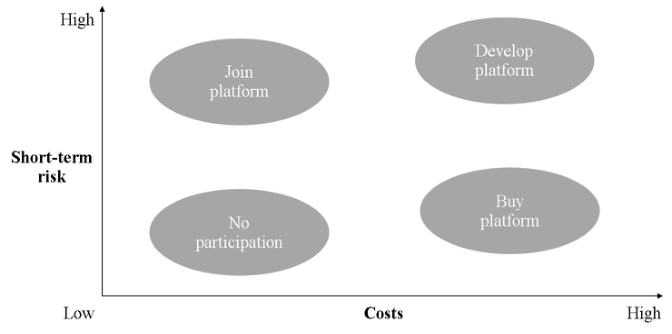
Companies planning to enter the platform economy can choose between different strategies, which, in ascending order, require more investment and
COOPE – A Framework for Managing Coopetition in the Platform Economy 21
work on the part of companies (see Figure 1). Continuing with the traditional business model represents the first strategy. However, when making this deci- sion, companies must be aware that the platform economy can turn industries upside down. New competitors can create new markets or establish an enti- rely new business model in the existing market (Parker et al., 2016). Thus, there is a high risk for the long-term future with this strategy. The second strategy is to join at least one existing platform as a participant. There are many reasons for joining a platform, such as increasing awareness (Cabrera, 2014) or using platform resources (Velu, 2018). In addition, joining a platform allows for short development and ramp- up times and, thus, short-term opportunities in a rapidly evolving market environment. The third strategy envisions operating a platform itself. Here, companies face a “make-or-buy” decision. This strategy makes particular sense for companies if the platform is compatible with the company’s other business models. Combining the different components of a company can lead to differentiation and improve or reshape the customer experience (Reillier and Reillier, 2016).
Relevance of Coopetition in the Platform Economy Since entering the platform economy is often linked to high investments and risks, sharing these with market competitors seems to be a promising strategy.
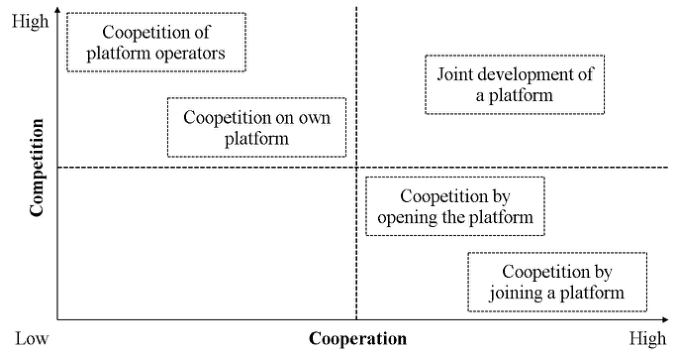
If companies want to join the platform economy, they can pursue more than one of the above mentioned goals simultaneously. The context in which coopetition takes place can also be important. Here, a distinction can be made between physical context and digital context. In the following, five options for coopetition in the platform economy are outlined. The options outlined have different disadvantages in terms of risk, costs, and governance (see Figure 2).
Companies that are partners in the physical context, for example, by mutually supplying important components or systems, can become com- petitors in the digital context through competing platforms.
Figure 1: Strategies to join the platform economy.Figure 2: Types of coopetition (adapted from Luo, 2007; Chin et al., 2008).
If a company decides to join the platform economy by buying or deve- loping a platform itself, it has the option of opening up this platform to competitors.
In addition, a platform operator can offer its own products or services on the platform and thus compete with the providers on its own platform.
Suppose a company does not want to establish its own platform and a competitor operates an attractive platform with considerable network effects. In that case, the company should consider joining this platform as a participant. This decision can also be made if a company already owns a platform. Participation in multiple platforms is called “multihoming”.
Companies aiming to buy or develop a platform have the option to do this with competitors. In this constellation, companies jointly take care of the development and operation of the digital platform to minimize expenses. Since, in addition to generating network effects, technical aspects repre- sent hurdles in setting up a platform so co-operation can make particular sense. For example, in infrastructure, interfaces, or basic services (Bullin- ger et al., 2017, Schiller et al., 2021). After the successful establishment of the platform, competition on the platform with products or services is possible.
One examples in this context is the ADAMOS platform, jointly opera- ted by various providers from the mechanical and plant engineering sector as well as supporting software companies. Founded by DMG Mori, Dürr, Software AG, Zeiss, and ASM PT as a joint venture, ADAMOS GmbH became a vendor-neutral and platform-independent ecosystem. ADAMOS offers an integration platform (ADAMOS HUB) connecting data of machines with apps, a manufacturer-independent marketplace with integrated proces- ses (ADAMOS STORE), as well as an optional IIoT platform that connects production processes, machines, and plants. Goal of the digital platform is to provide future-proof solutions to develop digital products and applica- tions of IoT technologies for machine and plant engineering. To this end,
COOPE – A Framework for Managing Coopetition in the Platform Economy 23
partners share apps, codes, prototypes and knowledge within the ADAMOS network and through ADAMOS services in order to create new ideas, servi- ces, and products. The focus is on developing solutions, e.g., in the form of digital apps, in a way that customers can design, develop and use them. The companies share the costs of the IT infrastructures (Schiller et al., 2021). Digital solutions can be offered independently on the marketplace while ADAMOS resolves legal and tax aspects. The supporting software compa- nies can offer open and vendor-neutral platforms that do not approach the end customer. This protects customer and supplier relationships of potential participants (ADAMOS GmbH, 2023, Software AG, 2023). This strategy supports cooperation as well as competition.
The previous options do not claim to be exhaustive. However, they illu- strate the complexity that of coopetitive situations within digital platforms. Various coopetition constellations have been identified by pursuing different platform strategies (see Figure 2). Based on this, three coopetition strate- gies can be differentiated for entry into the platform economy, which will be explained in more detail later.
APPROACH A snowball literature search was conducted before developing the COOPE framework. In addition, the authors are members of a working group on the topic of coopetition, which consists of members from research and industry. As part of the working group, workshops were held with employees from various companies.
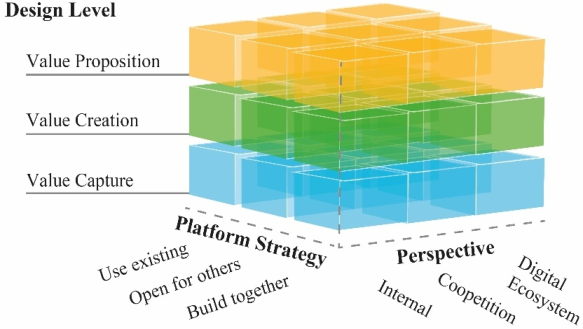
The goal of the framework is to lay a strong foundation for joining the platform economy through coopetition, thus helping companies successfully navigate the road ahead. In this context, the platform is considered as a business model rather than from the technical side. Based on theoretical concepts, a three-dimensional model was elaborated that reduces complexi- ties and provides decision support for building relationships with competitors in the following dimensions: (1) strategies for entering the platform economy, (2) design levels that enable a structural approach, and (3) perspectives that reduce complexities by being considered (see Figure 3).
The three dimensions are briefly described in the following sections: Platform Strategy: The model is limited to the question of how joining the platform economy can be managed. The strategies described above can be summarized in three strategy designs:
Joining an existing platform of a competitor,
Open the own platform to a competitor,
Work together with a competitor to build a platform and then to compete on the platform.
Design Level: Once it is clear how the company wants to position itself through one or several coopetition strategies, it is important to design the value creation mechanisms. In this paper, we consider the platform as a business model which “mediates the link between technology and firm per- formance” (Baden-Fuller and Haefliger, 2013, p. 1). Therefore it makes sense
Figure 3: Framework for managing coopetition in the platform economy (COOPE).
to sub-divide the business model concepts into the following three elements to make it more applicable, easier to understand, and to establish:
value proposition
value creation
value captures.
Perspective: The complexity created by the platform economy, in combi- nation with coopetition, can be reduced by looking at different perspectives. On the one hand, companies should pay attention to internal activities, for example, in order to identify erroneous behavior. Looking at coopetition is relevant in order to analyze the tension between cooperation and competi- tion and to be able to react accordingly. The digital ecosystem is of great importance for platforms as it generates value-creating (indirect) network effects. When entering into co-competitive relationships within the platform economy, the platform’s digital ecosystem should therefore, also be included.
By combining the various concepts and perspectives, the framework pro- vides a theoretical framework for evaluating the potential of coopetition and realizing it through appropriate design. The model is described in more detail below.
(1) PLATFORM STRATEGY Coopetition within the platform economy can be linked horizontally and ver- tically along the value chain of the company and can take place at different organizational levels (Bahar et al., 2022; Bengston and Raza, 2016). In this context, three coopetition strategies can be differentiated for entering the platform economy. Based on the selected strategy(s), the targeted roles can be noted. These are divided into owners, providers, and users. The main benefit of a platform for all roles is usually the advantage of network effects.
Use existing: One option for companies is to decide to join a competitor’s platform. When joining, the competitor provides the technical infrastructure and acts as the operator. Furthermore, the competitor can take on additional
COOPE – A Framework for Managing Coopetition in the Platform Economy 25
roles on the platform. By joining, the company becomes a part of the extended ecosystem. Thus, the company can assume the role of a user or provider.
Open for others: If a company wants to buy or build its own platform, it can make sense to open the platform to competitors. An opening enables the competitor to join the platform as a user and provider. It is important to keep the benefit for the ecosystem in mind. The company itself can take on all three roles when opening up.
Build together: Companies can build or buy a platform with competitors to compete on it. Competitors can range from start-ups to established cor- porations. Not only is the technical infrastructure provided jointly, but an ecosystem must also be created. When competitors build a platform together, the company itself as well as the co-competitor can act in all three roles.
(2) DESIGN LEVEL For this model the definition of a business model as “design or architecture of value creation, delivery, and capture mechanisms it employs” (Teece, 2010) is used in line with the nine building blocks of Osterwalder’s business model ontology (Osterwalder & Pigneur, 2010). The classic view on business models is static. Coopetition requires monitoring and adjusting of business models due to the changing situation. Therefore this model follows the understan- ding of Demil and Lecocq (2010), who propose that business models are in a constant disequilibrium and transform over time, due to frequent changes of their interrelating components. Following, the three levels will be explained in detail (cf. Neuhüttler et al. 2020):
Value proposition: The model is concerned with the design of coope- tition situations. While it is crucial to consider the customer during this process, this model offers the opportunity to look at value delivery topics like customer segments, relationships, and distribution channels through the “Digital ecosystem”and the “Coopetition”perspective introduced later. The- refore value delivery will just consist of value proposition and will be named “Value Proposition”. The value proposition describes the value the company provides to its customers and (coopetition) partners.
Value creation: The value creation level describes how value is generated. It looks at the combination and coordination of different resources and capabi- lities and describes processes and activities. Additionally, a look at necessary partnerships and networks besides the coopetitive situation can be helpful.
Value capture: When a company enters a new market, it is important to understand how the value the company wants to provide can be monetarized. For this, a closer look at cost structures that are established with a platform and the design of revenue streams are essential.
(3) PERSPECTIVE Many reasons lead to coopetition (Brandenburger and Nalebuff, 2021). In the context of the platform economy, these drivers can be translated into three perspectives. These are the internal, the coopetition, and the digital ecosystem perspectives. Looking at strategies and design levels from different
perspectives helps companies to reduce the complexities that arise from the diverse constellations of coopetition.
Internal: For companies, entering into coopetitive relationships is often associated with obstacles and bureaucratic hurdles. The “internal” perspe- ctive therefore deals with aspects in the internal environment of the company and can lead to profound changes. Furthermore, it can help the company navigate in the platform economy. Especially in areas far from traditional core competencies, collaboration with competitors can help companies to increase the speed of innovation and to be able to act proactively in dynamic markets (Neuhüttler et al., 2020). A company’s own expectations and reasons for entering into partnerships can influence the form and scope of coopeti- tion (Yami and Nemeh, 2014). For example, if a successful platform already exists in the targeted market, the potential economic benefits from network effects are greater than a competitive advantage or bargaining power (Parker et al., 2016). In the platform economy, the question should therefore be asked as to whether having one’s own platform is in itself decisive for competition or whether the individual implementation of products or services and use of an existing platform would also lead to a significant improvement in one’s own service offering.
Coopetition: The “coopetition” perspective deals with cooperation and competition aspects of relationships that arise in the context of the selected platform strategy. Relevant characteristics of partners may be complemen- tary capabilities and resources that are useful to the company and distinctly different from its own (Luo, 2007). For example, it may be beneficial to build a platform with partners to develop technical infrastructures more qui- ckly, as these are a major challenge for the company (Bullinger et al., 2017). Similarly, pursuing the same or similar goals can motivate companies to col- laborate. Relationship characteristics such as interpersonal trust (Tortoriello et al., 2011) or the power relationship between companies can likewise act as drivers for coopetition relationships. Cultural similarities may also have an impact on entering and maintaining coopetition (Garraffo and Siregar, 2021).
SUMMARY AND OUTLOOK Digital platforms offer compelling opportunities for companies to conduct business in a new and, in some cases, better way via digital business models. SMEs often shy away from the barriers to entry and investment required to adopt platform-based business models. In this context, coopetition offers a lightweight approach to attractive new market opportunities while sha- ring the risks and efforts between competitors collaborating on platform business.
Despite the potential, coopetition also presents challenges for companies. Because of the multiple strategic considerations and levels of design, they must make complex decisions to participate in the platform economy in the context of coopetition. To support these strategic considerations, we have presented the COOPE framework in this paper. It is intended to support companies to make strategic considerations when deciding whether or not to enter the cooperative platform business and how to design the coopetition
COOPE – A Framework for Managing Coopetition in the Platform Economy 27
constellation according to the needs of the companies involved. From the distinct company’s point of view, it is significant to consider the design levels of a business model and to mirror them with the perspectives on the partners of the coopetition and the extended digital ecosystem in addition to their own. When designing the content aspects, the stratgeic aspects and options must also be taken into account. Therefore, the framework concept structures the relevant design and action areas for companies along the three dimensions (1) strategies for entering the platform economy, (2) design levels to enable a structural approach, and (3) perspectives.
Future research needs to focus on possible weaknesses and gaps of our framework concept. First, the content of the framework concept needs to be provided: Researchers should make use of the structure to locate possi- ble design recommendations, methods, and tools within it to facilitate access for organizations. Second, the meaning of the three perspectives and the ele- ments they contain must be investigated through empirical observations. In the focus of further work, the relationship between the design variants and the success of coopetition in the platform economy should also be conside- red. As a third key point, the applicability of the framework concept should be tested in a concrete business case.
REFERENCES
ADAMOS GmbH. (2023). Mit ADAMOS IIoT Ihre Maschinen verstehen. Global Website. online: https://www.adamos.com/iiot/, [Retrieved on: 10/01/2023]. Baden-Fuller, C., and Haefliger, S. (2013). Business models and technological
innovation. Long range planning, 46 (6), 419–426. Bahar, V. S., Nenonen, S., and Starr Jr, R. G. (2022). On the same boat but singing a different tune: Coopetition between hotels and platforms close to customers. Industrial Marketing Management, 107, 52–69. Bengtsson, M., and Kock, S. (2000). “Coopetition” in business Networks—to coo-
perate and compete simultaneously. Industrial marketing management, 29(5), 411–426. Bengtsson, M., and Kock, S. (2014). Coopetition—Quo vadis? Past accomplishments and future challenges. Industrial marketing management, 43(2), 180–188. Bengtsson, M., and Raza-Ullah, T. (2016). A systematic review of research on coo-
petition: Toward a multilevel understanding. Industrial Marketing Management, 57, 23–39. Brandenburger, A., and Nalebuff, B. (2021). The rules of co-opetition. Harvard Business Review, 99(1), 48–57. Bruhn, M., and Hadwich, K. (2019). Service Coopetition–Dienstleistungen im
Spannungsfeld von Wettbewerb und Kooperation. Kooperative Dienstleistungen: Spannungsfelder zwischen Service Cooperation und Service Coopetition, 3–34. Bullinger, H. J., Neuhüttler, J., Nägele, R., and Woyke, I. (2017). Collaborative development of business models in smart service ecosystems. In: Kocaoglu, D. (eds.): Proceedings of PICMET’17: Technology Management for an Interconnected Word, S. 130–139. Cabrera, M. (2014). Use Co-opetition to build new lines of Revenue. Harvard
Business Review, 10. Demil, B., and Lecocq, X. (2010). Business model evolution: in search of dynamic consistency. Long range planning, 43(2-3), 227–246.
Garraffo, F. M., and Siregar, S. L. (2021). Coopetition among competitors in global industries: drivers that lead to coopetitive agreements. Competitiveness Review: An International Business Journal. Gassmann, O., Frankenberger, K., and Csik, M. (2013). Geschäftsmodelle entwi-
ckeln: 55 innovative Konzepte mit dem St. Galler business model navigator. Carl Hanser Verlag GmbH Co KG. Luo, Y. (2007). A coopetition perspective of global competition. Journal of world business, 42(2), 129–144. Neuhüttler, J., Kett, H., Frings, S., Falkner, J., Ganz, W., and Urmetzer, F. (2020). Arti-
ficial Intelligence as driver for business model innovation in smart service systems. In: Spohrer J., Leitner C. (Eds) Advances in the Human Side of Service Enginee- ring and Advances in Intelligent Systems and Computing, vol 1208, S. 212–219. Springer, Cham. Osterwalder, A., Pigneur, Y. (2010). Business model generation: A handbook for visionaries, game changers, and challengers. Wiley. Park, B. J. R., Srivastava, M. K., and Gnyawali, D. R. (2014). Walking the tight
rope of coopetition: Impact of competition and cooperation intensities and bala- nce on firm innovation performance. Industrial Marketing Management, 43(2), 210–221. Parker, G. G., Van Alstyne, M. W., and Choudary, S. P. (2016). Platform revolution: How networked markets are transforming the economy and how to make them work for you. WW Norton and Company. Reillier, L. C., and Reillier, B. (2017). Platform strategy: How to unlock the power
of communities and networks to grow your business. Routledge. Schiller, C., Müller-Wieland, R., Blank, D., Leyh, J., Jütting, M., and Neuhüttler, J.
(2021). Wertschöpfung vernetzt gestalten. Software AG. (2023). IIoT für die Produktion. Global Website. online: https://www.softwareag.com/de_de/customers/iiot-produktion.html, [Retrieved on: 10/01/2023]. Teece, D. J. (2010). Business models, business strategy and innovation. Long range planning, 43(2-3), 172–194. Tortoriello, M., Perrone, V., and McEvily, B. (2011). Cooperation among competi-
tors as status-seeking behavior: Network ties and status differentiation. European Management Journal, 29(5), 335–346. Velu, C. (2018). Coopetition and business models. In The Routledge Companion to Coopetition Strategies (pp. 336–346). Routledge. Yami, S., and Nemeh, A. (2014). Organizing coopetition for innovation: The case of
wireless telecommunication sector in Europe. Industrial Marketing Management, 43(2), 250–260.
LISTED IN THE AHFE DIGITAL BOOKSTORE CATALOGUE
Explore the complete digital volume
The Human Side of Service Engineering
Read this individual research paper free through the original publisher, or explore the full digital proceedings book.
ISBN 978-1-958651-84-1
Explore this ISBN in the AHFE Bookstore ↗Listed in the July 2026 bookstore catalogue; search by ISBN to confirm current availability · Digital book purchase optional