Ruth Chau, Amic Ho (2023). The Impact of Artificial Intelligence and Machine Learning on Visual Communication Design. In: Human-Centered Metaverse and Digital Environments. AHFE Open Access, vol. 99, pp. 74–83. https://doi.org/10.54941/ahfe1003933
Powerful technologies like Artificial Intelligence (AI) and Machine Learning (ML) allow us to reinvent how we integrate information, evaluate data, and put the resultant insights into practice to make better choices. AI systems are man-made software and hardware systems that perceive their physical or digital environments through data acquisition, interpretation of the acquired data, reasoning on the acquired knowledge, or processing of the data to achieve specific goals. Artificial Intelligence and Machine Learning focus on developing unprogrammed, data-driven computer learning algorithms and statistical models. AI and ML have the potential to profoundly change development theory and practice by stimulating a reconsideration of how data and algorithms interact to provide insights into how development issues are identified, analysed, and managed. This case study investigates the influence of explainable AI on visual communication design.
Artificial Intelligence and Machine Learning are transforming visual commu- nication design by facilitating the interpretation and analysis of visual data, the creation of new visual designs, and the improvement of user experie- nces. Artificial intelligence (AI) systems have been programmed by humans to act in the physical or digital world by acquiring data, interpreting that data (whether structured or unstructured), making decisions based on that kno- wledge, or processing that data in order to accomplish specific objectives. Machine learning focuses on developing unprogrammed, data-driven com- puter learning algorithms and statistical models. The increased demand for automation, personalisation, and real-time decision-making in visual com- munication design has fuelled the use of Artificial Intelligence and Machine Learning.
The fields of healthcare, transportation, education, and the economy are just some of the domains that might be significantly impacted by the intro- duction of Artificial Intelligence. Education has been enhanced as a result of the growing use of information and communication technologies in the classroom, particularly Artificial Intelligence. Online healthcare systems are
The Impact of Artificial Intelligence and Machine Learning 75
not an exception to the application of Artificial Intelligence and machine learning in a range of fields, including robotics and aviation, amongst oth- ers. Since the 1950s, several fields of study, including mathematics, physics, and philosophy, have been investigating the possibility of developing Arti- ficial Intelligence. Artificial Intelligence refers to a kind of computer system that, when given challenging challenges, is able to reason, learn from experie- nce, and make intelligent decisions. The accelerated development of Artificial Intelligence and Machine Learning presents a number of challenging ethi- cal and scientific issues, including concerns about the future of work, the protection of sensitive data, and the eradication of prejudice. It is necessary to evaluate the potential societal impact of AI and to address scientific and ethical concerns.
BACKGROUND INFORMATION ON AI AND ML Academics have been interested in the development of Artificial Intelligence and Machine Learning for decades. With the advent of machine learning, the strategy for Artificial Intelligence development shifted. Algorithms for mach- ine learning learn from data and improve over time. This study discusses the history of Artificial Intelligence and machine learning, as well as its pros and cons, types, applications, and issues. Perhaps the term ‘Artificial Intelligence’ was coined during the 1950s (Hindawi and Tao, 2022). Artificial Intellige- nce was predominantly concerned with symbolic Artificial Intelligence, also known as the goal, at the time. In the 1980s, the emphasis shifted to con- nectionism, which involved the development of neural networks that could learn from data. In the 1990s, machine learning was utilised in a variety of applications, including ‘voice recognition’, ‘computer vision’, and ‘natural language processing’ (Hindawi et al., 2022). Deep learning has emerged as a powerful machine learning approach in recent years, and it has been utili- sed to achieve cutting-edge results in a wide range of applications, including image identification, voice recognition, and natural language processing.
Using Artificial Intelligence and Machine Learning has various benefits. They may, for example, be used to automate repetitive activities, increase accuracy and efficiency, and generate more accurate estimates (Hindawi and Tao, 2022). Artificial Intelligence and Machine Learning can also be used to investigate enormous data sets and identify patterns that are difficult or impossible for humans to recognise. There are, however, downsides to emplo- ying Artificial Intelligence and Machine Learning. There are three categories of Artificial Intelligence and Machine Learning: ‘supervised learning’, ‘unsu- pervised learning’, and ‘reinforcement learning’ (Hindawi and Tao, 2022). Using labelled data, supervised learning is the process of training a model to make predictions. Unsupervised learning involves recognising patterns in unlabelled data. In reinforcement learning, a decision-making model is trai- ned using a reward system. Each type of AI and ML has advantages and disadvantages, and the technique employed depends on the application.
AI and ML have applications in numerous fields, including healthcare, finance, and manufacturing. They have the potential to improve healthcare by aiding in illness diagnosis, therapy discovery, and prognosis. The use of
76 Chau and Ho
AI and ML may be applied to spot fraud, guide investment choices, and control financial risks. They might be put to use in the industrial sector to enhance efficiency and quality. However, the development and implemen- tation of Artificial Intelligence and Machine Learning present a number of obstacles. Concerns have been expressed about the ethical ramifications of Artificial Intelligence and Machine Learning, including privacy, prejudice, and job displacement. Other technological obstacles include the need for vast quantities of high-quality data, advanced computer resources, and trained data scientists.
THE DEVELOPMENT OF AI AND ML AI and ML are strong technologies that allow us to reinvent how we inte- grate information, evaluate data, and put the resultant insights into practice to make better choices. They have the potential to profoundly change develo- pment theory and practice by stimulating a reconsideration of how data and algorithms interact to provide insights into how development issues are iden- tified, analysed, and managed. In healthcare, they can be used to improve patient outcomes by assisting with disease diagnosis, developing treatment plans, and predicting patient outcomes. Additionally, they can be used to make investment decisions, manage risk, and detect fraud. Artificial Intellige- nce and machine learning have the potential to detect anomalous patterns in financial transactions, increase productivity and efficiency, and analyse vast amounts of data to identify trends and make more informed decisions. How- ever, possible bias in algorithms and uneven treatment are two examples of ethical issues that have been raised about these technologies. These technolo- gies have impacted numerous aspects of human activity and decision-making, including healthcare, the economy, and workplace productivity. It is impor- tant to consider the ethical implications and mitigate potential biases and negative outcomes when using them.
THE DEVELOPMENT OF AI AND ML INFLUENCE THE PROCESS OF COMMUNICATION Artificial Intelligence and Machine Learning are revolutionising how people interact, process visual data, and make decisions (Ruiz-Arellano, 2022). In this study, we will examine how the development of Artificial Intelligence and machine learning has affected various aspects of human existence. By enabling machines to comprehend and respond to human language, Artificial Intelligence has altered how people communicate. Natural Language Proces- sing (NLP) has made it possible for machines to comprehend and reproduce human language with accuracy and precision (Hindawi et al., 2022). This has led to the creation of numerous applications, such as chatbots, vir- tual assistants, and language translation services, which are now extensively used in fields such as customer service, healthcare, and finance. In addi- tion, voice assistants powered by Artificial Intelligence (Chen, 2017), such as Siri, Alexa, and Google Assistant, have made communication significan- tly more intuitive and effective. Artificial Intelligence and Machine Learning
The Impact of Artificial Intelligence and Machine Learning 77
advancements have also had an impact on visual communication. Thanks to computer vision and image recognition algorithms, machines can now iden- tify and classify photos and videos with greater accuracy and speed. This has led to the development of applications such as face recognition, object dete- ction, and autonomous vehicles. These technologies are now widely utilised in numerous industries, including security, transportation, and entertainment. Moreover, virtual and augmented reality experiences propelled by Artifi- cial Intelligence have added a new dimension to visual communication by enabling users to interact with digital content in real-time.
THE DEVELOPMENT OF AI AND ML HAS A SIGNIFICANT IMPACT ON HUMAN With the assistance of predictive analytics and machine learning algorithms, machines can now analyse large volumes of data and deliver insights that were previously challenging to obtain (Ruiz-Arellano, 2022). This has led to the development of numerous applications, including fraud detection, credit risk analysis, and personalised marketing. Moreover, AI-powered decision- making systems are becoming more prevalent in industries such as healthcare and finance, where expeditious and accurate decisions can mean the dif- ference between life and death or profit and loss. Nonetheless, the rise of AI-powered decision-making systems has raised concerns regarding the loss of human agency and autonomy, as well as the possibility of algorithm bias.
AI and machine learning have altered the manner in which humans inte- ract, interpret visual information, and make decisions. Thanks to advances in NLP, computer vision, and predictive analytics, machines can now interpret and generate human language, recognise and categorise images and videos, and analyse vast amounts of data to provide insights and guide decision- making. While these technological advancements have benefited numerous industries, they have also raised concerns about the potential loss of human agency and the need to ensure that algorithms are free of bias.
CASE STUDIES ON THE LATEST VISUAL ANALYSIS DEVELOPMENT Image Recognition
In the context of contemporary visual analysis research, image recognition is an area of interest where AI and ML are used to detect and analyse images, allowing designers to select the best images for their projects (Hindawi et al., 2022). The use of AI and ML in image recognition has enabled designers to rapidly evaluate and comprehend the content of photographs, thereby impro- ving the efficiency of the image selection process (Hindawi et al., 2022). AI and ML applications may also aid in the recognition of visual patterns, pro- viding designers with insights into design trends and allowing them to stay abreast of the most recent industry developments. A thorough case study on the most recent visual analytic improvement in image recognition should include a clear statement of objectives, a selection of relevant material, and evidence of adequate and appropriate prior reading.
78 Chau and Ho
The case study should also include a comprehensive explanation of the image recognition methodology, including the use of AI and ML, and a critical analysis of the benefits and limitations of using AI and ML in image recogni- tion. AI and machine learning can provide designers with valuable insights and save them time, but the technology has limitations. To successfully per- form a case analysis, the case’s contents must be appropriately prepared and evaluated. This may involve evaluating the most recent research on AI and ML in image recognition, as well as any recent case studies or applications of the technology in the real world (Wang, 2021). Through a case study of the most recent visual analysis development in image recognition using AI and ML, significant insights into the benefits and limitations of the technology can be acquired for the design process. The case study may impact future resea- rch and practical implementations of the technology (Hindawi et al., 2022) by keeping to the framework of an academic essay and offering a critical examination of the issue.
Explainable AI AI and ML have been important in the area of visual communication design in previous years. Explainable AI is one of the most recent advancements in this field, allowing designers to employ AI systems that give explicit explanations of how things function (Luo & Zeng, 2022). This case study investigates the influence of explainable AI on visual communication design and offers a thorough knowledge of how designers might benefit from it. Explainable AI is significant in visual communication design because it can assist designers in better understanding how AI systems assess their designs, improving the accuracy of such evaluations. This is especially critical for designers working on projects requiring a high degree of precision, such as medical imaging or face recognition.
Explainable AI may help designers understand how the AI system makes its judgements in certain circumstances, allowing them to make more infor- med design decisions in the future. This document explains how designers can use explainable AI in visual communication design (Luo & Zeng, 2022). It can be used to assess the efficacy of a design, such as the effect of a certain colour scheme on a website, or to increase the correctness of their designs. To use explainable AI successfully, designers must understand how the AI system works, including the underlying algorithms and data sources, and comprehend the AI system’s explanations (Hindawi and Tao, 2022). Finally, explainable AI is a valuable tool that can help designers enhance the cor- rectness of their ideas and better understand how AI systems assess their designs. To use explainable AI efficiently, designers must first understand how the AI system works and then comprehend the explanations supplied by the system.
Font Recognition Font recognition, or the act of determining which font was used to write a given text, may be automated with the use of machine learning (ML) and artificial intelligence (AI). This technology has the potential to save designers
The Impact of Artificial Intelligence and Machine Learning 79
a substantial quantity of time and effort, increasing their productivity. The theoretical framework for font recognition using ML is comprised of multi- ple phases. To commence, designers must collect a set of distinct typefaces for identification. Second, they must develop a model capable of identifying the various fonts in the dataset. This model must be constructed using mach- ine learning techniques capable of discovering the patterns and properties of each typeface. Lastly, designers can utilise this model to ascertain which font is used in a given text (Hindawi et al., 2022). One of the primary benefits of using ML for font identification is that it can assist designers in locating the ideal font for their projects swiftly and easily. By outsourcing the font identifi- cation process, designers can devote more time to other aspects of their work, such as design and layout. With the latest advancements in ML and AI, font recognition is becoming more accurate and efficient, making it an indispen- sable tool for designers in today’s fast-paced design industry (Hindawi and Tao, 2022).
Personalisation This case study investigated the use of AI in producing personalised desi- gns and its influence on the design business. The approach used to perform the case study was a mix of qualitative and quantitative data-gathering approaches, including interviews with graphic designers and consumers, questionnaires, and design sample analysis. The sample size was 50 peo- ple, including 25 graphic designers and 25 users. The findings of the case study showed that the usage of AI in producing personalised designs has a substantial influence on the design business, as it can lead to higher custo- mer satisfaction and brand loyalty, and boost graphic designers’ efficiency and production. Additionally, AI algorithms can handle tedious and time- consuming chores like producing design variants, freeing up designers’ time to concentrate on the creative parts of the design process (Hindawi and Tao, 2022).
However, the application of AI in personalised design has certain ethical considerations, such as the usage of user data to generate personalised desi- gns, which creates privacy and security concerns (Xiang, 2023). This case study demonstrates the potential of using AI algorithms to create persona- lised designs and their influence on the design business. It is important for designers to be aware of the ethical problems around data privacy and secu- rity, as well as the possibility of bias in the design process. The use of AI in personalised design has the potential to revolutionise the design profes- sion and increase client happiness and brand loyalty, as well as make the design process more effective and productive. However, it also raises ethical questions about data privacy and security, as well as the possibility of bias in the design process. Finally, this case study demonstrates AI’s potential for producing personalised designs as well as its influence on the design business.
Style Transfer in Visual Design Style transfer is a cutting-edge technology in visual design that integrates the characteristics of a style image with the content of an input image to generate
80 Chau and Ho
new graphics using Artificial Intelligence (AI) and Machine Learning (ML) techniques. It has grown in prominence in recent years due to its capacity to produce aesthetically pleasing images with minimal human intervention (Chen, 2017). Style transfer is achieved by utilising a deep neural network, a type of machine learning algorithm capable of comprehending complex data patterns, which is taught to recognise the stylistic characteristics of a reference image by analysing its texture, hue, and pattern. The learned aesth- etic characteristics are then applied to the content image via neural network translation into a latent space representation, which is a vector that encapsu- lates the image’s design and information. Style transfer is a computationally complex technique that combines AI and ML techniques to generate new images that combine the style characteristics of a reference image with the content characteristics of an input image. It is used to create visually appea- ling images for marketing, advertising, social media, artwork in the style of renowned painters, and video content. It is a computationally complex tech- nique that requires a significant amount of computer resources, but it has multiple applications in visual design (Xiang, 2023), including marketing, advertising, social media, and art. As AI and ML design techniques prolife- rate, style transfer is expected to become an indispensable tool for designers and artists alike.
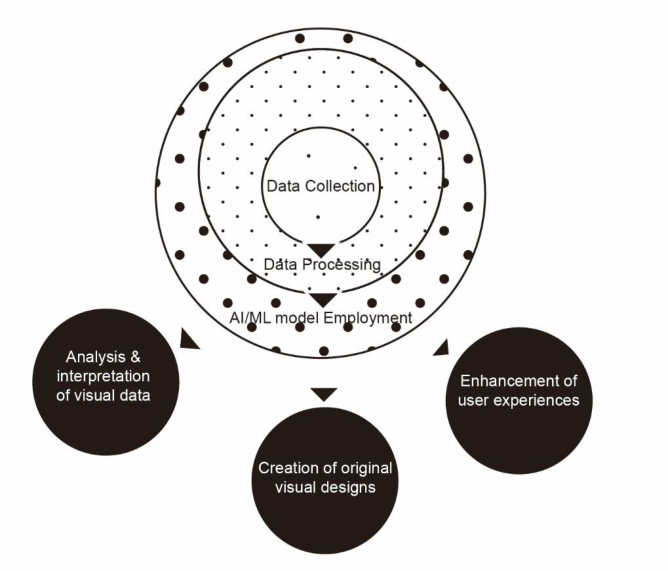
Findings from the Case Studies According to the search results, there are multiple phases involved in the con- struction of an AI or ML model framework that can be used for the analysis and interpretation of visual data, the production of creative visual designs, and the enhancement of user experiences in academic contexts (Wang, 2021). The first step is to collect data, including visual data, for analysis, interpreta- tion, and training of the AI or ML model. The quality and quantity of data collected are essential for determining the success of the model. In the second stage, the acquired data is prepared for use in the model. This involves cle- ansing and processing the data to ensure its veracity, utility, and relevance. After that, a suitable AI or ML model must be selected. ‘Linear discriminant analysis’, ‘Naive Bayes’, ‘Support vector machines’, ‘learning vector quanti- zation’, ‘K-nearest neighbours’, and ‘random forest’ are among the models provided (Wang, 2021). The chosen model must be capable of managing the pertinent visual data and responsibilities. Once a model has been chosen, it must be trained using the provided data. The training process involves modif- ying the model’s parameters to improve its precision and performance. This may require multiple iterations and modifications prior to producing satisfa- ctory results. After receiving training, the model can be utilised to analyse and comprehend visual data, create innovative visual designs, and enhance user experiences. The model may be able to identify patterns and trends in visual data, generate new visual designs based on input data or user preferences, and optimise user experiences based on user feedback and usage statistics. Lastly, it is essential to monitor and evaluate the model’s efficacy over time. It may be necessary to make additional adjustments and updates to the model
The Impact of Artificial Intelligence and Machine Learning 81
to ensure that it continues to produce accurate and meaningful results. Deve- loping an academic model framework for AI and ML in the analysis and interpretation of visual data, the creation of original visual designs, and the improvement of user experiences necessitate a number of crucial stages, as depicted in Figure 1. These phases consist of data collection, preparation, model selection, training, and ongoing evaluation and monitoring.
AI and machine learning have revolutionised the study and interpreta- tion of visual data, as well as our approach to vast datasets. Methods of deep learning can be used to train neural networks to recognise and classify objects in photographs, as well as to discover patterns and trends and draw relevant conclusions. This technique has numerous applications, including medicine, security, and entertainment. AI and ML can also be used to gene- rate novel visual concepts. Using generative adversarial networks (GANs) and other techniques, it is possible to train computers to produce original photos, videos, and music. These designs can be utilised in numerous industries, inclu- ding painting, advertising, and gaming. AI and machine learning can be used to maximise and personalise user interactions to enhance user experiences. Using machine learning techniques, computers may adopt recommendations and improve user interfaces based on user actions and preferences. This tech- nology has applications in e-commerce, education, and healthcare, among others. It is essential to acknowledge that AI and ML have limitations and
Figure 1: A model framework for AI and ML in the analysis and interpretation of visual data, creation of original visual designs, and enhancement of user experiences.
82 Chau and Ho
ethical issues. As scientists have cautioned, networked AI may threaten the autonomy and capabilities of humans, highlighting the need for discipline and ethical values. In addition, the impact of AI on higher education and the replacement of academic employees with robotics is an intensely con- tested topic. In conclusion, the potential of AI and ML in the analysis and interpretation of visual data, the creation of distinct visual designs, and the enhancement of user experiences is extensive and constantly expanding. It is essential to investigate the ethical implications of emerging technologies and ensure that they are utilised for the benefit of society as a whole.
CONCLUSION
This study’s findings shed light on the possibilities of artificial intelligence and machine learning in the analysis and interpretation of visual data, the production of unique visual designs, and the improvement of user experie- nces. Future research should concentrate on the application of AI and ML to personalise user experiences via visual data analysis. The additional study might look at how effectively AI and machine learning systems understand and analyse visual inputs. Future studies might look at ethical problems with the use of AI and ML in visual design and user experience, such as bias and privacy. Researchers and practitioners may work together to create new AI and machine learning (ML) tools and methodologies for visual data analysis and design, as well as innovative applications of these technologies. Future studies might look at the use of AI and ML to automate visual design proces- ses and develop new design ideas while keeping human input and creativity in mind. AI and machine learning (ML) analysis of visual data provides pra- ctitioners with useful insights that may be utilised to impact design choices and improve user experiences. More study is required to properly understand and enhance the possible uses of AI and ML, but the implications given here indicate that they have the potential to profoundly alter the visual design and user experience.
REFERENCES
Chen, B. D. (2017) Application of Artificial Intelligence Technology in the Visual Communication Design of Shopping Platform, Application of Artificial Intelli- gence Technology in the Visual Communication Design of Shopping Platform | SpringerLink. doi: 10.1007/978-3-319-60744-3_13. Hindawi and Tao, J. (2022) Visual Fatigue Phenomenon in Visual Communication
Design Integrating Artificial Intelligence, Visual Fatigue Phenomenon in Visual Communication Design Integrating Artificial Intelligence. doi: https://doi.org/10. 1155/2022/3706373. Hindawi et al. (2022) Design of Visual Communication Effect Evaluation Method of Artworks Based on Machine Learning, Design of Visual Communication Effect Evaluation Method of Artworks Based on Machine Learning. doi: https://doi.or g/10.1155/2022/4566185. Luo, H., & Zeng, Q. (2022) Study on the Application of Visual Communication
Design in APP Interface Design in the Context of Deep Learning. Computational Intelligence and Neuroscience, 2022. doi: https://doi.org/10.1155/2022/9262676.
The Impact of Artificial Intelligence and Machine Learning 83
Ruiz-Arellano, A. E., et al. (2022) Addressing the Use of Artificial Intelligence Tools in the Design of Visual Persuasive Discourses, MDPI. doi: 10.3390/desi- gns6060124. Wang, P. (2021) Research on the Application of Artificial Intelligence in the
Innovative Development of Visual Communication Design Education - IOPsci- ence, Research on the Application of Artificial Intelligence in the Innovative Development of Visual Communication Design Education - IOPscience. doi: 10.1088/1742-6596/1744/3/032196. Xiang, S. (2023) The application of big data and Artificial intelligence in visual communication design - IOS Press, The application of big data and Artificial intel- ligence in visual communication design - IOS Press. doi: 10.3233/JCM-226627.
LISTED IN THE AHFE DIGITAL BOOKSTORE CATALOGUE
Explore the complete digital volume
Human-Centered Metaverse and Digital Environments
Read this individual research paper free through the original publisher, or explore the full digital proceedings book.
ISBN 978-1-958651-75-9
Explore this ISBN in the AHFE Bookstore ↗Listed in the July 2026 bookstore catalogue; search by ISBN to confirm current availability · Digital book purchase optional