Amic Ho, Ruth Chau (2024). Design Thinking in Higher Education: An Action Research Approach to Developing Creative Problem-Solving Skills in Young Designers. In: Creativity, Innovation and Entrepreneurship. AHFE Open Access, vol. 125, pp. 144–154. https://doi.org/10.54941/ahfe1004730
One of the most important roles of emotions is in communication or motivation, but they also affect the level of engagement. Design education assignments often require students to display exceptional creativity and problem-solving skills and also to mull over many questions. Negative moods like frustration, boredom, restlessness and sluggishness will not only affect people's learning ability but could also reduce productivity. With an educational emphasis on academic instruction, students are much less motivated to learn and make more frequent errors. Creating design that evoke emotions is a framework that addresses these needs through products or services that improve emotional experiences, increasing involvement. This research will use an action research approach, focusing on qualitative and quantitative data collection and analysis technologies, to examine the impact of emotional concerns on communication design. The results can provide guidance for educators, designers, and researchers in developing innovative educational strategies that are responsive to emotional needs. Emotions are an indispensable part of the development of pedagogical ideas.
As a key element of any human interaction, emotions are fundamental to communication, motivation and involvement. In the realm of communica- tion design education, numerous tasks require students to have creative and analytical abilities. However, negative emotions such as anxiety, monotony, restlessness, and fatigue hurt students ‘ability to learn and reduce overall output power. Through concentrating on academic instruction and strict adherence to standards, educators ignore the children’s emotional balance and do not prize the significance of emotion in communication design educa- tion. Consequently, student motivation and involvement are not increasing. This problem prompted practitioners to propose Designs that evoke emo- tions as a means to satisfy consumers’ emotional needs through various
Design Thinking in Higher Education: An Action Research Approach 145
frameworks. Creating designs that evoke emotions is the process of develop- ing products or services that create more positive emotional experiences for consumers Employing both an action research approach and questionnaire evaluation, the author analyses the effects of Creating designs that evoke emotions upon students in communication design. Through observation, interview, questionnaire and experience research techniques, the affective experiences of students will be explored using both qualitative data col- lection and quantitative data analysis. The method attempts to find new perspectives based on research on the influence of emotions in communica- tion design education and a strategy for enhancing student engagement and academic achievement. The approach and results of this study will be a help to academics, designers and researchers looking for innovative educational strategies to meet the emotional requirements of users. This investigation is intended to foster a collaborative learning environment that takes the diverse emotional needs of many participants into account. Furthermore, students are to be involved in the planning of machinery for this interactive (If public opinion does not count too much, we suggest that emotions play a big part in the dove resort of students’ Pupils). This is also the main focus of Creating designs that evoke emotions.
THE ROLE OF EMOTIONS IN HUMAN INTERACTION AND LEARNING In human interaction and learning, the role of emotions is indispensable to the cognitive process. It covers a many-faceted, crucial part. Tyng et al. (2017) suggest that emotions significantly impact all kinds of cognitive pro- cesses, including the perception of stimuli, attention, learning and memory. It affects judgement as well (incl. examples mentioned in previous chapters e.g. problem-solving): 54, 55. Positive emotions in particular are at the root of human flourishing and contribute to learning as a result. The cognitive process is deeply engaged by interest, joy or love. Emotions, both positive and negative, are still significant areas for exploration as far as their influ- ence on learning. More research is needed (Aalto et al., 2020). Emotions are also present in professional learning, significantly affecting teachers’ profes- sional learning. Perceived social presence, arousal level and cognitive load of students all intermingle with emotions to influence the final achievement (Stark & Koslouski, 2022; Wang, 2020). Indeed, emotions are responsible for a significant portion of learner engagement and success, making it critical to consider students’ emotions throughout the teaching and learning process (Jumaat & Termidi, 2022). Additionally, emotions mediate the relationship between attachment, approaches to learning, and academic outcomes, which speaks to their central role in shaping learning experiences (Rentzios, 2021). Furthermore, emotions moderate cognitive skills, and are responsible for the social shaping of human interactions, which makes it clear that there is nearly no aspect of learning and social interaction that emotions do not affect (Loon & Bell, 2017). Finally, emotional intelligence outlines this broader role of emotional presence in learning by outlining how emotions unfold in the learning process (Majeski et al., 2018). Hence, the role of emotions is
146 Ho and Chau
clear – emotions shape professional learning, student engagement and aca- demic success, the teaching and learning process, cognitive skills, and how human interaction is shaped. Thus, it is critical to understand the many ways in which emotions impact learning to foster effective learning environments and positive learning experiences.
The interplay between the conscious and unconscious parts of the human mind shapes the development of creative problem-solving skills in young designers. Research shows that the mind’s ability to wander and engage in unconscious associative processing is critical for creativity and problem- solving skills development. The unconscious mind is actively engaged in creative problem-solving, and differing levels of unconscious processing may influence the generation of new and novel ideas and solutions. Further, conscious awareness and mindfulness can influence the degree to which individuals engage in unconscious processing and pattern recognition, with some h some favouring highly conscious, controlled thought. Research fur- ther notes that intuition, personality traits and emotional creativity may interact both consciously and unconsciously in ways that influence problem- solving outcomes. Thus, tools such as mind mapping in education may impact creativity through the enhancement of unique thinking styles and the improvement of problem-solving skills. Research confirms that mind map- ping results in the development of creative thinking skills and aid in the solving of complex problems. Additionally, overloading conscious thought may leave unconscious processes to run freely, which enhances the ability of the unconscious mind to process information, thus leading to innovative solu- tions. Training interventions that result in increased penetration skills and forecasting have a positive impact in the development of creative problem- solving skills. Reflective and enhanced brain plasticity would also enable creativity and problem-solving skill development in the field of design. The interplay between the conscious and unconscious mind is complex and would limit the development of creative problem-solving skills among young design- ers. Therefore, while it presents challenges, educators and designers have the designers have the capacity to understand how to leverage the mind to enable creative thinking and improve problem-solving skills.
Challenges in Communication Design Education and the Impact of Negative Emotions As a result, negative emotions appear to be an important and under-examined component of communication design education. In the realm of educa- tional design materials and their effects on emotions and learning outcomes, Um et al. (2012) conclude that controllable emotions such as anger and fear have a large effect on intergroup attitudes. Negative emotions also sig- nificantly affect responses to corporate hypocrisy and intergroup attitudes toward a brand (Bukowski et al., 2014; Wang et al., 2020). Addition- ally, the findings of Bukowski et al. (2014) and Wang et al. (2020) show that such effects are significantly exacerbated for individuals experienc- ing negative emotions. Negative emotions also have the largest effect on service customer responses and improved satisfaction, suggesting that the
Design Thinking in Higher Education: An Action Research Approach 147
effects of negative emotions are reported by customers in a service setting (Liljander & Strandvik, 1997; Wei, 2021). In keeping with this idea, nega- tive emotions did indeed have a significant and negative impact on the mean values of order links between students’ emotional responses. This calls for more research aimed at the sequence of attention psychological flow among pupils from an emotional perspective (Msosa, 2020). Negative emotions also result in a decrease in one person’s knowledge/sharing abilities. Such occur- rences tend to give individuals even more reason to pay attention and care about rage’s reverberations in cultivating knowledge innovations (Chen et al., 2021). Negative guilt and anger were also recently found to significantly lower friendship-encounter and relationship focus in service encounters, thus reinforcing the notification that negative emotions in user experience should remain front-of-mind of educators (Dolen et al., 2004).
As this research indicates, the effects of negative emotions extend well beyond consumer behaviour and educational settings. Students subjected to feelings of disgust were found to evaluate concepts more negatively. Not only that, the more the students associated the word customer with negative as opposed to positive words, the more negatively they evaluated the service. Angry and sad individuals were found to evaluate leadership more negatively in a crisis. In addition, the participants suggested that the suppression of nega- tive emotions has a negative impact on those interpersonal processes affecting service judgments, further underlining the need to address negative emotions in service encounters. As noted by Choi et al. (2016), negative emotions may be found to enhance satisfaction. The possibility that negative emotions on product evaluations may be more positive at lower emotional arousal levels than valence and higher valence than emotional arousal levels suggests that negative emotions must be considered in communication design education as well, along with why and how they produce such influence. In sum, the chal- lenges of communication design education are closely tied to the influence of negative emotions on a range of aspects of human interaction and decision- making. Addressing them is vital if communication design educators are to foster the most positive learning experiences for students if managers in our corporate cultures are to be assured the most satisfied and loyal customers as consumers evaluate whether their marketing designs have succeeded for the customer, and if leadership is to be made the most effective across the spectrum of crises the organisation (Madera & Smith, 2009).
Creating Designs That Evoke Emotions as a Framework for Addressing Emotional Needs in Education The Emotion-Centered design framework is a comprehensive approach that argues the centrality of emotions in the design process, particularly in education. Creating designs that evoke emotions suggests an approach to addressing the emotional dimension of education by integrating emotional intelligence, empathy, and affective neuroscience in the design of educa- tional materials and experiences. This concept is centred on the importance of emotions in learning, hence learning environments should be emotional. This framework is built on and draws directly from the biological and
148 Ho and Chau
evolutionary account of how emotion and rational thought are inseparably linked, and how emotional, cognitive, and social functioning are intertwined in the learning process. Attending to humans as emotional and social beings indicates that educational experiences should be designed to resonate with the emotional and social needs of learners, an orientation consistent with student-cantered learning, and human-centred design, which emphasises that designing for the emotional qualities of the learner is central to the practice of understanding and addressing the learning needs of students.
Furthermore, scholars, who studies Emotion-centred Design recognise the harmful consequences of negative emotions on learning and work to mitigate them by incorporating emotional design principles into educational resources and interactions. Most critically, those mood changes must be factored into the design of people’s creative experiences. Teachers can now identify the emotional stereotypes of their students and guide them, accordingly, thereby increasing the likelihood that uniquely positive emotional experiences suit- able for learning will ensue. This is the purpose behind Emotional Intelligence and Emotional Regulation Development (Zedelius & Schooler, 2016). The emotional regulation development aims to build emotional intelligence and programs to include emotional knowledge in educational theories, such as Emotion-centred Design, so that students return with more competent emo- tive abilities following their formative stints at school. When regulating and managing emotions, motions greatly impact students’ academic per- formances and mental health; emotion is indispensable in educational and social contexts. Emotions in a design framework provide a human-centred approach to meeting emotional needs in education. A design framework provides a human-centred approach to meeting emotional needs in educa- tion. The concepts integrate emotional intelligence, empathy, and neuro- science into the design processes. Thus, Emotion-centred Design enables students to have positive emotional experiences, learn more effectively, and use emotion as a method for investigation in mathematics and throughout their studies.
Previous Studies of Emotions in Communication Design Education The influence of emotions in communication design education is an impor- tant research direction that has become more and more popular in recent years. Tyng et al. (2017) suggest that emotions have a major impact on cog- nitive processes such as perception, attention, learning, memory, reasoning, and problem-solving. Pleasant emotions may act as effective retrieval sig- nals for other pleasant memories, as well as affect cognitive organisation, altering the framework within which cognitive processes occur (Um et al., 2012). Academic emotions such as pleasure, optimism, pride, relief, anger, concern, humiliation, despair, and boredom have been investigated in con- nection to students’ self-regulated learning and performance. The function of emotions—especially in teacher learning and development—is a commonly studied issue in professional learning and has received increased attention in light of the COVID-19 epidemic (Stark & Koslouski, 2022). The literature has also underscored the importance of understanding how the experience of
Design Thinking in Higher Education: An Action Research Approach 149
discrete emotions influences cognitive, behavioural, and motivational learn- ing processes, particularly in informal learning contexts. While past research has mostly focused on the influence of negative emotions on learning, there has been an increasing interest in investigating the function of good emotions in learning. An area noted as largely unexplored is the influence of emotional stimuli—especially from happy facial expressions—on contingency learning, pointing to the possibility of continued exploration (Saylik et al., 2021). Also being explored, are the impacts of emotional states on novel word learning and the moderating role of positive emotion in the motivation-engagement link, shedding light on the complex web of relationships that exists between emotions and learning outcomes. Emotion control tendencies, accomplish- ment feelings, and physiological arousal in medical diagnostic reasoning simulations were explored in terms of instructional science, illustrating the complex and multidimensional nature of emotions in educational contexts (Harley et al., 2019). Research has explored the significance of academic emotions and their function in mediating the relationship between distant factors and learning to enhance our comprehension of how emotions impact student learning (Rentzios, 2021). Although emotions have traditionally been viewed as influencing students’ learning outcomes, research has also begun to investigate the role of emotions in communication design education. The potential emotional design of internet experiences was also acknowledged, recognising the need to further explore emotion regulation in students’ learn- ing experiences (Kay, 2023). Parental emotional companionship’s impact on children’s second-language learning was recognised as an important area for advancing theoretical understanding of the affective factors that influence second-language acquisition. From the literature on the influence of emotions in Communication Design education, much has been learnt regarding the complexity of emotions as they pertain to learning, memory, problem-solving, and creative thinking. While early work mainly looked at emotions and their role as learning outcomes are being produced, this literature has expanded to see the role of emotions in Communication Design education develop across instructional science, internet experiences, and second language acquisition.
RESEARCH METHODOLOGY A combination of research activities can offer a comprehensive overview of the higher education institution’s communication design program and cur- riculum, teaching methods and learning environment, as well as the factors that influence students’ emotions and engagement. A comprehensive doc- ument analysis of program brochures, course catalogues, syllabi and other teaching materials could provide valuable insights into the structure, objec- tives and core courses of the communication design program. Interviews with faculty who teach communication design courses could reveal deeper insights into their teaching methods, pedagogical approaches and attitudes toward emotions and engagement in their courses. Classroom observations offer the opportunity to see first-hand the physical environment and evalu- ate factors including room layout, furnishings, technology integration and
150 Ho and Chau
student-faculty interaction. Surveys of students could determine their per- ceptions of their learning environment as well as the availability of resources of various types, as well as the adequacy of software, tools and equipment for designing and presenting work. Focus groups would allow for more in- depth discussions of specific factors that might influence students’ emotions, such as class sizes, the presence of collaborative projects, interactions with faculty and what support services are offered. A thorough inspection of facil- ities used by the communication design program, such as design studios, computer labs, printing facilities and prototyping spaces will allow for a fair assessment of how adequate various resources are and how accessible they are to students who may need them. Finally, a review of student work, through student portfolios or various other assignment examples, could yield insights into the degree of quality, creativity and problem-solving skills that students are demonstrating, thus providing some sense of the effectiveness of the curriculum and teaching methods. Together, these research activities provide multiple views of the higher education institution’s communication design program and curriculum, its learning environment and resources, and the methods and modes of teaching that may be influencing the emotions and engagement of students in these courses.
Table 1. Research procedures.
Table available in the original PDF paper.
Stage Research Activity 1 Faculty Interviews 2 Classroom Observations and Student Surveys 2.1 Classroom Observations 2.2 Student Surveys 3 Focus Groups and Facilities Assessment 3.1 Focus Groups 3.2 Facilities Assessment
FINDING AND DISCUSSION Emotional and communication design education The literature on the effect of Creating design that evoke emotions on communication design education is limited, as few studies use quantitative analysis to assess the impact of such interventions. However, there is a breadth of relevant literature on the assessment of design that evoke emotions interventions and early childhood development, and on the evaluation of educational practices more gener- ally, which provide important perspectives and methodologies that can be leveraged to evaluate the impact of Creating designs that evoke emotions on communication design education. Gelli et al. conducted a cluster-randomised trial to assess the impact of embedding a community-based emotion-centred design centre into Tajikistan’s primary healthcare system on the production and consumption diversity in households, on the nutrition knowledge and practices of caregivers, and on the diets and nutrition of preschoolers and their younger sibling (Gelli et al., 2018). This quantitative approach provides
Design Thinking in Higher Education: An Action Research Approach 151
a framework for evaluating the impact of evoke emotions interventions on dietary intake and growth outcomes and provides important illustrations of how quantitative assessment can be applied to evaluate the effect of creating designs that evoke emotions initiatives.
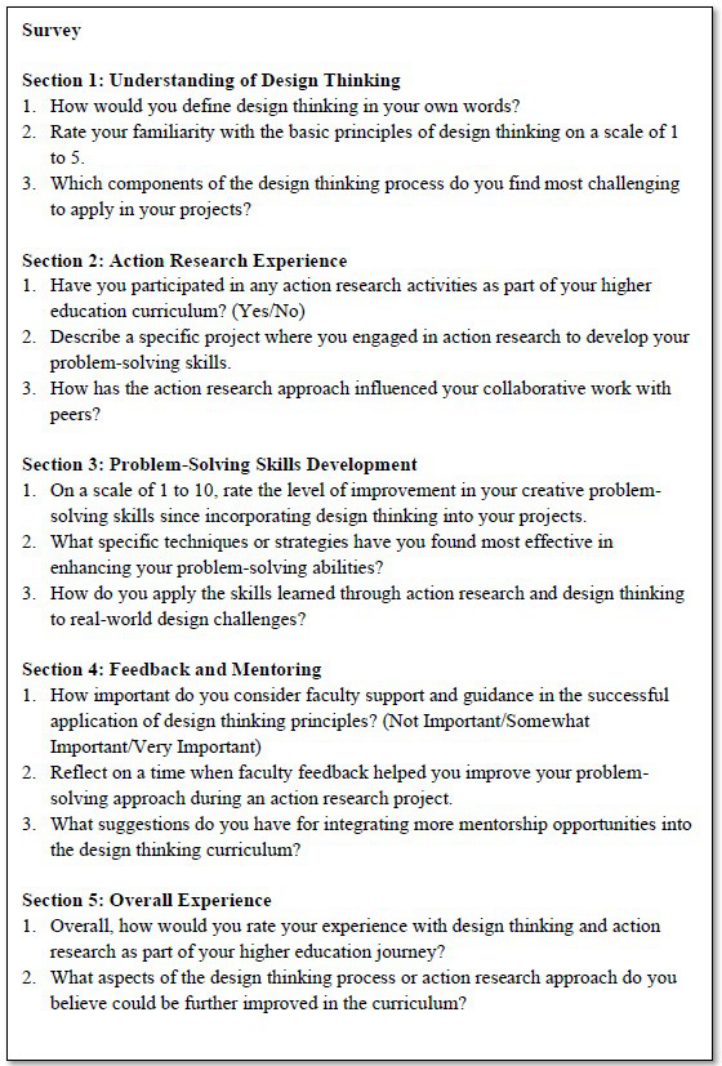
Figure 1: Extracted survey questions.
152 Ho and Chau
Both offer a case for why early childhood development belongs there—that ECD has the potential for a huge impact on health, ability to learn, and pro- ductivity in later life. The costliest potential child-centric early interventions, and therefore a guarantee of the realisation of human rights (Britto et al., 2018); deserve a place within overarching human prosperity (Walker et al., 2011). In short, the quantitative not only suggests the importance and poten- tial benefits of implementing interventions that promote creating designs that evoke emotionsbut also offers an underlying view that child development is at once a profound indicator, and a fundamental cause, of societal well- being. In 2006, Mislevy and Haertel discussed the implications of ‘Design and Emotion’ concepts for educational testing and assessment, underscoring the importance of creating designs that evoke emotions in assessment design and implementation. While not directly related to communication design edu- cation, this work offers guidance on how evoking emotions principles could be applied to educational assessment, and their impact measured, provid- ing a methodological framework for assessing the impact of creating designs that evoke emotions on educational practices. The existing literature lacks in quantitative analysis of evoking emotions on communication design edu- cation. Nevertheless, existing research on evoking emotions interventions and early child development, policy analysis, and educational assessment can offer interesting methodological direction and framework for impact analysis of design projects. The survey has also shown that in its explo- ration of the effect of early childhood interventions, it is necessary to go into evidence-based approaches and quantitative analysis, laying a foundation for communication design education in future.
CONCLUSION
That action research has been implemented in a variety of fields as indi- cated by the cited references. In community-based participatory research and participatory action research many different manifestations have appeared; these it is that show the breadth and versatility of action research itself. The references therefore provide examples of experimental, participatory, evidence-based descriptions and how these aspects of the nature of action research interpenetrate with each other. They emphasise the importance of stakeholder involvement, and community partnerships; and also urge that rigorous methodologies should proceed from knowledge rooted in context or practice--treat practical problems as areas where rigorous practice may con- tribute toward social justice improvements. Also, according to the literature review action research can lead to educational innovation, improve commu- nity health, and give rise to evidence-based interventions. Creating designs that evoke emotions within the frame of a communication design education is beyond what we can tell from the sources. The methodological framings and detailed analyses that the references supply are beneficial for learning how one might study the repercussions of including such a program in commu- nication design education compatibility. The valorisation of evidence-based models, participatory techniques, and collaborative partnerships that occur in the references make possible a research program to look at how Creating
Design Thinking in Higher Education: An Action Research Approach 153
designs that evoke emotions might affect communication design education. Hence, the literature review shows that in action research-- being an organic, creative way to address difficult problems and overcome barriers for good- anyone who takes part becomes part of a community of researchers who share their resources. What the diverse frames of action research in the lit- erature review have to say about this program is that they could well make a backdrop against which to study their impact upon transmission design scholarships.
REFERENCES
Aalto, J., Raatikainen, E. and Isacsson, A. (2020) ‘Between Despair and Joy – Emotions in Learning’, Journal of Applied Research in Higher Education 13(1), 228–241. Britto, P. R., Singh, M., Dua, T., Kaur, R. and Yousafzai, A. K. (2018) ‘What Imple-
mentation Evidence Matters: Scaling-up Nurturing Interventions That Promote Early Childhood Development’, Annals of the New York Academy of Sciences. Bukowski, M., Dragon, P. and Kossowska, M. (2014) ‘The Impact of Incidental Fear and Anger on in-And Outgroup Attitudes’, Polish Psychological Bulletin. Chau, P. W. and Ho, A. G. ‘Investigation the City Environment with the Help of Typo-
graphic Communication Design Perspectives’. Advances in Creativity, Innovation, Entrepreneurship and Communication of Design: Proceedings of the AHFE 2021 Virtual Conferences on Creativity, Innovation and Entrepreneurship, and Human Factors in Communication of Design, July 25–29, 2021, USA: Springer, 459–465. Chen, S., Xiao, H., He, W., Mou, J., Siponen, M. T., Qiu, H. and Xu, F. (2021) ‘Determinants of Individual Knowledge Innovation Behavior’, Journal of Organizational and End User Computing. Choi, N. H., Jung, J. M., Oyunbileg, T. and Yang, P. (2016) ‘The Impact of Emo-
tional Arousal Levels and Valence on Product Evaluations’, European Journal of Marketing. Dolen, W. v., Ruyter, K. d. and Lemmink, J. G. A. M. (2004) ‘An Empirical Assessment of the Influence of Customer Emotions and Contact Employee Performance on Encounter and Relationship Satisfaction’, Journal of Business Research. Fredrickson, B. L. (2001) ‘The Role of Positive Emotions in Positive Psychology: The
Broaden-and-Build Theory of Positive Emotions’, American Psychologist. Gelli, A., Margolies, A., Santacroce, M., Roschnik, N., Twalibu, A., Katundu, M., Moestue, H., Alderman, H. and Ruel, M. T. (2018) ‘Using a Community-Based Early Childhood Development Center as a Platform to Promote Production and Consumption Diversity Increases Children’s Dietary Intake and Reduces Stunting in Malawi: A Cluster-Randomized Trial’, Journal of Nutrition. Ho, A. G. (2019) ‘Encoding from Visual Content Analysis in Cultural Design
Research’. Ho, A. G. (2022) ‘18 Emotion and communication design’, Language and Emotion.
Volume 1, p. 385. Jumaat, N. F. and Termidi, N. S. A. (2022) ‘Assessments of Student’s Emotions and Their Relevance in Online Learning’, Asean Journal of Engineering Education. Kay, R. (2023) ‘Examining the Role of Emotions in Learning With Technology’,
Journal of Digital Life and Learning. Liljander, V. and Strandvik, T. (1997) ‘Emotions in Service Satisfaction’, International Journal of Service Industry Management.
154 Ho and Chau
Loon, M. and Bell, R. (2017) ‘The Moderating Effects of Emotions on Cognitive Skills’, Journal of Further and Higher Education. Madera, J. M. and Smith, D. (2009) ‘The Effects of Leader Negative Emotions on
Evaluations of Leadership in a Crisis Situation: The Role of Anger and Sadness’, The Leadership Quarterly. Majeski, R. A., Stover, M. and Valais, T. (2018) ‘The Community of Inquiry and Emotional Presence’, Adult Learning. Msosa, S. K. (2020) ‘The Impact of Perceived Justice on Students’ Negative Emo-
tional Responses During Service Recovery’, International Journal of Higher Education. Pekrun, R., Goetz, T., Titz, W. and Perry, R. P. (2002) ‘Academic Emotions in Students’ Self-Regulated Learning and Achievement: A Program of Qualitative and Quantitative Research’, Educational Psychologist. Rentzios, C. (2021) ‘Rethinking Associations Between Distal Factors and Learn-
ing: Attachment, Approaches to Learning and the Mediating Role of Academic Emotions’, Psychology. Saylik, R., Castiello, S. and Murphy, R. A. (2021) ‘The Role of Emotional Interference on Learning in an Emotional Probabilistic Go/No-Go Task’, Dusunen Adam the Journal of Psychiatry and Neurological Sciences. Stark, K. and Koslouski, J. B. (2022) ‘The Emotions of Professional Learning:
Considerations for Instructional Leaders’, Nassp Bulletin. Tyng, C. M., Amin, H. U., Saad, M. N. M. and Malik, A. S. (2017) ‘The Influences of Emotion on Learning and Memory’, Frontiers in Psychology, 8, 235933. Um, E. R., Plass, J. L., Hayward, E. O. and Homer, B. D. (2012) ‘Emotional Design
in Multimedia Learning’, Journal of Educational Psychology, 104(2), 485. Wang, Z., Zhang, L. and Liu, X. (2020) ‘Consumer Response to Corporate Hypocrisy From the Perspective of Expectation Confirmation Theory’, Frontiers in Psychology. Wei, J. (2021) ‘The Impacts of Perceived Risk and Negative Emotions on the Service
Recovery Effect for Online Travel Agencies: The Moderating Role of Corporate Reputation’, Frontiers in Psychology 12, 685351. Zedelius, C. M. and Schooler, J. W. (2016). ‘The richness of inner experience: relating styles of daydreaming to creative processes.’ Frontiers in Psychology, 6. https: //doi.org/10.3389/fpsyg.2015.02063
LISTED IN THE AHFE DIGITAL BOOKSTORE CATALOGUE
Explore the complete digital volume
Creativity, Innovation and Entrepreneurship
Read this individual research paper free through the original publisher, or explore the full digital proceedings book.
ISBN 978-1-964867-01-4
Explore this ISBN in the AHFE Bookstore ↗Listed in the July 2026 bookstore catalogue; search by ISBN to confirm current availability · Digital book purchase optional