Amic Ho (2022). Application of Art-Tech in Visual Experience. In: Symposium on Creative Technology and Digital Media. AHFE Open Access, vol. 27, pp. 28–37. https://doi.org/10.54941/ahfe1001438
Since the invention of the media in the 20th century, technological advances in the field of information have revolutionised the art and science of design. Thanks to new screen devices, communication platforms, printing technologies, and software, artists and designers have unprecedented creative freedom to combine a variety of tools and techniques to generate images and ideas based on their own ideas. The emerging immersive virtual reality technology in recent years is both complex and interesting. Because its development time is very short, there is still great room for exploration. Artists have traditionally been early adopters of new technologies focused on promoting innovative ideas, but now that role is more forward-looking than ever. Visual research is often cited as an aesthetic criterion by some artists and designers, but in fact, it should be explored how to use its theory to explore the communication of digital information communication technology or to develop more ideographic tools. It is not simply a feature or term used to identify the development of visual creativity over the past two decades; it is a discipline in itself worth exploring. This study aims to investigate what does visual experience means in general? Whether it is a medium independent of all fields of design and art or just another innovation in a long-term technological breakthrough, remains unclear. How does it affect our perception, understanding, and creation of visual communication? This article explores the issues listed above but also discusses the obstacles designers and artists face in the age of digital art and design.
From the 1990s to the early 2000s, digital media experienced unprecedented technological development, from the digital ages into the social media ages. Though the fundamental of various digital technologies was started 60 years ago, hardware and software improved and grew more affordable throughout the last decade of the twentieth century, while the World Wide Web provided another layer in the mid-1990s. As early as the 1970s, artists were experimen- ting with digital media, long before the term digital revolution was coined to describe the phenomenon. Most of their work was first shown at events dedicated to electronic or technical media such as conferences, festivals, and symposiums; it was deemed at best on the outskirts of the conventional art community. Digital art was established worldwide. Museums and galleries
have begun collecting and organising large-scale exhibitions of digital works. The terms of the technological art form have always been very flexible. It is often used interchangeably with ‘new media art’ which was used primarily in film and video in the late 20th century and sound art and other hybrid forms (Caarls, Jonker, Kolstee, Rotteveel & van Eck, 2009). The adjective ‘new’ relates to the term’s ephemerality. But, what is ‘new’ about digital media? Some digital art notions date back almost a century. Other issues have been addressed in ‘traditional’ artworks. What is new is that digital technology has advanced to a point where it can create and experience art in whole new ways. Some of these options are listed here. The phrase digital art has grown so broad that it no longer describes a single style. This page will describe the many digital art forms, their aesthetic language, and their technological and creative growth. The contrast established here is between digital and internet- based art and conventional art, such as photographs, prints or sculptures. After being digitally born, computable art is created, Store and distributed digitally and use its capabilities as its medium. The latter is often understood as ‘new media art’. These two broad digital art categories, which can be very different in form and aesthetics, are preliminary illustrations of an extremely mixed field. Identifying and labelling an art form, particularly one that is con- tinually emerging, such as digital art, may be problematic. It has been called the post-media and post-Internet age by artists, curators, and theorists alike when creative expression takes on digital technology’s impact and structure yet ultimately straddles media.
DIGITAL AND ART Using digital technology as an artistic medium means that the works, from production to exhibition, fully utilise the digital platform to showcase and explore the inherent possibilities of the platform. The distinctive features of digital media undoubtedly constitute a unique aesthetic form: interactive, engaging, dynamic and customisable. List a few key features. However, art has numerous forms and is incredibly complex. Virtual reality, artist-written software, internet-based art, or any combination of these may be conside- red. Scholars studied these forms, focusing on their unique formal language. Technologies often evolve faster than the rhetoric that evaluates them.
Designers constantly use digital technology as a medium to develop arti- stic vocabulary - socially, economically, and aesthetically. The characteristics usually assigned to digital media need further clarification, as they are often used generally and have little meaning. For example, the word ‘interaction’ has become almost meaningless due to its overuse at many exchange levels. Ultimately, any experience of a work of art is interactive and depends on a complex interaction between the recipient’s context and meaning produ- ction. When it comes to classic art forms, the viewer’s presence does not modify the physical attributes of a painting or sculpture. However, with digital art, interactivity includes navigation, assembly, and contribution to a piece of art, as well as psychological activities. While the possibility of user or participant engagement in works has been explored in performance art, event art, and video art, we are now faced with the complex possibilities of
30 Ho
remote and immediate intervention specific to digital media. The possibili- ties for complex interactions in digital art go far beyond simple ‘click and click’. It only provides a complex viewing of work or interaction where a user action triggers a specific response. Virtual artwork has changed more fundamentally. Interaction with virtual art objects like open-ended ‘infor- mation narratives’ communicates content, context, and temporal control to their respective receivers. These works may take several shapes, with diffe- ring degrees of management supervision by the designer or spectator. Digital art is not always cooperative in the original sense but depends on the partici- pation of multiple users. They select their own conditions or become distant participants in moment live performances. In some cases, the visual represen- tation of the artwork is ultimately created by the viewer: without input, the artwork may consist of a blank screen.
Digital media is dynamic, reacting to changing data streams and real-time data transfers. Various artworks (some of which are discussed later) use stock market and financial data for different visualisations. It should be noted that digital media is not visual but consists of a “back end” of code or scripting language and a visible “front end” of the viewer/user experience, the former mostly still hidden and the latter generated by the former. The result can be complex visuals or very abstract communication processes. Some digital art is primarily visual; others are more concerned with raw data or databases. Another outstanding feature of the media is that it can be customised to meet the needs or interventions of individual users. For example, in artistic works, the user’s data has become the basis for the development and change of the work.
These distinctive digital media features are not necessarily expressed but used in different combinations. Jim Campbell (Duchowski, Price, Meyer & Orero, 2012). Fifth Avenue series is the poster child for digital work. It shows only some of its characteristics – it is a dynamic art, but it is neither intera- ctive, engaging, nor customisable. The piece consists of a scene displayed on a panel created by computer-controlled red light-emitting diode (LED) lights. The scenes show video images of people walking on Fifth Avenue in Manhat- tan. In front of the panels are treated plexiglass panes. Since the plexiglass is placed at different angles to the LEDs, the scene goes through different stages of pixelation (from intense to almost invisible), and the transition from digi- tal to analogue seems to be reflected not only on extraction on the aesthetics of these different media types. Another example of dynamic digital artwork is John F. Simon’s Color Panel series (Duchowski, Price, Meyer & Orero, 2012), which consists of custom hardware, software, and liquid crystal displays (LCDs). This panel shows a dynamic composition based on software writ- ten by the artist. The viewer can see that the algorithm drives the visuals on the screen without repetitive changes. Both Campbell and Simon’s work expands the concept of an art object in the digital age, which preserves all aspects of the object and transforms it into a changing, time-based structure. One benefit of using digital media is that information may be generated end- lessly, repurposed, and reused. It can be reorganised to produce a new idea. The re-contextualisation of information in various relational combinations
Application of Art-Tech in Visual Experience 31
is intrinsically linked to the logic of building the database, which ultima- tely expresses the core idea of the digital art project. As media theorist Lev Manovich puts it, digital artwork can be described as one or more interfaces to a multimedia database. The notion of an interface enables the users or viewers to encounter virtual things, according to Manovich. The word ‘inter- face’ has practically become synonymous with navigation. Devices helped users to apply for the three-dimensional virtual computer programs. Howe- ver, the term has been around and describes where independent systems allow one system to interact with another Navigation tool for system communica- tion. The interface works as a guide and interpreter between two parties. Different interfaces have surrounded us for a long time, so we hardly notice them anymore. From TV, video recorders, audio remotes, stereos, microw- ave ovens, and elevator control panels to telephones and fax machines, we have always relied on them to communicate with machines and the outside world. Plus, with live imaging, photographers can share photos with their subjects on the spot and offers takeaway photos, which opened the door to a previously impossible sense of co-authorship. Polaroid photography once fostered a sense of real-time imagery when cameras in phones allowed users to capture, store instantly, and send photos in the blink of an eye. The demand for images became greedy and pervasive. How this ubiquitous image culture transformed into the art world is a story in itself.
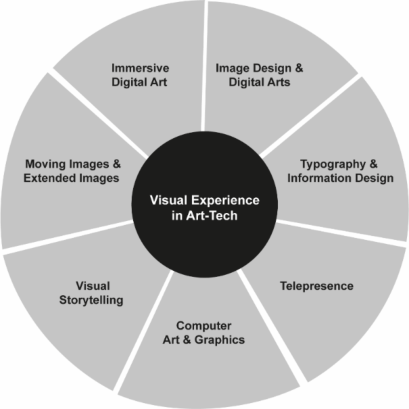
VISUAL EXPERIENCE IN IMAGE DESIGN AND DIGITAL ARTS Several issues in digital art are in many ways particular to the digital medium. That is not to imply these themes are not prevalent in more conventional media or that digital media is not addressing concerns that artists have stu- died for ages. More particular subjects explored here include; Typography and Information Design; Telepresence; Computer Art and Image; Visual Storytelling; Moving Image and Extended Image; Immersive Digital Art; and interactive digital art. Several of these topics have been portrayed in 20th-century art and particularly in digital art.
TYPOGRAPHY AND INFORMATION DESIGN Users may explore visual and textual information while experiencing chan- ges over time. Any dataset may be shown in a variety of ways. Valence, a data visualisation project by Benjamin Fry (Grau, 2004), creates dynamic visual forms from vast quantities of data (1999). The programme visualises data depending on how it interacts with other data. Valence may be used to compare data sources or to illustrate book content. The final graphic evo- lves with time and additional data. Rather than offering statistics, Valence presents qualitative slices of the data’s structure to reveal overall patterns and anomalies. Valence establishes linkages between data items that are not immediately apparent and lie under the surface of what we normally notice. W. Bradford Paley’s web project TextArc (Grau, 2004) is a visual approach for expressing whole texts (eg books) on a single page. TextArc, like valence, provides content trends and enables users to filter text. TextArc also features
32 Ho
an offset printing model. TextArc’s two-dimensional design is distinct from the Fry project’s two-dimensional architecture, therefore ‘charging’ the two projects with the same text will reveal distinct patterns and relationships.
Archive and database are crucial parts of cartography and our knowledge of digital culture. In the 1990s, digital archives and databases became a cultu- ral genre. For example, archiving and databases have become essential forms of cultural memory due to the digitalisation of libraries, historical documents, and museum collections as well as commercial data collecting. The database itself is laborious, made up of discrete parts that may not always make sense. The value of databases rests in their relational potential, the ability to link diverse information and build cultural narratives. While databases, in gene- ral, are typically a part of digital art, several projects expressly concentrate on database culture. For example, Hungarian artist George Legrady explo- res the impact of databases on cultural narratives. His CD-ROM installation An Annotated Archive of the Cold War (Simon, 2015) provides personal and official papers from Stalinist Hungary with an interface that replicates the former Hungarian Communist Propaganda Museum’s floor design. For additional information on his work, see Slippery Traces: The Postcard Trail (Legrady, 2000). Legrady uses postcards as ready-made expressions and cul- tural memory traces to build a narrative environment that reflects narrative development and mediates memory. Pockets Full of Memories by Legrady invites people to scan an item they possess and answer questions about it at a scanning station at the Centre Pompidou in 2001. An algorithm classifies scanned items in a two-dimensional map by description. Users may access sta- tistics and submit personal tales and comments. With this project, you may create a map of conceivable links between things, from simple functions to personal value signifiers. The mapping of these things suggests the prospect of personalising objects. The project straddles the line between categorisation and meaning.
Dynamic process visualisations may track our individual interactions, inte- rventions, and communications. Social media platforms have generated new communication settings that may be data mined using software tools to yield relevant information for marketing and income-generating. With better fil- tering techniques, the display of communication processes has grown more complicated and beautiful. Early attempts at conversation mapping include American artist Warren Sack’s Conversation Map (Duchowski, Price, Meyer & Orero, 2012). Conversation Map is a web browser that analyses the big internet Create a graphical interface that shows distinct social and seman- tic ties. For example, Judith Donath and Fernanda B. Viegas’ Chat Circles graphically depict large-scale conversation. Everyone in the chat room is represented by a coloured circle with their name on it. If a person publi- shes a message, it displays in their circles, which expands and then fades. Now that big data and cultural analytics are everywhere, data visualisation must expand its scope. Lev Manovich, Nadav Hochman, and Jay Chow studied urban representations by combining millions of pictures shared on social networks in The Aggregate Eye (Fujihata, 2002). Over three months, the researchers collected and evaluated 2,353,017 Instagram photographs
Application of Art-Tech in Visual Experience 33
from 312,694 users in 13 cities. Large prints and movies show unusual pat- terns in these photographs. New York, Tokyo, and Bangkok compared using 150,000 Instagram photographs. A visual story was created from 23,581 pictures shared in Brooklyn during Hurricane Sandy. A component of Hoch- man, Manovich, and Chow is the Phototrails research project, Aggregate Eye explores visual patterns, dynamics, and structure in user-generated shared pictures. Academia, industry, and government often employ data visualisa- tion tools Many Eyes (Grau, 2004) is a website where individuals may submit their own data, create interactive visualisations, and talk together.
EXPERIENCE IN TELEPRESENCE The concept of telepresence is not only related to digital technology but is intrinsically linked to any form of telecommunications - telecommunications. The phone has ushered in a new era of remote presentations. Telecommunica- tion Connections: A Virtual Embrace, establishes a historical framework for recent works of this kind. Comprising installation pieces, film clips, online projects, and a ‘Telecomic Timeline’, the project begins to explore the uto- pian aspirations of expanding global awareness about the possible dystopian consequences of computer-mediated communication. Webcam in real-time Broadcasting a local view to the internet opens a window to the world and into people’s lives from a very complex perspective.
EXPERIENCE IN COMPUTER ART AND GRAPHICS Aesthetics of expression and perception; cultural and political processes modifying the human situation; emotional and spiritual worlds; personal, communal, and inter-community relationships, to mention a few. Art has always mirrored societal change, and ‘technology’ in its widest sense has alw- ays been a component of it. After all, during the 1990s, digital technology has grown exponentially. However, the “future of technology” may include new types of intelligent interfaces and machines, as well as the convergence of digital, biological, and nanotechnology. Digital technology will become increasingly prevalent in life and art.
We live in a world where bioengineering and cloning are realities, and art is increasingly influenced by genetics and biotechnology. While art integra- ting biotechnology and genetic engineering was initially considered part of new media art, bio-art practices involving biological tissues, bacteria, orga- nisms, and life processes—has evolved as a distinct discipline. The traditional computer, monitor, and keyboard arrangement are progressively being sup- planted with interfaces that allow users to engage with machines through speech, gestures, eye movements, and other means. Physical computing inclu- des embedded computing devices, wearable computing, and the Internet of Things. The latest frontier in human-computer interaction is BCI and BBI, which are continually advancing. Future art will also represent the cultu- ral shifts caused by the convergence of computer technology, biotechnology, neurology, nanotechnology, and other fields. While art is a cultural asset that does not need a purpose, it must perform a function. Open to the artistic,
34 Ho
emotional, and political investigation. As we confront major problems, we must redefine ourselves and our planet.
VISUAL STORYTELLING Most electronic linked settings seen today in digital art and on the internet are hybrid forms that enable users to edit text, pictures, and music. Traditi- onal writings are physically and mentally stable. Its solid and steady reality negates the ethereal psychological narrative the reader is attempting to build. The connecting mechanism changes the text, not the reader’s impression of it. Associative references are used to access information in hypermedia applications. Hypertext connects readers and authors in superficial ways, underlining deconstructionist theory’s ultimate constraints of literature and language—sign play, lack of intertextuality, and closure. Digital technology’s increasing flexibility and instability of printed texts – from typography to books to narrative structures – has become a major creative focus. Arti- sts that address these concerns include hypertext fiction, which commonly blends text with visuals and sounds, typography, and book themes. Beyond Pages (Grau, 2004) by Masaki Fujihata directly contrasts conventional rea- ding methods with the possibilities given by digital media. This contraption projects a leather-bound picture onto a table. The light pen may be used to trigger stones, apples, doors, and lights in the book. Books may be consi- dered as an information space with its own ‘architecture’ in digital culture. Writing occupies and delineates space on paper or computer, utilising stru- ctural components like sentences, divisions, and paragraphs. The Talmud Project (Simon, 2015) by David Small and Tom White established a reading experience through virtual media that related to both the books and informa- tion construction outside books. Using the Talmud, an ancient Jewish holy literature, and Emmanuel Levinas’ commentary on the Talmud, Small built a narrative and reading environment in which all texts are interconnected. Can be read in its entirety, yet allows for selective reading without losing context.
MOVING IMAGES AND EXTENDED IMAGES The film was supplanted by digital, affecting moving visuals. This alteration is not permanent. Since 1996, there have been twelve distinct video file formats, ranging from Digital Video to multi-view video encoding. Digital techno- logy’s influence on video is as significant as it is on photography. The 1960s graphic art movement emphasised the variety of moving images in art. The instruments of the film business were digitised and eventually appeared on every computer desktop as computer animation evolved and interconnected with computer graphics and sculpting. Compared to video art and cinema, television is considered as a ‘commercial media’ that controls the culture. These changes are due to recent advances in live video streaming and mobile technologies Data storage replaced film, affecting all time-based media. To create master tapes, early video artists had to sequentially merge pictures or re-record in real-time. Data access from a hard drive is a non-linear way to cutting tape. It also allows for non-sequential storytelling forms.
Application of Art-Tech in Visual Experience 35
MOVING IMAGES AND EXTENDED IMAGES The film was supplanted by digital, affecting moving visuals. This altera- tion is not permanent. Since 1996, there have been twelve distinct video file formats, ranging from Digital Video to multi-view video encoding. Digi- tal technology’s influence on video is as significant as it is on photography. The 1960s graphic art movement emphasised the variety of moving images in art. The instruments of the film business were digitised and eventually appeared on every computer desktop as computer animation evolved and interconnected with computer graphics and sculpting. Compared to video art and cinema, television is considered as a ‘commercial media’ that con- trols the culture. These changes are due to recent advances in live video streaming and mobile technologies Data storage replaced film, affecting all time-based media. To create master tapes, early video artists had to sequenti- ally merge pictures or re-record in real-time. Data access from a hard drive is a non-linear way to cutting tape. It also allows for non-sequential storytelling forms.
IMMERSIVE DIGITAL ART Interface, interaction, immersion, and visual evolution define virtual art (Small, 1999). Immersion is the sensation of being surrounded by a crea- ted picture or reality. Human individuals lose distinction from simulation in some technological environments (Small, 2012). Virtual art, like telema- tics, merges art with technology via virtual, augmented, or mixed reality settings. It allows for real-time modelling and engagement across several sensory channels. Immersion, interactivity, and imagination are hallmarks of virtual reality settings (Van Krevelen, 2010). Augmented reality (AR) integrates components of the physical and virtual worlds. Mixed Reality (MR) is a subset of augmented reality in which physical and virtual items coexist in real-time in a shared area (Viegas, 2007). Computers had alre- ady laid the groundwork. Computer technology gives the impression of being immersed in an image space where you can move and interact in real-time.
THE MODEL OF VISUAL EXPERIENCE IN ART TECH Since 2010, art and design have been moving towards a future defined by technological difficulties. These technical hurdles have spawned an intera- ctive media and communication trend that combines static (text and graphics) and dynamic (animations and simulations). Interactive media and commu- nication are widely used in today’s media-driven world. The distinctions between art, design and information creation were blurred. It is no lon- ger enough for designers and artists to arrange visual components in art and communication design as means for expression and communication. Designers tackle issues in creative ways, while Digital Artists execute their emotional expression using visual components, as depicted in the following model.
36 Ho
Figure 1: The framework of Disciplines in Art Tech.
CONCLUSION
The variability in the techniques used by artists is constantly evolving. Digital art catalyses the transformative power of art across categories and more bro- adly. The differences between digital works and traditional art objects (e.g. paintings, illustrations, sculptures) are emphasised, which are relatively unch- anged over time. Exposure of traditional art objects to strong light, heat, or rough handling will undoubtedly degrade the painting; but with proper pro- tection, its form can remain relatively intact and recognisable from its age. Media works—often based on audience participation, one-off events, and critical concepts—are in a state of constant change, thus resisting the notion that all artworks are immutable objects. The changing nature of some digital artworks presents a challenge for conservators, who cannot conceptualise the work as an object but must think in terms of process, event and the general importance of novelty.
REFERENCES
Caarls, J., Jonker, P., Kolstee, Y., Rotteveel, J., & van Eck, W. (2009). Augmented reality for art, design and cultural heritage—system design and evaluation. EURASIP Journal on Image and Video Processing, 2009, pp. 1–16. Duchowski, A. T., Price, M. M., Meyer, M., & Orero, P. (2012). Aggregate gaze
visualization with real-time heatmaps. In Proceedings of the symposium on eye tracking research and applications (pp. 13–20). Fujihata, M. (2002). Beyond Pages. Leonardo, Volume 35, No. 5, pp. 545–545. Grau, O. 2004. Virtual Art: from illusion to immersion. MIT Press. Legrady, G. (2000). Modular structure and image/text sequences: Comics and interactive media. Comics and culture: analytical and theoretical approaches to comics, 79–90.
Application of Art-Tech in Visual Experience 37
Simon, John F. Jr., (2015). “Every Icon License Agreement”, http://www.radicalart.info/AlgorithmicArt/grid/every/EveryIcon/index.html. 1997. Accessed November 2, 2015. Small, D. (1999). Rethinking the book (Doctoral dissertation, Massachusetts Institute of Technology. Small, D., & White, T. (2012). The Talmud project. Van Krevelen, D. W. F., & Poelman, R. (2010). A survey of augmented reality techno-
logies, applications and limitations. International journal of virtual reality, Volume 9 No. 2, pp. 1–20. Viegas, F. B., Wattenberg, M., Van Ham, F., Kriss, J., & McKeon, M. (2007). ManyEyes: a site for visualization at internet scale. IEEE transactions on visualization and computer graphics, Volume 13, No. 6, pp. 1121–1128.
LISTED IN THE AHFE DIGITAL BOOKSTORE CATALOGUE
Explore the complete digital volume
Symposium on Creative Technology and Digital Media
Read this individual research paper free through the original publisher, or explore the full digital proceedings book.
ISBN 978-1-958651-03-2
Explore this ISBN in the AHFE Bookstore ↗Listed in the July 2026 bookstore catalogue; search by ISBN to confirm current availability · Digital book purchase optional