Hui Xue, Johan-Fredrik Røds, Bjørn-Morten Batalden (2023). The impact of safety factors on decision-making in maritime navigation. In: Human Factors in Transportation. AHFE Open Access, vol. 95, pp. 751–758. https://doi.org/10.54941/ahfe1003950
On the basis of the Safety System Project theory, the navigation system is a ‘ship-human-environment’ [1,2]. Hence, approximately 85% of maritime accidents are accounted for by navigation accidents (i.e., collision and grounding) [3], caused by human errors such as mistakes in impropriate decision-making [4,5]. In maritime navigation, decision-making skills are the key to safe sailing [6]. However, the assessment of decision-making based on objective measurements is rarely studied.This paper aims to assess the impact of safety factors on decision-making in maritime navigation. In this study, two different levels of complexity with a different number of safety factors are designed for the experiment. NASA-TXL rating is used as a subjective assessment tool to rate the perceived workload and performance of the participants [7,8]. In addition, several learning objectives were listed, performance criteria were developed, and objective performance measures such as deviation from the planning route are used to analyze the participants’ decision-making and performance. Statistical tests are applied to determine the significance of the results. The experiment is conducted on a full-mission, motion-platform ship bridge simulator. A total of 22 nautical science students voluntarily participated. The participants are familiarized with the simulated ship model from their previous navigational training. The voyage is in an area near Tromsø in the north of Norway. The sailing route is about 14 kilometers long in narrow water with a sharp turn and passes under a tall, narrow bridge. The results indicate that when the participants were in a more complex scenario with more safety factors associated with navigational tasks, they felt a significantly higher workload and stress level than they were in an easier scenario with safety factors. In the complex scenario, the deviation from the planned route is overall higher than in the easy scenario, however, the trend seems to be that they fast sail back into the planned route. While the grope of sailing in an easy scenario takes more time to get back to the planned route from the point where the deviation is largest. The results also showed that while they were under different stress due to different safety factors, they all performed about the same. The finding of the study proved that when the participants are more stressed, safety is the priority in their decision-making. Human behavior has adaption so that under a certain range of stress, the performance can be stable and does not change with the stress level [9]. The research helps enhance decision-making skills in maritime training programs.
According to the Safety System Project theory, the navigation system in maritime operations is a complex interplay between the ship, human ope- rators, and the environment (Inoue, 2000; Xiufeng et al., 2005). Hence, approximately 85% of maritime accidents are caused by navigation acci- dents such as collisions and groundings (Oh, Park and Kwon, 2016), with human errors such as mistakes in decision-making being a major contribu- ting factor (Wróbel, Montewka and Kujala, 2017; Wu et al., 2020). In order to ensure safe sailing, decision-making skills are crucial in maritime navi- gation (Norros and Hukki, 2003). Decision-making skills are influenced by various safety factors including equipment maintenance, adherence to navi- gation rules and regulations, effective communication among crew members, and proper training and education for all personnel on board. Additionally, understanding weather conditions, sea state, and potential hazards in the area can aid in decision-making by allowing the crew to anticipate and plan for potential risks.
Maritime operations are considered a high-risk industry due to the stress-related nature of work at sea, which is characterized by peak wor- kloads, high uncertainty, and complex tasks. The stress threatens the health of seafarers and impairs their safety-related behavior. Therefore, developing
maritime training programs to improve decision-making skills and promote safety at sea is essential. However, the assessment of decision-making based on safety performance is rarely studied.
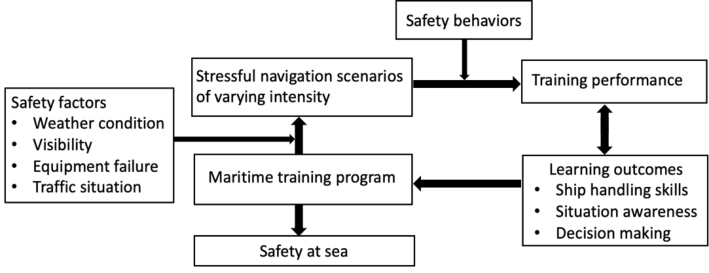
The aim of the present study is to assess the impact of safety factors on decision-making in maritime navigation. The study will focus on adding unsafety factors and stressful events during navigation tasks, as this is con- sidered critical for making correct decisions and associated risks are greater. The conception and design of the study can be found in Figure 1. “How do safety factors affect the decision-making of maritime students?” The secondary research question is “Which decision models can be applied to analyze the decisions made by maritime students?” The following section will present a comprehensive literature review of relevant studies pertaining to decision-making models in maritime navigation. This review will serve as the theoretical framework for the current study and provide a foundational understanding of the subject matter. Subsequently, the methodology used to conduct the experiment, the results obtained, and a thorough discussion of the findings will be presented. This will include an analysis of the impact of safety factors on decision-making in maritime navigation and an examination of navigators’ prioritization of safety participation and compliance based on their decision-making.
Figure 1: Conception and design of the present study.
DECISION-MAKING IN MARITIME NAVIGATION Decision-making in maritime navigation refers to the process of making real-time decisions based on constantly changing conditions in the maritime environment. This can include factors such as weather, sea state, traf- fic, and navigation hazards. In maritime navigation, assessing the state of the events, then taking appropriate actions and re-evaluating the results is required for ensuring the safe and efficient operation of vessels (Li et al., 2021). It requires the integration of data from multiple sources, inclu- ding radar, AIS, meteorological and oceanographic sensors, and the use of advanced navigation systems such as ECDIS (Electronic Chart Display and Information System) and AIS-SART (Automatic Identification System-Search and Rescue Transponder) (Conceição et al., 2018). It also requires the
The Impact of Safety Factors on Decision-Making in Maritime Navigation 753
ability to quickly assess and respond to new information, and to make decisions that balance safety, efficiency, and the mission objectives of the vessel.
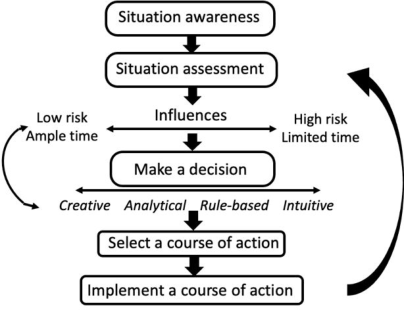
Decision-making models are used to understand how individuals make decisions in realistic settings (Knox Clarke and Campbell, 2020). Despite the absence of a unified decision theory, various models have been proposed by researchers in different contexts (Klein, 1993). In the maritime domain, seafarers are required to possess situational awareness. Depending on their assessment of risk, one or more methods of decision-making, such as rule- based, analytical, intuitive, and creative methods can be applied to their decisions. A simplified model of decision-making can be visualized in Figure 2 (Flin and O’Connor, 2017). The development of decision-making skills is par- ticularly crucial in the maritime industry, as seafarers may be operating under time constraints and stress. Consequently, training maritime students to enh- ance their decision-making abilities is crucial. The selection of appropriate decision-making methods is fundamental for making decisions. For insta- nce, rule-based decision-making relies on a set of predefined rules to guide decision-making, which can be used to make decisions swiftly and efficien- tly but may not be adaptable to new or unexpected situations (Norros and Hukki, 2003). For students with less experience, rule-based decision-making is a prioritized option. As their knowledge and experience increase, they can analyze the situation, search their memory store, and identify similar patterns to the current situation, subsequently making decisions based on such pat- terns. Therefore, it is essential to investigate the impact of safety factors on decision-making for improved training outcomes.
Figure 2: Simplified model of decision-making (Flin and O’Connor, 2017).
METHODOLOGY
The current study was designed to first two different stressful scenarios with a different number of stressful events in sailing in high latitude areas, and secondly to use it to assess the decision-making skills based on their per- formance. A total of 22 nautical science students (mean age = 22.36 years,
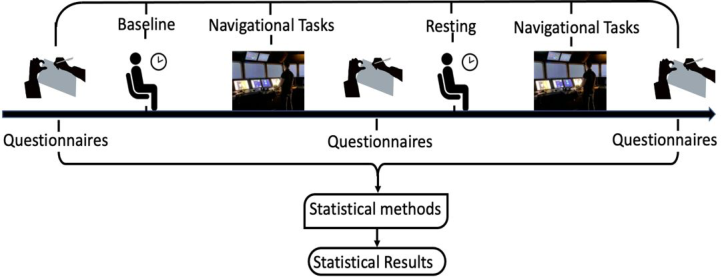
standard deviation = 2.38 years) participated in this experiment volunta- rily. The experiment is conducted on a full-mission ship bridge simulator. A couple of statistical tests have been used to assess the stress level from the NASA-TLX rating. NASA TLX rating includes six categories: Mental Demand, Physical Demand, Temporal Demand, Performance, Effort, and Frustration Level (Hart and Staveland, 1988; Sharek, 2011). The ratings are then converted to a ten-point scale score, with 0 representing low levels of workload and 10 representing high levels of workload. The experiment set up can be found in Figure 3.
Experiment Set Up In order to investigate the impact of safety factors in decision-making, two distinct levels of complexity were evaluated using a simulated environ- ment with no current, tidal stream, or wind. The control task scenario was conducted under fair weather conditions with six events, while the experi- mental task scenario was performed under snowy weather conditions with an additional four events compared to the control task scenario. The event design in the two scenarios is presented in Table 1. Other simulated vari- ables, such as location and traffic situation, were kept constant across the two trials. In order to control for the potential influence of the order of the scenarios on the results, participants were instructed to complete the navigation tasks twice during the experiment. They were randomly assi- gned to one of three groups: a control group (Group C), an experimental group 1 (Group E1), or an experimental group 2 (Group E2). The con- trol group (Group C) performed the easy navigation scenario twice, while the experimental groups (Group E1 and Group E2) completed either an easy scenario followed by a complex scenario or a complex scenario follo- wed by an easy scenario, respectively, with a 10-minute break between the two sections.
The experiment was conducted on three different simulator bridges, all of which were equipped with the K-sim Navigation software from Kongsberg Digital and featured a 240
and 360
view. Each simulator bridge was
Figure 3: Experiment set up. Two distinct stressful scenarios were sail by the participants. Three types of questionnaires were filled out during the experiment.
The Impact of Safety Factors on Decision-Making in Maritime Navigation 755
Table 1. Events design in the two scenarios. Note that F1 is steering pump failure, VHF is weather forecast VHF, F2 is echo sounder failure, T1 and T 2 are meeting a fishing vessel, F3 is gyro failure, F4 is GPS failure and T4 is meeting a tug. At 16 min, the snow is added intensively 100%, then change the snow intensive back to 50% at 18 min, and stop the snow after 18.5 min. After 20 min participants need to pass a narrow bridge. After 22 min, the visibility will be reduced by adding fog intensive100%.
Table available in the original PDF paper.
Time (min) 0.5 2 4 6.5 9 13 16-18.5 20 22 After 22 Event F1 VHF F2 T1 F3 T2 Snow Narrow bridge F4 Fog T4 Con. √ √ √ √ √ √
Exp. √ √ √ √ √ √ √ √ √ √
equipped with an independent instructor station, enabling the simultaneous execution of three exercises. The vessel model utilized in the study was the BULKC11 Hagland Saga, a small bulk carrier with a length between per- pendiculars of 85 meters, and was deemed appropriate for the tasks being evaluated. Additionally, all participants were familiar with the vessel model as a result of their prior navigational training. The designed sailing route is in the Sandnessundet area near Tromsø in the north of Norway and is about 14 kilometers long in narrow water with a sharp turn and passes under a tall, narrow bridge.
RESULT AND DISCUSSION
A couple of statistical tests have been used to assess the stress level from the NASA-TXL rating. The results of the Welch t-test show that the par- ticipants felt a significantly higher workload of doing the experiment task (29.3633 ± 8.0871) than doing the control task (19.9862 ± 8.5724) (t(29.945) = −3.5714, p = 0.0012) with a difference of 9.3771 (95% CI, −14.7398 to −4.0144). The effect size (Lakens, 2013) is large (ds = 1.1145). In addition, the Spearman rank correlation coefficient (Zar, 2014) was applied to test the association between performance and workload. The results showed that there was a significant moderate association betw- een how workload the participants rated, and the score of the parti- cipants got by the performance assessment. The Spearman correlation coefficient rs = −0.3171226, p-value = 0.03595. That is, the higher workload rated, the lower score in performance graded, and vice versa. The results are presented in Table 2. The findings indicate that there is a correlation between complexity scenario and their perceived stress levels.
Table 2. Welch t-test results of the NASA TLX rating.
Table available in the original PDF paper.
Groups Mean SD Welch Two Sample t-test 95% CI Effect size Cohen’s ds
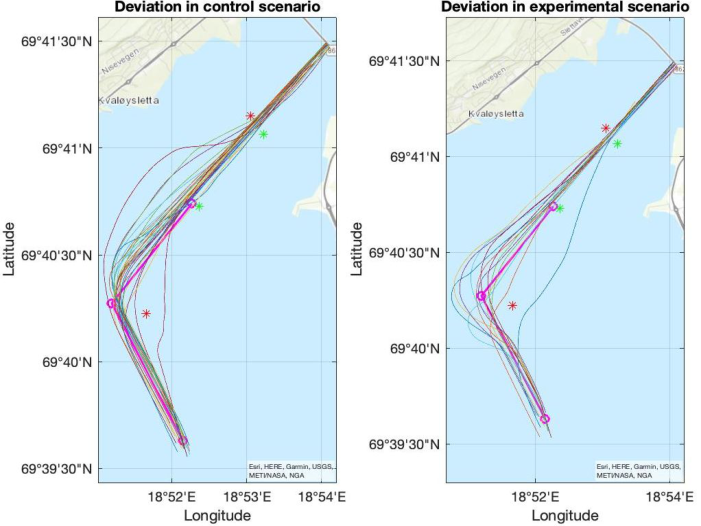
In addition to the statistical results of the perceived workload and stress levels, an examination of the deviation from the planned route is conducted for the assessment of performance and decision-making. The result, as illu- strated in Figure 4, indicates that the students are more focused on safety matters when the situation is complex. In the easy scenario, the students may find the situation easy to handle. All equipment is available and functional, the external factors, such as visibility, do not affect the situation, and the traffic scenario is uncomplex and easy to assess. Due to this, it is reasonable to believe that the students increase the margins for what they consider to be safe, for instance when it comes to acceptable deviation from the planned route. It is obvious that the students are able to detect and establish the devi- ation from the route in both scenarios, but in the easy scenario, they feel so comfortable in the situation that they allow themselves to deviate from the route and not implement measures to correct the situation immediately. In the complex scenario, the students are unsure about the situation and seek to correct the position as soon as possible. This is might be the reason that they consider the planned route the safest place to be, and they feel that they can use more of their available resources on other factors than positioning when they are on the planned route.
If the deviation from the planned route is assessed independent of the other factors in the scenarios, it can be argued that a given deviation represents
Figure 4: The deviation between the planned route and the sailed route is presented both in the control and experimental scenarios. Note that the result only presents the greatest deviation occurring between the point at which participants began turning and the point where they aimed to cross the narrow bridge.
The Impact of Safety Factors on Decision-Making in Maritime Navigation 757
the same risk in the two scenarios. The distance to other objects, land con- tours, and infrastructure will be the same. It is also clear that the planned route should be considered the safest position to be in, as this route has been assessed during the planning phase and found to be the desired option. From this, we can draw the conclusion that the decision not to immediately cor- rect the position when being aware of the deviation is more unsafe than the decision to implement measures of correction. There can, of course, be other relevant factors when making the decision, such as practical considerations. When applying these thoughts to the findings from the experiment, it beco- mes apparent that the students reduce the limit for acceptable risk when the complexity rises. This is natural for other factors, such as for instance speed. But increased speed represents an increased risk in all conditions and levels of complexity. The deviation from the route represents, in general, the same risk in both scenarios.
Regarding the decision-making models, it can be argued that the decision to deviate from the route in the easy scenario can be explained as a creative decision. The students are probably familiar with the situation and prioritize the task of sailing the ship to the designated ending station over the safety factor that deviation from the route represents. In the complex scenario, the situation is more difficult to assess for the students, and therefore the model of rule-based decision-making can be applied to the decision to not deviate from the route, as the general rule is that the planned route is the safest place to be.
The findings above imply that the students act safer in complex situations. They value safe decisions higher and decrease the acceptable safety margins. This can be for instance related to their lack of experience regarding such situations.
CONCLUSION AND FUTURE WORK This study shows that safety factors affect the decision-making of maritime students. In easy scenarios, the task to be accomplished seems to be the main focus for the students. In more complex scenarios, the safety factors seem to affect decision-making. Further, different decision models can be applied to the decisions made by the students under different levels of complexity. This can be used for the improvement of the teaching and education in mari- time simulator training. In future work, the obtained knowledge regarding decision-making under different levels of complexity should be used in the development of training scenarios in maritime simulator-based training.
ACKNOWLEDGMENT
The authors extend their thanks to instructors from the Nautical Science Group at UiT The Arctic University of Norway for their support; and to all the participants for their time and approval for the use of the data in this study.
REFERENCES
Conceição, V. et al. (2018) ‘Visualization in Maritime Navigation: A Critical Review’, in N. A. Stanton (ed.) Advances in Human Aspects of Transportation. Cham: Springer International Publishing (Advances in Intelligent Systems and Compu- ting), pp. 199–212. Available at: https://doi.org/10.1007/978-3-319-60441-1_ 20. Flin, R. and O’Connor, P. (2017) ‘Chapter 3 Decision-Making’, in Safety at the Sharp
End: A Guide to Non-Technical Skills. London: CRC Press. Available at: https: //doi.org/10.1201/9781315607467. Hart, S. G. and Staveland, L. E. (1988) ‘Development of NASA-TLX (Task Load Index): Results of Empirical and Theoretical Research’, in P. A. Hancock and N. Meshkati (eds) Advances in Psychology. North-Holland (Human Mental Workload), pp. 139–183. Available at: https://doi.org/10.1016/S0166- 4115(08)62386-9. Inoue, K. (2000) ‘Evaluation Method of Ship-handling Difficulty for Navigation in
Restricted and Congested Waterways’, Journal of Navigation, 53(1), pp. 167–180. Available at: https://doi.org/10.1017/S0373463399008541. Klein, G. A. (1993) ‘A recognition-primed decision (RPD) model of rapid decision making’, in Decision making in action: Models and methods. Westport, CT, US: Ablex Publishing, pp. 138–147. Knox Clarke, P. and Campbell, L. (2020) ‘Decision-making at the sharp end: a
survey of literature related to decision-making in humanitarian contexts’, Jour- nal of International Humanitarian Action, 5(1), p. 2. Available at: https://doi.org/ 10.1186/s41018-020-00068-2. Lakens, D. (2013) ‘Calculating and reporting effect sizes to facilitate cumulative science: a practical primer for t-tests and ANOVAs’, Frontiers in Psychology, 4. Available at: https://www.frontiersin.org/articles/10.3389/fpsyg.2013.00863 (Accessed: 26 January 2023). Li, M. et al. (2021) ‘Comparison between the collision avoidance decision-making in
theoretical research and navigation practices’, Ocean Engineering, 228, p. 108881. Available at: https://doi.org/10.1016/j.oceaneng.2021.108881. Norros, L. and Hukki, K. (2003) ‘Utilization of information technology in navigational decision-making.’, in Co-operative Process Management: Cognition And Information Technology. CRC Press, pp. 77–88. Oh, J., Park, S. and Kwon, O.-S. (2016) ‘Advanced Navigation Aids System based
on Augmented Reality’, International Journal of e-Navigation and Maritime Eco- nomy, 5, pp. 21–31. Available at: https://doi.org/10.1016/j.enavi.2016.12.002. Sharek, D. (2011) ‘A Useable, Online NASA-TLX Tool’, Proceedings of the Human Factors and Ergonomics Society Annual Meeting, 55(1), pp. 1375–1379. Availa- ble at: https://doi.org/10.1177/1071181311551286. Xiufeng, Z. et al. (2005) ‘Simulating test of ship navigation safety evaluation using
ship handling simulator’, in Proceedings of OCEANS 2005 MTS/IEEE. Procee- dings of OCEANS 2005 MTS/IEEE, pp. 1902–1905 Vol. 2. Available at: https: //doi.org/10.1109/OCEANS.2005.1640037. Zar, J. H. (2014) ‘Spearman Rank Correlation: Overview’, in Wiley StatsRef: Statistics Reference Online. John Wiley & Sons, Ltd. Available at: https://doi.org/10. 1002/9781118445112.stat05964.
LISTED IN THE AHFE DIGITAL BOOKSTORE CATALOGUE
Explore the complete digital volume
Human Factors in Transportation
Read this individual research paper free through the original publisher, or explore the full digital proceedings book.
ISBN 978-1-958651-71-1
Explore this ISBN in the AHFE Bookstore ↗Listed in the July 2026 bookstore catalogue; search by ISBN to confirm current availability · Digital book purchase optional