Luca Dolgow, Alban Hajzeri, Gregor Henn, Sandra Luther, Bjarne Meyer-clasen, Franziska Sauter, Isabel Schlecker, Rainer Nägele, Anne Sophie Tombeil, Anja Braun, Daniel Palm, Peter Ohlhausen (2024). Governance of interconnected value creation systems: rules of engagement for effective cooperation among companies in a competitive context. In: The Human Side of Service Engineering. AHFE Open Access, vol. 143, pp. 57–62. https://doi.org/10.54941/ahfe1005083
In the context of the digital transformation of the 21st century, this paper explores the evolution from traditional, hierarchically organized value chains to dynamic, networked multi-actor constellations. The focus is on identifying and analyzing suitable governance mechanisms that are crucial for the success of both individual partners and the value creation system as a whole. Through a combination of comprehensive literature research and qualitative interviews with various leading experts from business, science, and politics the relationships between value creation, networking, and governance were analyzed as part of this study. This emphasizes the importance of transparency, motivation, and trust in these networked systems and discusses the use of technology to ensure effective governance. Technologies can be used to create data security through the traceability and immutability of data. The literature shows that there are no universal solutions, but that individual, situation-specific approaches are required that combine legal expertise and the use of technology. The results of the study indicate that customers are increasingly becoming integral parts of networked value creation systems, with data protection, laws and guidelines, exit plans, exploitation rights, and the challenges of international contract negotiations playing key roles. The work provides important insights into the need for continuous adaptability to constantly changing framework conditions.
Due to the globalization and liberalization of markets as well as the digitaliza- tion of all political, social, and economic life, the understanding of the terms value creation, networking, and governance is subject to constant change. As a result, these terms are interlinked and closely related (Hommelhoff, 2001, p. 238 ff.). This is accompanied by the realization that companies can create value more successfully through cooperation, which they would not be able
to do on their own. The further development and intensification of this coop- eration can lead to collaborations that are based voluntarily (Expert 1, 2023). Consequently, the development is moving away from straightforward, hier- archical structures towards networked value creation systems in which the players meet as equals (Expert 2, 2023). Through a combination of com- prehensive literature research and qualitative interviews with various leading experts from business, science, and politics, the relationships between value creation, networking, and governance are analyzed and rules for collabora- tion in networked value creation systems are developed. Among other things, the basic research emphasizes the importance of transparency, motivation, and trust in these networked systems and discusses the use of technologies to ensure effective governance (Expert 2, 2023).
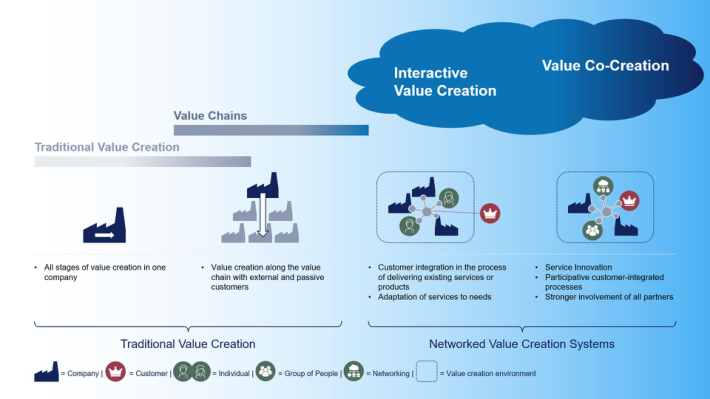
NETWORKED VALUE CREATION Today, value creation no longer takes place exclusively in a linear fash- ion within traditional value chains. The digital transformation is changing the way companies create value. Traditional, hierarchical value chains are increasingly being transformed into dynamic, networked multi-actor sys- tems. This is also changing the role of the customer, who is increasingly being integrated as an active partner in value-creation systems. This devel- opment is shown in Figure 1 (Gupta et al., 2021, p. 386 ff.; Piller et al., 2017, p. 110 ff.; Wulf et al., 2015, p. 111 ff.; Nenonen & Storbacka, 2010, p. 43 ff.; Payne et al., 2007, p. 84 ff.).
Figure 1: Value creation in transition, source: own illustration.
GOVERNANCE OF NETWORKED VALUE CREATION New forms of governance are required as a result of further development towards networked value creation systems (Benz et al., 2007, p. 94 ff.). This is the only way to ensure successful cooperation in networked value- creation systems. The forms of governance (market, hierarchy and network)
Governance of Interconnected Value Creation Systems 59
are subject to change and require a symbiosis of the respective governance mechanisms as the basis for functioning governance. According to previous findings, governance continues to be dominated by regulation based on the hierarchical principle, although this is being extensively modified by new approaches. The further development towards collaboration between com- panies is becoming increasingly important and enables the achievement of a common goal through mutual interaction at eye level. Suitable governance mechanisms such as prices, directives, trust, and negotiations as well as other corresponding regulatory framework are crucial for this (Expert 1, 2023; Benz et al., 2007, p. 94 ff.; Hess et al., 2007, p. 80).
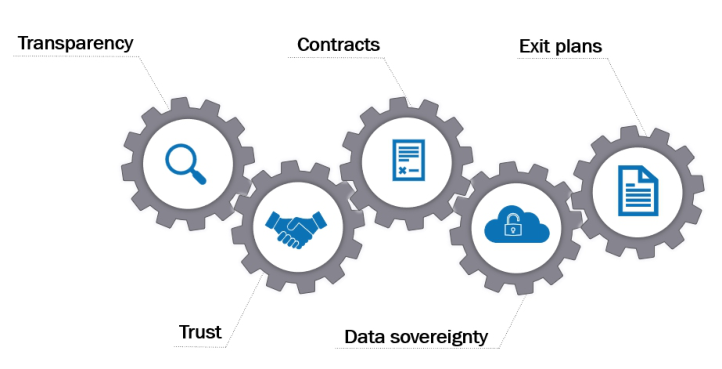
REGULATORY FRAMEWORK AND FIELDS OF ACTION This chapter takes a closer look at the regulatory framework, that is needed for successful collaboration despite simultaneous competition. One partic- ular challenge is that, on the one hand, successful cooperation is linked to the openness of the companies involved. On the other hand, the existing competitive relationship entails a certain degree of restraint. The regulatory framework that are relevant to the governance of networked value-creation systems are outlined below.
Transparency The actors aspire and necessitate collaboratively solving complex problems. To effectively work together on these issues, a transparent, intensive, and detailed exchange of knowledge is imperative. Only when the necessary level of detail in exchanged knowledge and the appropriate degree of transparency are achieved for solving the problem, can collaboration generate added value that the actors could not have achieved individually (Expert 2, 2023).
Trust For successful collaboration, a certain level of trust must exist. This forms the foundational element for being transparent or engaging in transparency at all. However, involved actors must not exploit acquired information for personal purposes (Expert 2, 2023).
Contracts In tension with the rules mentioned above (trust and transparency) are the necessary and always present contracts. These constitute the contractual framework in interconnected value-creation systems. Additionally, legal pro- visions must be considered, which the network participants must adhere to. Notably, antitrust law, competition law, and the law on the protection of trade secrets are mentioned here. This demonstrates that trust and trans- parency cannot be implemented without limits but are rather constrained by contractual and legal regulations. This prevents unilateral misuse of infor- mation. For example, contractual penalties could be conceivable in contracts for violations of confidentiality agreements (Expert 3, 2023; Expert 4, 2023; Government Commission on the German Corporate Governance Code, n.d.).
Data Sovereignty To gain the trust of the involved actors, clear regulations regarding data sovereignty must be established in the digital world. This means that each actor must be aware of which data they are allowed to collect, store, and pro- cess. Only in this way can trust and transparency be built. An advancement and support in this context would be the use of blockchain technology. The advantage lies in the encrypted storage of data, ensuring high data security (Fill & Meier, 2020; Taylor et al., 2020, p. 147 ff.).
Exit Plans In principle, it is assumed that the involved actors initially expect successful cooperation and consider the worst-case scenario (failure of cooperation) as unlikely. Nevertheless, the parties should know what happens if the cooper- ation is terminated unilaterally or prematurely due to a mutual decision. To avoid later disputes, contractual agreements must be made. These should be negotiated and agreed upon in advance through an open exchange (Expert 5, 2023).
Figure 2: Overview of the regulatory framework and fields of action, source: own illustration.
From this regulatory framework, it is possible to derive fields of action that should be considered more closely in the future. On the one hand, the creation of balanced structures is of crucial importance, but the topics of digi- talization and sustainability must also be addressed in the future. These fields of action include opportunities and challenges that arise in the collaboration of networked value creation systems (European Commission, 2023; Expert 5, 2023; Hinckeldeyn, 2019, p. 46 ff.). In summary, effective governance in networked value creation systems is established when the involved parties have established guidelines through contractual regulations. Transparency and trust prevail within these guide- lines. The partners are protected by the fact that abuse is sanctioned. Based
Governance of Interconnected Value Creation Systems 61
on this foundation, successful collaborations can also be entered into in a competitive environment.
SUMMARY AND CONCLUSION In the future, cross-company and international cooperation will become increasingly important, which will require continuous adaptation and opti- mization of value creation processes. If cooperation and thus the integration of resources and knowledge is successful, values can be created together that none of the players could realize alone. The challenge lies in the fact that, on the one hand, successful cooperation requires openness on the part of the companies involved, while on the other hand, the existing competitive rela- tionship entails restraint. This dilemma can be avoided through functioning governance. The prerequisite for this is that the parties involved can create value together in a trusting and transparent environment. Contractual regu- lations can act as guidelines to support this. As this is basic research on this topic, the areas of action identified for the creation of balanced structures, digitalization, and sustainability must be subjected to further research in the future in order to highlight the opportunities and challenges in more detail.
OUTLOOK The examination of the following unresolved questions can function as guid- ing principles for future research, proving essential in thoroughly addressing the subject.
These include, among others:
How are decisions made within established value creation systems regard- ing the fate of assets after dissolution, particularly concerning the distri- bution of value-added shares and usage rights? To what extent are the proportions of the involved parties considered in these decision-making processes? (Field of Action: Creation of Balanced Structures)
Who exercises control over data in interconnected value-creation systems? (Field of Action: Digitalization)
What measures could be taken to develop data protection solutions in the context of new technology? (Field of Action: Digitalization)
How can companies implement concrete measures to establish improved rules and promote a sustainable, low-carbon economy? (Field of Action: Sustainability)
How can clearly defined formal governance rules, ensuring data trans- parency, building trust, and individually shaping contract negotiations be implemented to ensure successful sustainable collaboration? (Field of Action: Sustainability).
In conclusion, the escalating significance of governance in networked value creation for the future underscores the imperative need for further research. The exploration of the abovementioned unresolved questions serves as a pivotal foundation for guiding future research endeavors, proving indispens- able for a comprehensive understanding of the subject. The identified fields
of action, ranging from the creation of balanced structures to digitaliza- tion and sustainability, highlight key areas where nuanced investigations can significantly contribute to advancing knowledge in this critical domain.
REFERENCES
Benz, A., Lütz, S., Schimank, U. & Simonis, G. (2007). Handbuch Governance: Theoretische Grundlagen und empirische Anwendungsfelder. In VS Verlag für Sozialwissenschaften eBooks. https://doi.org/10.1007/978-3-531-90407-8 European Commission. (2023, 29. September). European Commission - European
Commission. https://ec.europa.eu/commission/presscorner/detail/en/ip_23_4685 Expert 1 (2023, 29 November). Interview - Governance of networked value creation. Expert 2 (2023, 30 November). Interview - Governance of networked value creation. Expert 3 (2023, 6 December). Interview - Governance of networked value creation. Expert 4 (2023, 13 December). Interview - Governance of networked value creation. Expert 5 (2023, 6 December). Interview - Governance of networked value creation. Fill, H. & Meier, A. (2020). Blockchain: Grundlagen, Anwendungsszenarien und Nutzungspotenziale. Springer-Verlag. Gupta, S., Zhou, J., Feng, S. & Nyadzayo, M. W. (2021). The effect of equity on value
co-creation in business relationships. Journal of Business & Industrial Marketing, 37(2), 385–401. https://doi.org/10.1108/jbim-10-2020-0468 Hess, R. L., Ganesan, S. & Klein, N. M. (2007). Interactional Service Failures in a pseudorelationship: the role of organizational attributions. Journal of Retailing, 83(1), 79–95. https://doi.org/10.1016/j.jretai.2006.10.010 Hinckeldeyn, J. (2019). Blockchain-Technologie in der Supply Chain. In Essentials.
https://doi.org/10.1007/978-3-658-26440-6 Hommelhoff, P. (2001). Die OECD-Principles on Corporate Governance - Ihre Chancen und Risiken aus dem Blickwinkel der deutschen Corporate Governance- Bewegung. Zeitschrift für Unternehmens- und Gesellschaftsrecht. https://doi.org/ 10.1515/zgre.2001.003 Nenonen, S. & Storbacka, K. (2010). Business model design: Conceptualizing net-
worked value co-creation. International Journal of Quality and Service Sciences, 2(1), 43–59. https://doi.org/10.1108/17566691011026595 Payne, A., Storbacka, K. & Frow, P. (2007). Managing the co-creation of value.
Journal of the Academy of Marketing Science, 36(1), 83–96. https://doi.org/10. 1007/s11747-007-0070-0 Piller, F., Möslein, K., Ihl, C. & Reichwald, R. (2017). Interaktive Wertschöpfung Kompakt: Open Innovation, Individualisierung und neue Formen der Arbeit- steilung. Springer Gabler. Regierungskommission Deutscher Corporate Governance Kodex. (o. D.). Präambel–DCGK - Deutsch. https://www.dcgk.de/de/kodex/aktuelle-fassun g/praeambel.html Taylor, P. J., Dargahi, T., Dehghantanha, A., Parizi, R. M. & Choo, K. R. (2020). A
Systematic Literature Review of Blockchain Cyber Security. Digital Communica- tions and Networks, 6(2), 147–156. https://doi.org/10.1016/j.dcan.2019.01.005
LISTED IN THE AHFE DIGITAL BOOKSTORE CATALOGUE
Explore the complete digital volume
The Human Side of Service Engineering
Read this individual research paper free through the original publisher, or explore the full digital proceedings book.
ISBN 978-1-964867-19-9
Explore this ISBN in the AHFE Bookstore ↗Listed in the July 2026 bookstore catalogue; search by ISBN to confirm current availability · Digital book purchase optional