Nada Ruzicic, Anja Braun, Peter Ohlhausen (2024). Interdependency Matrix to Evaluate Influence Factors in Circular Value Creation Systems. In: Human Aspects of Advanced Manufacturing, Production Management and Process Control. AHFE Open Access, vol. 146, pp. 68–78. https://doi.org/10.54941/ahfe1005152
The circular economy is one of the emerging trends in value creation systems, which emphasises the efficient use of resources, minimising waste and the loss of value added as well as replacing the concept of “end of life” for products and services in value creation systems. Since many of products and complementary services available on the market are not designed for circularity, it is challenging to convert the linear product life to a circular life cycle. However, conceptualise value creation systems that are suitable for a circular economy is a challenge, as a large number of influence factors are interrelated. Thereby not all influence factors reinforce each other, but can also have no or even a negative influence. Thus, in order to make the mutual influence transparent and create a holistic understanding of how the circularity can be implemented in value creation systems, this paper proposes an interdependency matrix which is enhancing the decision-making in the conception of circular value creation systems. The research design follows the mixed method approach. First, a literature review is carried out to review the state of the art. The research is extended by structuring relevant influence factors in the design of circular value creation. The findings from the literature research are supplemented by expert knowledge from industry and research. Finally, the findings are then incorporated into the development of the interdependency matrix. The assessment of the correlations between the individual influence factors is based on unique morphologies. A case study serves as a reference and framework for the application of the developed interdependency matrix. In order to validate and further develop the interdependency matrix, a verification process is carried out by creating application examples for the developed case study. The application examples serve as practical instances to test the applicability and resilience of the interdependency matrix. The proposed interdependency matrix shows which influence factors have correlations to each other – a distinction is made between whether the influence has a positive or negative effect. It also shows which influence factors are to be considered independently and for which influence factors a statement about their correlation is only possible depending on the specific situation in the value creation system. The core of this study is the determination and evaluation of the correlations, which the influence factors of a circular value creation system exhibit. The developed interdependency matrix aims to ensure that decision-makers in value creation systems are increasingly able to make decisions that promote a circular value creation in future. However, therefore it is insufficient to consider only individual influence factors or measures without their correlations. The approach serves to take a holistic view of a circular value creation system and is intended to help accelerate the transformation towards a circular economy.
Interdependency Matrix to Evaluate Influence Factors in Circular Value Creation Systems 69
INTRODUCTION
Industry 5.0 includes technologies of the previous, Circular Economy (CE)- enabling, human-centric industrial revolution and is characterised by the aim of sustainability for a resilient economy (European Comission, 2023). The components of the earth system that are relevant to the overall state of the earth are represented by nine boundaries. Six out of nine planetary bound- aries for safe behaviour and economic activity on earth have been exceeded (Richardson et al., 2023). This is due to human activity (Richardson et al., 2023). The transformation towards more sustainability requires a stronger focus on production systems, collaborative relationships, and green logistics (Bag et al., 2021). The circular economy is seen as a solution for climate change and resource scarcity.
Due to the dependencies that the circular economy entails, the implementa- tion of circular processes in existing value creation structures poses a complex challenge (Saidani et al., 2017; Kirchherr et al., 2017).
The transformation to circular value creation systems is a challenge because many products are not circular and different influence factors have to be considered towards a circular economy. The influence factors are also interrelated. Therefore, this paper addresses the research gap of influence fac- tors for circular economy by developing an approach to the solution with an interdependency matrix.
The results do not claim to be complete. The interdependency matrix is being continuously optimised and further developed. It serves as a first application for other researchers and users.
RESEARCH DESIGN The presented research design follows a mixed methods approach (Schoonenboom and Johnson, 2017). To present the state of the art, a litera- ture review was carried out. ScienceDirect was mainly used for the research. Additionally scientific papers were searched with Google Scholar. The focus of the research was initially on existing metrics and evaluation tools for analysing the circularity of companies and was then expanded to include the analysis of other circularity indicators and requirements. The research was extended by structuring relevant influence factors in the design of circular value creation. The findings from the literature research are supplemented by expert knowledge from industry and research. Most of the interviewed experts are partners of the network of the project cyclometric. The interviews were based on the first draft of the interdependency matrix and an addi- tional overview connecting factors and indicators for the interdependency analysis. Finally, the findings are incorporated into the development of the interdependency matrix.
The relationships between the individual influence factors are evaluated based on unique morphologies. A case study serves as a reference and framework for the application of the developed interdependency matrix.
To validate and further develop the interdependency matrix, a verifica- tion process is executed by generating application examples for the developed
case study. The application examples serve as practical instances to test the applicability and resilience of the interdependency matrix.
STATE OF THE ART AND SCIENCE This work follows the definition of circular economy by Kirchherr et al., (2023). Considering the circular value creation this work refers to the Cradle- to-cradle concept by McDonough and Braungart (2002). “The circular econ- omy is a regenerative economic system […] with the aim to promote value maintenance and sustainable development, creating environmental quality, economic development, and social equity, to the benefit of current and future generations. […]” (Kirchherr et al., 2023).
Furthermore, this work is based on the nine strategies promoting a circular economy (R-Strategies) defined by Potting et al. (2017). The strategies define the differences and impact considering the handling of a product applying e.g., remanufacturing, repair, or reuse, and therefore are known as “R- Strategies”. Referring to Potting et al. (2017) “R-” is used in this paper to summarise the nine strategies for circular economy.
Circular production and logistics require a different structure and more intensive interaction with suppliers as well as with customers (Schmitt et al., 2021). Production planning should consider aspects of additional space, time, and process steps for returning products and materials, their analy- sis, and their reintegration into the value-creating processes (Schmitt et al., 2021). The necessary infrastructure and regulated markets are lacking for the broad application of reuse and remanufacturing (Kara et al., 2022). Circu- lar manufacturing is one of the most important factors in achieving higher productivity and reducing waste and pollution (Nascimento et al., 2019). Existing methods and tools provide an initial insight into the circularity of products. However, the circular economy is far from being taken into account in its full complexity (Saidani et al., 2017). The combination of methods can also help to analyse the relationships and resolve potential conflicts between sustainability or a circular economy and the principles of waste management. In addition, various tools can be used to identify risks, understand conflicting goals, and avoid unintended externalities (Meidl, 2021).
To target the complexity of interdependencies of circular economy related factors the research question is: How can the interdependencies of the influence factors for circular value creation systems be evaluated?
DEVELOPMENT OF THE CIRCULAR VALUE CREATION INFLUENCE FACTORS INTERDEPENDENCY MATRIX There is a high complexity considering circular economy assessments on the level of various existing metrics (Saidani et al., 2017). The metrics serve differ- ent levels. For example, percentages of air pollution in a certain process can be measured. It is noted that many existing metrics and indicators often also refer to effects on entire companies (production, offices, etc.), countries or regions, or even the whole earth (OECD 2020). Other indicators and metrics refer to specific materials and scenarios, but not to the production in a general
Interdependency Matrix to Evaluate Influence Factors in Circular Value Creation Systems 71
and holistic perspective. When assessing production metrics, a comprehen- sive understanding of process structures, materials composition in products, and transportation methodologies is essential. This knowledge becomes par- ticularly crucial when conducting a Life Cycle Assessment (LCA) utilising either real or standard values. This information is often not fully available for example in the planning phase of a production.
To improve better comparability and streamline applicability, this paper predominantly addresses influence factors at the production level. Con- sequently, it adopts a value creation- and production-centric perspective, distinguishing it from existing research in the field of circular economy assessments. The resulting interdependency matrix also provides further information in the supplement for the microlevel of the metrics and indi- cators. The user is also may to further expand the interdependency matrix as an evaluation scheme according to their requirements and real scenarios and with the company’s data.
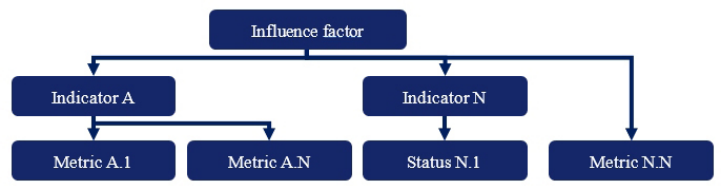
The following (see Figure 1) shows the relation between factors and indica- tors. Factors represent a higher level of consideration. Factors may represent requirements, relevant aspects, etc. for a circular value creation system. One factor may include one or more indicators and metrics. The indicator gives a qualitative or quantitative value showing the state of a defined aspect. This may happen with metrics (numerical) or with a status (something is the case or not). Occasionally a metric is not part of an indicator but is directly allocated to a factor, evaluating it.
Figure 1: Visualisation of the relationship between factors, indicators, and metrics.
Metrics were not further considered in the interdependency matrix, because their level would create too much complexity for the current state of the work. For metrics, space is given in the section for indicators in a sec- ond table connected to the interdependency matrix. Several indicators can be assigned to one influence factor. For example, there can be different indica- tors measuring the energy consumption at different stages of a production system. Institutions or further research can add metrics or qualitative indica- tors to the influence factors. This micro level of the aspects is currently filled with some examples and can be further expanded by following research work.
The influence factors are structured in categories and subcategories refer- ring to the design of a circular value creation system (see Table 1). This gives the user a better orientation and helps to differentiate similar influence fac- tors due to their reference frame. The categories are adapted from Saidani
et al. (2019), Aranda et al. (2019), and the OECD report on circular economy in cities and regions (OECD, 2020) and adjusted to circular value creation systems. The influence factors are grouped into categories as follows: prod- uct design, business model and corporate strategy, material flow, production, and reprocessing. “Material flow” and “reprocessing” are parts of a circu- lar production system. To highlight those categories and the differences they include compared to linear production systems “reprocessing” and “mate- rial flow” are represented as extra categories. The category topics are further subdivided into subcategories. The subdivision is also done by topics such as “production waste” or “production emissions” in the category group of “production”.
Table 1. Influence factors for circular value creation systems ordered by categories and subcategories.
Table available in the original PDF paper.
Category Subcategory Influence factors Product design Material-specific properties Emissions caused by material, toxicity, renewable raw material, wear qualities of the material, R-promoting reprocessing trait Design-specific processing and repairability
Utilisation Product life span
Modularity of the product, wear qualities of the product (amount wear parts, design-specific abrasion, etc.), R-strategy friendly joining techniques, reusability of components, repairability Business model and corporate strategy
Recirculation of water, material, and energy (heat)
Return system Accessibility to return system, reward system for return system Costs Margin per R-step Material flow Material Circularity of the material flow Production Energy in processes Process energy, energy in support processes Energy in transports Upstream transports, downstream transports, energy consumption of reverse logistics transports Heat energy Utilised waste heat (process input), reutilised waste heat (process output) Production waste Material waste (packaging, drill cuttings), faulty materials and goods Production emissions Air pollution, water pollution, soil pollution, process emissions Possibility of recirculation (reprocessing) Costs Work in process (WIP) costs, material costs, cost savings through the use of secondary material Reprocessing R-strategy reprocessing Percentage of reprocessed material Reprocessing emissions Reprocessing costs
Interdependency Matrix to Evaluate Influence Factors in Circular Value Creation Systems 73
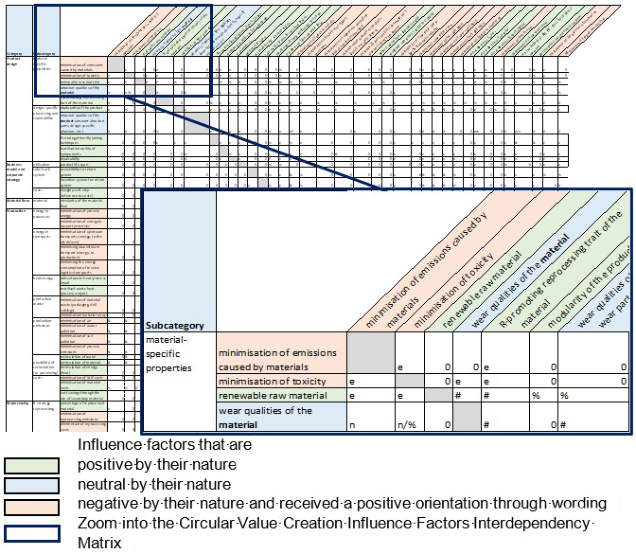
The influence factors might be positive, negative, or neutral by their nature. For example, influence factors involving emissions are considered negative for a circular development. Influence factors like “modularity” or “renew- able raw material” are considered positive. In the case of the “margin for R-processed”, it depends on the value of whether the influence factor can be seen as positive or negative. To make the influence factors more comparable and the interdependency matrix clearer and more understandable, the influ- ence factors in the interdependency matrix are formulated to a supporting effect for the circular economy. As an example of the positive wording, the term “material waste” became the term “reduction of material waste”. If the wording implicates a reduction the background of the labelling in the interde- pendency matrix is red. It is green when the influence factors themselves are positive for the development of a circular value creation system and therefore a rise of the factor is implied. Blue represents impact factors that are neutral and get their positive or negative tendency from the situation and structure known of a certain value creation system (see Figure 2). An example of a neu- tral influence factor is the “wear properties”. Wear properties can be good in terms of the circular economy if the abraded material is a sustainable raw material. Alternatively, a positive evaluation can be made if the abraded com- ponent serves to protect another component. It must be evaluated negatively if the wear is not intended by product design or the material is made of toxic material and the abrasion causes environmental pollution.
Figure 2: Structure of the circular value creation influence factors interdependency matrix with zoom.
The interdependency matrix is a multi-layer, two-dimensional matrix. The influence factors are listed vertically and horizontally. The interdependency matrix is currently displayed in an Excel spreadsheet and for better visu- alisation split into two parts for the moment. Other spreadsheets show a comparison with the factors and associated indicators and metrics. The inter- faces and parallels to companies and research institutions are noted on a second worksheet of the same document.
To avoid misinterpretation, explanations of the symbols used in the inter- dependency matrix for the dependencies of the influence factors are also noted in the document. It is planned to transfer the results into a software tool as part of the Cyclometric project.
Figure 2 shows a zoomed section of the matrix. The interdependency matrix is read from left to top. The symbols represent the interdependencies as follows:
e: The influence factor has a reinforcing, increasing effect on the other influence factor.
0: Neutral – influence factor has no influence, no connection to the influence factor.
n: The influence factor has a reducing, softening effect to the other influence factor.
%: It may or may not have an influence (case-specific); whether it has an influence depends on the processes, the product, and the framework conditions.
&: It has an indirect effect (via other factors or aspects); one influence factor (row) does not have a direct influence on the second influence factor (column), but by certain constraints (it does not have to be the influence factors mentioned), as these constraints, in turn, create an indirect relation to the second factor.
#: It can have a reinforcing or reducing effect (system/process-dependent); it is clear that the first influence factor affects the second factor, but whether it increases or decreases it or whether the influence is positive or negative depends on the framework conditions/processes/materials, etc.
FINDINGS The resulting matrix is not symmetrical. This means if an influence factor A has a certain effect on influence factor B, it does not imply the same kind of dependency vice versa. For example, renewable material used can impact the toxicity, but the toxicity does not impact the material. At the same time, it cannot be ruled out that two factors influence each other in the same way. The results show which influence actors are particularly dependent and which are not. There are also different types of dependency. Influence factors may have a clearly positive (increasing), clearly negative (decreasing), or situation- dependent positive or negative influence on each other. There are also factors where the structures of the company, processes, or product designs will decide whether the factors are interdependent or not. In some cases, it might be situation-dependent in general whether a factor influences another or not.
Interdependency Matrix to Evaluate Influence Factors in Circular Value Creation Systems 75
The research demonstrates that influence factors can influence each other indirectly. Factor A will affect state B and the manifestation of this state will affect factor C Five types of influences are included in the interdependency matrix.
There is no grading as to whether the influence is strong or light. It proved difficult to determine this categorisation. Here, guidelines could be defined for a selected company if the interdependency matrix is applied in practice.
The research results showed that “investment costs” and “personnel costs”, and the category of personnel with “circular economy know how” and “circular economy culture”are relevant to consider, but would distort the assessment of circular production and business, and therefore were excluded in the interdependency matrix. The main problem investment costs create is usually having a big value in the beginning, when for example buying new machines. Later the investment pays off in the reduction of resources needed and less pollution, which sometimes can’t be captured properly. In addition, calculations often do not or can’t consider the costs needed to clean nature from pollution, because it is difficult to tell what polluting material belongs to which source.
The expert interviews showed that there are many parallels to LCA in terms of required input information. Examples are volumes of emissions and information about process steps to be able to proceed with a good assessment.
The resulting interdependency matrix shows that influence factors of the categories “Design” and “Business Model and corporate strategy” are strongly affecting the “material flow”, “production”, and “reprocessing” influence factors. Also, the “reprocessing”influence factors are strongly con- nected to the influence factors of the category “Business model and corporate strategy”.
The development of the influence matrix showed the complexity of the factors that need to be taken into account when switching to circular value creation systems. It is often impossible to clearly predict whether a change in the value of one influence factor will have a positive or negative effect on another influence factor or the entire value creation system.
VALIDATION IN THE LEARNING FACTORY WERK150 BASED ON USE CASE In order to validate and further develop the interdependency matrix, a ver- ification process is carried out by creating application examples for a case study. The use case is developed with the help of morphological analysis and based on the products and infrastructure of the learning factory “Werk150” at the campus of Reutlingen University.
A learning factory is a learning environment that is authentically designed through processes, comprises several stations, and includes both organisa- tional and technical aspects. In addition, the structure within the environment is changeable and a real value chain should ideally be modelled (Abele et al., 2017). The developed use case serves as application examples to test the applica- bility and resilience of the interdependency matrix and are noted alongside
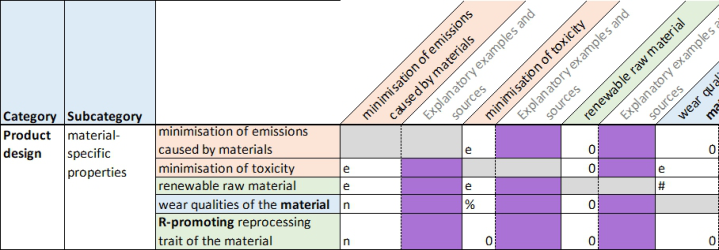
the assessments in the interdependency matrix. The application examples are noted on the right side next to the estimation symbols in the matrix as schematically highlighted in purple in Figure 4.
Figure 3: Zoom into the circular value creation influence factors interdependency matrix showing schematically the space for the examples of verification.
The validation showed that the interdependency matrix is easy to under- stand and use. The interdependency matrix could be applied well to the case study and offers a good level of discussion and various possibilities were noted in the column for examples. This makes it easy to understand why a particular estimation was made.
CONCLUSION AND FURTHER RESEARCH The research shows that the interdependencies between influence factors for circular value creation systems can be illustrated well using an interdepen- dency matrix. The matrix is suitable for mapping correlations of influence factors to the transformation towards a circular value creation system. The interdependency matrix represents a new contribution to science by com- paring different influence factors for circular value creation systems on a production-centric perspective. The matrix shows which factors are inter- dependent and in what way, as described earlier in this paper. In practice companies can then take measures towards a circular economy based on an assessment using the interdependency matrix. Estimations depend on the specific situation and structure of a company, its production, products, and services. The interdependency matrix, therefore, offers in addition to explicit estimations such as “has an effect” or “does not have an effect”, also “can, but does not necessarily have to have an effect”. The developed interdepen- dency matrix does not claim to be complete. Limitations result from the literature used and time constraints. Furthermore, research is needed to vali- date the matrix, to assign more indicators and examples. The results will also be translated into a decision support software tool to support engineers in the early stages of product development. Examples are expanded and assessments are further evaluated. The table is optimised and expanded according to the findings. The table should be continuously adapted, as the framework cir- cumstances and global impacts are also constantly changing. Further research
Interdependency Matrix to Evaluate Influence Factors in Circular Value Creation Systems 77
is required to further analyse the quantification. By applying it to a specific company, the interdependency matrix can be filled with real data and values and adapted to evaluate planned and existing products and services and their value creation systems. The matrix can support companies in strategic and alternative decisions, in setting up or changing to circular production, and in adapting products and services to the circular economy. By presenting the interrelationships, potential optimisations that lead to negative consequences in the overall concept can be avoided. Measures can also be better prioritised, as users can identify which influence factors have the greatest impact.
ACKNOWLEDGMENT
The authors would like to acknowledge the Federal Ministry of Educa- tion and Research (BMBF) sponsors the research project “Cyclometric” (02J21E030 ff.) which contributed to the results of this work.
ElMaraghy, Hoda. Seliger, Günther. Sivard, Gunilla. ElMaraghy, Waguih. Hum- mel, Vera. Tisch, Michael and Seifermann, Stefan. (2017) “Learning factories for future oriented research and education in manufacturing.”, in: CIRP Annals Volume 66, No. 2. pp. 803–826. Aranda-Usón, Alfonso. Portillo-Tarragona, Pilar. Scarpellini, Sabina and Llena- Macarulla, Fernando. (2020). The progressive adoption of a circular economy by businesses for cleaner production: An approach from a regional study in Spain, Journal of Cleaner Production, Volume 247, No. 119648. pp. 1–12. Bag, Surajit. Yadav, Gunjan. Dhamija, Pavitra and Kataria, Krishan Kumar. (2021).
Key resources for industry 4.0 adoption and its effect on sustainable production and circular economy: An empirical study, Journal of Cleaner Production Volume 281, No. 125233. pp. 1–12. European Commission. (2023) Industry 5.0: What this approach is focused on, how it will be achieved and how it is already being implemented. European Commis- sion Webseite: https://research-and-innovation.ec.europa.eu/research-area/indus trial-research-and-innovation/industry-50_en. Potting, José. Hekkert, Marko. Worrell, Ernst and Hanemaaijer, Aldert. (2017).
Circular Economy: Measuring Innovation in the Product Chain, no. 2544, PBL Netherlands Environmental Assessment Agency, Available online: https://dspace.l ibrary.uu.nl/handle/1874/358310. Kara, Sami. Hauschild, Michael. Sutherland, John and McAloone, Tim. (2022).
“Closed-loop systems to circular economy: A pathway to environmental sustain- ability?”, in: CIRP Annals Volume 71, No. 2. pp. 505–528. Kirchherr, Julian. Yang, Han-Hua Nadja. Schulze-Spüntrup, Frederik. Heerink, Maarten J. and Hartley, Kris. (2023). Conceptualizing the Circular Economy (Revisited): An Analysis of 221 Definitions, Resources, Conservation and Recy- cling Volume 194, No. 107001. pp. 1–12. McDonough, William, Braungart, Michael. (2002) Cradle to Cradle. Remaking the
way we make things. NY North Point Press. Meidl, Rachel A. (2021). Disentangling Circular Economy, Sustainability and Waste Management Principles: James A. Baker III Institute for Public Policy of Rice University. pp. 1–6.
Nascimento, Daniel Luiz Mattos. Alencastro, Viviam. Quelhas, Osvaldo Luiz Gonçalves. Caiado, Rodrigo Goyannes Gusmão. Garza-Reyes, Jose Arturo. Rocha-Lona, Luis and Tortorella, Guilherme. (2019). Exploring Industry 4.0 tech- nologies to enable circular economy practices in a manufacturing context, Journal of manufacturing Technology Management Volume 30, pp. 607–627. OECD (2020), The Circular Economy in Cities and Regions: Synthesis Report,
OECD Urban Studies, OECD Publishing, Paris. Richardson, Katherine. Steffen, Will. Lucht, Wolfgang. Bendtsen, Jørgen. Cornell, Sarah E. Donges, Jonathan F. Drüke, Markus. Fertzer, Ingo. Bala, Govindasamy. Von Bloh, Werner. Feulner, Georg. Fiedler, Stehanie. Gerten, Dieter. Gleeson, Tom. Hofmann, Matthias. Huiskamp, Willem. Kummu, Matti. Mohan, Chinchu. Nogués-Bravo, David. Petri, Stefan. Porkka, Mina. Rahmstorf, Stefan. Schaphoff, Sibyll. Thonicke, Kirsten. Tobian, Arne. Virkki, Vili. Wang-Erlandsson, Lan. Weber, Lisa and Rockström, Johan (2023). Earth beyond six of nine planetary boundaries. Science advances 9. edition No. 37 eadh 2458. pp. 1–9. Saidani, Michael. Yannou, Bernard. Leroy, Yann and Cluzel, François. (2017): How
to Assess Product Performance in the Circular Economy? Proposed Requirements for the Design of a Circularity Measurement Framework, Recycling Volume 2, No. 1:6. pp. 1–18. Schmitt, Thomas. Wolf, Christopher. Lennerfors, Thomas Taro and Okwir, Simon.
(2021). Beyond “Leanear” production: A multi-level approach for achieving cir- cularity in a lean manufacturing context, Journal of Cleaner Production Volume 318, No. 128531. pp. 1–13. Schoonenboom, Judith and R. Burke, Johanson. How to Construct a Mixed Methods Research Design. Kolner Zeitschrift fur Soziologie Und Sozialpsyhologie 2017, 69 (Suppl 2). pp. 107–131.
LISTED IN THE AHFE DIGITAL BOOKSTORE CATALOGUE
Explore the complete digital volume
Human Aspects of Advanced Manufacturing, Production Management and Process Control
Read this individual research paper free through the original publisher, or explore the full digital proceedings book.
ISBN 978-1-964867-22-9
Explore this ISBN in the AHFE Bookstore ↗Listed in the July 2026 bookstore catalogue; search by ISBN to confirm current availability · Digital book purchase optional