Sai Raghava Pathuri, Bhushan Lohar, Ninad Pandit, Sudhanshu Tarale (2025). Enhancing Disaster Responses using Uncrewed Systems (UxS) as a Digital Twin (DT). In: Human Factors in Design, Engineering, and Computing. AHFE Open Access, vol. 199, pp. 2232–2243. https://doi.org/10.54941/ahfe1007035
Conventional disaster response paradigms are fundamentally constrained by reliance on human-centric intelligence, which introduces significant cognitive and heuristic biases, resulting in sub-optimal decision-making and inefficient resource allocation under high-stress, dynamically evolving scenarios. This research posits a novel framework that transcends these limitations by operationalizing a cyber-physical System of Systems (SoS) architecture where a heterogeneous fleet of Uncrewed Systems (UxS) functions as a high-fidelity Digital Twin (DT). The cognitive core of this framework is a Model-Based Artificial Intelligence (MBAI) engine, a synergistic integration of Model-Based Systems Engineering (MBSE) methodologies with advanced AI. This MBAI leverages pre-compiled Pattern Libraries (PL), constraint-based mathematical models, and predictive physics-based and stochastic simulations (ModSim) to explore potential state-space evolutions and derive optimal control policies. The DT provides a real-time, synchronous emulation of the physical environment by assimilating multi-modal data streams from UxS sensor suites and disparate inter-agency systems. The system provides the functional mechanisms to enforce data consistency across a federated architecture, thereby adhering to the single source of truth principle, and meticulously documents data lineage to maintain a forensically sound chain of custody for all collected data objects. Architecturally, the complex UxS fabric is conceptualized using an SoS methodology and decomposed via the rigorous Systems Engineering (SE) Vee model to ensure robust integration, verification, and validation of all subsystems. Operationally, the MBAI-driven DT autonomously establishes comprehensive situational awareness, performs multi-objective optimization to orchestrate a minimum viable plan, and dynamically allocates assets to mitigate impacts in high-vulnerability sectors. The system is designed to interface directly with critical infrastructure nodes such as power, communication, and transportation to model interdependencies, predict and preempt cascading failures, and reinforce Emergency Support Functions (ESF). Initial field deployment of physical UxS assets focuses on high-resolution geospatial data acquisition to calibrate and validate the DT's underlying models. The longitudinal, high-fidelity data generated throughout the response lifecycle (from heroic to disillusionment phases) is invaluable for post-hoc forensic analysis, model refinement, and provides a quantitative, auditable basis for Federal Emergency Management Agency (FEMA) assessments and insurance claims adjudication, ensuring verifiable data provenance and maintaining a strict chain of custody for evidentiary purposes. This extensible framework is agnostic to disaster typology and is engineered to enhance operational resiliency across a spectrum of catastrophic events, from hydrometeorological and geophysical events to technological and anthropogenic crises.
Billion-dollar disasters, both natural and anthropogenic are increasing in frequency, scale, and complexity. The FEMA have led and supported large- scale disasters but the increase in annual average of 9.0 events (1980–2024)
Enhancing Disaster Responses Using Uncrewed Systems (UxS) 2233
to 23.0 events (2020–2024) is demanding a shift in focus from reactive response to proactive readiness (NCEI, 2025). From wildfires aggravated by climate change to industrial accidents and global pandemics, crisis events are stretching the limits of traditional emergency response frameworks. The dynamic and often unpredictable nature of these sequences of events demand more than reactive measures; it requires a coordinated, informed, and adaptable approach that can keep pace with rapidly emerging conditions. Disaster response in plain terms, can be organized into three phases: before, during and after a disaster. In the pre-disaster phase, efforts focus on preparedness and mitigation activities like vulnerable area mapping, critical infrastructure reinforcement and community education. Response phases begin the very moment a disaster strikes. Critical tasks such as search and rescue, medical triage, emergency evacuation and damage control come into play. The post-disaster phase involves reconnaissance, recovery and restoration of utilities. In all three phases, information/data is the critical element. Decision-makers and ground teams rely on situational awareness to allocate resources, identify high-priority areas, and execute time-sensitive missions. However, the ability to gather, interpret and act on information is often hindered by the very nature of disasters causing chaotic environments, degrading communications and weakening coordination efforts (Drabek et al., 2002). Current state-of-the-art disaster response relies on a multi- level process that begins locally and scales up as required, shadowing the National Response Framework (NRF) (GSA, 2024). First responders always identify as the initial point of contact, followed by state, territorial support and finally, federal assistance from FEMA. Martin et al. (2016) describes, “Communication, coordination, cooperation, and collaboration are deemed critical to ensure the effectiveness of critical response functions”. The growing frequency and intensity of disasters are overwhelming the existing systems, while administrative complexities (Shareef et al., 2022) and outdated equipment further hinder the effectiveness of disaster response personnel. Traditional field intelligence often is sourced from manual surveys, eyewitness reports, or data collected via manned aerial vehicles. These methods are time consuming, limited in coverage and burdensome. Furthermore, communication networks like cell towers, radio relays or internet infrastructure are overloaded or compromised during disasters leading to gaps in information flow and operational coordination. The limitations of traditional frameworks have led to avoidable delays and human-suffering in real-world events. During hurricane Katrina, gaps in communication and situational awareness severely hampered evacuation efforts (Morton and Levy, 2011). Even with satellite imagery and social media analysis, the absence of real-time, on-the ground intelligence continues to be a persistent weakness. The need for a responsive, scalable, and intelligence- driven system that supports the critical decision-making throughout the disaster management lifecycle is what unites the stakeholders. Disasters evolve rapidly, a storm can knock out power grids, causing cascading failures across water systems, hospitals, and communication lines (Sarker et al., 2024). The linear and reactive nature of traditional disaster response is undeniably mismatched with the non-linear interconnected threat of modern
crises. The response system must be capable of persistent monitoring, not just during the disaster, but before and after. Continuous data collection across land, air and maritime domains can provide early warnings, detect emerging threats, and track progress of recovery (Abid et al., 2021). The system must not rely on human presence and be able to operate in denied or dangerous environments, ensuring coverage when critical infrastructure is compromised and unsafe for manned operations. Raw data is not enough, the next-generation systems must include the ability to analyse data at the edge, prioritize critical alerts, and initiate automated workflows. Conventional disaster response involves a mosaic of actors (system stakeholders) such as federal agencies, local government, and volunteer networks. Any effective system must be interoperable so as to plug into diverse command and control environments without requiring uniform platforms and protocols. The system must be scalable, meaning self-deploy, self-organize, and self- update, feeding insights back into a common operational picture that all stakeholders can access. Disaster response systems should no longer be limited by human bandwidth, physical access, or static planning. Vulnerable zones should be mapped and updated autonomously without putting human life at risk and, aid dynamically rerouted based on predictive analysis.
PROPOSED UNCREWED SYSTEM Stakeholders in disaster management agencies and law enforcement departments solicit the need for advanced autonomous and real-time data driven systems that aid in disaster responses. Digital twin (DT) technology can provide the much-needed data driven solution that can be used for such applications. DTs are bi-directional interactive virtual system model(s) of their respective physical system(s) capable of real-time working emulation. This paper presents a paradigm-shifting framework for disaster response by operationalizing a squadron of Uncrewed Systems (UxS) as high-fidelity DT, governed by Model-Based Artificial Intelligence (MBAI) engine. The successful integration of these systems will offer a tangible architecture for autonomous, optimized, and forensically sound crisis management.
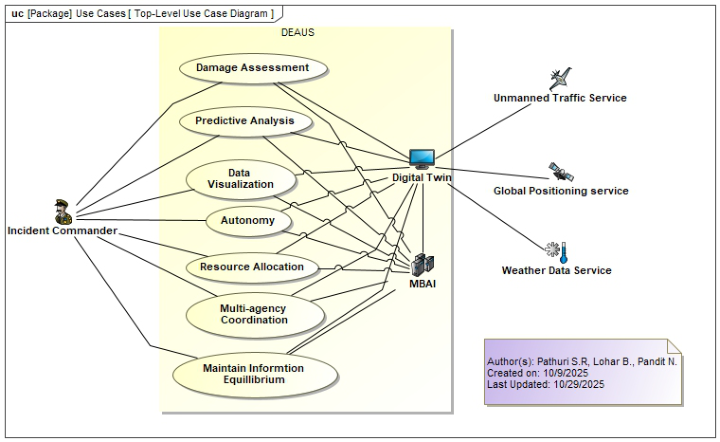
Use Cases The proposed Digital Twin Enabled Artificial Intelligence Uncrewed System (DEAUS) autonomously operates to establish situational awareness, perform heuristic optimization to orchestrate a MVP, and dynamically allocates assets to mitigate impacts in high-vulnerability sectors. Aiding human intelligence for critical decision-making and efficient resource allocation is the top-level use case for the proposed DEAUS.
The use-case diagram below (see Figure 1) illustrates a few use cases which UxS will perform in the given disaster response domain to satisfy the top- level use case. DT and MBAI in conjunction will utilize incoming data through the deployed physical systems to provide damage assessment, run predictive analyses, perform data-visualization, enable autonomy, orchestrate resource allocation suggestions, comply with multi-agency co-ordinations, air bosses, and finally maintain information equilibrium. Here the actor
Enhancing Disaster Responses Using Uncrewed Systems (UxS) 2235
Incident Commander (IC) is the person who has the most authority over the interaction between DEAUS and the Disaster Response agencies. The National Incident Management System’s (NIMS) Incident Command System (ICS) provides the framework to interact between agencies (Alabamatim.org, 2025). By utilizing the DT capabilities and MBAI, the proposed UxS will adhere to the standards set and aid the system autonomously where it lacks.
Figure 1: Use cases of DEAUS.
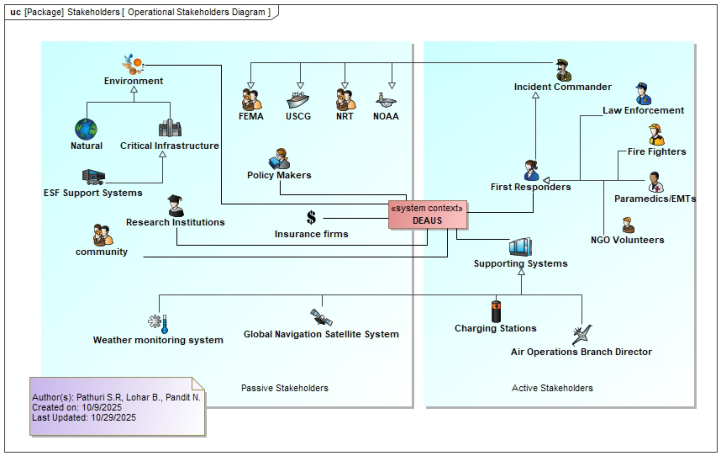
Operational Stakeholders The system satisfies the operational needs of stakeholders involved. These are individuals, entities and other systems who interact and influence the success of the DEAUS. It is important to identify stakeholders as they serve as the source of requirements and needs, in building the system. Disaster management agencies are the ultimate end-users or customers of actionable intelligence produced by DEAUS. These are the most senior stakeholders operating at the highest level of command. Although they are not directly present at the incident site, they lead the overall response. Their needs, operational procedures, and feedback are essential inputs for system development. They have a significant say in the regulations and policies governing the proposed system in disaster areas. Effective response relies on seamless coordination among many different agencies and entities. For DEAUS to be successful, it must be integrated into a broader framework managed by these agencies. The IC functions as the central node for tactical and strategic oversight within the ICS framework. This role is responsible for defining mission parameters, orchestrating the allocation of heterogeneous assets, and directing human-machine teams during evolving catastrophic events. The integration of autonomous UxS
platforms into the operational battlespace introduces significant ethical and legal complexities, necessitating a command authority capable of ensuring both mission efficacy and auditable accountability. Unlike a traditional commander overseeing human-centric units, this role must possess domain expertise in autonomous systems. The IC provides unified command and control in high-stress, information-saturated environments, synchronizing a multidisciplinary cohort of first responders. Crucially, the IC must have sufficient technical grasp to interrogate the system’s decision-making logic, comprehend the cascading effects of proposed AI-driven actions, and validate the outputs of DEAUS to ensure alignment with the overarching mission objectives. Outside the system’s boundary lies other systems or system of systems (SoS) which extend beyond the system control but rather influence the system to achieve its objectives. Several critical supporting systems work in concert to ensure the success of the overall mission such as, the Unmanned Traffic Management (UTM) service which deconflicts the operating space of the DEAUS physical systems with other Manned Aerial vehicles (MAV) and Manned Ground Vehicles (MGV), while also integrating and coordination with “air bosses” officially known as Air Operations Branch Director (AOBD).
Figure 2: Operational stakeholder diagram.
Similarly, charging stations provide endurance to DEAUS’ physical systems which otherwise are limited by their battery life or fuel. Passive stakeholders maintain intermittent interaction and are affected by the system but have minimal involvement in its development. DEAUS passively communicates with Global Navigation Satellite System (GNSS) for autonomous navigation, control, and precise guidance in different environment settings. GNSS is
Enhancing Disaster Responses Using Uncrewed Systems (UxS) 2237
vital for controlling unmanned and manned physical systems, ensuring they stay within operational boundaries and execute complex tasks effectively. Real-time meteorological data crucial for generating and simulating mission plans is gathered from weather monitoring system. DEAUS will continuously receive updates from the national weather stations. Regulating bodies, also referred to as policy making bodies influence the system development by inhibiting standardization and restrictive operational guidelines. Communities may perceive the systems differently depending on the context of DEAUS usage. While the presence of DEAUS during disasters can signal a rapid and efficient rescue effort, promoting a sense of hope, it can also induce some fear, anxiety and distrust related to privacy and dehumanizing nature of the technology. Research institutions & insurance firms utilize the data collected during heroic and disillusionment phases of disaster response to provide assessments in avoiding damages, fatalities, and cascading failures in future disastrous situations. This similar data can also be utilized by FEMA and insurance providers for accurate and unbiased support during reconstruction phases.
METHODOLOGY
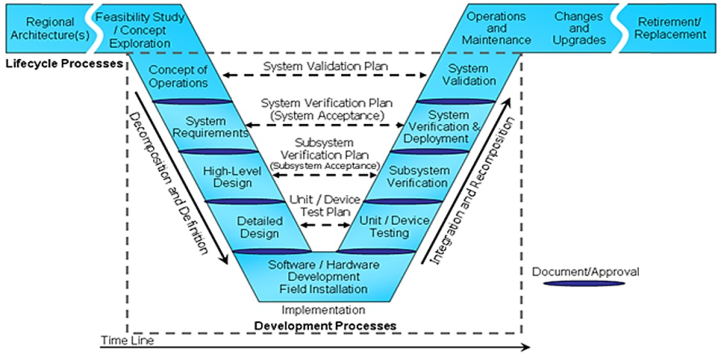
This section describes the methodology for designing the DEAUS using SE’s “Vee” model and a MBSE approach. The activities in the “Vee” model presented by the Federal Highway Administration (FHWA) will be shadowed to develop the system. For this paper, only the left side of the “Vee” model is of primary importance.
Functional Decomposition For the earlier mentioned top-level use case of disaster response, a top- level function can be derived as “Reducing disaster impact and its cascading failures.” Following is the list of top-level functions decomposed into second- level functions:
Figure 3: Systems engineering “Vee” model (Federal-Highway-Administration, 2007).
1. Generate predictive insights: DEAUS uses its MBAI engine with ModSim capabilities to analyze the current state within the DT and forecast future events. This includes predicting the path of a wildfire, modelling the spread of floodwaters, or identifying areas at high risk of cascading infrastructure failures, such as major power generation stations, power grids or major interstate bridges. 2. Establishing situational awareness: This function involves deploying the physical UxS fleet to collect, process and integrate multi-modal sensor data to emulate the physical world systems and environment into high- fidelity DTs. 3. Orchestrate mission plans: Based on the established awareness and predictive insights, MBAI using the PL’s documented patterns of reusable solutions, generates and optimizes mission plans. The most effective allocation and tasking of DEAUS and human assets is achieved. 4. Execute and manage missions: This function encompasses the command and control of the UxS fleet to carry out the orchestrated plan. It includes real-time navigation, dynamic re-tasking based on newly collected data, and monitoring the health and status of all deployed resources. 5. Facilitate inter agency collaboration: DEAUS enforces functional mechanisms to ensure a SSOT is securely disseminated to all authorized stakeholders (FEMA, First Responders etc.) managing the data consistency, access control and collaboration. 6. Maintain evidence integrity: This DEAUS function is responsible for meticulously logging all system actions and documenting the data lineage into a secured immutable locker for a forensically sound Chain-of- Custody for post-incident analysis and research (Pathuri et al., 2025).
Concept of Operations (CONOPS) DEAUS will take a methodical approach to disaster responses. The initial deployment of physical autonomous systems will focus on data acquisition and viable assistance in disaster-affected and prone areas (Pandit et al., 2025). To provide accurate in-sync impact assessments, all deployed physical systems have one of their primary functions as continuous data capturing and transmission (Pandit et al., 2025). The captured data is multi-modal, including visual, auditory, text, and more. The visual dataset will include live disaster feed and specific situational imagery, while auditory and text will include sensor data. Other than the deployed physical systems, DT utilizes data from sources including local, federal, and other disaster response agencies (Pandit et al., 2025), and utilizes inter-agency data sharing to maintain knowledge equilibrium. Data flows from these different sources, and the collected datasets get processed into information before being used for different action-planning, prediction, and model refinement. Most of the information is managed by MBAI (Lohar et al., 2025). MBAI does instantaneous big-data analysis, performs data-driven simulations, and generates optimized action plans (Lohar et al., 2025). MBAI inherently utilizes Patterns, ML models, and ModSim to perform different capabilities (PivotPoint Technology, 2025). Patterns are objectively structured forms
Enhancing Disaster Responses Using Uncrewed Systems (UxS) 2239
of implicit knowledge (Cloutier et al., 2005), such as repeated behaviors, architectures, and data structures. By mining, connecting, and integrating different patterns, PL are made (Lohar and Cloutier, 2022). MBAI makes use of such implied patterns for anomaly detection, state awareness, and decision-making (Lohar et al., 2025). In the initial stages, historical data- mines from FEMA and other emergency response agencies will be used to create a foundational PL. For each individual disaster, specialized PLs will be created; they will be fine-tuned to specific characteristics, impact-factors, and mitigation responses. DT is one promising technology that MBAI can benefit from, with capabilities like system emulation that enhance the ModSim capabilities, real-time high-fidelity analysis, and decision refinement (Lohar et al., 2025).
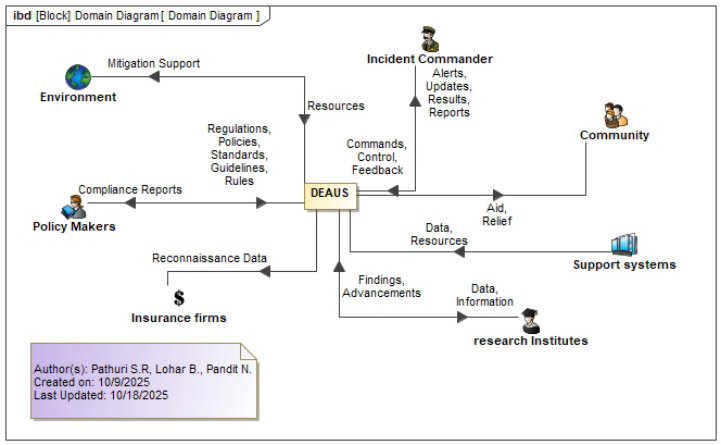
Figure 4: DEAUS domain diagram.
DT can benefit from PLs to create model-centric virtual models including systems and environments. Conversely, the in-use PLs get verified using DT functionalities. Using MBAI capabilities, DTs will be utilized for simulation- based testing, action-plan generation, and monitored assessment. The action- plans generated by MBAI are not limited to but include specific commands, action rules, and information feed, which help the physical systems make informed decisions accordingly. Information is shared and exchanged in the form of different interactions, including commands, shared-data, knowledge, results, and updates. DEAUS orchestrates the MVP by allocating and commanding the deployed resources in real-time (Pandit et al., 2025). It interacts with the available infrastructure and agencies to inform, support, and coordinate functionalities at different levels. During interactions, the physical systems perform the actual actions while the MBAI makes decisions that need to be followed. As newer data flows in and gets appraised, MBAI
refines action plans. As more and more data get appraised, newer patterns are mined and existing PLs get validated and refined (Lohar, 2022). Furthermore, MBAI decision-making accuracies and DT model accuracies get refined with time. The disaster response agencies and law enforcement teams’ operational needs are to utilize autonomous uncrewed systems for critical decision- making and real-time action. All the efforts made by the DEAUS are aimed at successfully reducing the disaster impacts and their cascading failures.
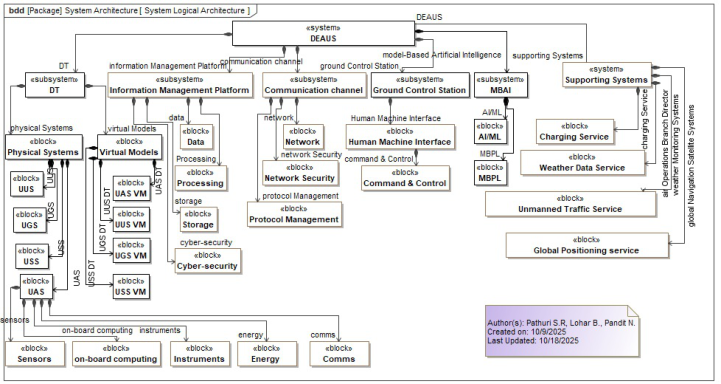
Logical Architecture The proposed system is made up of various sub-systems including but not limited to DT, information management platform, communication channel, Ground Control Station (GCS), MBAI, and other supporting systems. DT includes the target process or physical system(s) and their respective virtual model(s) with the ability of bi-directional interactions. The virtual model(s) have the capability of real-time system working emulation. The system emulation and models are used for various different functions including Verification, Validation and Testing (VVT). MBAI, as mentioned above, is a type of AI engine that utilizes ModSim capabilities, Pattern Libraries (PLs) and various Machine Learning (ML) techniques to perform functions like assessment, decision-making and coordination. Information management platform deals with storing, processing, and providing security to the data through Chain-of-Custody. Networks, network security and protocol management will be handled by a communication platform to provide seamless ad-hoc connectivity when traditional networks fail. GCS provides human-machine interfaces for IC to delegate command and control. These sub-systems along with all supporting systems work together to execute the top-level function of reducing disaster effects and its cascading failures.
Figure 5: Logical architecture of DEAUS.
Enhancing Disaster Responses Using Uncrewed Systems (UxS) 2241
DISCUSSION
The proposed SoS architecture is developed to integrate various DT, AI, and UxS capabilities, fine-tuned for disaster response applications. The main functionality of DEAUS will be achieved through the working harmony of these mentioned sub-systems. Functionalities like real-time assessment, situational awareness, resource allocation, and autonomous execution work to mitigate disaster impacts, reduce cascading failures, and avoid spill-over effects. The traditional disaster response frameworks, in contrast, are often plagued by human-centric induced biases, inaccuracies, and critical failures, and their fragmented working has bottlenecked them into failures. Built using refined systems engineering methodologies while keeping in mind the INCOSE 2035 Vision, the proposed architecture is equipped with necessary capabilities, including AI enhanced autonomy, high-fidelity DT emulations, and swarm intelligence, to provide an integrated decentralized disaster response (INCOSE, 2022). Furthermore, this research provides a novel solution to the critical challenge of ensuring data integrity for post-event legal and financial adjudication (an area largely overlooked in previous technical research) by embedding a Chain-of-Custody into the system’s architecture. Based on the literature review done for this research, while there are many well-documented uses of UxS in disaster response (Kedys et al., 2024), these research-focused deployments are often limited to single-mission, human- in-loop systems focused on trivial tasks like data acquisition, including aerial imagery. This work is focused on the refined generalization of such different approaches into a SoS architecture that can be applied to different domains. Similarly, while Digital Shadows are being heavily adopted by the manufacturing and aerospace industries to emulate singular assets, this research moves towards DTs; the bi-directional interactive system emulations that will handle swarm intelligence systems, dynamic environments, and real-time decision-making. Furthermore, previous applications of AI in this domain have largely focused on machine learning for data processing, such as object recognition in video feeds. Integration of MBSE with AI creates a more sophisticated cognitive architecture. The MBAI does not merely classify data; it reasons based on underlying models of physics, logic, and constraints. This model-based approach provides a level of explainability and robustness that is absent in purely data-driven AI systems.
CONCLUSION & FUTURE WORK The implications of this framework are profound, promising to reshape the future of emergency management. Operationally, it enables a transition from reactive, human-centric response model to a proactive, optimized, and machine-driven one. By offloading high-stakes decision-making to the MBAI, the system can allocate resources with a speed and efficiency that surpasses human capabilities, particularly when managing the cascading effects that define modern catastrophes. This directly translates into enhanced operational resiliency, with the potential to save more lives, protect critical infrastructure, and reduce the economic fallout of disasters. For this research, in the future, we plan to transition from the conceptual SoS architecture to
a tangible system in the form of a Proof-of-Concept (POC). By developing and utilizing different Integration, Verification, Validation, and Test (IVVT) plans we will verify system working and validate the theoretical advantages of DEAUS. Once fully developed, the proposed DEAUS then can be adopted for any disaster responses including storms, floods, hurricanes, oil rig fire & spillage, tsunami, wildfires, earthquakes, nuclear meltdown, space debris chain reaction and others, to reduce the disaster impacts and cascading failures.
REFERENCES
Abid, S. K., Sulaiman, N., Chan, S. W., Nazir, U., Abid, M., Han, H., Ariza-Montes, A. and Vega-Muñoz, A. (2021). “Toward an Integrated Disaster Management Approach: How Artificial Intelligence Can Boost Disaster Management,” Sustainability, 13(22), p. 12560. Alabamatim.org. (2025). “TIM Command and Control,” Website: https://www.alab
amatim.org/commandControl.html. Cloutier, R., (2005). “Toward the application of patterns to systems engineering,” Sys. Eng, pp. 73–80. Drabek, T. L. and McEntire, D. A. (2002) “Emergent phenomena and multiorga-
nizational coordination in disasters: Lessons from the research literature,” International Journal of Mass Emergencies and Disasters, 20(2), pp. 197–224. Federal-Highway-Administration (2007). Systems Engineering for Intelligent Transport Systems. US-DoT, US Department of Transportation. Website: https:// \penalty-\@Mops.fhwa.dot.gov/publications/regitsarchguide/73useprojimp.htm. International Council on Systems Engineering (INCOSE). (2022). Systems Engineering Vision 2035. Website: https://www.incose.org/publications/se-vision- 2035. Kedys, J., Tchappi, I. and Najjar, A., 2024. “UAVs for Disaster Management – An Exploratory Review,” Procedia Computer Science, 231, pp. 129–136. Lohar, B., & Cloutier, R. (2022). “Towards a Model-Based Pattern Language for
New Space-Based Systems.” https://doi.org/10.20944/preprints202208.0177.v1. Lohar, B., Pandit, N. and Pathuri, S. R. (2025) “An MBSE Driven Advanced UxS Post Disaster Response System.” https://doi.org/10.13140/RG.2.2.13134.32324. Lohar, B. R. (2022). Development of new space systems architecture in SysML
using model-based pattern language (Doctoral dissertation, University of South Alabama). https://doi.org/10.13140/RG.2.2.20226.70089. Martin, E., Nolte, I. and Vitolo, E., 2016. “The Four Cs of disaster partnering: Communication, cooperation, coordination and collaboration,” Disasters, 40(4). https://doi.org/10.1111/disa.12173. Morton, M., & Levy, J. L. (2011). “Challenges in disaster data collection during
recent disasters,” Prehospital and disaster medicine, 26(3), pp. 196–201. National Centers for Environmental Information (NCEI) NOAA. (2025). “Billion- Dollar Weather and Climate Disasters.” Website: https://www.ncei.noaa.gov/acce ss/billions/. doi: https://www.doi.org/10.25921/stkw-7w73 Pandit, N., Bhushan Lohar, Sai Raghava Pathuri and Wade, J. T. (2025). “Model-
Based Systems Engineering (MBSE) Driven Uncrewed Systems (UxS) Digital Twins for Disaster Responses.” https://doi.org/10.13140/RG.2.2.19350.41283. Pathuri, S. R., Clark, G. and Lohar, B. (2025) “Model-Based Systems Engineering (MBSE) for Integration of Cyber-Physical Systems.” https://doi.org/10.13140/RG .2.2.22705.85601.
Enhancing Disaster Responses Using Uncrewed Systems (UxS) 2243
PivotPoint TechnologyTM. (2025). PivotPoint FAQ: What is Model-Based AI?
Website: https://ptcorp.com/faq/what-is-model-based-ai.html. Sarker, P., Lohar, B., Walker, S., Patch, S. and Wade, J. T., (2024). “Recovery Resiliency Characteristics of Interdependent Critical Infrastructures in Disaster- Prone Areas. Infrastructures”, 9(11), p. 208. Shareef, M. A., Dwivedi, Y. K., Kumar, V., Hughes, D. L. and Raman, R., (2022).
“Sustainable supply chain for disaster management: Structural dynamics and disruptive risks. Annals of Operations Research”, 319(1), pp. 1451–1475. U.S. General Services Administration (GSA). (2024). The National Response Framework. Website: https://www.gsa.gov/governmentwide-initiatives/emergen cy-response/the-national-response-framework.
LISTED IN THE AHFE DIGITAL BOOKSTORE CATALOGUE
Explore the complete digital volume
Human Factors in Design, Engineering, and Computing
Read this individual research paper free through the original publisher, or explore the full digital proceedings book.
ISBN 978-1-964867-75-5
Explore this ISBN in the AHFE Bookstore ↗Listed in the July 2026 bookstore catalogue; search by ISBN to confirm current availability · Digital book purchase optional