Rachel Chai, Bhushan Lohar, Kevin White, Kaushik Venkiteshwaran, Sean Walker (2024). Sociotechnical Aspects of Decentralized Wastewater Treatment Systems. In: Human Factors in Software and Systems Engineering. AHFE Open Access, vol. 140, pp. 26–35. https://doi.org/10.54941/ahfe1005034
Decentralized wastewater treatment systems are utilized in areas where sewer systems are not feasible and septic service is unaffordable. Approximately 25% of the US population uses decentralized wastewater systems for their wastewater treatment. The Black Belt, which extends from the East Coast of the US from Virginia through the Carolinas, Georgia, Alabama, and Mississippi is an area that has a large population that depends on decentralized wastewater systems. In the State of Alabama, the Black Belt area is a 17-county region where, depending on the county, up to 85% of the residents rely on decentralized wastewater treatment. These decentralized systems are largely unaffordable for the residents in this region due to a median household income of $29K, which is half of the national average. One proposed system is a low-cost lab-scale hybrid evapotranspiration/lateral flow sand filter. The hybrid sand filter system is designed to treat 55 gallon per day (GPD) of septic tank effluent, sized at 13 ft x 12 ft x 3 ft. The influent is treated physically, chemically, and biologically within the sand layers of the system. Hydraulically, influent flows laterally and rises via capillary action within the sand layers. The system has a correlation to ambient temperature and humidity. Lower discharge rates are directly proportional to higher temperature and humidity. The following data represents the percent reduction for our wastewater treatment system: Ammonia (64%), Phosphorus (92%), COD (76%), and BOD (96%). The hydraulic and treatment data for the hybrid sand filter system are promising. In this analysis, the authors identify sociotechnical factors that can affect the performance and useful life of the system in a multiple decision matrix. Sociotechnical factors, such as persons per residence, electricity usage, and distance of the decentralized system from the residence, are analyzed to build a simple agent-based model (ABM) which will determine the impacts on the overall performance of the system.
Access to wastewater infrastructure and management is believed by the pub- lic to be universal right (Capone et al., 2020; Maxcy-Brown et al., 2021). However, that belief may not be consistent with the reality for some resi- dents of the United States. Consecutively for the past 3 years, the United
Sociotechnical Aspects of Decentralized Wastewater Treatment Systems 27
States has earned a D+ (Poor Below Standard) for its wastewater infrastruc- ture in a report from the American Society of Civil Engineers (ASCE). The grading scale set by ASCE ranges from A (Exceptional) to F (Failing/Criti- cal, Unfit for Purpose) (ASCE, 2021). Wastewater treatment in the United States is divided into two broad categories: decentralized and centralized. Centralized wastewater treatment is the treatment of wastewater of many homes by sending their wastewater using a collection network of pipes to one large treatment plant. Centralized treatment of wastewater is used by 80% of the population with 16,000 publicly owned wastewater treatment plants treating 62.5 billion gallons of wastewater per day (ASCE, 2021). Many of these treatment systems and other related infrastructure were built with funding provided by the Clean Water Act in the 1970s with plans of a 40 to 50-year lifespan for each system (ASCE, 2021). Currently, many of these systems have reached the end of their 40 to 50 year-lifespan. Decentralized wastewater treatment is the treatment of wastewater at the home with an at-home wastewater treatment system unit. With the reduction of funding and lack of attention, many of the decentralized treatment systems cur- rently in operation have reached or surpassed the end of their lifespan or are overcapacity. Many of these systems have been identified as being out of com- pliance with regulations set by the United States Environmental Protection Agency (EPA). Straight pipes are direct unpermitted wastewater discharges from the home with or without solid settling, usually by a PVC pipe into the backyard (Maxcy-Brown et al., 2021). Unpermitted wastewater treatment systems are either not visible straight pipes or a created in-ground disposal system.
Alabama Black Belt Some of the communities facing inadequate wastewater infrastructure and management are the residents of the Alabama Black Belt. The Alabama Black Belt is a 17-county region in the region south-central Alabama. Barbour, Bul- lock, Butler, Choctaw, Crenshaw, Dallas, Greene, Hale, Lowndes, Macon, Marengo, Montgomery, Perry, Pike, Russel, Sumter, and Wilcox are the 17 counties. The Alabama Black Belt’s name comes from the fertile clay, verti- sol soils making this region rich in farming history. These soils are suited for growing agricultural products (i.e. sweet potatoes, cotton, etc.) as the soil tends to retain and swell water. This swelling of water is known for form- ing impermeable clay barriers for water. This impermeable layer does not let water pass through, which is necessary for functioning and disposal of wastewater treatment with decentralized wastewater treatment systems. Up to 50% of residents in the Alabama Black Belt use decentralized wastewa- ter treatment (McCaskill, 2023). The lack of drainage necessitates the use of expensive advanced wastewater treatment options, which are unaffordable to residents relying on decentralized treatment systems. Over 50% of the soil area in the Alabama Black Belt is unsuitable for septic tank systems (He et al., 2011). A field survey in 2005 of Bibb County of 4000 homes reported 35% of homes had septic tank failure and 15% of homes had no septic tank/drain- field (White and Jones, 2006). A field study conducted in 2017 on Wilcox
County reported 172 homes with straight pipes and 98 homes with unper- mitted wastewater treatment systems (Elliott et al., 2017). A study in Hale County in 2017 reported 24 homes with and 243 homes with unpermitted wastewater treatment systems (Elliott et al., 2017). The lack of wastewater treatment is a public and environmental health hazard. Unprotected con- tact to raw sewage/wastewater exposes individuals to pathogens associated with fecal materials, heavy metals, microplastics, endocrine disruptors, and pharmaceuticals (Dickin et al., 2016; Wear et al., 2021). Further increas- ing the challenge for these counties to gain access to sustainable wastewater infrastructure is their rural nature and low economic basis. In a 2018 sur- vey of 11 of the 17 Black Belt Counties the average median house income was reported to be less than $29,000 (approx. 50% the median house income of the United States) and the population density was reported to be 26.4 people per square mile (29% of the United States) (White and Elliot, 2018). In a more recent study, reported from the 10 poorest counties of Alabama, 9 of those counties are considered Alabama Black Belt counties (Capone et al., 2023). The vertisol soil, prevalent poverty, and rural spread of homes are some of the challenges which have made abstaining wastewater infrastructure/management for this region unattainable.
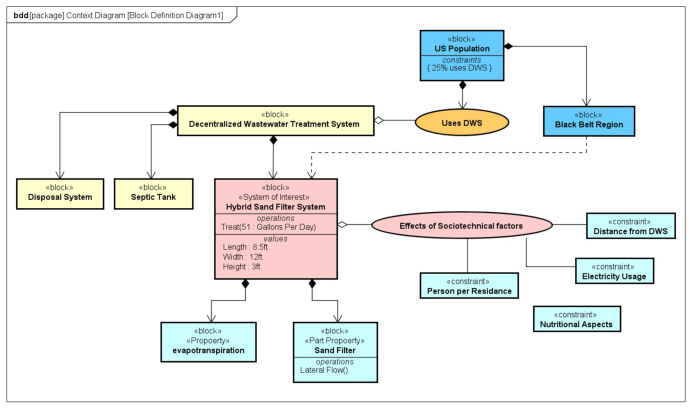
Evapotranspiration/Lateral Flow Sand Filter In the exploration of more affordable wastewater treatment options for the residents of the Alabama Black Belt, the University of South Alabama designed a hybrid evapotranspiration/lateral flow sand filter with design heavily inspired by the Evapotranspiration Design Guidelines as described by the EPA (EPA, 2000) and On-Site Sewage and Disposal Systems: Techni- cal Guidelines by the Nova Scotia Department of Environment and Climate Change (Department, 2013). A Systems Engineering approach was taken to develop the proposed “Hybrid Sand Filter System.” The authors used a Model-Based Systems Engineering (MBSE) approach to model the over- all logical architecture of the proposed decentralized wastewater treatment system (Figure 1) using Systems Modeling Language (SysML). MBSE is a formalized application of modeling to support system requirements, design, analysis, verification, and validation activities beginning in the conceptual design phase and continuing throughout development and later life cycle phases (SEBoK, 2023). In this study, the authors chose to model various SysML diagrams such as Block Definition Diagrams to develop a System context diagram, Domain diagram, and logical architecture. A Hybrid Sand Filter System is denoted as a “System of Interest” (SoI) for this project. The authors used the V-model approach to develop stakeholder definition, mis- sion and system requirements analysis, the concept of operation (ConOps), specification, analysis, design, verification, and validation models of the SOI; the proposed model represents views of these systems, not the systems themselves. SysML parametric diagrams can be used to analyze and display various mathematical relationships; it will also be helpful to calculate the disposal output volumes in two use cases:
1. The amount of water outflow from the Hybrid Sand Filter. 2. The amount of water inflow into the Hybrid Sand Filter.
Sociotechnical Aspects of Decentralized Wastewater Treatment Systems 29
Figure 1: Illustration of the application of the MBSE demonstrating a top-level hybrid Sand filter system domain diagram with the important use case and its constraints.
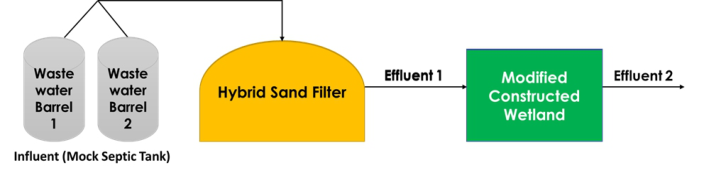
The hybrid sand filter was designed with three major subsystems for a treatment flow of the following in corresponding order: a septic tank, a lat- eral flow/evaporation sand filter, and constructed wetland as illustrated in Figure 2. For testing purposes, the hybrid sand filter was sized at 13-ft × 12-ft × 3-ft (Length × Width × Height) designed to treat synthetic wastew- ater dosed at 55 GPD with continuous dosing. The constructed wetland had the modification from typical design with the addition of 48-qt of biochar, 36-cubic ft of #57 gravel, and 20-lb of sawdust with sizing of 6-ft × 4-ft × 1.5ft. Design of the hybrid sand filter corresponded to the temperature and environmental conditions of the Alabama Black Belt.
Figure 2: Treatment configuration of hybrid sand filter (McCaskill, 2023).
Testing of the treatment efficacy of the hybrid sand filter was recorded over the period October 8th, 2022, until January 3rd, 2023. The treatment results of the hybrid sand filter systems can be seen in Table 1. The influ- ent, in this system, is defined as untreated wastewater. Effluent (Eff) can be described as treated wastewater after it has gone through the wastewater treatment system. In Figure 2, wastewater barrels are representative of the septic tank. Biological Oxygen Demand (BOD), Chemical Oxygen Demand
(COD), Nitrate (NO3), Ammonia (NH3), Total Nitrogen (TN), and Total Phosphorus (TP) are given in Table 1 in each test parameter in Table 1 is a discharge contaminant regulated by the EPA.
Table 1. Treatment results of hybrid sand filter (Bakchan et al., 2023).
The Avg Influent is the characteristics of the synthetic wastewater, Avg Effluent 1 is the treated wastewater characteristics after the hybrid sand filter and Avg Effluent 2 is the treated wastewater characteristics after the hybrid sand filter and constructed wetland. The rates of COD and BOD removal were satisfactory at 93% and 96%. The addition of the constructed wetland improved Total Nitrogen removal from 35% to 52%. Addition- ally, the constructed wetland greatly improved the reduction of nitrate and ammonia. Depending on the state standards and disposal requirements, the hybrid treatment system has the potential to scale to larger systems. From a cost perspective, material costs of the hybrid sand filter and modified con- structed wetland were $7,500. This estimate did not consider the costs of the septic tank, piping, or labor costs. Material costs can be considered cost effective for the wastewater treatment in the Alabama Black Belt in compar- ison to other advanced wastewater treatment technologies which can exceed $10,000 (Maxcy-Brown et al., 2021).
The results show that the proposed model in this study is easy to under- stand and produces a shared understanding of how MBSE methods are useful in developing a decentralized wastewater treatment system. The SysML mod- els developed in this study are useful in understanding the relevance of the sociotechnical factors and their impact on the proposed hybrid sand filter sys- tem. More specifically the treatment factors and their impact on the overall decentralized wastewater treatment environment. The authors recommend further research into this area by understanding socio-technical factors of the Black Belt Area population in the state of Alabama. We believe that our model will help stakeholders determine, design, and develop the size of the hybrid sand filter per their requirements, environment, and socio technical factors.
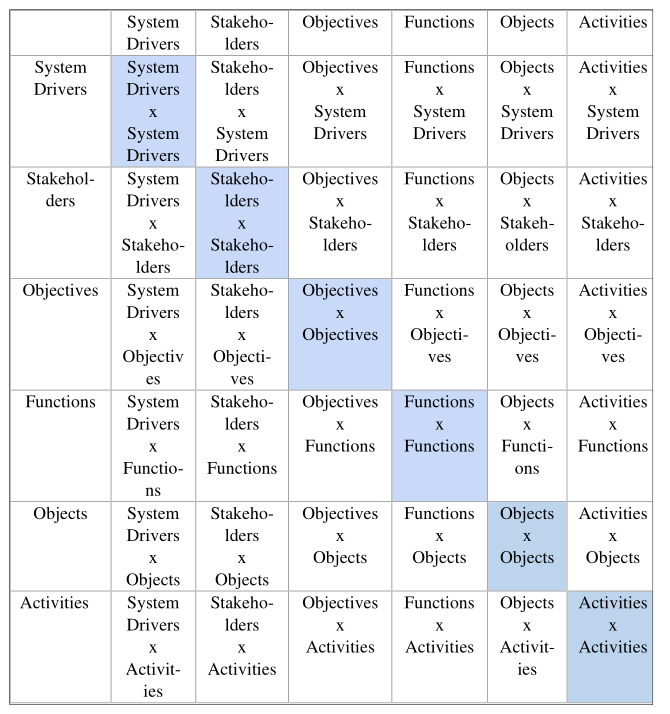
Domain Matrix A Multiple Domain Matrix is a conceptualization tool used to structure information and acknowledge concerns/limitations of a system. The frame- work can be visualized as a matrix with identical column and row headings
Sociotechnical Aspects of Decentralized Wastewater Treatment Systems 31
(Table 2). These headings serve as systems components and relationships. The combination helps the user visualize the interactions between the rela- tionships, thus identifying actors and interactions for an Agent Based Model (ABM). System Drivers are factors that influence the system development and operation. These drivers are economic, political, social, and technical in nature. System Drivers constrain and enable the system and its expansion. Stakeholders are actors within the systems. They contribute to goals and con- trol aspects of the system. Objectives are defined as the goals of the systems. What does the stakeholder want the system ultimately made to do? Functions are the behaviors of the system. How does the system perform to achieve its objectives? Objects are physical components of systems. Activities are the processes of the system (Bartolomei et al., 2012).
Table 2. Multiple decision matrix.
Highlighted in blue are identified system components that are used in deter- mining the interaction between domains. The identified system domains for the hybrid sand filter system can be seen in Table 3. These domains were identified by viewing the social, technical, political barriers of the hybrid sand filter system for permitting, construction, and use of the system.
Table 3. System components.
Table available in the original PDF paper.
System Drivers x System Drivers
Environmental factors (i.e. Temperature, Water Table, Soil Porosity)
Proximity Bodies of water
Proximity of Houses
Regulations of County (i.e. City officials)
Regulation of Local State (ADPH, ADEM)
Regulations of National government (i.e. EPA)
Available Funding
Provided Treatment Volume
Energy Usage Stakeholders x Stakeholders
Local Government
Users
Health Department
Property Owners
Funding Agencies
Engineering Companies
Parts Manufactures
Surrounding Environment
Management companies Objectives x Objectives
Protect the surrounding environment
Protect the public health
Prevent Waste Accumulation Functions x Functions
Treats raw sewage (influent)
Pumps water from provider to disposal
Disposes of treated wastewater Objects x Objects
Pump systems
Drainfield
Pipes
Wastewater treatment system (i.e., Septic tank, Hybrid Sand Filter & Constructed Wetland) Activities x Activities
Collect wastewater
Clean wastewater
Pumping water through pipes
Disposing of clean water
Examples of the resulting interaction of those systems domains can be seen in Table 4. All the resulting interactions were too large to display in a table and are available upon request. System drivers served as the system components with stakeholders and objects as the determining relationship. Many of the interactions for stakeholders were coupled by natural interac- tions. Many of the interactions on proximity bodies of water had similar or the same interactions with proximity of houses. This similar interaction was shown true from regulations set by county, state, and national governments. As displayed, the functions and activities are very similar in definition and have almost identical system components. Much of the interactions of the multiple domain matrix focus on the use of the systems. Thus, identifying actors as users of the systems, providing various volumes of water into the
Sociotechnical Aspects of Decentralized Wastewater Treatment Systems 33
system, and the objects identified as physical components need to be mod- elled with a few of the system drivers that affect the system. Chosen system drivers are energy usage, environmental factors, and provided treatment vol- ume of wastewater. One of the most important interactions identified in the multiple decision matrix is the disposal of the treated wastewater from the system. If the water cannot be disposed, the system cannot continue to func- tion, and the treated water will back up to the system and ultimately to the home. The back-up water in the system will fail the objective of prevent- ing the waste accumulation. The back-up in the system will cause system failure. The resulting system failure because the objectives of protecting the surrounding environment and public health will also fail cannot be achieved. System drivers affecting the disposal of the wastewater is the surrounding environment, proximity to bodies of water, regulations, set and energy usage. This makes disposal one of the key activities that will need to be modelled in the ABM. Other important interactions are the movement of water through- out the wastewater treatment system. The movement of water is necessary to flow from the provider of wastewater (user) to the system, and eventually out of the system. The movement of the water is represented physically by the pipe and pump systems which use energy to move water through the system. Systems drivers that affect this interaction are funding available, proximity of houses, and surrounding environment. If water does not flow through the system, the system failures its objectives as it will accumulate waste and pose as a danger to public health and the surrounding environment.
Table 4. Interactions of the system.
Table available in the original PDF paper.
System Drivers Stakeholders Objectives Functions Objects Activities System Drivers
Treating raw sewage helps keeps bodies of waters clean
Proximity of houses will add or less the pipes need to provide water from provider to disposal
Disposing of treated water adds water back to water bodies and the surrounding environment necessary for the community
Environmental factors (i.e. Temperature, Water Table, Soil Porosity)
Proximity Bodies of water
Proximity of Houses
Regulations of Country (i.e. City officials)
Regulation of Local State (ADPH, ADEM)
Regulations of National government (i.e. EPA)
Available Funding
Provided Treatment Volume
Energy Usage
The pump system adjusts water disposal depending on the soil porosity and other environmental factors
The sizing of the septic tank will depend on the users of the household
The drainfield of the environment will be designed and located based on the surrounding environment and proximity to bodies of water.
The size and materials used in the piping systems are determined by the proximity of boxes of water and proximity to the house
The disposal of the wastewa- ter adds water back to the water table affecting the environmental factors.
The collection of wastewa- ter determines the treatment volume used to design the wastewa- ter treatment system.
The energy needs of the wastewa- ter treatment sys- tem will depend on the pumping of the wastewa- ter.
The cleaning of the wastewater of the wastewa- ter will prevent contaminants from going back in the environment.
Engineers design wastewater treatment based on environmental factors
Engineers design wastewater treatment systems sized based on amount of water used by users
Engineers locate treatment to avoid contamination of the environment and bodies of water
Local Government provide assistants for wastewater treatment upgrades based on available funding
Users pay maintenance fees based on energy usage and volume of wastewater provided
Engineer chose wastewater treatment system depending of area available and location of houses
Local Government permit wastewater treatment system based by regulations set by the state and country
The cleaning of wastewater to protect the surrounding environment limits algae growth from excess nutrients (from wastewater) in the surrounding bodies of water
The cleaning of wastewater to follow the regulation set by the local state and country
Chosen wastewater technology to meet the needs of the community of energy usage to continue protecting the public health and community
Chosen wastewater technology to meet the needs of the community of funding provided usage to continue protecting the public health and community and not bankrupt the community
Chosen wastewater technology that continues to treat wastewater with the surrounding environment
CONCLUSION
In a challenging area like the Alabama Black Belt where there are social, envi- ronmental, and political complexities, cost effective alternatives are needed like the hybrid sand filter is needed for wastewater treatment infrastruc- ture and management. Using modelling with SysML and following local and national regulations, engineers can design and implement hybrid sand filters treatment systems that effectively treat wastewater and achieve stakeholder desires for this region. In this study, the authors have gained some insights for design implementation from bench-scale testing and use of the multiple deci- sion matrix. Further insights will be gained using the insights gained from multiple decision matrix in an ABM with goals of helping solve the prob- lem of wastewater infrastructure for the Alabama Black Belt. The author recommends taking a digitalization approach by setting a sustainable devel- opment goal of developing a Model-Based Patterns Library for the proposed Wastewater treatment system. The proposed patterns will further assist in developing a generic taxonomy and ontology of the overall wastewater treat- ment (Lohar, 2022; Lohar and Cloutier, 2022). That can be used further to analyze sociotechnical applications and constraints not only in the Black Belt area but also applicable in underdeveloped nations where wastewater systems are needed or do not exist.
ACKNOWLEDGMENT
This research has greatly benefited from the funding from the U.S. Environ- mental Protection Agency under the project Reinventing Rural Wastewater Management. This paper has not been formally reviewed by EPA. The views expressed in this document are solely those of the authors and do not neces- sarily reflect those of the Agency. Additionally, I would like to thank Bryant M. Baldwin for paper feedback and Systems Engineering support.
REFERENCES
ASCE, 2021. ASCE Wastewater Report. 2021 Infrastructure Report Card. Bakchan, A.*, Chai, R., McCaskill, H., White, K. D., 2023. Scale of Responsible Management of Decentralized Clustered Wastewater Systems in Rural Alabama’s Black Belt: A Mixed-Method Analysis. WEFTEC, Chicago. Bartolomei, J., Hastings, D., de Neufville, R., Rhodes, D., 2012. Engineering Systems
Matrix: An Organizing Framework for Modeling Large-Scale Complex Systems. Systems Engineering 15, 41–61. https://doi.org/10.1002/sys.20193 Capone, D., Bakare, T., Barker, T., Chatham, A. H., Clark, R., Copperthwaite, L., Flemister, A., Geason, R., Hoos, E., Kim, E., Manoj, A., Pomper, S., Samodal, C., Smith, S., Poole, C., Brown, J., 2023. Risk Factors for Enteric Pathogen Exposure among Children in Black Belt Region of Alabama, USA. Emerg Infect Dis 29, 2434–2442. https://doi.org/10.3201/eid2912.230780 Capone, D., Cumming, O., Nichols, D., Brown, J., 2020. Water and Sanitation in
Urban America, 2017–2019. Am J Public Health 110, e1–e6. https://doi.org/10. 2105/AJPH.2020.305833 Department, N. S. E., 2013. On-Site Sewage Disposal Systems: Technical Guidelines.
Sociotechnical Aspects of Decentralized Wastewater Treatment Systems 35
Dickin, S., Wallace, C., Qadir, M., Pizzacalla, K., 2016. A Review of Health Risks and Pathways for Exposure to Wastewater Use in Agriculture. Environ Health Perspect 124. https://doi.org/10.1289/ehp.1509995 Elliott, M., White, K., Jones, R., Das, P., Price, M., Stevens, Z., Lu, Y., 2017. Sur-
face Discharge of Raw Wastewater among Unsewered Homes in Central Alabama [WWW Document]. EPA Decentralized Wastewater Webinar Series. EPA, U. S., 2000. Decentralized Systems Technology Fact Sheet: Evapotranspiration Systems. Environmental Protection 1–4. He, J., Dougherty, M., Zellmer, R., Martin, G., 2011. Assessing the Status of Onsite
Wastewater Treatment Systems in the Alabama Black Belt Soil Area. Environ Eng Sci 28, 693–699. https://doi.org/10.1089/ees.2011.0047 Lohar, B., 2022. Development of New Space Systems Architecture in SYSML Using Model-Based Pattern Language (Dissertation). JagWorks. Lohar, B., Cloutier, R., 2022. Towards a Model-Based Pattern Language for New
Space-Based Systems. https://doi.org/10.20944/preprints202208.0177.v1 Maxcy-Brown, J., Elliott, M. A., Krometis, L. A., Brown, J., White, K. D., Lall, U., 2021. Making waves: Right in our backyard- surface discharge of untreated wastewater from homes in the United States. Water Res. https://doi.org/10.1016/ j.watres.2020.116647 McCaskill, H. I., 2023. A Hybrid Lateral Flow Sand Filter Wastewater Treatment
System: A Hybrid Lateral Flow Sand Filter Wastewater Treatment System: An Evaluation on the Treatment and Disposal Capabilities of a An Evaluation on the Treatment and Disposal Capabilities of a Modified Sand Filter Modified Sand Filter. Mobile. SEBoK, 2023. Model-Based Systems Engineering (MBSE) (glossary) [WWW Document]. SEBoK v. 2.9. URL https://sebokwiki.org/wiki/Model-Based_Systems_Eng ineering_ (MBSE) _ (glossary) (accessed 2.14.24). Wear, S. L., Acuña, V., McDonald, R., Font, C., 2021. Sewage pollution, declining
ecosystem health, and cross-sector collaboration. Biol Conserv 255, 109010. http s://doi.org/https://doi.org/10.1016/j.biocon.2021.109010 White, K., Elliot, M., 2018. Alabama Black Belt and Sanitation Issues: Description and Proposal. White, K., Jones, R., 2006. A Survey of Onsite Wastewater Systems in Bibb
County, Alabama. Report for the Alabama Association of Conservation Districts. Montgomery, AL.
LISTED IN THE AHFE DIGITAL BOOKSTORE CATALOGUE
Explore the complete digital volume
Human Factors in Software and Systems Engineering
Read this individual research paper free through the original publisher, or explore the full digital proceedings book.
ISBN 978-1-964867-16-8
Explore this ISBN in the AHFE Bookstore ↗Listed in the July 2026 bookstore catalogue; search by ISBN to confirm current availability · Digital book purchase optional