Sean Walker, Mohamed El-sharkh (2025). Sociotechnical Challenges in the Implementation of Hydrogen Fuel Cell Trucking. In: Human Factors in Software and Systems Engineering. AHFE Open Access, vol. 181, pp. 79–88. https://doi.org/10.54941/ahfe1006397
As automobile and semi-truck manufacturers wheel out new hydrogen fuel cell vehicles (HFCV), new infrastructure to refuel and repair these vehicles must be developed. In this paper, the authors examine the sociotechnical hurdles to developing the infrastructure needed to refuel or recharge these vehicles in the state of Alabama and throughout the Southeast of the United States. Currently, no infrastructure exists in the state to support the use of HFCV trucks. However, given the presence of Interstates 10 and 65 which connect northern cities like Chicago and Indianapolis with shipping ports like New Orleans and Mobile, regional infrastructure will be required to support these new trucks. In this paper, the authors break down the sociotechnical issues using a multiple domain matrix to examine the social, technical, and sociotechnical challenges to implementing the infrastructure needed for hydrogen semi-trucks
The development of infrastructure to support privately owned electric (EV) and hydrogen fuel cell vehicles (HFCVs) is a source of contention. In the EV market, the lack of publicly available charging stations has limited the appeal of EVs to those who own a home as those who rent apartments and unable to charge their vehicles overnight (Zhang, et al., 2018). Some of those who need a vehicle for commuting may find that EV-sharing or renting schemes help them cope with the lack of access to at-home charging (Langbroek, et al., 2019). Due to this lack of infrastructure, the implementation of fleet vehicles for corporate or government use remains the logical next step in their technical development (Loeb, Kockelman, & Liu, 2018). Many of the hurdles that exist for the integration of EVs into the modern traffic system, also impact the potential use of HFCVs. Like many technologies, a period of pre-development could be used to acquire real-estate, develop policies, and put in place charging and refuelling stations for EVs and HFCVs. This period of pre-development mirrors what was accomplished before the public acceptance and use of cellular phones (Hardman & Steinberger-Wilckens, 2014). Like these technologies, societal perceptions and human factors are important aspects of the acceptance of new transportation technologies (Guo, Kang, Susilo, Antoniou, & Pernestal, 2025).
To support the transportation of goods from American ports in the southeast to major cities in the west, northeast, and Midwest, it is essential that infrastructure is available for future HFCV trucks in Florida, Alabama, Mississippi, and Texas. Hydrogen stations are scarce in the south-eastern region of the United States of America as 53 of 68 such stations are located in California (United States Department of Energy, 2022). A route from Mobile, Alabama at the southern terminus of I-65 to the border of Alabama and Tennessee cannot be currently made with a hydrogen vehicle as no refuelling stations exist along this corridor. However, a driver could drive the same route in an EV with 71 recharging stations within 5 miles of the route (Office of Energy Efficiency and Renewable Energy, 2022). To make use of the greater energy density, longer range, and quicker refuelling of HFCVs, a similar set of infrastructure needs to be developed along the 366.2-mile stretch of Interstate 65 in Alabama. Transportation is, like most infrastructure systems, a sociotechnical system which depends heavily on the requirements of a group of disparate stakeholders. These requirements vary, and in many cases are in direct conflict, due to the values held by stakeholders. In this analysis, the authors will examine the ways in which stakeholders for hydrogen refuelling interact with the system drivers, functions, objectives, objects, activities, and other stakeholders using elements of the multiple domain matrix (Bartolomei, Hastings, de Neufville, & Rhodes, 2012). The focus on stakeholders will allow the authors to examine the system interactions from the Human Viewpoint (Handley, 2013). The set of stakeholders for the hydrogen refuelling system include: consumers, hydrogen vendors, equipment vendors, hydrogen vehicle manufacturers (OEM), gasoline companies, city, county, state, and federal regulators. Each stakeholder group has its own benefits, and/or costs, associated with implementing and operating hydrogen refuelling.
METHODOLOGY
The multiple domain matrix is intended to allow systems engineers to examine the connection between stakeholders, systems drivers, objectives, functions, objects, and activities to understand system interactions and to improve the overall system behaviour. In this analysis, the authors analyse only the stakeholders and examine only their interactions within the sociotechnical systems. In Table 1, below, an example of Bartolomei’s multiple domain matrix is given (Bartolomei, Hastings, de Neufville, & Rhodes, 2012).
Table 1: Multiple domain matrix.
Table available in the original PDF paper.
System Drivers Stake-Holders Objectives Functions Objects Activities
Objectives Functions
Objects Activities X
Stake-holders System Drivers System Drivers
System Drivers
X System Drivers
X System Drivers
X System Drivers
X System Drivers
X System Drivers
Continued
Sociotechnical Challenges in the Implementation of Hydrogen Fuel Cell Trucking 81
Table 1: Continued System Drivers Stake-Holders Objectives Functions Objects Activities
Table available in the original PDF paper.
Stake-holders System Drivers Stake-holders
Objectives Functions
Objects Activities
X Stake-holders
X Stake-holders
X Stake-holders
X Stake-holders
X Stake-holders
Objectives Functions
Objects Activities
Stake-holders
X Stake-holders Objectives System Drivers
X Objectives
X Objectives
X Objectives
X Objectives
X Objectives X Objectives Objectives
Functions Objects
Activities
Stake-holders Functions System Drivers X Functions
X Functions
X Functions
X Functions
X Functions X Functions Objectives
Functions Objects
Activities
Stake-holders Objects System Drivers X Objects
X Objects
X Objects
X Objects
X Objects X Objects Objectives
Functions Objects
Activities
Stake-holders Activities System Drivers X Activities
X Activities
X Activities
X Activities
X Activities X Activities
Each cell inside the multiple domain matrix represents an interaction between aspects of the larger, complex adaptive system. For example, the entry in the top row and the third column is “Objectives X System Drivers” which represents the impacts that the overall objectives of the systems might have on systems drivers. The objectives of the hydrogen refuelling system are: to provide hydrogen safely, minimize operating costs, maximize customer service, minimize filling times, and maximize sales of hydrogen. The system drivers include: the price of hydrogen, the safety of hydrogen, the cost of building refuelling stations, consumer perceptions of hydrogen, and climate change. Looking at the interaction of objectives on systems drivers, providing hydrogen safely (objective) can change some consumer perceptions of hydrogen (systems drivers). Using these relationships, an analysis is undertaken to understand how the social aspect of the systems – stakeholders – interacts with other system domains. In Section 3, the interactions of each of the bolded squares are discussed.
Results of Multiple Domain Matrix Analysis In the hydrogen refuelling system, there are numerous stakeholders including: consumers, hydrogen vendors, equipment vendors, hydrogen vehicle manufacturers (OEM), gasoline companies, city, county, state, and federal regulators. Using the multiple domain matrix, and only observing the interactions shown in bold, numerous relationships between stakeholders and the other system domains can be examined. In Table 2, below, the system drivers, stakeholders, objectives, functions, objects, and activities are given.
82 Walker and El-Sharkh
Table 2: Components of hydrogen refuelling systems domains.
Table available in the original PDF paper.
System Drivers
Price of H2
Safety of H2
Climate Change
Availability of H2 powertrain vehicles
Cost of building refuelling
Consumer perception of H2 Stakeholders
Consumers
H2 Vendors
Equipment Vendors
OEMs
Regulators
Objectives
To provide H2 safely and cheaply
Minimize operating costs
Maximize customer service
Maximize H2 sales
Minimize filling times Functions
Provide H2 to driver/operators
Utilize minimum required electricity
Utilize minimum required cooling water
Charge maximum sales price for H2
Utilize maximum flow for each HFCV
Objects
H2 dispenser
Electrolyser
Heat exchanger
Water feed
Renewable power
Grid Power Activities
Producing H2
Filling vehicle tanks
Processing payments
Receiving H2 shipments Going across the second row of Table 1, the impact of systems drivers, objectives, functions, objects, and activities will be examined.
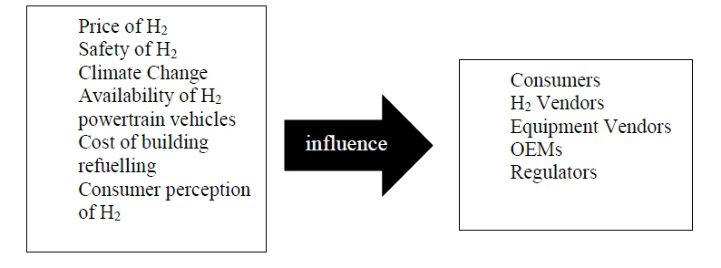
System Drivers x Stakeholders Looking at the impacts of systems drivers on stakeholders means examining the interconnections shown in Figure 1, below. As there are 6 system drivers and 5 stakeholders listed, there are 30 possible one-way interactions with systems drivers impacting stakeholders.
Sociotechnical Challenges in the Implementation of Hydrogen Fuel Cell Trucking 83
Figure 1: System drivers x stakeholders.
The price of H2 has a significant impact on consumers, H2 vendors, Equipment Vendors, and OEMs. A reduction in price can increase the demand for H2 by making HFCVs economically feasible. This change in demand for HFCVs would also impact the demand for equipment vendors and OEMs. H2 safety has an impact on all stakeholders. The risk of fire or explosion means that H2 vendors and producers must develop safe fuel handling procedures and tools. Safety also impacts the way H2 equipment and vehicles are designed, in order to minimize risk. Finally, regulators must consider the safety of hydrogen when considering the design and zoning for hydrogen refuelling stations. Climate change is likely to have the most impact on individual vehicle consumers who see alternative fuels, such as hydrogen, as an opportunity to reduce the amount of greenhouse gases they produce. Vehicle availability impacts consumers, H2 producers and vendors, equipment vendors, and regulators. Without significant availability, consumers may turn to alternative vehicle technologies while H2 producers and equipment vendors may struggle financially. Additionally, the availability of hydrogen vehicles impacts regulators and the demand for regulation. The costs of building refuelling stations are mostly felt by H2 vendors and producers who face significant capital costs to start their businesses (Atabay & Devrim, 2024). Consumer perception of H2 has a significant impact on all stakeholders. The fear of safety risks due to hydrogen decreases consumer demand and introduces barriers to business for hydrogen vendors, OEMs, and equipment vendors. The fear of impacts from hydrogen also increases public demand for regulation from local, state, and federal regulators.
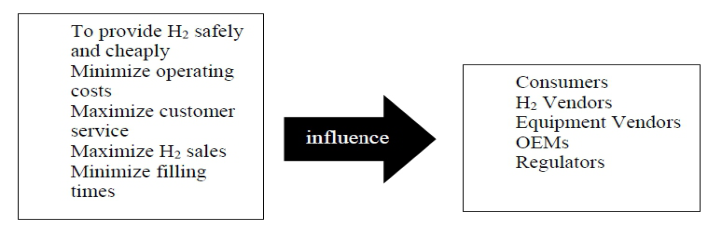
Objectives x Stakeholders Next, the impact of systems objectives and system stakeholders is examined, as shown in Figure 2, below. There are 5 objectives and stakeholders, respectively, meaning that there are 25 possible one-way interactions with systems drivers impacting stakeholders.
84 Walker and El-Sharkh
Figure 2: Objectives x stakeholders.
There are numerous interactions between system objectives and stakeholders. For example, the need to provide H2 cheaply and safely greatly impacts the way H2 producers/vendors provide fuel. Indeed, the need for safety and reduced costs gives rise to safety and handling procedures. This need for safety and cheaper operation also impacts the price of H2. Minimizing operating costs can impact consumers through lower prices, H2 vendors through thinner margins, and equipment producers through the quality and price of H2 equipment. Maximizing customer service may cause consumers to pay a slightly higher price for fuel, but also means that H2 Vendors may need to pay their employees more. Maximizing the sales of H2 while minimizing operating costs means that H2 Vendors need to find an efficient point where they are providing excellent service while not using extra energy or labour. Finally, minimizing filling times impacts all of the stakeholders. For example, reduced filling times require designs from both OEMs and Equipment Vendors that are efficient.
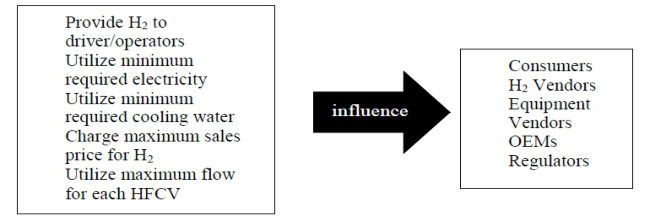
Functions x Stakeholders Next, the impact of systems objectives and system stakeholders is examined, as shown in Figure 3, below. There are 5 objectives and stakeholders, respectively, meaning that there are 25 possible one-way interactions with systems drivers impacting stakeholders.
Figure 3: Functions x stakeholders.
Sociotechnical Challenges in the Implementation of Hydrogen Fuel Cell Trucking 85
Many of the functions directly impact the stakeholders in the system, as expected. For example, using the minimum amount of electricity and water impacts how the H2 producer operates their facility and how the equipment company builds and sells their H2 equipment. The function calling for charging the maximum tolerable sales price certainly impacts the consumer, which in turn can impact the H2 Vendor through a change in demand for fuel. Additionally, the directive to use maximum flow to refill HFCVs reduces consumers’ time and requires vendors to have a greater capacity, which requires a larger upfront cost. The function of using less cooling water not only impacts H2 Vendors, but also impacts Equipment Vendors who must design their equipment to more efficiently use water, and Regulators who ensure that H2 is kept below auto-ignite temperatures.
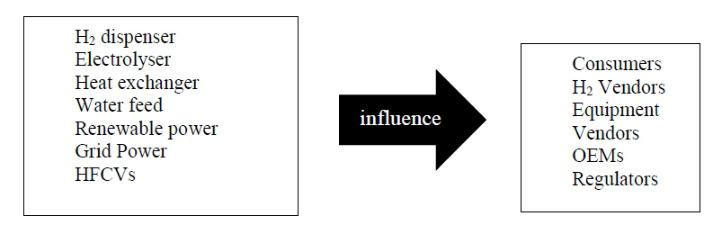
Objects x Stakeholders Next, the impact of systems objectives and system stakeholders is examined, as shown in Figure 4 below. There are 7 objectives 5 and stakeholders, respectively, meaning that there are 35 possible one-way interactions with objects impacting stakeholders.
Figure 4: Objects x stakeholders.
There are numerous impacts by the objects on the stakeholders and many of the stakeholders interact with the physical infrastructure of the system. The performance and design of the H2 dispenser impact how the consumers use it and how the H2 vendor manages the site. Similarly, the design of HFCVs impacts how vendors’ layout and operate their refuelling stations and how equipment for handling and dispensing H2 is used and designed. The performance of the power grid, and renewable power, impacts the reliability of the system – a concern for both consumers and H2 Vendors. The conditions of the water feed impact those that produce the hydrogen – H2 Vendors – and those that make the equipment needed to produce the fuel – Equipment Vendors.
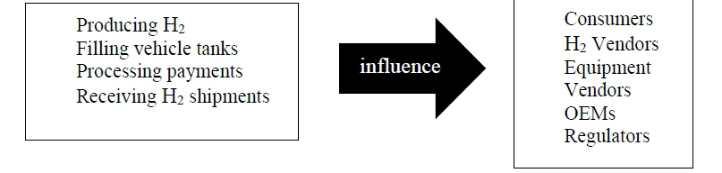
Activities x Stakeholders Finally, systems activities and system stakeholders are examined, as shown in Figure 5. There are 4 activities and 5 stakeholders, respectively, meaning
86 Walker and El-Sharkh
that there are 20 possible one-way interactions with activities influencing stakeholders.
Figure 5: Activities x stakeholders.
Numerous activities that are required to carry out the objectives of the system are done so by stakeholders. These activities, and their safety, efficiency, and ergonomic performance impact stakeholder performance of these tasks. For example, H2 vendors produce the H2 and the impact of these activities on vendors can influence when and how the fuel is produced. The time, safety, and ease of filling vehicle tanks can lead to specific consumer behaviours and preferences, OEM designs, and regulator behaviour. The efficiency of processing payments impacts all stakeholders involved.
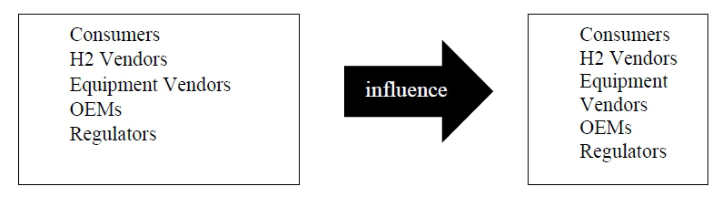
Stakeholders x Stakeholders Stakeholder-stakeholder interactions are illustrated in Figure 6, below. There are 5 stakeholders, giving rise to 25 possible stakeholder interactions.
Figure 6: Activities x stakeholders.
There are numerous stakeholder interactions surrounding the development and operation of hydrogen refuelling stations. The prices set by H2 Vendors impact the shopping behaviour of Consumers. H2 Vendors’ behaviour also impacts Regulators who must regulate the safety and commercial aspects of H2 sales. The demand for H2 by consumers impacts all the other stakeholders by increasing demand for H2 Vendors, Equipment Vendors, and OEMs while also increasing the need for safety regulations from the Regulators.
Sociotechnical Challenges in the Implementation of Hydrogen Fuel Cell Trucking 87
CONCLUSION
Providing sufficient hydrogen infrastructure to sustain the operation of hydrogen fuel cell transport trucks is a challenge, especially in the parts of the United States that have not previously invested in this technology. However, understanding the ways in which stakeholders interact with the systems drivers, objects, objectives, functions, and activities within the hydrogen refuelling systems. Using the Multiple Domain Matrix developed by Bartolomei et al., it is possible to determine the interactions on and by systems stakeholders (Bartolomei, Hastings, de Neufville, & Rhodes, 2012). In the case of hydrogen refuelling, which is a complex sociotechnical system, there are numerous interactions that must be examined to improve the technical, social, and political performance of the system. These interactions, listed in Figures 2 through 6, can provide a basis for creating an agent-based model surrounding the refuelling of hydrogen semi-trucks.
In this study, the authors have gained some insights from the use of the multiple decision matrix. It can be seen that the performance of each of the other aspects of the hydrogen refuelling system has a significant impact on the stakeholders and thus on the overall system viability. Further insights will be gained using the insights gained from multiple decision matrices in an agent- based model with goals of helping solve the problem of hydrogen refuelling infrastructure in the State of Alabama.
REFERENCES
Atabay, R., & Devrim, Y. (2024). Design and techno-economic analysis of solar energy based on-site hydrogen refueling station. International Journal of Hydrogen Energy, 80, 151–160. Bartolomei, J., Hastings, D., de Neufville, R., & Rhodes, D. (2012). Engineering
Systems Multiple-Domain Matrix: An Organizing Framework for Modeling Large-Scale Complex Systems. Systems Engineering, 15(1), 41–61. Guo, J., Kang, X., Susilo, Y., Antoniou, C., & Pernestal, A. (2025). Temporal patterns of user acceptance and recommendation of the automated buses. Travel Behaviour and Society, 38, https://doi.org/10.1016/j.tbs.2024.100909. Handley, H. (2013). Using Architecture Models to Design Adaptive. Complex
Adaptive Systems 2013. Baltimore. Hardman, S., & Steinberger-Wilckens, R. (2014). Mobile phone infrastructure development: Lessons for the development of a hydrogen infrastructure. International Journal of Hydrogen Energy, 39(16), 8185–8193. Langbroek, J., Cebecauer, M., Malmsten, J., Franklin, J., Susilo, Y., & Georén, P.
(2019). Electric vehicle rental and electric vehicle adoption. Research in Transportation Economics, 73, 72–82. Loeb, B., Kockelman, K., & Liu, J. (2018). Shared autonomous electric vehicle (SAEV) operations across the Austin, Texas network with charging infrastructure decisions. Transportation Research Part C: Emerging Technologies, 89, 222–233. Office of Energy Efficiency and Renewable Energy. (2022, February 21). Electric
Vehicle Charging Station Locations. Retrieved February 21, 2022, from https://afdc.energy.gov/fuels/electricity_locations.html#/find/route?fuel=ELEC& start=36695&end=pulaski, %20tennessee&distance=10.
88 Walker and El-Sharkh
United States Department of Energy. (2022). Hydrogen fueling station locations. (Alternative Fuels Data Center: Hydrogen Fueling Station Locations) Retrieved February 8, 2022, from https://afdc.energy.gov/fuels/hydrogen_locations.html#/find/nearest?fuel=HY. Zhang, Q., Li, H., Zhu, L., Campana, P., Lu, H., Wallin, F., & Sun, Q. (2018). Factors influencing the economics of public charging infrastructures for EV – A review. Renewable and Sustainable Energy Reviews, 94, 500–509.
LISTED IN THE AHFE DIGITAL BOOKSTORE CATALOGUE
Explore the complete digital volume
Human Factors in Software and Systems Engineering
Read this individual research paper free through the original publisher, or explore the full digital proceedings book.
ISBN 978-1-964867-57-1
Explore this ISBN in the AHFE Bookstore ↗Listed in the July 2026 bookstore catalogue; search by ISBN to confirm current availability · Digital book purchase optional