Bhushan Lohar, John Wade, Abhishek Mange, Mir Ali, Ryan Colquhoun, Lyliandra Larson (2025). Applying Model-Based Requirement Patterns Library Concept to Astronaut Space Suit System for Deep-Space Travel and Mars Surface Exploration Missions. In: Human Factors in Software and Systems Engineering. AHFE Open Access, vol. 181, pp. 1–12. https://doi.org/10.54941/ahfe1006389
Risk of extinction and survival has always pushed humans to develop new technologies, starting from the innovation of a wheel up to producing advanced materials and alternative energy sources. Becoming a multiplanetary species reduces the risk of extinction from home grown and external threats like nuclear wars, effects from extreme temperature changes, and asteroid impact. Going to Mars is beyond current medical, technological, and economical challenges. A trip to Mars requires over 140 million miles deep-space travel in harsh space environment with no assistance readily available. Similarly, landing, exploring, and returning from Martian surface exposes numerous challenges with extreme uncertainties. Astronauts Space Suit System plays a vital role in all these missions. This paper proposes an analysis of a space suit system that would be suitable for long duration space travel, Extravehicular Mobility Unit (EMU) and surface exploration missions. When designing suits for deep-space space travel and Extravehicular Activity (EVA) on the surface of Mars, it is important to start with the top-level systems requirements, such as life support, mobility, microgravity, human factors, ergonomics, and protection from environmental hazards. To better understand this human systems integration, the designers can utilize Model-Based Systems Engineering (MBSE) with Model-Based Pattern Library (MBPL) concept to specify the necessary requirements for the suits. In this approach, the original requirements are decomposed and translated into Object-Oriented Models (OOMs) that are generated using System Modelling Language (SysML). This paper also demonstrates a unique systems-of-systems approach that combines human health and physiology, system requirement analysis for human factors and ergonomics using MBSE and pattern libraries. Once built, the pattern libraries can be used to develop the various logical architectures for the space suits with mission and program specific requirements.
As humanity pushes new frontiers, we need to consider looking beyond our horizons. While mankind strives to flourish here on Earth, humanity remains vulnerable to the existential risk of extinction via internal threats such as famine or nuclear war, and external threats from extreme temperature changes to asteroid impacts. The current sum of human life does not reach a Type 1 civilization on the Kardashev scale, which means that a civilization is able to access all of the energy available on its planet and store it for consumption (Kardashev, 1964). However, gradual steps have been and are being made for humans to grow into the role of an interplanetary civilization. Since the dawn of civilization, we have looked to the Moon and the stars for guidance, with the hopes to reach them someday. The Gemini and Apollo programs laid out the technological foundations to prove that humans can survive in space and explore other celestial surfaces like Moon. The Space Shuttle and International Space Station (ISS) missions further assisted in studying human behaviours in longer durations stays in microgravity environment. With the Artemis program, humans are going back to Moon for longer durations and can eventually learn how to live and work on another world. In the mid-20th century, that dream became a reality, and humanity emerged out of Earth’s orbit, walked on the Moon, and established a continuous human presence aboard the ISS. These milestones have expanded our understanding of microgravity, life support systems, and the physiological impacts of space travel. However, a Mars mission presents significant medical, technological, and economic considerations. The 140-million-mile deep-space voyage for nine months in a harsh environment, where immediate assistance from Earth is unavailable.
Our journey to Mars is the next critical step in humanity’s evolution and the establishment of a safety net for future generations to come. In order to achieve this goal, the need for systems engineering practices will be applied to design the next generation of mIVA (Mars Intravehicular Activity) and mEMU (Extravehicular Mobility Unit) spacesuits. These spacesuit systems must support astronaut survival and performance during spacecraft ascent, deep-space travel, descent into the Mars atmosphere, and surface operations on Mars. Human exploration of Mars represents a huge undertaking that necessitates decades of research, rigorous testing, and careful design, verification, and validation. This extensive knowledge base is essential for identifying and mitigating the inherent hazards associated with human missions. Extravehicular Activities (EVAs) will be critical for both short- term mission objectives and the long-term success of a Mars mission. These activities necessitate a highly reliable and adaptable mobility unit, the mEMU, to ensure astronaut safety and mission effectiveness. These mEMUs present unique challenges due to extreme environmental factors, the fine regolith of Mars, extreme temperature, and lack of radiation shielding.
The research in this paper aims to address a critical gap in current mEMU development by leveraging Model-Based Systems Engineering (MBSE) principles and System Modelling Language (SysML) to create a comprehensive Model-Based Patterns Library (MBPL) (Lohar, 2022).
This effort will be built upon existing research and address previously identified challenges. The main goal of this research is to define a systems engineering framework for the design and evaluation of this next generation mIVA spacesuits for missions to Mars. The proposed pattern library will enable more effective requirements definition, architectural evaluation, and subsystem integration, which will contribute to a more robust and dependable mEMU, mIVA and other astronaut spacesuits designs. The development of a comprehensive pattern library is the key to reduce development time, improve communication among engineering teams, enhance requirements traceability, facilitate early detection of design flaws, and strengthen the verification and validation processes. This research will define, verify, and evaluate the architecture and performance of mIVA and mEMU spacesuits. While establishing a validation process to evaluate spacesuit performance under mission-specific scenarios. The study highlights the integration of advanced life support, radiation shielding, thermal regulation, mobility, and communication systems to ensure mission success and astronaut safety.
A comprehensive review of existing literature and previously identified challenges was reviewed to pinpoint the most critical design considerations for mEMU and mIVA. The goal of this research will be to determine the optimal approach for addressing each design aspect and achieving the overall comprehensive SysML library that provides a standardized and reusable set of SysML models, which enables engineers to effectively capture and manage the complex interactions and requirements of the mEMU throughout its development process. Developing a comprehensive SysML library for the mEMU and mIVA presents multiple challenges due to the system’s complexity and the need to accurately capture the complex interactions between its subsystems. Further, maintaining scalability for future design changes and establishing consistent modelling standards are also key hurdles.
The physical science and physiology play a critical role in the research and development of Martian spacesuits by analyzing the biomechanical, physiological, and environmental challenges astronauts face in microgravity and reduced-gravity environments. Physical science contributes by studying material durability, thermal regulation, radiation shielding, and ensuring that spacesuit components can withstand extreme Martian conditions. Physiology, on the other hand, encompasses astronaut mobility, muscle atrophy prevention, ergonomic suit design, optimizing movement efficiency, and reducing physical strain during extravehicular activities. For graduate students, this research provides invaluable interdisciplinary studies through conducting experiments in biomechanics and human performance and developing innovative countermeasures for space-induced physiological changes. These contributions will not only advance space exploration but will also translate into practical applications in rehabilitation, robotics-assisted movement, and wearable exoskeleton technologies on Earth.
The research aligns with the objectives of NASA’s Exploration Systems Development and Space Operations mission directorates by directly addressing critical challenges in human space exploration. It contributes to the development of advanced IVA spacesuits necessary for deep-space
missions, ensuring astronaut safety, mobility, and operational efficiency. The research also holds major potential for the mIVA in governmental and commercial space ventures designed for long durations. The contributions would advance the health of astronauts aboard commercial space stations and extend missions in microgravity. During the research, graduate students will acquire expertise in MBSE best practices, SysML modelling, and the formation of complex engineering systems by gathering necessary information regarding the intricate design of spacesuits.
SPACE SUIT SYSTEM EVOLUTION AND DESIGN CONSIDERATIONS The development of space suits for deep-space travel and Mars surface exploration presents numerous challenges due to the unique environmental and functional demands imposed on systems. To systematically address these challenges, the application of MBPL has been proposed to enhance the efficiency and robustness of space suit design. The following literature review examines existing research on space suit systems and their evolution, incorporating model-based approach to optimize design considerations. Space suit design has evolved significantly from early EVA suits for low-Earth orbit (LEO) missions to advanced suits required for lunar and Martian environments. Hill and Johnson (2010) compared different EVA architectures, highlighting the distinct challenges posed by LEO, lunar, and Martian environments. Their research provides a foundational understanding of the requirement variations necessary for deep-space suits and underscores the need for adaptable designs to support long-duration missions and varying planetary conditions. The introduction of robotic exoskeletons in space suit design, such as the X1 robotic exoskeleton developed by Rea et al. (2013), has contributed to advancements in astronaut mobility and countermeasure strategies against muscle atrophy during prolonged missions. Their study detailed the mechanical and software components integrated into the exoskeleton, emphasizing how assistive technology can enhance astronaut performance. The integration of model- based requirement patterns can further enhance the design of such assistive systems, ensuring a balance between flexibility, power efficiency, and biomechanical support. Ross (2016) reviewed the advancements in space suit technologies, particularly for planetary surface exploration. The study emphasized the importance of modular and adaptable suit designs that incorporate feedback from previous missions and simulations, aligning well with model-based approaches to requirement specification. Ross also detailed the development of self-healing materials, improved radiation shielding, and enhanced life support system miniaturization, all of which play critical roles in designing suits for deep-space missions.
Martian Space Suit Requirements and Challenges Lousada et al. (2017) analyzed various approaches to Martian space suit design, focusing on thermal regulation, radiation protection, and mobility enhancements. Their findings support the need for a structured requirement framework to systematically address these design constraints.
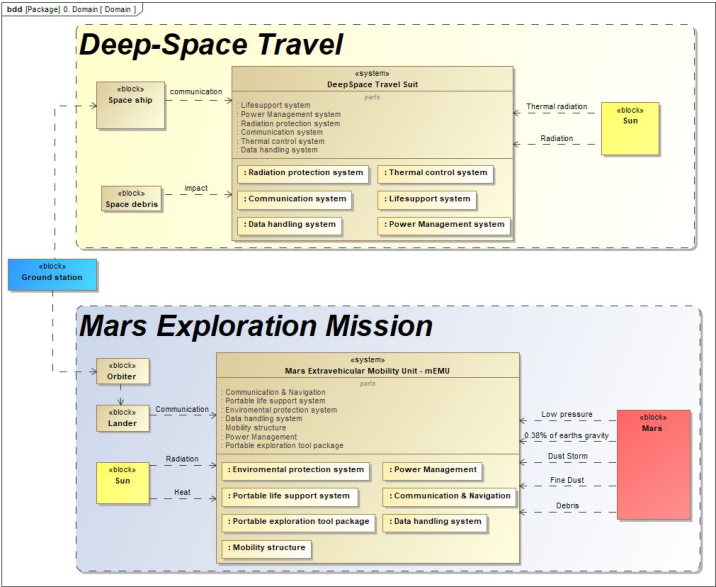
Figure 1: Domain diagram for deep space travel and mars exploration mission spacesuits.
The research outlined different material compositions, pressure regulation techniques, and EVA support systems that contribute to extended operational efficiency on Mars. Similarly, Swatkowski (2020) outlined EVA system technical standards, which serve as a critical reference for developing a requirement patterns library tailored to Mars missions. These standards define specifications for suit flexibility, endurance under extreme temperature shifts, and integration with advanced mission support systems. The impact of Martian dust on space suits and life support systems, as discussed by Simonds (1991), presents another design challenge that necessitates a structured approach to material selection and suit durability. Simonds’ research highlights the abrasive nature of Martian regolith and its potential to degrade fabric layers, seals, and joint mechanisms. This aspect highlights the importance of incorporating requirement patterns that address environmental resilience and longevity, including dust-repellent coatings, self-repairing polymers, and modular component replacement strategies.
Performance Metrics and Optimization McFarland and Norcross (2016) introduced an objective performance metric for space suit mobility based on metabolic cost and functional tasks. Their study identified key movement constraints and metabolic
thresholds that influence astronaut endurance, which will result in optimized requirement modelling via simulations. Carr (2016) examined optimal suit mass considerations for Mars EVA, emphasizing trade-offs between mobility and life support capacity. His results indicate that reducing overall weight while maintaining critical safety features can significantly improve astronaut efficiency and reduce fatigue. These findings contribute to defining requirement patterns that prioritize structural integrity, thermal insulation, and weight distribution. Bayar, Tuzcu, and Kaya (n.d.) provided a comprehensive review of space suit design perspectives, identifying key challenges and future directions. Their insights underscore the relevance of a model-based approach to requirement specification, ensuring that all critical aspects of space suit functionality are systematically addressed. Their work included a comparative analysis of existing designs, highlighting the benefits of integrating AI-driven diagnostics, automated maintenance protocols, and adaptive fit technologies to enhance astronaut comfort and performance.
Cardiovascular Responses to Microgravity & Orthostatic Intolerance Long-duration space missions, particularly deep-space travel and Mars surface exploration, present significant physiological challenges to astronauts. Among these challenges, the effects of microgravity on the cardiovascular system are of paramount importance due to their implications for astronaut health and operational performance. The application of space suit systems that mitigate cardiovascular deconditioning is critical for mission success.
Microgravity induces significant alterations in cardiovascular physiology, including fluid shifts, cardiac atrophy, and orthostatic intolerance upon return to gravity. Van Loon et al. (2022) developed computational models to predict orthostatic intolerance during Mars travel, emphasizing the need for countermeasures such as fluid loading, lower body negative pressure (LBNP), and artificial gravity. Their study provided a detailed analysis of the cardiovascular adaptations astronauts experience, reinforcing the need for space suit systems that integrate mechanical and pharmacological support to stabilize circulatory function. Jordan, Limper, and Tank (2022) examined cardiovascular autonomic nervous system responses and orthostatic intolerance in astronauts, revealing autonomic dysfunction as a critical issue. The authors conducted extensive research on how reduced baroreceptor sensitivity and sympathetic dysfunction lead to cardiovascular instability. They suggest that continuous monitoring and real-time adjustments to suit pressurization and mobility support can help mitigate these effects, improving astronaut endurance and reducing mission risks. Additionally, Patel (2020) reviewed cardiovascular risks associated with space radiation and microgravity. The study analyzed data from various spaceflight missions and highlighted how the absence of gravitational forces affects endothelial cell gene expression and vascular elasticity. These findings indicate the necessity of including pharmacological agents and artificial gravity technologies in space suit systems to mitigate cardiovascular deterioration.
Mechanotransduction and Cardiovascular Adaptations Mechanotransduction, is the process by which cells convert mechanical forces into biochemical signals, plays a fundamental role in cardiovascular homeostasis. Garoffolo and Pesce (2019) explored the impact of altered mechanical stimuli in microgravity, demonstrating that cardiovascular cells lose normal regulatory cues, which leads to deconditioning. Their research detailed how the absence of mechanical load disrupts endothelial shear stress, impairing nitric oxide production and increasing arterial stiffness. Their findings support the integration of mechanostimulation technologies, such as vibration therapy and active compression within space suits to maintain cardiovascular function and prevent long-term vascular complications. Giacinto et al. (2024) investigated the combined effects of cosmic radiation and microgravity on cardiovascular health, emphasizing oxidative stress and inflammation as major contributors to vascular damage. Their research provided molecular-level insights into how prolonged space exposure triggers inflammatory pathways and accelerates atherosclerotic progression. These findings highlight the need for space suits equipped with radiation shielding and biochemical countermeasures, such as antioxidant supplementation and targeted drug delivery systems, to mitigate cardiovascular risks.
Muscle Atrophy, Immobilization, and Cardiovascular Implications Muscle atrophy due to prolonged immobilization further exacerbates cardiovascular deconditioning in space. Liu et al. (2024) outlined the mechanisms of muscle atrophy in microgravity and proposed countermeasures. Their study detailed the metabolic and structural changes that occur in muscle fibers, linking muscle loss to decreased venous return and reduced cardiac preload. These findings reinforce the need for space suits designed with integrated resistance training devices to maintain muscle tone and cardiovascular efficiency. Shi et al. (2024) developed non-invasive electromyography-based methods to assess muscle atrophy, which could be integrated into space suit diagnostics for real-time monitoring of astronaut health. Their study demonstrated how surface electromyography can detect early signs of muscle degradation, allowing for timely intervention. This technology can be embedded in space suit sensors to track muscle function and cardiovascular response dynamically.
Lindgren et al. (2004) identified immobility as a major risk factor for pressure ulcers and vascular complications, underscoring the necessity of active circulation-promoting designs in space suits. Their research, conducted in a clinical setting, provided empirical evidence on how prolonged bed rest leads to deep tissue ischemia and venous thromboembolism. The study’s findings are applicable to spaceflight, where similar conditions prevail due to prolonged microgravity exposure, necessitating the incorporation of adjustable compression garments and mobility aids in space suits. Patel et al. (2020) classified cardiovascular risks among the highest-priority health concerns for Mars missions, advocating for pre-emptive strategies such as pharmacological interventions and adaptive physical conditioning. Their comprehensive review emphasizes the necessity of personalized medicine
approaches in future space suit designs. The integration of individualized medical monitoring and tailored countermeasure deployment in space suits could significantly enhance astronaut safety and performance.
NASA and SpaceX initiatives As humanity prepares for deep-space missions, the development of specialized spacesuits is paramount. These suits must address the unique challenges posed by both IVA within spacecraft and EVA on the Martian surface. The literature review in this paper examines official documentation from NASA and SpaceX concerning the design, functionality, and technological advancements of mIVA and mEMU spacesuits. IVA suits are designed for use within the pressurized environment of spacecraft, providing life support and protection during launch, re-entry, and potential cabin depressurization events. For Mars missions, IVA suits must accommodate prolonged wear, ensure comfort in reduced gravity, and facilitate mobility within confined habitats.
Historically, NASA has utilized suits like the Advanced Crew Escape Suit (ACES) for IVA purposes. The ACES, a full-pressure suit, was employed during Space Shuttle missions to safeguard astronauts during critical mission phases. While the ACES provided essential life support and protection, its design was optimized for short-duration wear within Earth’s orbit (NASA Office of Inspector General, 2017). For extended missions to Mars, NASA recognizes the need for an evolved IVA suit. The Exploration Extravehicular Mobility Unit (xEMU), primarily designed for EVA, incorporates features that could inform next-generation IVA suits. The xEMU emphasizes improved mobility, reduced weight, and enhanced life support systems, all of which are pertinent to IVA suit development for Mars missions (NASA, 2020). SpaceX has introduced modern IVA suits for its Crew Dragon missions. These suits are custom-fitted, flame-resistant, and designed for use during launch and re-entry. They integrate with the spacecraft’s life support systems and feature touchscreen-compatible gloves, facilitating interaction with onboard systems. While these suits are tailored for Earth-orbit missions, their design principles such as integration with spacecraft systems and user comfort provide a foundation for developing mIVA suits suitable for the longer durations and unique challenges of Mars missions.
The EMUs are critical for activities conducted outside the spacecraft, such as surface exploration and scientific experiments. Mars presents a distinct set of challenges, including reduced gravity (approximately 38% of Earth’s), a thin carbon dioxide-rich atmosphere, and pervasive dust. mEMU suits must address these factors to ensure astronaut safety and mission success. NASA’s xEMU serves as a baseline for developing mEMU suits. The xEMU is designed with modularity in mind, allowing for adaptability across different mission environments, including the lunar surface and, prospectively, Mars. The Polaris Dawn mission launched in 2024, tested SpaceX’s new EVA suit during the first private spacewalk. This suit incorporated advancements in materials and life support integration, building upon the company’s IVA suit experience. Insights gained from this mission will inform the
design and functionality of mEMU suits for future Mars missions (Time, 2024). A spacesuit must fulfil three fundamental functions: maintain and monitor astronaut physiological well-being, enabling freedom of movement for mission specific activities, and providing protection against the harsh environment, including thermal extremes, debris, radiation, abrasion, sharp edges, regolith, and rocks.
The development of mIVA and mEMU suits benefits from collaboration between NASA, SpaceX, and other industry partners. NASA’s Artemis program, which aims to return humans to the Moon, serves as a testing ground for technologies and operational concepts applicable to Mars missions. The lessons learned from lunar EVA operations, particularly regarding suit performance and dust mitigation, are directly transferable to Martian exploration (NASA, 2020). Moreover, NASA’s partnerships with commercial entities, exemplified by contracts awarded to companies like Axiom Space for the development of advanced EVA suits, foster innovation and accelerate the maturation of technologies critical for Mars exploration (Axiom Space).
MBSE IN MARTIAN SPACESUIT DESIGN Martian exploration presents unprecedented challenges for space suit design, necessitating a structured and systematic approach to specifying requirements. MBSE combined with a MBPL, provides a robust framework for defining, analyzing, and validating these requirements (Lohar & Cloutier, 2022). MBSE facilitates an integrated, model-driven methodology that improves traceability, consistency, and adaptability in designing complex systems such as Martian spacesuits. MBPL, a repository of reusable requirement patterns, further enhances the efficiency and accuracy of requirement definition by leveraging past experiences and validated design principles. MBSE employs digital models to represent system architecture, performance, and interactions. By using modelling languages such as SysML, it enables engineers to create interconnected diagrams that describe system behavior, structure, and constraints. This approach is crucial for developing Martian spacesuits, which require multidisciplinary integration across materials science, robotics, life support systems, and human factors engineering. MBSE ensures that every requirement, from mobility and life support to radiation protection, is traced throughout the design process. This traceability improves verification and validation, reducing design flaws.
Through early simulation and testing using digital twins and simulation environments, MBSE enables engineers to evaluate and refine spacesuit designs before physical prototyping. This reduces costs and development time. Martian spacesuit design involves diverse domains, including material durability (Simonds, 1991), cardiovascular considerations (Jordan et al., 2022), and EVA mobility (McFarland & Norcross, 2016). Given the iterative nature of space technology development, MBSE supports systematic updates and refinements based on new findings from Artemis and Mars missions. MBPL consists of reusable requirement patterns that serve as templates for defining system functionalities, constraints, and performance criteria. These
patterns are derived from previous space suit designs, NASA’s Exploration EVA System Standards (Swatkowski, 2020), and best practices in human spaceflight. This spacesuit development process can benefit from continuous updates as new research emerges. For instance, results from the Polaris Dawn EVA tests (Time, 2024) and NASA’s Artemis III lunar EVAs will inform refinements in mobility and life support technologies. Additionally, MBSE’s simulation capabilities can validate MBPL-defined requirements in Mars analogous environments before final implementation.
CONCLUSION
The integration of model-based requirement patterns into space suit system design for deep-space and Mars exploration offers a structured methodology to address complex design challenges. By leveraging existing research on space suit advancements, mobility metrics, and environmental considerations, MBPL can enhance the efficiency and adaptability of future EVA systems. The reviewed literature demonstrates the necessity of a systematic approach that ensures that space suits are optimized for performance, safety, and mission success. Future research should focus on refining simulation models, expanding material science innovations, and integrating real-time monitoring systems to ensure the continued evolution of space suit technology.
The cardiovascular challenges posed by microgravity and deep-space missions necessitate the development of advanced space suits with integrated countermeasures. By incorporating findings from computational modelling, autonomic regulation, mechanotransduction, and muscle atrophy research, space suit systems can be optimized to maintain astronaut health and mission performance. Future research should focus on real-time physiological monitoring, adaptive compression systems, and enhanced countermeasure integration to mitigate cardiovascular risks in space exploration. Continued advancements in biomedical engineering and materials science will be essential in designing next-generation space suits capable of supporting long-duration space travel. The successful exploration of Mars necessitates the development of specialized mIVA and mEMU spacesuits that address the planet’s unique environmental and operational challenges. NASA’s ongoing advancements with the xEMU, combined with SpaceX’s innovative approaches to suit design, contribute to a robust foundation for the suits that will one day enable humans to live and work on the Martian surface. The application of MBSE and MBPL in Martian spacesuit development offers a structured and efficient approach to defining, analyzing, and refining requirements. MBSE ensures traceability, integration, and validation, while MBPL leverages past expertise to streamline the requirement specification process. As Mars exploration advances, this combined approach will be instrumental in developing safe, dependable, and adaptable spacesuits for deep-space missions.
Axiom Space. Axiom Suit. Retrieved from https://www.axiomspace.com/axiom-suit. Bayar, B., Tuzcu, G., & Kaya, G. Space Suit Design: A Review of Current State and Perspectives on Requirements and Challenges. Carr, C. E. (2016, March). Optimal space suit mass for mars extravehicular activity.
In 2016 IEEE Aerospace Conference (pp. 1–10). IEEE. Giacinto, O., Lusini, M., Sammartini, E., Minati, A., Mastroianni, C., Nenna, A.,... & Pelliccia, F. (2024). Cardiovascular effects of cosmic radiation and microgravity. Journal of Clinical Medicine, 13(2), 520. Garoffolo, G., & Pesce, M. (2019). Mechanotransduction in the cardiovascular
system: From developmental origins to homeostasis and pathology. Cells, 8(12), 1607. Hill, T. R., & Johnson, B. J. (2010, March). EVA space suit architecture: Low earth orbit vs. moon vs. mars. In 2010 IEEE Aerospace Conference (pp. 1–28). IEEE. Jordan, J., Limper, U., & Tank, J. (2022). Cardiovascular autonomic nervous system
responses and orthostatic intolerance in astronauts and their relevance in daily medicine. Neurological Sciences, 43(5), 3039–3051. Kardashev, N. S. (1964). Transmission of Information by Extra-terrestrial Civilizations. Soviet Astronomy, Vol. 8, p. 217. Lohar, B. R. (2022). Development of new space systems architecture in SysML using model-based pattern language (Doctoral dissertation, University of South Alabama). Lohar, B., & Cloutier, R. (2022). Towards a Model-Based Pattern Language for New
Space-Based Systems. Lousada, J., Kamaletdinova, G. R., Patel, D., Lakmal, Y., Oluwafemi, F. A., De La Torre, A., & Skvortsov, S. A. (2017). Approaches and solutions for Martian spacesuit design. In Proceedings of the International Astronautical Congress, IAC (pp. 228–241). McFarland, S. M., & Norcross, J. (2016, July). Development Of an Objective Space
Suit Mobility Performance Metric Using Metabolic Cost and Functional Tasks. In International Conference on Environmental Systems (No. ICES-2016-278). NASA. (2020). Exploration EVA System Concept of Operations. Retrieved from https://www.nasa.gov/wp-content/uploads/2017/02/eva-exp-0042_xeva_system_ con_ops_rev_b_final_dtd_10192020_ref_doc.pdf. NASA Office of Inspector General. (2017). NASA’s Management and Development
of Spacesuits (IG-17-018). Retrieved from https://oig.nasa.gov/docs/IG-17- 018.pdf. Patel, Z. S., Brunstetter, T. J., Tarver, W. J., Whitmire, A. M., Zwart, S. R., Smith, S.
M., & Huff, J. L. (2020). Red risks for a journey to the red planet: The highest priority human health risks for a mission to Mars. npj Microgravity, 6(1), 1–13. Patel, S. (2020). The effects of microgravity and space radiation on cardiovascular health: From low-Earth orbit and beyond. IJC Heart & Vasculature, 30, 100595. Rea, R., Beck, C., Rovekamp, R., Neuhaus, P., & Diftler, M. (2013). X1: A robotic
exoskeleton for in-space countermeasures and dynamometry. In AIAA space 2013 conference and exposition (p. 5510). Ross, A. (2016). Advanced Space Suits (No. JSC-CN-36470). Shi, L., Hong, Y., Zhang, S., Jin, H., Wang, S., & Feng, G. (2024). Non-Invasive and Quantitative Evaluation for Disuse Muscle Atrophy Caused by Immobilization After Limb Fracture Based on Surface Electromyography. Diagnostics, 14(23), 2695.
Simonds, C. H. (1991). Impact of Mars sand on dust on the design of space suits and life support equipment: A technology assessment. NASA. Ames Research Center. Swatkowski, J. (2020). Extravehicular Activity (EVA) Office Exploration EVA
System Technical Standards (No. EVA-EXP-0034/Revision B). Time. (2024, September 10). Polaris Dawn Sets New Space Altitude Record—and There’s More to Come. Retrieved from https://time.com/7020171/polaris-dawn- sets-new-space-altitude-record/. Van Loon, L. M., Steins, A., Schulte, K. M., Gruen, R., & Tucker, E. M.
(2022). Computational modeling of orthostatic intolerance for travel to Mars.npj Microgravity, 8(1), 34.
LISTED IN THE AHFE DIGITAL BOOKSTORE CATALOGUE
Explore the complete digital volume
Human Factors in Software and Systems Engineering
Read this individual research paper free through the original publisher, or explore the full digital proceedings book.
ISBN 978-1-964867-57-1
Explore this ISBN in the AHFE Bookstore ↗Listed in the July 2026 bookstore catalogue; search by ISBN to confirm current availability · Digital book purchase optional