Omar Huerta, Dipo Olaosun, Jonathan Biner, Tauqeer Ali Khan, Peter Culmer (2026). Framework to Support SMEs Transition from Traditional to Connected Smart Medical Devices: Value Creation Through Data and Enhanced User Experience. In: Human Interaction and Emerging Technologies (IHIET 2026). AHFE Open Access, vol. 236, pp. 389–400. https://doi.org/10.54941/ahfe1008114
The medical device industry is undergoing a transformative shift, driven by the integration of connectivity, data analytics, and user-centered design. While large corporations are increasingly adopting smart and embedded medical systems, small and medium-sized enterprises (SMEs) often face significant barriers in this transition due to limited resources, limited hardware-software co-design expertise, fragmented knowledge, and regulatory complexity. This paper presents the design of a new comprehensive framework adapted to support SMEs in evolving from traditional standalone medical devices to connected Internet of Things (IoT)-enabled embedded medical device systems. The proposed framework integrates technological, organizational, and human-centered dimensions to guide SMEs through critical stages of transformation, including digital capability assessment, data strategy and interoperability across ecosystems, and stakeholder experience optimization. By enabling SMEs to harness the full value of data generated by connected embedded devices, the framework supports evidence-based decision-making, predictive maintenance, personalized healthcare solutions, and enhanced collaboration across the medical ecosystem. Further, emphasizing the co-creation value among diverse stakeholders including patients, clinicians, manufacturers, and regulators through improved user experience and data-driven insights. An iterative design approach combines literature analysis, expert consultations, and case study validation within the medical device industry. Results demonstrated potential to accelerate digital transformation, reduce innovation risks with embedded systems, and foster sustainable competitiveness among SMEs in the emerging smart healthcare landscape.
The healthcare digital technologies industry is rapidly evolving through data analytics, and networked systems to redefine how care is delivered and experienced. The growing demand for personalized care has accelerated the need for medical devices capable of continuously monitoring health parameters, providing real-time feedback, and adapting to individual users’
physiological and behavioural patterns (Topol, 2019; Kirubakaran, 2025). This shift from standardized treatment models to data-driven and patient- specific healthcare underscores the strategic importance of IoT-based smart medical device systems. These devices enable predictive diagnostics, remote monitoring, and personalized interventions that improve clinical outcomes and efficiency. However, small and medium-sized enterprises (SMEs), which represent a substantial share of the medical technology ecosystem, face distinctive challenges in capitalizing on these opportunities. Barriers such as limited digital capabilities, data governance expertise, a highly regulated complex market, and resource constraints hinder their ability to transition from traditional to connected medical device models (European Commission, 2020; Kaplan et al., 2022). In this context, Design emerges as a pivotal discipline to bridge the gap between technology potential and real-world adoption. Traditionally perceived as a matter of aesthetics and usability, design in healthcare has evolved into a multidisciplinary field that integrates digital technology, engineering, behavioural science, and systems thinking. User Experience (UX) methodologies are increasingly relevant for creating functional, compliant, intuitive, safe, and emotionally engaging solutions (Norman, 2013; Bate and Robert, 2007). UX approaches help to identify user pain points, reduce cognitive load, and foster trust in connected medical devices, factors that are essential for both patient adherence and clinical acceptance (Singh, 2024). UX enhances accessibility and inclusivity, ensuring devices cater to diverse user groups with varying levels of digital literacy, mobility, and cognitive ability. In the context of connected human interfacing devices, UX plays a pivotal role in transforming complex technical systems into meaningful experiences.
Combining UX with Human-Centered Design (HCD) offers a structured way to embed stakeholder insight throughout innovation (ISO 9241-210, 2019; Organización Internacional de Normalización, 2010). HCD promotes iterative engagement with patients, clinicians, caregivers, engineers, and regulators to align connected IoT medical devices with real needs, safety requirements, and user well-being (Giacomin, 2014). For SMEs, this approach can reduce innovation risk, improve usability, support adoption, and strengthen competitiveness in the connected healthcare ecosystem.
BACKGROUND AND EMBEDDED SYSTEMS FRAMEWORK Design research, human factors engineering, and health informatics provides a rich interdisciplinary framework for UX in healthcare. HCD principles, long used in consumer product development, is now helping healthcare technologies better fit users’ needs, abilities, and real-world context. Health informatics integrates clinical data into user-friendly digital platforms, while human factors research emphasizes safety, usability, and cognitive load reduction. Edge IoT devices must balance computational performance,
Framework to Support SMEs Transition 391 security, real-time responsiveness, and interoperability across heterogeneous clinical ecosystems. An interdisciplinary approach can support the development of intelligent, user-centred healthcare systems that are robust, scalable, and suitable for deployment in clinical settings. The framework aspires to provide SMEs with practical guidance for embedding connectivity, interoperability, and value creation into their innovation processes.
RESEARCH AIM AND OBJECTIVES This research aims to create a comprehensive framework that helps SMEs in the medical device industry scale and grow from traditional products to connected IoT and smart devices. The framework seeks to enable enterprises to harness the full potential of data generated through device connectivity into actionable insights that enhance clinical decision-making, operational efficiency, and user experience.
Through the aims and objectives, the research addresses two core challenges. Digital capability and transformation. Many SMEs lack technological and organizational readiness to adopt connected systems (expertise in data governance, cybersecurity, and interoperability) Existing design methods often fail to fully integrate user experience and stakeholder insights, leading to products that may meet technical requirements but fall short in accessibility, emotional resonance, or ease of use. While connected devices can generate large volumes of data, SMEs often lack structured methods to extract, interpret, aggregate and utilize this data to create value for users and business stakeholders alike.
Current barriers faced by SMEs in transitioning toward connected and smart medical devices were analyzed. This required evaluation of best practices and success factors from existing literature and case studies that demonstrate how design methodologies can enhance user experience and stakeholder engagement in healthcare innovation. A conceptual framework was developed that integrates design-led innovation, data strategy, and digital capability building to guide SMEs in their transformation journey towards connected embedded IoT Systems. The framework was piloted through a case-based application within an SME context to ensure its relevance, feasibility, and adaptability.
METHODOLOGY
This study adopts an applied research approach aimed at developing and validating a practical framework to support SMEs in transitioning toward connected and smart medical devices.
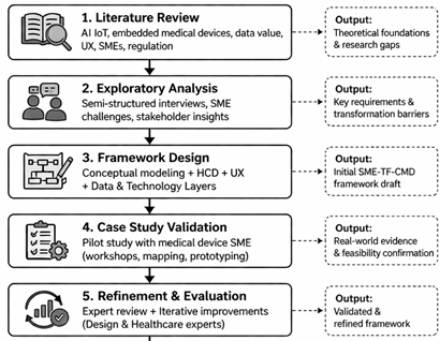
Figure 1: Research methodology - SME-TF-CD framework.
The framework will be designed using design science research (DSR) principles (Hevner et al., 2004), ensuring a balance between theoretical grounding and practical utility. Iterative co-design sessions with industry participants and design experts will be employed to refine the framework structure, ensuring alignment with real SME contexts and regulatory constraints. The methodology combines qualitative and design-based research methods within an iterative, human-centered process. The research design is structured into four interrelated phases (Fig. 1): (1) exploratory analysis, (2) framework design, (3) validation, and (4) refinement and evaluation. Each phase builds upon the previous ensuring that the emerging framework remains grounded in empirical insights, stakeholder perspectives, and real- world applicability.
Exploratory Analysis A focus on developing a comprehensive understanding of the current state, needs, and challenges of SMEs within the medical device sector. A systematic literature review is conducted to identify trends in connected medical device innovation, digital transformation barriers, and design-led approaches in healthcare. This will be complemented by semi-structured interviews with key stakeholders, engineers, regulatory experts, and healthcare professionals at a case study of the SME. The objective is to identify both the technological and human factors influencing SMEs’ ability to adopt connectivity, such as digital maturity, cybersecurity readiness, and UX integration. Data collected will be thematically analyzed to extract insights that inform the framework’s foundational components.
Framework Design Building upon Phase 1, a conceptual framework will be developed to guide SMEs through the transition process. The framework will integrate core dimensions: Digital Enablement, focusing on infrastructure and cybersecurity
Framework to Support SMEs Transition 393 readiness, Integration incorporating UX and HCD methodologies to capture stakeholder needs, usability goals, and emotional impact. Data Value Creation, addressing mechanisms for transforming device-generated data into actionable insights for improved clinical outcomes and business value.
Validation To evaluate the feasibility and effectiveness of the proposed framework, validation activities will be carried out through targeted case studies and expert evaluations. Selected SMEs within the medical device sector are engaged to pilot specific components of the framework such as stakeholder mapping tools, data strategy guidelines, or UX evaluation methods. Data from these pilots will be collected through observation, interviews, and workshops, focusing on usability, adaptability, and perceived value. In parallel, expert panels comprising academics, regulators, and industry professionals will assess the framework’s completeness, coherence, and scalability. Feedback will be systematically analyzed to identify strengths, weaknesses, and improvement opportunities.
Refinement and Evaluation Insights from the validation phase informed refinement of the framework. An emphasis will be placed on ensuring that the framework supports replicability, scalability, and regulatory compliance for SMEs operating across diverse healthcare markets. The evaluation will consider both process outcomes (e.g., improved design capability, stakeholder engagement) and impact outcomes (e.g., enhanced user experience, better data utilization, and readiness for connected device deployment). The final version of the framework will be presented as a guidance tool, combining practical checklists, design prompts, and data strategy templates that SMEs can adopt or adapt based on their maturity level.
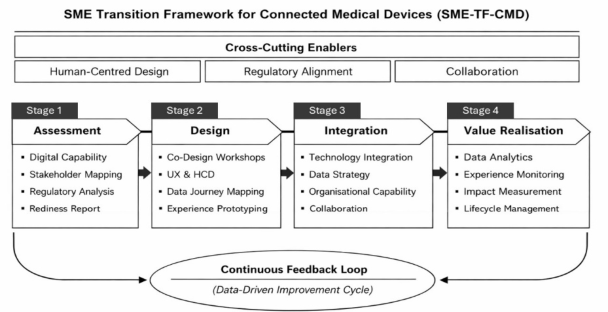
FRAMEWORK STRUCTURE AND COMPONENTS The proposed framework, “Medtech IOT Adoption Framework’ (MIOTA), has been designed to guide SMEs’ through a structured process of transformation from the production of traditional medical devices to the development and commercialization of connected/ smart medical devices. The framework integrates technological, organizational, and human-centered design dimensions, ensuring strategic alignment of innovation efforts with stakeholder needs, regulatory compliance, and data-driven value creation (see Fig. 2 below).
Figure 2: MIOTA framework steps.
Comprised of four distinct stages: assessment, design, integration, and value realization supported by cross-cutting enablers such as capability building, stakeholder engagement, and regulatory alignment. Each stage includes goals, tools, and outcomes to systematically guide SMEs through their transition journey.
Stage 1: Assessment, Understanding Readiness and Context Establishes a baseline understanding of an SME’s technical and operational capabilities, resources, and ecosystem context to determine digital maturity and organizational and technology readiness. It involves assessing software/ hardware, infrastructure, connectivity, cybersecurity, and data management capabilities using adapted maturity models, alongside stakeholder mapping through HCD methods. A concurrent regulatory and market analysis reviews key standards (e.g., MDR, ISO 13485, ISO 14971, ISO 9241-210) and identifies opportunities for connected health solutions. The outcome is a readiness report highlighting critical gaps and opportunities across technological, organizational, and human-centered domains
Stage 2: Design, Co-creating Connected Device Concepts The design stage applies HCD and UX approaches to co-create connected device solutions that are meaningful, usable, and engaging. Through co-design workshops, multidisciplinary teams collaboratively generate concepts, explored using low and high-fidelity prototypes to simulate user interaction with connected features. These concepts are refined through usability testing and risk assessment, while data journey mapping ensures transparent, secure, and ethical data flows across the system. The outcome is a set of validated design concepts that integrate connectivity with clear user value and compliance considerations.
Framework to Support SMEs Transition 395 Stage 3: Integration, Building Digital and Organisational Capabilities
This stage focuses on implementing the designed solutions through scalable technological integration and organizational development. It includes selecting and deploying appropriate software, communication technologies, cloud systems, and cybersecurity measures aligned with regulatory requirements such as GDPR and ISO/IEC, 27001 & 62304. A structured data strategy is developed to support data governance and analytics, while training initiatives enhance digital literacy and foster agile, design-led practices within teams. Collaboration with external partners further strengthens innovation capacity. The outcome is operational readiness supported by infrastructure, skilled personnel, and effective data governance.
Stage 4: Value Realisation, Leveraging Data and Enhancing User Experience Stage 4 emphasizes continuous value creation through data-driven insights and ongoing improvement. Analytics are applied to device-generated data to inform clinical decisions, operational performance, and strategic development, while user feedback mechanisms support continuous evaluation of usability and engagement. Sustainability and lifecycle considerations are integrated to ensure long-term compliance and responsible innovation. Impact is measured through both qualitative and quantitative indicators, including user outcomes and organizational performance. The result is a feedback- driven ecosystem that enables continuous refinement and sustainable value creation from connected device adoption.
Framework Summary The MIOTA provides a holistic and adaptable roadmap for SMEs to navigate the technological, organizational, and human complexities of digital transformation in the medical device sector. By positioning design and data as strategic assets, the framework enables SMEs to move beyond compliance- driven development toward experience-centered innovation. It bridges the gap between technological capability and human value, empowering SMEs to contribute meaningfully to the evolution of personalized, connected healthcare ecosystems.
DISCUSSION
The integration of UX methodologies into medical application design highlights three key imperatives: human-machine symbiosis, context-aware adaptability, and participatory co-design. Applications must facilitate intuitive interactions between users and autonomous systems with adaptability to varied user and clinical contexts and involve users throughout design to build relevance, trust, and adoption. Our case analysis demonstrates how that feedback loops and adaptive interfaces improve responsiveness, while
real-time performance data strengthens shared understanding among clinicians, patients, and intelligent systems.
Throughout all four stages, the framework is supported by three cross- cutting enablers that ensure cohesion and sustainability:
1. HCD Integration: Embedding empathy-driven, iterative design processes across every stage to maintain focus on stakeholder needs and usability outcomes. 2. Regulatory and Ethical Alignment: Ensuring that design and data practices comply with medical device regulations, ethical data use standards, and international interoperability requirements. 3. Collaborative Learning and Knowledge Sharing: Creating mechanisms for SMEs to share experiences, tools, and best practices across networks and clusters to accelerate collective learning and industry-wide transformation.
In the context of Industry 5.0, the co-design of healthcare applications requires a shift from system-driven optimization to human-centered adaptation. UX design serves as the bridge between technical capability and user satisfaction. By incorporating adaptive feedback loops, real- time personalization, and transparent data visualization, future health applications can serve both clinical accuracy and patient empowerment. UX methodologies support the ethical implementation of AI in healthcare by ensuring accountability, explainability, and inclusivity. This research contributes to alleviating the broader discourse on digital health innovation by articulating design principles that uphold resilience, ethical alignment, and user trust.
The proposed SME Transition Framework MIOTA provides a structured, design-led pathway for SMEs to navigate the complexities of digital transformation within the medical technology sector. The framework’s emphasis on Human-Cantered Design (HCD), User Experience (UX) methodologies, and data value creation respond to an urgent need in healthcare innovation: the alignment of technological capability with human needs and regulatory expectations. This section discusses the implications of the framework, its contribution to theory and practice, and its relevance to the evolving healthcare landscape.
Bridging the Gap Between Technology and Human Experience A key insight from this research is that the transition to connected medical devices is not only a technological challenge but a socio-technical transformation (Greenhalgh et al., 2017; Sony and Naik, 2020). SMEs often prioritize engineering and compliance while overlooking the emotional, cognitive, and experiential factors that shape adoption and sustained use (Jones, Clarke and Wilson, 2020). By embedding HCD and UX throughout the framework, SMEs are encouraged to engage stakeholders from ideation to post-market monitoring so connected solutions deliver genuine value and trustworthiness.
Framework to Support SMEs Transition 397 This design-led perspective reflects growing recognition that experience- based innovation can improve safety, accessibility, and user satisfaction in healthcare (Bate and Robert, 2007). When connected devices feel intuitive and empowering, adherence and data reliability improve, strengthening both patient outcomes and clinical decisions. HCD fosters empathy and inclusivity by involving diverse users and designing for differences in age, ability, and digital literacy (Giacomin, 2014). The result is improved usability and a broader sense of psychological comfort and emotional connection with medical technologies.
Empowering SMEs for Digital Transformation Another contribution of MIOTA is its recognition of the systemic barriers SMEs face in adopting digital health technologies, including limited analytics expertise, financial constraints, and fragmented understanding of interoperability and cybersecurity (European Commission, 2020; Kaplan et al., 2022). By offering a staged roadmap assessment, design, integration, and value realization the framework supports incremental transformation with clear priorities and feedback mechanisms. It also treats data as a strategic asset, rather than a by-product of device operation enabling SMEs to build governance and analytics capabilities that support predictive maintenance, adaptive features, regulatory evidence, and also continuous improvement (Riazi et al., 2021; Tortorella et al., 2020).
From an organizational perspective, the framework’s emphasis on collaborative learning and ecosystem engagement supports SMEs overcoming isolation and limited resources. Partnerships with universities, technology providers, and clinical institutions can accelerate knowledge transfer and innovation. This reflects open innovation and co-creation approaches that emphasize value creation across stakeholder networks (Chesbrough, 2020).
Enhancing UX and Regulatory Compliance Integrating HCD and UX within the regulatory landscape also offers strategic benefits. Medical device standards increasingly emphasize usability engineering and post-market surveillance related to user interaction and safety (ISO 9241-210:2019; FDA, 2023). MIOTA treats these design practices not only as compliance requirements but also as opportunities to build trust, strengthen regulatory submissions, and improve product quality and brand reputation.
By integrating data ethics and user consent into design decisions, SMEs can build long-term trust and reduce reputational risk. This reinforces that user experience in connected healthcare depends on data integrity and privacy protection (Glikson and Woolley, 2020).
Theoretical and Practical Implications Theoretically, this research extends the application of HCD frameworks beyond product usability into strategic organizational transformation,
demonstrating how design can serve as an integrative mechanism connecting engineering, business strategy, and user experience within healthcare SMEs. It introduces the MIOTA framework with a structured HCD-based approach that supports SMEs in adopting connected medical devices while aligning innovation with stakeholder needs, regulatory requirements, and sustainable value creation.
MIOTA positions design as a strategic enabler of digital transformation rather than a downstream activity. Through four stages assessment, design, integration, and value realization the framework helps SMEs evaluate readiness, co-create user-centred solutions, develop digital capabilities, and generate clinical and business value from device data. Cross-cutting enablers, including HCD integration, regulatory and ethical alignment, and collaborative learning, support scalability, adaptability, and responsible implementation.
From a practical standpoint, the framework offers actionable guidance for SMEs introducing connectivity and smart features without compromising usability, safety, or trust. Its promotes participatory design, data governance, and analytics enables organizations to transform device-generated data into meaningful outcomes. The framework also highlights the importance of training, funding, and innovation networks in strengthening SME digital and design capabilities.
Theoretically, this study advances research on design-led digital transformation in healthcare by embedding HCD within a strategic framework for SMEs. It contributes to literature on experience-based innovation, Industry 4.0 adoption, and connected healthcare ecosystems, showing how design and data strategy can jointly drive innovation in regulated, high-stakes environments.
Despite these contributions, broader validation is needed. Future research should include longitudinal and multi-case studies to evaluate impacts on innovation speed, user satisfaction, market access, and regulatory efficiency. Further work should also explore digital readiness tools, decision-support systems, and emerging issues such as AI, interoperability, cybersecurity, data ownership, algorithmic transparency, and patient trust. Finally, deeper investigation into the ethical and social implications of data-driven medical devices particularly issues of data ownership, algorithmic transparency, and patient trust will be critical to ensuring that digital healthcare innovation remains equitable and human-centered
CONCLUSION
Design for healthcare must evolve alongside emerging technologies, with UX methodologies playing a central role in creating accessible, effective, and emotionally resonant healthcare experiences. As Industry 5.0 reshapes the healthcare landscape, co-designed, user-centered digital tools will be key to achieving intelligent, resilient, and human-centric care systems. This work highlights the importance of participatory design and real-time data integration in aligning healthcare applications with both human needs and machine performance.
Framework to Support SMEs Transition 399 By positioning design as a strategic driver rather than a downstream activity, the proposed framework empowers SMEs to align product development with stakeholder needs, regulatory standards, and emerging opportunities for data-driven value creation. The outcome is a pathway for SMEs to evolve into human-centered, digitally capable organizations that can actively participate in the next generation of innovative smart healthcare solutions. The MIOTA provides a foundational step toward enabling SMEs to participate meaningfully in the emerging ecosystem of personalized, connected healthcare. By uniting design thinking, digital capability building, and stakeholder engagement, it empowers SMEs to transition from reactive device manufacturers to proactive innovators who generate clinical, economic, and social value. Ultimately, the framework underscores that the future of connected medical devices will not be defined by technology alone but by the thoughtful integration of human experience, data ethics, and collaborative innovation.
REFERENCES
Bate, P. and Robert, G. (2007) Bringing user experience to healthcare improvement: The concepts, methods and practices of experience-based design. Oxford: Radcliffe Publishing. Chesbrough, H. (2020) Open Innovation Results: Going Beyond the Hype and
Getting Down to Business. Oxford: Oxford University Press. European Commission (2020) SME Strategy for a sustainable and digital Europe. FDA (2023) Applying Human Factors and Usability Engineering to Medical Devices: Guidance for Industry and FDA Staff. Silver Spring, MD: U.S. Food and Drug Administration. Giacomin, J. (2014) ‘What is human centred design?’, The Design Journal, 17(4),
pp. 606–623. Glikson, E. and Woolley, A.W. (2020) ‘Human trust in artificial intelligence: Review of empirical research’, Academy of Management Annals, 14(2), pp. 627–660. Greenhalgh, T., Wherton, J., Papoutsi, C. et al. (2017) ‘Beyond adoption: A new
framework for theorizing and evaluating nonadoption, abandonment, and challenges to scale-up of healthcare technologies’, Journal of Medical Internet Research, 19(11), e367. Hevner, A.R., March, S.T., Park, J. and Ram, S. (2004) ‘Design science in information systems research’, MIS Quarterly, 28(1), pp. 75–105. doi:10.2307/25148625. ISO 9241-210 (2019) Ergonomics of human-system interaction – Human-centred
design for interactive systems. Jones, S., Clarke, D. and Wilson, J. (2020) ‘User experience in connected medical devices: A review of challenges and opportunities’, Journal of Medical Engineering & Technology, 44(8), pp. 467–479. Kaplan, A., Patel, V. and Smith, L. (2022) ‘Digital transformation challenges for
SMEs in medical technology’, Health Technology Innovation, 6(2), pp. 155–167. Kirubakaran, D. (2025) ‘Review on Emerging Frontiers in Medical Sensing: Innovations Shaping the Future of Healthcare’, Biomedical Materials & Devices, pp. 1–21. Norman, D.A. (2013) The design of everyday things. Revised and expanded edn.
New York: Basic Books.
Organización Internacional de Normalización (2010) Ergonomics of Human-system Interaction: Human-centred Design for Interactive Systems. Geneva: ISO. Riazi, H., Larsson, A. and Broman, G. (2021) ‘Data-driven healthcare: The role of
connected medical devices in personalized medicine’, Frontiers in Digital Health, 3, 667845. Singh, J. (2024) ‘Challenges with Medical Devices Connected To Hospital Network’, International Journal for Research in Applied Science & Engineering Technology, 12(VI). Sony, M. and Naik, S. (2020) ‘Industry 4.0 integration with socio-technical systems
theory: A systematic review and proposed theoretical model’, Technology in Society, 61, 101248. Topol, E. (2019) Deep medicine: How artificial intelligence can make healthcare human again. London: Hachette UK. Tortorella, G. et al. (2020) ‘Digital transformation in manufacturing: The role of
Industry 4.0 technologies in lean production systems’, Technological Forecasting and Social Change, 159, pp. 120–199.
SEARCH THE AHFE DIGITAL BOOKSTORE BY ISBN
Explore the complete digital volume
Human Interaction and Emerging Technologies (IHIET 2026)
Read this individual research paper free through the original publisher, or explore the full digital proceedings book.