Jing Luo, You Wang, Zhao Xinyu, Jiatai Zhang (2022). A new conceptual design for subsea charging station. In: Human Factors in Software and Systems Engineering. AHFE Open Access, vol. 61, pp. 9–14. https://doi.org/10.54941/ahfe1002516
With deepening ocean development , a larger scale Internet of Underwater Things (IoUT) is being realized[1].More and more underwater equipment is being deployed, various ocean monitoring equipment, underwater robots and underwater group sites amongst others, all of which will be working in the deep sea for long periods of time in the foreseeable future[2].Due to the increasing working time and power consumption, it has become difficult for the high energy batteries carried by these facilities to cover their energy needs [3]. Therefore, it is necessary to solve the problem of electrical energy replenishment for underwater equipment.Based on Equinor’s Underwater Intervention Drone (UID) standard interface definition, Blue Logic have produced the world's first three universal, open-standard subsea drone docking stations.But this is not perfect, in the face of deeper waters, more complex multi-shape deep sea equipment charging needs, the current program is not enough to solve[4].Therefore, based on the IoUT scenario positioning, this research designs a subsea charging station that can serve multiple devices.The concept is similar to a land-based collection station for power banks, providing multiple sub-charging equipment that can be carried on the move to charge multiple subsea equipments of different types simultaneously.It also uses ocean energy to provide in-situ produced electricity for the underwater charging base station .Compared to Blue Logic's Subsea Drone Docking Station (SDS), it enables the multi-device charging needs of the IoUT using ultrasonic technology[5,6].In the long term, the combination of existing equipment will greatly reduce the cost of regional subsea long-term exploration and expand the scope of exploration[7].The paper will solve the following problems:1) How to solve the charging problem of long-distance survey of underwater equipments(e.g. AUV)?2) How to make the design applicable to charging usage scenarios common to different types, forms and sizes of underwater equipments?3) How to design underwater charging energy transmission more efficiently and sustainably?The research approach composed following parts:- Through literature research, sort out the development status of technical equipment such as underwater charging, underwater docking, underwater information transmission and marine power generation.- A structure interview with the opinions of deep-sea equipment designers and researchers to clarify the design requirements. - Analyze product features and problems and summarize the design process and direction through brainstorming method and solution building method.The design of the underwater multi-port charging base station solves the energy problem of deep-sea long-term survey equipment, with poor energy sustainability and low charging efficiency.This approach will enable true continuous subsea operations in extremely dynamic ocean environments.Although the project is still a conceptual design and various sensors are still being experimented with, it is forward-looking and instructive for future applications.References1.Wang X., Lu J., Peng W., &Song L.,(2021) Accelerating the construction of marine "new infrastructure" and promoting high-quality development of marine industry,Science & Technology Review,39(16),pp.76-80.2.Qu, Feng-Chong, Lai. , Liu, J.-Z., Tu, X.-B., Jiang, Y.,(2021)'Research and Application of Key Technologies for Marine Internet of Things', Telecommunications Science, 37, (7), pp. 25-33.3.Tian Y., Yuan R.,&Li X.,(2018)'Design and experiment of deep-sea microcurrent power generation system', Acta Energiae Solaris Sinica,Journal of China Academy of Electronics and Information Technology, 39, (4), pp. 873-878.4.SubseaDockingStation(SDS).[Online].Available:https://www.bluelogic.no/news-and-media/subsea-docking-station-sds-.5.Abicht, D., Torvestad, J.C., Solheimsnes, P.A., and Stenevik, K.A., ‘Underwater Intervention Drone Subsea Control System’, in Proceedings of the OTC, 2020.6.Wang Y., &Tian F.,(2019)'Research on acoustic wave-based charging planning in underwater sensing networks',Journal of China Academy of Electronics and Information Technology,14(11),pp.1183-11877.Cruz, N.A., Matos, A.C., Almeida, R.M., and Ferreira, B.M.: ‘A lightweight docking station for a hovering AUV’, in Proceedings of the IEEE, 2017, pp. 1-7.
China has vast seas and rich marine resources. With the deepening of marine development, IoUT requires reliable power supply and data transmission (Wang et al., 2021) (Li et al., 2020). IoUT evolved from the development of traditional marine cable network and cableless network. Zhejiang Uni- versity (China) proposed a new IoUT architecture with Zhoushan Islands waters as a typical case. From the comparison of existing research and the new framework, miniaturization, cable-free and intelligence are the develo- pment trends of underwater observation devices (Qu et al., 2021). Currently, China’s research in subsea charging stations lacks solutions for charging in the face of diverse underwater vehicles, which will limit the development and promotion of IoUT in the future.
At present, the main way to power underwater equipment is to salvage and replace the batteries ashore, a solution that is costly to deploy in a single run. Alternatively, wired charging is performed underwater through a wet plug interface, but this approach has low automation and carries the risk of short circuiting. Underwater wireless power transmission (UWPT) techno- logy has a broad application prospect because charging using wireless power transmission technology does not require a physical connection and is chara- cterized by insulation safety and high autonomy. The magnetic field UWPT
technology is the most mature UWPT technology compared to the electric and ultrasonic UWPT. It has the advantage of high-power levels and high transmission efficiency (Gu et al., 2021).
In order to reduce the cost of power exchange and extend the duration of underwater devices, a prototype has been developed using magnetic field UWPT. The prototype is a funnel structure whose counterparts are fixed to the docking station and the AUV, respectively. When they are coupled, the AUV is charged by electromagnetic induction. The energy transfer has been tested and this solution has achieved over 90% efficiency in underwater experiments (Agostinho et al., 2021). The next step for this prototype is the commercial development and practical exploration of an integrated UWPT.
In areas already commercialized, Blue Logic has produced the world’s first three common, open-standard subsea UAV docking stations based on Equi- nor’s Underwater Intervention Drone (UID) standard interface definition. A subsea docking station (SDS) is a semi-permanent structure mounted on the seafloor, consisting of a subsea docking base (SDB) and an interchangeable subsea docking module (SDM) (Abicht et al., 2020). The disadvantage of this solution is that the charging base station is underutilized and can only service one subsea device at a time.
These solutions are not enough to address the charging needs of diverse underwater devices in the framework of IoUT in the face of deeper waters and larger ranges. This project compares the development status of underw- ater charging technologies and devices through literature research. Through structured interviews, we listened to deep-sea device designers to clarify the design requirements. Through brainstorming method and solution building method, we analyze the product characteristics and problems, and summarize the design process and direction. Finally, according to the design require- ments, the subsea charging station was conceptualized and designed. This solution can solve the charging problem of underwater long-term survey equipment and enable the AUV to operate continuously on the seafloor. It improves the efficiency of the use of the existing charging base station and reduces the charging cost of underwater vehicles (Abicht et al., 2020).
USER RESEARCH The user study consists of two parts: (a) Observe similar competing SDS and analyze the structural design of the equipment. Observe the entire pro- cess from pre-launch preparation, to actual subsea operation and look for design opportunities. (b) Interviews with deep-sea designers to seek design insights from the observations and to gather additional information from the interviews to develop design concepts.
Observation We take a look at the competing Blue Logic subsea docking station (SDS). the SDS consists of a subsea docking base (SDB) and an interchangeable subsea docking module (SDM). All electrical components and connectors are placed on the SDM, while the SDB is predominantly mechanical. the SDM also sup- ports infrastructure expansion such as sensors, navigation aids, etc. the SDB
A New Conceptual Design for Subsea Charging Station 11
is designed as a permanent structure mounted on the seabed to support the SDM. the SDB is secured to the seabed using a gravity-based bottom fixing structure (Abicht et al., 2020).
The following problems were observed: First, the overall structure is too exposed, which is not conducive to the long-term operation and parts prote- ction of the equipment. Second, the utilization rate of the docking platform is low, and only one device is allowed for charging and transmission at the same time. Third, the setting of semi-permanent structure does not meet the needs of the new concept of IoUT, and the bottom fixed structure is too large in shape (Hu et al., 2014) .
Interview Then there were structured interviews with the opinions of the deep-sea equi- pment designers. These were collected on some of their top concerns. First, they want to ensure the versatility of the subsea charging station to serve most underwater vehicles as much as possible, thus improving operational efficiency. Secondly, they want to improve the efficiency of the station and thus reduce the cost of use. Finally, they hope to solve the surface cleaning problem of the station for long-term use without affecting the operation.
DESIGN PROCESS The results of the user study provide valid data for design concept and pro- totype development. The following reference bases and solution directions are proposed for the subsequent design in view of the above problems and the model characteristics of the existing charging stations. The main summary is as follows.
1. As a general design principle, charging base stations are partitioned for functional design. Reduce the electrical set-up on the exposed docking module, separate from the power supply module. 2. In the color selection of the base station, it is recommended to use bright colors such as yellow and orange, because most of the visible light bands underwater will be absorbed and appear blue-green on the seabed. 3. The base bed section to be considered must take into account typical sub- sea conditions and the structural design of the existing infrastructure. The bottom section needs to maintain the balance of the airframe during lan- ding, and also ensure that the top docking platform has sufficient space from the seabed. 4. Because of the need for power input from the repeater, a subsea wet interface should be left in the power section of the fuselage. 5. To address the cleanliness of the external surface, optimization is carried out by increasing the unity of the equipment and the smoothness of the surface material. The main performance is that the fuselage structure to reduce the turn and exposed structural support. 6. Because of the need for high precision coupling for electromagnetic wire- less charging, the module is recommended to be designed with positive and negative shape to enhance the accuracy of docking (Mohsan et al., 2020).
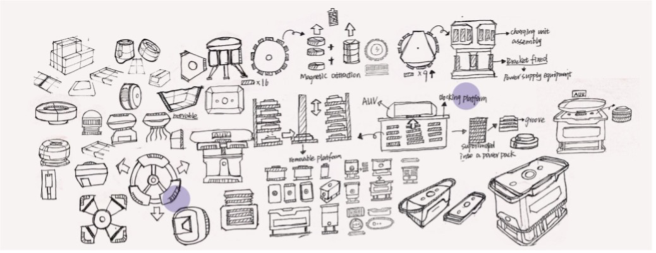
Concept The SDS solves the problem of docking underwater platforms, but lacks the ability to power many devices within the underwater network at the same time. For this reason, we bring the concept of mobile charging to the design of an underwater charging base station, using the underwater charger as a prototype. A conceptual solution was proposed due to the distillation of some design references from previous user studies. After the initial concept was defined, specific design concepts were further developed and explored. The conceptual design sketches are shown in Figure 1.
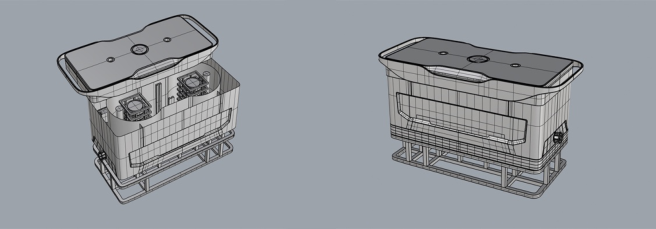
Model Considering the existing facilities and the typical conditions of the seabed, we finally chose the platform type charging base station solution in terms of the morphological structure of the model. The advantages of this structure are high overall station stability and high accuracy of charging coupling. At the same time, the mode of fixed wireless charging is optimized and replaced by the mode of mobile charging by carrying wireless charging batteries through the docking platform. The conceptual model is shown in Figure 2.
The main part is integrated and the storage part is enclosed to isolate the wireless charging battery. The module batteries are also electromagne- tically connected to each other, so the capacity of the batteries carried can be adjusted to the charging needs of different sizes of subsea vehicles.
A New Conceptual Design for Subsea Charging Station 13
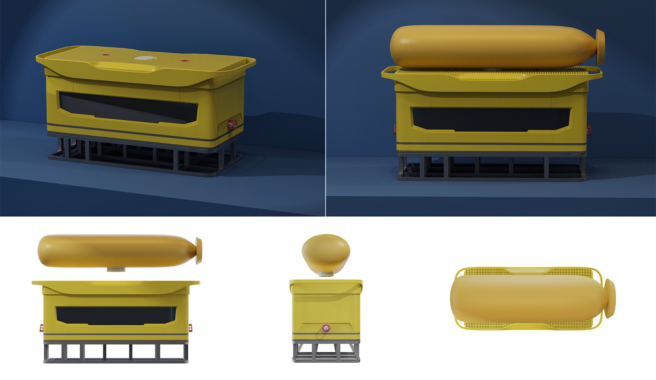
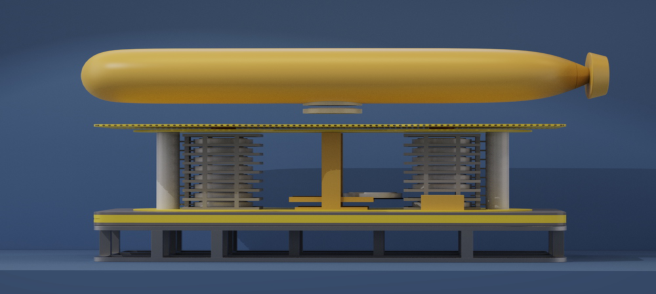
Figure 3: Final design.Figure 4: Internal structure.
EVALUATION OF DESIGN Based on the previous design directions and suggestions, we modified the model by computer to produce the final design as shown in Figure 3.
From top to bottom, firstly, the platform provides an effective docking solution for most of the underwater vehicles. The second is that the middle battery storage part uses an integrated outer envelope design, which plays a sealing role while solving the cleaning problem of the facade to some extent. The fuselage part is placed at a certain distance from the seabed to retain the wet interface to provide electrical energy for the device and access to the valve of IoUT. Third, the bottom bracket of the lowest level is made into a more lightweight structural frame design, which facilitates the autonomous landing of the charging base station. The cost of underwater deployment of the equipment is reduced.
Internally, the subsea charging station refers to the electric vehicle contai- nerized battery exchange service station, using a forklift-like delivery pallet
for battery pick-up and drop-off (Shen et al., 2018). The internal battery management structure is shown in Figure 4. By accessing IoUT, the intelli- gent management system effectively manages the battery and maximizes the effectiveness of the station.
CONCLUSION
The focus of this study is to improve the efficiency of subsea charging through innovative design of subsea charging stations. The goal is to extend the opera- ting time of underwater vehicles and improve the long-term group operation of underwater vehicles. Despite the conceptual design, the charging modu- les and connection methods used in it are all still under further study. For example, the advantages of the charging base station’s facade form in terms of equipment cleaning need to be combined with the coating material of the facade to be further revealed. However, the program hopefully completes the IoUT layout and extends the boundary of IoUT. It lays the foundation for later deeper ocean exploration and commercial development.
REFERENCES
Abicht, D., Solheimsnes, P.A., Stenevik, K.A. (2020) ‘Underwater Intervention Drone Subsea Control System’, in Day 1 Mon, May 04, 2020. Offshore Technology Conference, Houston, Texas, USA: OTC, p. D011S011R006. Agostinho, L.R., Ricardo, N.C., Silva, R.J., Pinto, A.M. (2021) ‘A Modular Indu-
ctive Wireless Charging Solution for Autonomous Underwater Vehicles’, in 2021 IEEE International Conference on Autonomous Robot Systems and Competitions (ICARSC), pp. 68–73. Gu, W.C., Qiu, D.Y., Zhang, B., Xiao, W.X., Chen, Y.F. (2021) “Review of Underwater Wireless Power Transfer Technology”, Journal of Power Supply, pp. 1–21. Hu, Z.M., Shi, W.Q., Chen, W.B., Zhang, P.J. (2014)” Overview on the Advances in
Structural Design for the Underwater Observation System——Seabed Platform”, Journal of Ocean Technology. , 33(06), pp. 123–130. Li, W.D., Ding, Z.J., Jing, C.L., Shi, X.P., Yang, L., Li, B.G. (2020) “Present Status and Development of International Seafloor Observatory Network”, Ocean Development and Management, 37(11), pp. 13–18. Mohsan, S.A.H., Islam, A., Ali, M., Mahmood, A., Selsabil, L., Mazinani, A., Amjad,
H.(2020) “A Review on Research Challenges, Limitations and. Practical Solutions for Underwater Wireless Power Transfer”. Qu, F.C., Lai, H.L., Liu, J.Z., Tu, X.B., Jiang, Y. (2021)” Research and application on key techniques of marine IoT”, Telecommunications Science, 37(07), pp. 25–33. Shen, GY., Yin, H.B., Zhuang, P., Jiang, D.W. (2018) “New container electric car
battery charging, exchange station complete set of equipment, Manufacturing Automation”, 40(02), pp. 144–149. Wang, X.M., Lu, J., Peng, W., Song, L.Y. (2021)” Accelerating the construction of marine “new infrastructure” and promoting high-quality development of marine industry”, Science & Technology Review, 39(16), pp. 76–80.
LISTED IN THE AHFE DIGITAL BOOKSTORE CATALOGUE
Explore the complete digital volume
Human Factors in Software and Systems Engineering
Read this individual research paper free through the original publisher, or explore the full digital proceedings book.
ISBN 978-1-958651-37-7
Explore this ISBN in the AHFE Bookstore ↗Listed in the July 2026 bookstore catalogue; search by ISBN to confirm current availability · Digital book purchase optional