Yubin Zhong, Jiawei Ou, Kaiqiao Zheng, Yan Luximon, Jing Luo (2024). Improving Product Design Efficiency Through AI Tools: An Empirical Study. In: Artificial Intelligence and Social Computing. AHFE Open Access, vol. 122, pp. 266–276. https://doi.org/10.54941/ahfe1004664
In recent years, the rapid development of artificial intelligence models has spawned a variety of artificial intelligence tools, especially those related to image generation. These tools have revolutionized the field of design. This study focuses on the overall process of product design, breaking it down into multiple parts to evaluate the functionality and utility of a range of AI tools. The goal is to test and determine if these tools can effectively facilitate and streamline the product design process.After identifying effective AI tools, conduct comprehensive testing to get the operations and parameters in these AI tools that are more consistent with the product design workflow. The study integrates these optimization operations into the entire product design process, resulting in a fundamental approach. This approach Outlines how these AI tools can work together to improve the efficiency and quality of the entire product design process, aiming to match or exceed the capabilities of human designers. In addition, preliminary experiments have verified the effectiveness of the method, showing that the design efficiency and quality are improved after adopting the integrated AI tool method in the product design process.Main research contents:1 Evaluate various AI tools in multiple parts of the product design process to identify effective solutions.2 Test the parameters and operating procedures of the identified AI tools to achieve the best results.3 Establish basic methods in combination with selected AI tools and conduct experiments to obtain preliminary results.Main research methods:1. In-depth understanding of product design process through in-depth interviews and field observation.2 Use data analysis and professional evaluation to evaluate the effectiveness of AI tools.3. Control variable method was used to design experiments to verify the effectiveness of the established method.
In recent years, artificial intelligence tools have profoundly influenced many fields, especially in the field of design, which is predominantly dominated by conversational and image generation and processing types of artificial intel- ligence models. Generative AI is increasingly applied in various areas of the creative industries (Sonya, 2023), and for many, AI is no longer solely a tech- nical or computational field, when it comes to AI for image generation. In the 1970s, an artist named Harold Cohen began building a computer pro- gram called AARON to paint. However, unlike current AI painting outputs, AARON actually controls a robotic arm to paint. Harold’s improvements to AARON continued for decades until his death. In 2012, two AI experts at Google, Andrew Ng and Jef Dean, conducted an unprecedented experiment, jointly using 16,000 CPUs to train what was then the world’s largest deep learning network to instruct computers to draw pictures of cat faces. At that time, they used 10 million cat face pictures from YouTube, trained 16,000 CPUs for three days, and the final model was exciting enough to generate a very fuzzy cat (Data monkey, 2022). In early 2021, OpenAI released the widely watched DALL-E system. AI is beginning to have an essential abil- ity; that is, it can follow the text input prompts to create. The OpenAI team opened the new deep learning model CLIP in January 2021, and in 2022,
Improving Product Design Efficiency Through AI Tools: An Empirical Study 267
a digital oil painting generated by the AI painting service MidJourney was created by a user who participated in the art competition at the Colorado State Fair in the United States and won the first prize. In addition to image generation AI tools, such as image processing, information collection, logic synthesis, and other AI tools, have also had a significant impact on the design field. AI has undergone profound rapid development in different types of design fields, leading to a large-scale reform of the industry. Lee believes gen- erative AI can play a role. “It really changes the way we do things so much that even achieving our goals can be enhanced” (Alison, 2023).
AI product design refers to the application of AI technology in the product development process to improve the quality, efficiency, and competitiveness of products. AI product design can involve product demand analysis, product concept design, product prototype design, and so on (OpenChat, 2024). At present, many product design departments or industrial design companies in China have extensively embedded different AI tools into their work- flows, which can improve the productivity of product design and engineering processes by enhancing the methods already known in the manufacturing process (Hiinckeldeyn, 2015). Therefore, it is worth exploring which parts of the entire product design process can be embedded with different types of artificial intelligence tools to help designers improve their efficiency and quality.
RESEARCH PURPOSE The purpose of this study is to assess and test various types of artificial intel- ligence tools to determine their effectiveness in influencing or improving the efficiency and quality of different stages of the product design process. The significance of process innovation research lies in its role as a driving force for design innovation, contributing to value creation in product development through the development of new product meanings, knowledge generation, actors and collaborations, capabilities, and processes (Goey, 2019).
This research primarily focuses on the assistance aspect. We will initially examine the fundamental product design process, break it down into multiple stages, and then investigate the efficacy of artificial intelligence tools in differ- ent phases of the process. Through various evaluation and testing methods, we will analyze their effective operation and parameters, integrating these data with artificial intelligence tools to form a collaborative process. Within this process, we aim to provide an initial description of how integrated artifi- cial intelligence tools can be employed throughout the entire product design process for collaborative creation.
PRODUCT DESIGN PROCESS To investigate how AI tools can be integrated into the product design pro- cess, the initial step involves defining a standardized process. Every design project must establish a comprehensive list of evaluation criteria and a sys- tematic approach for applying these standards to better assess the impact of
their utilization (Carneiro, 2021). To achieve this, we must initially decon- struct the product design process into steps, exploring a design process that is more compatible with AI tools. Luo Hongkai categorizes the product design process into four stages: product planning, program design, detailed pro- gram formulation, and product design improvement (Luo Hongkai, 2016). Employing the Double Diamond design thinking model, the entire design process is segmented into stages such as defining problems and challenges, gathering customer opinions, exploring unstructured and scattered research findings, establishing action directions, generating numerous schemes, seek- ing answers, and finalizing products and solutions (Tripartite, 2023).
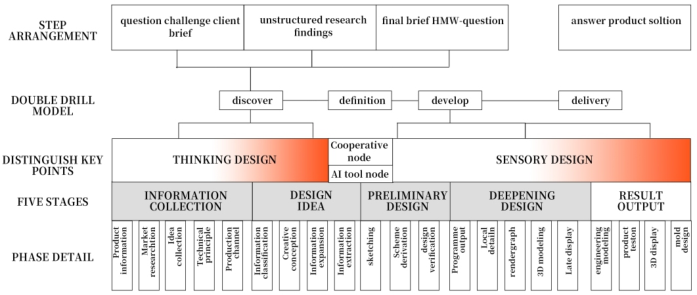
In the design process, inspiration is viewed as a mechanism for stimulat- ing and influencing thought processes used in problem framing or solution generation (Kim et al., 2016). Here, the process of thinking about inspiration is distinguished from the actual act of doing it, emphasizing the separation between thinking, acting, and feeling. Considering the characteristics of AI tools, the design process is divided into thinking design behavior and sensory design behavior. The crucial decision node for the entire separation stage lies in determining when thinking transitions into practical implementation. To thoroughly test the entire process with AI tools, we further categorize each step based on the two-drill model and extract insights from conventional design processes. The subsequent section outlines the decomposition of the entire AI product design process (see Figure 1).
Figure 1: The use of AI tools to evaluate the product design process.
Finally, we have divided the entire process into five steps, where A and B constitute the thinking design part, and C and D form the sensory design part. The integration of AI tools for both thinking and sensory design serves as the design nodes to distinguish the differences. These steps are as follows.
A: Information collection.Includes gathering product information, con- ducting market research, collecting creative ideas, understanding technical principles, and exploring production channels.
B: Design concept.Encompasses information classification, formulation of creative concepts, expanding on gathered information, and extracting relevant information.
Improving Product Design Efficiency Through AI Tools: An Empirical Study 269
D: Design deepening.Includes project output, refining local details, render- ing, 3D modeling, and post-display activities.
E: Result output.Encompasses engineering modeling, product testing, 3D display, and mold design.
This categorization outlines the specific steps to be undertaken in the prod- uct design process. Subsequently, we will employ various AI tools to test each step in accordance with the defined process.
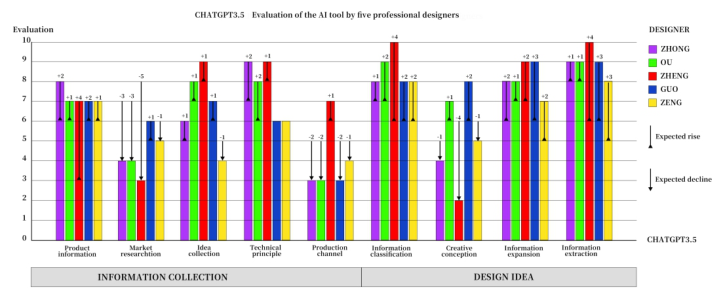
INTEGRATED AI TOOL TESTING After organizing the process and delineating the focus of each part’s use of AI tools, we need to test each AI tool to determine which ones can effectively optimize or positively influence specific stages. Therefore, we invited five pro- fessional product designers to conduct experimental evaluations.Evaluation process: There are 5 professional designers, with 3 having worked or cur- rently working in the field of product design, and 2 being engaged in product design research. They individually assess the tasks that AI tools can perform in each part. The evaluation mechanism involves a scoring system combined with expectations. The specific situation of this mechanism is as follows: pro- fessional designers use AI tools in the product design process, assess which specific tasks can be effectively completed by the AI tool, evaluate its use in this regard, and assign a score. Simultaneously, they score the future expectations of the AI. The future expectation score represents their attitude towards the future of the AI, whether it is positive or negative. The final result (T) is calculated as the sum of the score (S) and the expectation (E): T = S(score) + E(expectation). This process allows us to judge the evalua- tion of the use of the AI tool by professional designers, providing insights into the future trend of AI tools in the product design process and the focus of functional development.
Figure 2: CAHTGPT3.5 in expert evaluation of use.
Software: CHATGPT3.5. Features: The GPT-3.5 architecture is a model designed for processing sequence data, equipped with language understanding and text generation capabilities. It trains models by connecting large corpora to comprehend and generate natural language. From a technical perspective, ChatGPT employs techniques such as attention mechanisms and Encoder-Decoder architec- ture to enable the generation of meaningful responses based on context (Four, 2022). Findings emphasize the crucial role of perceptual intelligence in AI tools like ChatGPT, particularly in knowledge acquisition, application, and personalization (Hyeon, 2023). The evaluation process is outlined (see Figure 2).
Evaluation: ChatGPT excels in the design thinking stage, offering power- ful assistance in swiftly organizing product information. During evaluation, the logical extraction function is observed to be highly effective in sorting and classifying information. However, in terms of updating information and fostering creativity, ChatGPT performs suboptimally in the product design process.
Trend: To enhance ChatGPT’s capabilities, there is a need for improved information updating functions and expanded creative abilities. Experts in the evaluation process pointed out that the generated information sometimes exhibits misleading biases. Therefore, further verification is deemed necessary before proceeding to the next stage of design when the final design is based on specific information.
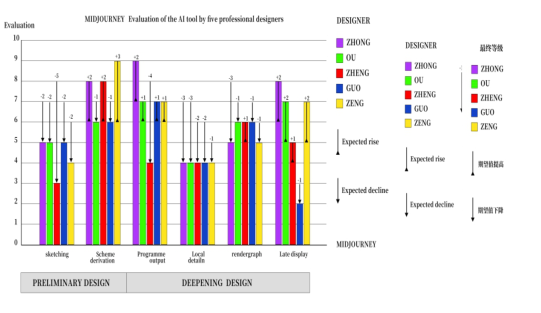
Software: Midjourney. What it does: Midjourney is an artificial intelligence program developed by Midjourney Research LABS, specializing in generating images from text. It entered public beta on July 12, 2022, enabling users to collaboratively create images through Discord’s bot commands. The following outlines the evaluation process (see Figure 3).
Figure 3: Midjourney in expert evaluation of use.
Evaluation: Midjourney’s image fusion function enhances the thinking and scheme expansion abilities of product designers. However, in the ini- tial sketch derivation and evolution, it falls short in adjusting details and
Improving Product Design Efficiency Through AI Tools: An Empirical Study 271
making changes. While it boasts good image quality and is user-friendly for beginners, its standout feature lies in its community function.
Trend: There is a need for further practical development in the image’s detail change function. However, due to the simplistic logic of its cre- ative community, Midjourney lacks a level of professionalism and should be complemented with other post-processing tools.
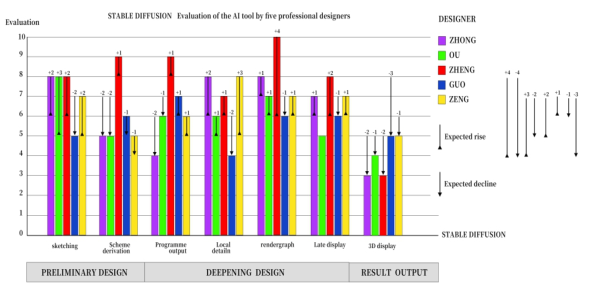
Software: STBALE DIFFUSION. Stable Diffusion is a text-to-image potential diffusion model developed by researchers and engineers at CompVis, Stability AI, and LAION. It is trained using 512x512 images from a subset of the LAION-5B database (Andrew, 2023).
Figure 4: Stable diffusion in expert evaluation of use.
Expected evaluation: Stable Diffusion (SD) demonstrates clear superiority over Midjourney (MJ) in sketching and detail adjustment. Thanks to its com- plex parameter adjustment system, SD excels in diverse image adjustments. Moreover, SD supports LOTA training, ensuring generated images maintain a consistent style and offering much greater control compared to MJ. This is a key factor influencing the preference of many designer companies or profes- sional designers for MJ. However, due to the absence of community features, SD requires integration with other prompt words and the LOTA website to enhance its functionality for producing superior images. Nevertheless, in the realm of 3D applications, SD’s performance is subpar and proves challenging to use.
Expected trend: SD is anticipated to exhibit a higher degree of professional- ism but comes with increased demands on equipment and learning thresholds. While excelling in fine-tuning image functions, SD may lack initiative and expansiveness in deriving solutions (see Figure 4).
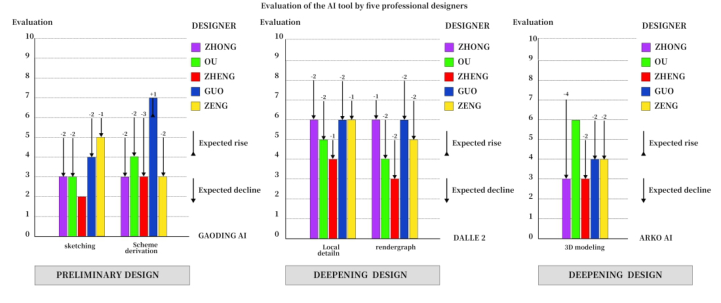
Software: Gaoding AI. Function: Gaoding AI is a versatile and comprehensive AI tool designed for quickly coloring design sketches, providing various color and material configuration options. It is particularly useful in the preliminary design stage for visualizing the effects of sketching.
Figure 5: 3 different AI tools in expert evaluation of use.
Evaluation: While sketch coloring is a crucial function in product design, Gaoding AI falls short in achieving the same level of effectiveness as SD and MJ.
Software: DALLE 2.0. Features: DALLE 2.0 excels in repairing defects in AI-generated images and offers the capability for local replacement of AI-generated product ren- derings. In the deepening scheme stage, AI-produced works can be further modified and enhanced.
Evaluation: This function is highly valuable in product design, allowing for further improvement such as rendering diagrams. However, it currently lacks precise control and still requires human testing. Among various specialized software options, DALLE 2.0 stands out as the best, yet it still falls short of meeting qualified standards in detail adjustments (see Figure 5).
Trend: Local detail adjustment remains a weakness in AI image tools and is a key factor preventing full integration into the entire workflow.
Software: Arko AI. Function: Arko AI is a plug-in designed to quickly generate the same view of a 3D model in modeling software based on a descriptor.
Evaluation: While offering better control and embedding capabilities as a plug-in, the actual experiential effect is suboptimal. It is suitable for simple simulations and overviews but lacks the capability for actual image output.
Trend: The ability to render models in real-time is a promising feature. Future integration with renderers could enhance its capabilities and make it a valuable trend.
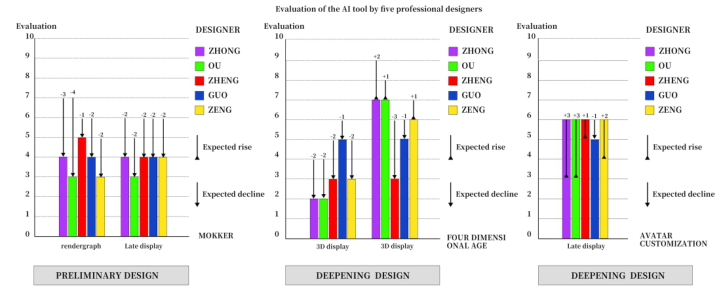
Software: Mokker. Function: Mokker is a website that generates AI-generated background maps, assisting designers in quickly constructing product scene renderings to enhance design efficiency and improve later results.
Evaluation: The AI tool applied to background changes is promising, but it currently lacks the capability to deliver professional rendering effects. This limitation has led to decreased expectations from evaluators. Although it is a useful function, its implementation effect is not mature, restricting its usage to simple product rendering with less demanding requirements (see Figure 6).
Improving Product Design Efficiency Through AI Tools: An Empirical Study 273
Figure 6: Other 3 different AI tools in expert evaluation of use.
Trend: To be considered for professional use, AI tools in this domain need improved image fusion capabilities without compromising the integrity of the scene.
Software: Four-dimensional age. Function: Four-dimensional age focuses on the domestic development of 3D models generated from AI-based photo analysis. It utilizes multiple photos or 3D scans for modeling.
Evaluation: As an industrial model, it falls short of meeting qualified stan- dards and can only produce rough models suitable for basic presentations. The current state of 3D modeling requires substantial design size and struc- ture planning, making it more suitable as a demonstration of 3D effects rather than a refined modeling tool.
Trend: While modeling is an essential function in design, most current applications are limited to basic demonstrations, especially in terms of size and industrial models. No AI tools have been identified that effectively collaborate with these requirements.
Software: Avatar Customization. Features: Avatar Customization enables users to create virtual people with AI-generated fictional portrait photos, avoiding any infringement of portrait rights. The platform offers a variety of editable options and can be used in the product design process to create user portraits and more.
Evaluation: Despite its simplicity, Avatar Customization proves surpris- ingly effective and meets the needs of product design. In the product design process, where human-related image materials are often required, the ability to create customizable human avatars without infringing copyright is highly valuable and has demonstrated effective performance.
Trend: The appeal of this software lies in its simplicity, yet impactful func- tionality. Offering a straightforward but effective solution can be attractive to users in the ongoing trend of AI tools.
PROPOSED COLLABORATIVE AI Throughout the entire evaluation process, which involved the in-depth use of nine different types of AI tools, ranging from complex professional
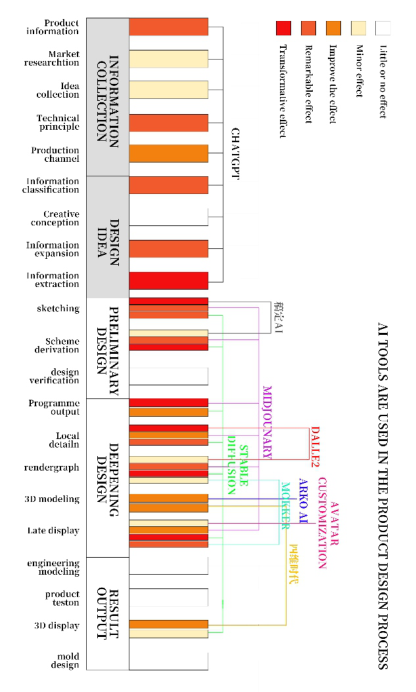
platforms and community platforms to smaller and specialized platforms, both expected and unexpected effects were observed. The evaluation experi- ence of applying AI tools to the product design process has been consolidated into a comprehensive process. The goal (see Figure 7) is to create a prelim- inary process diagram for collaboration with AI tools, offering a reference for users. This diagram illustrates the specific stages of the entire product design process and the types of AI tools available for each stage. Users can choose between tools of the same type or consider better alternative tools. It’s important to note that as AI technology evolves, these tools will undergo con- tinuous updates. However, the overarching purpose is to assess the ongoing trend in AI tool integration within the product design process.
Figure 7: Collaborate with AI tools in the product design process.
CONCLUSION
Throughout the design evaluation process, experts have utilized text and images to extract similar information, generating abundant inspiration that aids designers in quickly formulating solutions (Guanhua et al., 2023). AI tools demonstrate significant efficacy in various stages of product design, par- ticularly in image and information collection. The community aspect holds
Improving Product Design Efficiency Through AI Tools: An Empirical Study 275
great potential for expanding design thinking. However, while AI tools excel in classification and information sorting for product assistance, there remain challenges in accuracy, practicality, and creativity, making it challenging to fully align with design needs.In image processing and sketch schemes, AI tools can generate numerous schemes for designers, eliminating the need for rendering tools. They optimize and creatively derive sketches. Neverthe- less, the adjustment of local details still necessitates human intervention and subsequent modifications. In terms of professional processing, both small and professional platforms struggle to compete with human capabilities. The community feature stands out as a highlight, significantly enhancing the expansion of design thinking, especially when compared to MJ and SD. The future trend indicates that AI tools are likely to evolve towards sharing and co-creation. Smaller tools, such as Avatar Customization, have garnered posi- tive feedback from users.however, This evaluation has limitations in assessing software comprehensiveness and quantity. The conclusions lean towards the current application of AI tools in product design. The application direction and trend of AI tools in product design can be discerned through ongoing evaluations and summaries. As AI tools continue to develop, the efficiency of product design is expected to further improve. Gratitude is extended to all the researchers and evaluation experts for their dedicated efforts in this process.
ACKNOWLEDGMENT
This work was supported partially by P0050655 from The Hong Kong Polytechnic University (Colour, Imaging, and Metaverse Research Centre).
REFERENCES
Allison Whitten, magazine, S. (2023) Me, myself, and ai, STANFORD magazine.
Available at: https://stanfordmag.org/contents/me-myself-and-ai. Andrew (2023) How to use stable diffusion, Stable Diffusion Art. Available at: https: //stable-diffusion-art.com/beginners-guide/. Carneiro, V, da Rocha, Barata, Rangel, A., and Alves, B., L, J.. (2021) Design management and the SME Product Development Process: A... Available at: https://www.semanticscholar.org/paper/Design-Management- and-the-SME-Product-Development-A-Carneiro-Rocha/d576e958b8aa669 52737b090803c27d0cd80b563. Data monkey: Why is AI painting advancing so rapidly? From history to technolog-
ical breakthrough, the history of painting is read popular ai _dal_cohen (2022) _Dal_ Harold Cohen _Cohen. Available at: https://www.sohu.com/a/587697935_ 400678. Four Zero Four, a Chatbot Model Leading the New Trend of AI (2024) ChatGPT: A Chatbot model leading the New trend of AI - Baidu Developer Center. Available at: https://developer.baidu.com/article/details/2849484. Guanhua Hou et al. (2023) The impact of design creativity: Inspirations and timing
of stimulation, Telematics and Informatics Reports. Available at: https://www.sc iencedirect.com/science/article/pii/S2772503023000658.
Goey, H. D., Hilletofth, P. and Eriksson, L. (2019) Design-Driven Innovation: A systematic literature review, European Business review. Available at: https://doi.or g/10.1108/EBR-09-2017-0160. Hinckeldeyn, J., Dekkers, R. and Kreutzfeldt, J. (2015) Productivity of product design
and Engineering Processes: Unexplored territory for production management techniques?, International Journal of Operations & Production Management. Available at: https://doi.org/10.1108/IJOPM-03-2013-0101. Hyeon, J. (2023) Understanding AI tool engagement: A study of CHATGPT usage and word-of... Available at: https://www.semanticscholar.org/paper/ Understanding-AI-tool-engagement%3A-A-study-of-usage-Jo/7a9cdb7542d9 8738607f0dae3785e5cc5954eff2. Kim, K. M. and Lee, K. pyo (2016) Collaborative product design processes of
Industrial Design and Engineering Design in consumer product companies, PolyU Scholars Hub. Available at: https://research.polyu.edu.hk/en/publications/collab orative-product-design-processes-of-industrial-design-and-e. Luo Hongkai. (2016) Design Process Management in Product Design [J]. Science and Technology Innovation and Application, 2016(27):278. OpenChat (2024) Chapter 9: Commercial Application of AI Grand Models 9.1
AI Product Design, Rare Earth Mining. Available at: https://juejin.cn/post /7329034362685669386. Sonya Huang, P. G. and G.-3 (2023) Generative AI: A creative new world, Sequoia Capital. Available at: https://www.sequoiacap.com/article/generative-ai-a-creativ e-new-world/. Tripartite (2023) The ultimate guide to product design process execution, where
everyone is a product manager. Available at: https://www.woshipm.com/pd /5927087.html.
LISTED IN THE AHFE DIGITAL BOOKSTORE CATALOGUE
Explore the complete digital volume
Artificial Intelligence and Social Computing
Read this individual research paper free through the original publisher, or explore the full digital proceedings book.
ISBN 978-1-958651-98-8
Explore this ISBN in the AHFE Bookstore ↗Listed in the July 2026 bookstore catalogue; search by ISBN to confirm current availability · Digital book purchase optional