Zizhong Hua, Jing Luo (2022). Interactive design based on five senses solution for the externalization of pain sensation. In: Usability and User Experience. AHFE Open Access, vol. 39, pp. 345–352. https://doi.org/10.54941/ahfe1001727
Pain is the most common cause of the elderly entering the medical system, and according to the survey, the elderly who visit the clinic due to chronic pain account for 44% (Tao et al., 2017). So the pain assessment for the elderly has become particularly important, but with the aging of the cognitive ability and behavior of the elderly, it has become difficult to communicate with doctors. This paper is based on the existing tools of pain assessment, starting from the interaction design based on the five senses, using questionnaire survey and in-depth interview, combining the cognitive thinking and behavior characteristics of the elderly. The design of tools of pain assessment suitable for the elderly was concluded, and finally the design scheme is proposed based on the conclusion. Keywords: Doctor-patient Communication, Pain Feelings, Interaction Design, Five Senses, The Elderly, Pain Assessment
Pain is one of the most common symptoms in the elderly and the fifth major sign of life, and proper assessment of pain is the basis of pain management (Shan et al., 2010, Lin et al., 2019). However, as pain is a personal subje- ctive experience, each person describes their pain in different ways, which is affected by factors such as degree of education, gender, attention, social envi- ronment (Keefe et al., 2011, Strong et al., 2009). Therefore, self-reported pain assessment is the only mode of assessment that has the potential to provide a detailed, multidimensional assessment (Jaaniste et al., 2019).
This paper first reviewed relevant literature to learn the advantages and disadvantages of existing tools of pain assessment from the perspective of the elderly, and then introduced the multi-sensory design. Secondly, cognition and behavior of the elderly were analyzed, and questionnaire and in-depth interview were conducted on this subject to obtain design requirements. Finally, according to the above analysis, combining the advantages and disa- dvantages of various assessment tools, the need of interface for doctor-patient pain assessment, and cognitive and behavioral characteristics of the elderly, the conclusion of design is drawn, and the final design scheme is presented.
PAIN ASSESSMENT TOOL At present, there are various tools of pain assessment, including qualitative and quantitative assessment tools. The qualitative assessment was a descri- ption of the painful nature, location, extent, and course of pain. Quantitative assessment tools include Visual Analogue Scale (VAS), Numerical Rating Scale (NRS), Verbal Rating Scale (VRS), McGill Pain Questionnaire (MPQ), etc. However, VAS, NRS and VRS communicate through numbers and words, which is too abstract for the elderly (Williamson et al., 2005). The MPQ method contains some abstract vocabulary that requires patients to have a fairly high level of cultural education (Katz et al., 2011). Therefore, the Wong-baker method is commonly used as a clinical pain assessment tool for the elderly. It can be seen that most of tools of pain assessment are more abstract, the tools of pain assessment for the elderly involve less, how to improve the existing pain assessment tools to adapt to the cognitive beha- vior characteristics of the elderly, so that the doctor-patient relationship can be better developed is still a topic worth studying, of which the interaction design based on the five senses provides a thinking direction.
INTERACTION DESIGN BASED ON FIVE SENSES The five senses, namely sight/touch/hearing/smell/taste, multi-sensory inte- gration is to call multiple senses to collect information at the same time in a task, while accelerating the speed of information processing and impro- ving the fault tolerance rate of information processing, these independent sensory channel clues are efficiently integrated into a complete, continuous, and strong perception (Yang, 2018). In the field of design, multi-sensory integration is also known as multi-sensory interaction. It refers to breaking through the traditional visual-based experience mode and integrating other senses of the human body into the product experience to enrich the user’s experience. For example, Tesla Studios introduced teslasuits in 2019, where clothing is transmitted to tactile sensations to the body through electrical signals, which allow users to feel real environmental changes in a virtual environment (Caserman et al., 2021). It can be seen that while bringing people a new interactive experience, multi-sensory interaction design also realizes multi-dimensional information integration, so that the amount of information contained in the product can be maximized.
METHODS
Literature Review
Through the review of relevant literature, it is found that the cognitive beh- avior of the elderly has obvious characteristics of aging, which is mainly manifested in three aspects: the decline of perception ability, the slow pro- cessing of information and the aging of operational behavior. First, one of the manifestations of sensory decline is a decrease in visual sensitivity, that is, a decrease in sensitivity to graphics and color perception. In terms of color, there are difficulties in distinguishing adjacent colors due to the degrada- tion of the pyramidal cells of the retina in the elderly due to their decreased
An Interactive Design Based on Five Sense Solution for the Externalization 347
Table 1. Quotes from in-depth interview.
Table available in the original PDF paper.
Doctor
“Patients only say where it hurts, and we have to guide them to answer other pain information, but the elderly will have difficulty in expression.”
“Our hospital uses NRS in combination with FPS, and many patients who use NRS will score very high (8 points).”
“It is necessary to manage pain information file so that we can keep abreast of the patient’s physical condition and comfort them.”
Patient
“Having used the FPS(Wong-baker) once, I didn’t see much difference in the expressions, the first three and the last three were the same.”
color recognition (John et al., 1988). In terms of graphics, older people are unable to recognize the interrelationships between overly complex graphics. Secondly, the elderly are weaker than young people to process information, on the one hand, because most of the elderly brain recession leads to a wea- kening of learning ability, on the other hand, due to increasing age, they have a dependence on existing experience, making them less receptive to new things than young people. Finally, due to the aging of the elderly’s physical functions, the elderly are prone to insufficient grip and difficult to complete high-precision movements. From the above characteristics, it can be inferred from this:
Smaller fonts, the recognition of adjacent colors, and overly complex graphics can make it difficult to access information for the elderly.
Clear guidance is required in the assessment of pain for the elderly.
The familiar operation mode to the elderly should be selected in pain assessment.
In summary, through the analysis of the cognitive thinking and behavior of the elderly, the elderly’s ability to obtain information declines, so it is more necessary to stimulate the elderly to obtain information from multiple senses, so that the elderly can understand information more quickly and accurately.
In-Depth Interview Three users were interviewed, including an elderly patient and two doctors. The following are some statements of doctors and the patient during the interview (Table 1):
According to the statement, the following requirements are sorted out:
Many elderly patients do not have accurate evaluation of the numbers, and Wong-baker, a pain assessment tool which cause cognitive difficulties for the elderly, does not have much visual difference for the elderly.
Establishing a long-term pain management file can facilitate doctors to observe the patient’s health condition.
Letting patients know pain information in advance is conducive to the efficiency of communication between doctors and patients.
The Questionnaire Survey According to the characteristics of the existing pain assessment interface, the color preference and emotional cognition characteristics of the elderly are analyzed. In order to ensure that all elderly people have normal cognitive function, 52 participants with suitable cognitive ability and emotional state were finally screened to participate in the experiment, including 23 males and 29 females. The questionnaire is divided into two parts. The first part is the pre- ference for monochrome, color matching (low purity adjacent color, high purity adjacent color, low purity contrast color, high purity contrast color) and the preference for pattern style. The second part is the consistency of the judgment of emotion recognition (eyebrows, mouth, eyes) and emotion corresponding to the pain grade (Table 2).
It can be concluded from the data that:
The elderly generally prefer color matching with high purity and high contrast (80.77%), among which men prefer black (65.22%), green (62.63%), red (60.87%), and women prefer red (89.66%), orange (55.17%), purple (58.62%) and other monochrome.
The elderly generally prefer stereoscopic pattern (50%).
The elderly tend to focus on eyebrows and eyes when judging “happy” emotions (71.15%). Among them, males tend to choose option A (43.47%) and elderly females tend to choose option B (48.28%). Elderly men and women tend to focus on mouth expressions when judging “sad” emotions (82.69%).
There are subtle differences between “worst pain” and “no pain” in the elderly based on emotional characteristics, but the general principles of judgment are the same as those in emotional judgment.
An Interactive Design Based on Five Sense Solution for the Externalization 349
RESULT
According to the literature review, first, we found that most of tools of pain assessment for the elderly are more abstract. Secondly, we found that the elderly have decreased in visual sensitivity, short-term memory ability, and aging of operational behavior. According to in-depth interview, the elderly patients expressed difficulty in identifying the existing painful tool Wong- baker, and doctors expressed problems with communication difficulties with elderly patients. According to the questionnaire survey, the data shows that, first of all, the elderly prefer high-purity and high-contrast color collocations with the highest (80.77%), the elderly prefer three-dimensional pattern style (50%), and secondly, the elderly tend to pay attention to the part of eyebrows and eye when judging “happy” emotions (71.15%), and tend to pay atten- tion to the expression of the mouth when judging “sad” emotions (82.69%). Finally, the elderly judge “no pain” or “worst pain” based on “happy” or “unhappy.”
DISCUSSION
In response to the above result, we propose the following suggestions: On the one hand, the tool of pain assessment interface should be improved. First, in order to facilitate the interface identification of the elderly, high-purity and high-contrast colors should be selected on the color. Second, when impro- ving Wong-baker expressions, the corresponding expression parts should be exaggerated and partial three-dimensional expressions should be used. Third, the page should be in a broad and shallow web form, and provide obvious guidance on the page. Fourth, the page should establish a long-term pain management profile. It is convenient for doctors to observe the patient’s con- dition and pain records can improve communication efficiency and indirectly enhance the doctor-patient relationship. On the other hand, in addition to the visual interface evaluation, other senses can be added for evaluation. Tacti- lely, it is possible to use familiar interactive methods to the elderly, such as feedback on the operation of the entity. Hearing can also be linked to the familiar experiences for the elderly. Despite the corresponding experimental data and recommendations, there are still some limitations in this study. In the case of questionnaire surveys of the elderly, the geographical area invo- lved in the sample is relatively concentrated, and in view of this problem, a wider sample can be selected for investigation in the future. Based on the above discussion, the following design scheme is proposed. The design is divi- ded into two parts, one is the web interface, the other is the pain simulation block, and the two are used together.
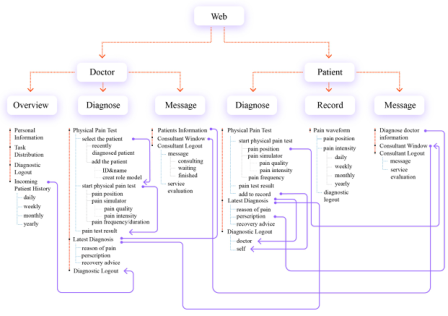
Based on the above analysis, the requirements of the doctor and the patient are analyzed and designed separately, and finally the web page high-fidelity architecture was finally obtained (Figure 1).
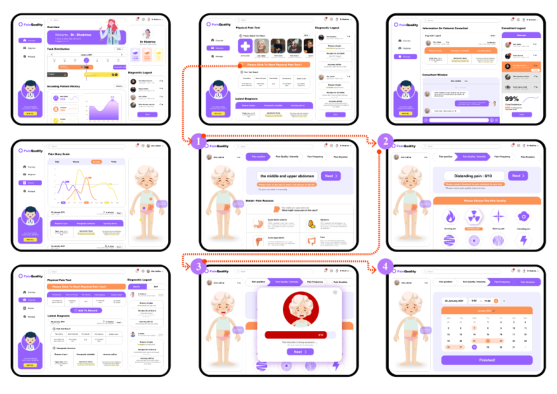
The Figure 2 shows the web page high fidelity. The page includes a com- plete process of pain assessment, improved the facial pain expression of Wong-Baker, and added a pain diary to facilitate doctor-patient communi- cation.
350 Hua and Luo
Figure 1: Web page architecture.Figure 2: Web page high fidelity.
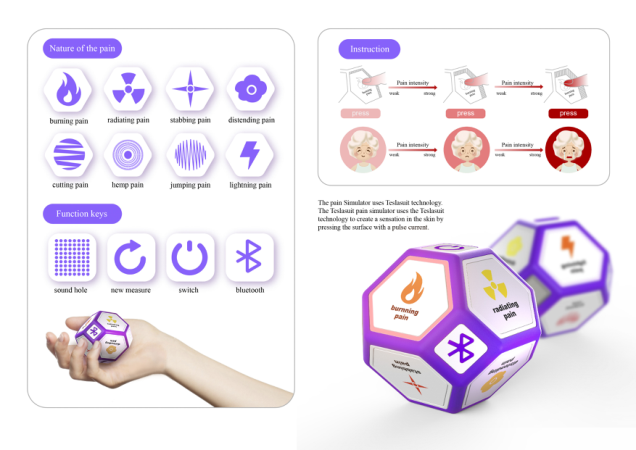
The Figure 3 shows the pain simulation block and instructions. The pain simulation block starts from the sense of hearing and touch, using Teslasuit equipment technology, simulating pain sensations through electrical signals, each area represents a different nature of pain, and the intensity of patient compression corresponds to the intensity of pain.
Based on the above discussion, two design suggestions have proposed, on the one hand, the tool of pain assessment interface should be improved . On the other hand, in addition to vision, touch and hearing can also be used to assess pain. Therefore, the webpage and the pain simulation block were designed, but the tactile technology used in the pain simulation block and its application to tools of pain assessment still need to be further studied.
An Interactive Design Based on Five Sense Solution for the Externalization 351
Figure 3: Pain simulation block and instructions.
CONCLUSION
This study is based on the interaction design of the five senses, and the pur- pose of the study is to provide information of pain assessment from multiple dimensions, so that elderly patients can understand information more qui- ckly and accurately, and then achieve a more accurate pain assessment effect. Through literature review, in-depth interview and questionnaire survey, this study provided a deeper understanding of the importance of tools of pain assessment for the elderly, and identified the shortcomings and improvement recommendations of existing pain assessments for the elderly. This study still has certain limitations, such as too concentrated on the survey sample, the technology of Teslasuit equipment is not yet mature, etc. How to specifically use haptic technology of Teslasuit, applied to tools of pain assessment, and then improve the doctor-patient relationship will be a fruitful area for further work.
REFERENCES
Caserman, P., Krug, C., Göbel, S. (2021), Recognizing Full-Body Exercise Execution Errors Using the Teslasuit. Jaaniste, T., Noel, M., Yee, R. D. (2019), Why Unidimensional Pain Measurement
Prevails in the Pediatric Acute Pain Context and What Multidimensional Self- Report Methods Can Offer. Children, 6(12), p. 132. John, S., Werner, Victoria, G. (1988), Sensitivity of human foveal color mechanisms throughout the life span. Journal of the Optical of America, (5),pp. 2122–2130. Katz, J., Melzack, R. (2011), The McGill Pain Questionnaire: development, psycho-
metric properties, and usefulness of the long-form, short-form and short-form-2. In: Turk DC, Melzack R. (eds.). Handbook of pain assessment. 3rd ed. New York: The Guilford Press, pp. 45–66.
352 Hua and Luo
Keefe, F.J., Somers, T.J., Williams, D.A., Smith, S.J. (2011), Assessment of pain behaviors. In: Turk DC, Melzack R. (eds.). Handbook of pain assessment. 3rd ed. New York: The Guilford Press, pp. 134–50. Lin, Z., Zheng, X.L., Shen, Q. (2019), Research progress in pain assessment in
children. General Nursing, 17(25): 3098–101. Shan, J., Pan, Z.H., Yuan, L. (2010), Clinical efficacy analysis of 45 cases of pancreatic cancer. Chinese Journal of Cancer Clinical and Rehabilitation, 17(04):363–5+9. Strong, J, Mathews, T., Sussex, R., New, F., Hoey, S., Mitchell, G. (2009), Pain
language and gender differences when describing a past pain event. Tao, J.F., Xue, H., Jia, X.M. (2017), Application of the Holistic Pain Assessment Scale in Chronic Pain Care in the Elderly. PLA Journal of Hospital Management, 24(02), pp. 181–183. Williamson, A., Hoggart, B. (2005), Pain: a review of three commonly used pain
rating scales. Journal of Clinical Nursing, 14, pp. 798–804. Yang, Z. Y. (2018), Research on the mechanism of central analgesia in the treatment of patients with menstrual migraine without aura based on brain pain perception network.
LISTED IN THE AHFE DIGITAL BOOKSTORE CATALOGUE
Explore the complete digital volume
Usability and User Experience
Read this individual research paper free through the original publisher, or explore the full digital proceedings book.
ISBN 978-1-958651-15-5
Explore this ISBN in the AHFE Bookstore ↗Listed in the July 2026 bookstore catalogue; search by ISBN to confirm current availability · Digital book purchase optional