Bolin Yang, Ren-Ke He (2022). User Experience Design of Online Education Interactive Product for International Students Based on SAPAD and Scenario Thinking. In: Usability and User Experience. AHFE Open Access, vol. 39, pp. 112–118. https://doi.org/10.54941/ahfe1001697
The COVID-19 Pandemic has had a huge impact on the studying abroad industry, but also brought new opportunities by way of online education for international students. In the post-epidemic era, the blended learning model combining the online and offline modes may become the new normal in the education of international students. Within this trend, considerable attention is being paid to improving the user experience of online education for international students through interactive product design. This research focuses on the importance of behavior and scene in interaction design. Specifically, an interactive product design method based on SAPAD and scenario thinking is proposed and applied in the online education scene for international students. Firstly, by determining the specific use scenarios of the product application and performing demand analysis on objective scenarios, the core needs that affect the online education experience of international students are obtained. Finally, a preliminary design is made for an interactive product targeted at the core needs and identified target scenarios to provide a reference for optimizing user experience in online education for international students.
Recent evidence suggests that the COVID-19 pandemic has brought about significant challenges for the global higher education industry (Aucejo et al. 2020). Especially for international students studying abroad, the mode and manner of education has been greatly impacted. At present, online education is being widely implemented in the field of international student education due certain of its advantages. In the future, a blended learning model which maximizes the potential of both e-learning and the traditional classroom, is likely to become the new normal in the education scene (Dakhi et al. 2020). In essence, the digitalization of international student education is expected to more extensively and intensely continue. Although online education has brought many conveniences, some of its downsides impact the user expe- rience of international students. However, utilizing friendly learning tools
User Experience Design of Online Education Interactive Product 113
can help improve these shortcomings and optimize the online learning expe- rience (Coman et al. 2020). Thus, from the perspective of improving user experience, designing online education interactive products for internatio- nal students based on real user needs identified through scientific research methods is an increasingly important area (Stevanovi´c et al. 2021).
The behavior and the scene are significant components of interactive systems, and both play a vital role in interaction design (Wang et al. 2017). Behavior is the direct object of interaction design, and the scene influences interactive behavior (Xin, 2015). This study therefore set out to design an online education interactive product for international students that considers the importance and interrelationship of behavior and scene.
RESEARCH METHODS The Semiotics Approach of Product Architecture Design (SAPAD) performs analysis, clustering and reconfiguration of the meaning behind user behavior by introducing analytical frameworks such as the semiotic ladder model and symmetric matrix. Here, the overall goal is to discover what are the actual user demands and then implement product architecture design that addresses these demands (Hu et al. 2013, Zhang et al. 2017). The SAPAD framework takes user behavior analysis as its core, which makes it have high application value in the area of interaction design where human behavior is the main decision logic. However, the application of SAPAD in interaction design has mostly been restricted to the evaluation and improvement of existing pro- ducts, and cases of its use in innovative interactive product design based on specific scenarios are lacking (Yuan et al. 2019).
Scenario-based design, proposed by John Carrol, is a user-centered design approach that focuses on describing the process and experience of users com- pleting tasks (Rosson and Carroll, 2009). In the field of interaction design, it is accepted to help designers understand users’ needs more vividly and accurately, thereby increasing the rationality of design and user satisfaction. Although some researchers have highlighted that observing and analyzing user behavior can provide a more comprehensive and real insight into user requirements than more subjective methods such as questionnaire surveys and interviews (Liang and Li, 2018), scientific and systematic behavior analysis models such as SAPAD are still scarcely applied in scenario-based interaction design cases.
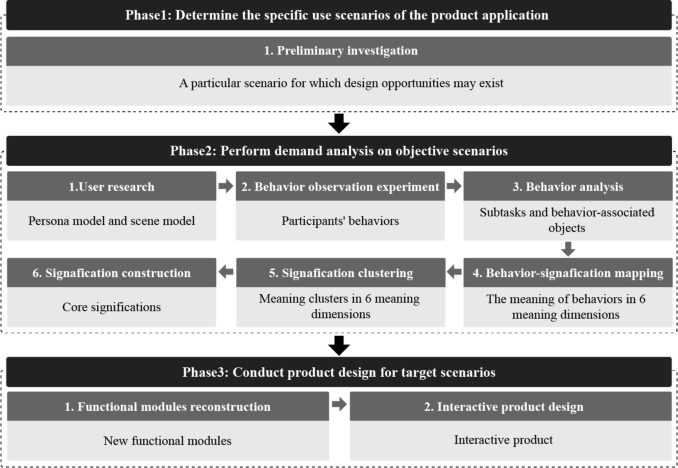
In view of the above research deficiency, this study proposes an intera- ctive product design method based on SAPAD and scenario thinking which involves 3 processes (Figure 1): determining the specific use scenarios of the product application, performing demand analysis on objective scenarios, and conducting product design for target scenarios. In the first phase, the designer will discover and define particular scenarios for which design opportunities may exist. In the second phase, the designer will establish a persona model and scene model through user research, then carry out behavior observation experiments based on these models and collate the behaviors of participants. Also, in order to obtain the core significations (core needs influencing the user experience in this scenario), the designer will conduct behavior-signification
114 Yang and He
Figure 1: The processes of the interactive product design method based on SAPAD and scenario thinking.
mapping, signification clustering and signification construction. In the third phase, the designer will apply the mapping and reconstruction of core signifi- cations and functional modules to obtain a new product architecture. Finally, the designer will create an interactive product based on core user demands by means of constructing target scenarios and other traditional interaction design processes.
RESEARCH PROCESS Determine the Specific Use Scenarios of the Product Application
By consulting related information, we found that it is more difficult for international students to record insights and organize notes easily and effi- ciently in the online education scenarios owing to constraints in time, space, language, and social culture. Consequently, the scenario of recording and organizing notes online was defined as the specific research object for the fol- lowing study.
Perform Demand Analysis on Objective Scenarios A questionnaire survey was conducted among 54 overseas students from China, and 5 users were selected and recruited for semi-structured intervi- ews. Based on the interviews, we chose users who like to try novelties and urgently desire to improve their performance in online education to build the persona model. Meanwhile, the scene model was built based on the common scenario of participating in online courses for international students via a variety of digital devices and software.
User Experience Design of Online Education Interactive Product 115
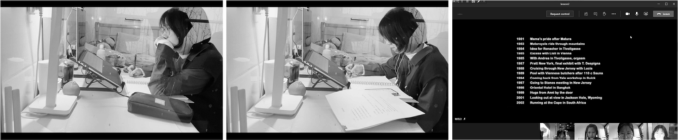
Figure 2: Behavior observation experiment.
According to the above models, we invited 3 subjects around ages 22-23 who had enrolled in non-native language online courses to participate in the behavior observation experiment and set up the experimental scene. In an attempt to increase the authenticity of the collected behavioral data, each participant was asked to simulate the persona model by role-playing and complete three tasks in turn in the experimental scene: attend a live class, participate in a group discussion, and organize notes after class (Figure 2). Participants’ behavior in relation to the experimental tasks was recorded through non-participatory observation.
On summarizing the recorded results, the behavior of the subjects in regard to recording and organizing notes in the experiment was divided into 4 modu- les: taking notes in class, taking notes in group discussion, organizing notes after class, and reviewing notes after class. In addition, all behavior modu- les were further divided into tasks and subtasks. Based on each subtask, we identified specific behavior-associated objects.
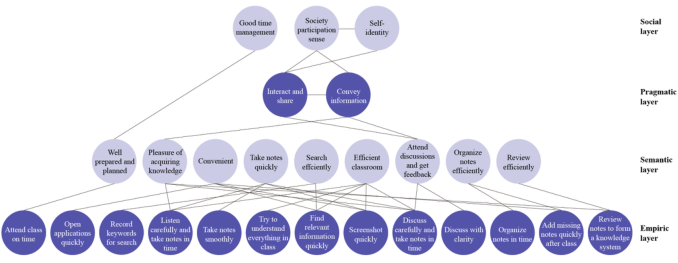
Three steps were conducted to obtain user core requirements through behavior analysis: Firstly, the meaning of user behaviors was excavated by mapping each subtask to 6 meaning dimensions, namely: the physi- cal, the syntactic, the empiric, the semantic, the pragmatic, and the social (Hu et al. 2019). Secondly, because of the different effects of each level’s meaning clusters on the subsequent function architecture, clustering analysis was carried out on the meanings of 5 of the dimensions except the physical level by using a Boolean logic algorithm. Hence, 9 meaning clusters were obtained via syntactic layer clustering, which were regarded as necessary functional modules and used for the subsequent reconfiguration of intera- ctive product functions. In addition, 13 meaning clusters were obtained from empiric layer clustering and 9 meaning clusters were obtained from seman- tic layer clustering, which represents the product functions based on user cognition and emotion respectively. Finally, 2 meaning clusters were obtai- ned from pragmatic layer clustering, and 3 meaning clusters were obtained via social layer clustering, which represents users’ expectations of products in terms of group interaction and social value, respectively. Finally, based on the relevance between different levels, the meaning clusters for the empiric, semantic, pragmatic, and social layers were again clustered (Figure 3). A total of 5 core significations (core needs influencing the user experience in scena- rio of recording and organizing notes online) were then identified, namely: schedule clearly before class, take notes efficiently in class, organize notes efficiently after class, review notes efficiently after class, interact and share in multiple ways.
116 Yang and He
Figure 3: Construction of core significations.
Conduct Product Design for Target Scenarios In SAPAD theory, core significations are associated with necessary functional modules. Based on the mapping relationship between them, we reconstructed 16 new functional modules: input and display course information, jump to live class interface, generate and display live subtitles, grab live subtitles by category, record and modify notes, display notes by category, search for infor- mation, screenshot, synchronize information across multiple devices, screen record, provide note templates, manage notes by category, navigate to desi- gnated notes, share team resources, offer team chat functionality, and provide online sharing community. The above functional modules basically cover the key user demands in the specific scenario of recording and organizing notes online.
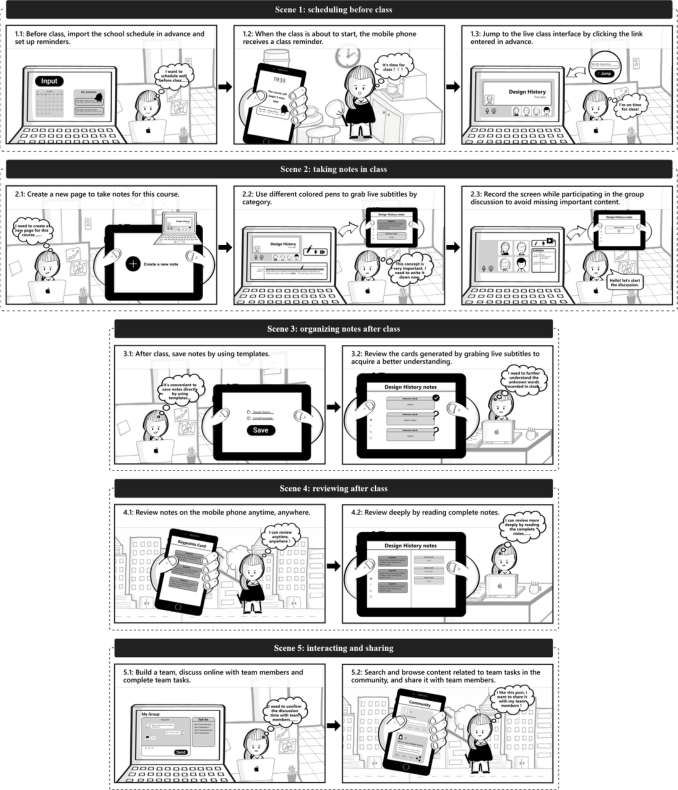
Based on these core significations, 5 target scenarios were constructed: scheduling before class, taking notes in class, organizing notes after class, reviewing after class, and interacting and sharing. The operation mode and interaction logic of the 16 identified functional modules were then determined in terms of the above target scenarios, and a preliminary inte- ractive product design scheme was described in the form of storyboard (Figure 4).
CONCLUSION
This study set out to provide guidance for improving user experience in online education for international students through interaction design. To scientifi- cally design a product that meets users’ needs, an interactive product design method based on SAPAD theory and scenario thinking is proposed. By inve- stigating online education as experienced by international students, the real user needs were comprehensively obtained and used to complete a prelimi- nary design for online notes recording and organizing application. We intend to further perfect the interactive product design scheme and improve the design method proposed in this paper, to make up for the shortcomings of existing research.
User Experience Design of Online Education Interactive Product 117
Figure 4: Storyboard of the preliminary interactive product design scheme.
REFERENCES
Aucejo, E. M., French, J., Araya, M. P. U. and Zafar, B. (2020). “The impact of COVID-19 on student experiences and expectations: Evidence from a survey.” Journal of Public Economics, 191, 104271. Coman, C., Èšîru, L. G., MeseÈ™an-Schmitz, L., Stanciu, C. and Bularca, M. C.
(2020). “Online teaching and learning in higher education during the coronavirus pandemic: students’ perspective.” Sustainability, 12(24), 10367. Dakhi, O., Jama, J. and Irfan, D. (2020). “Blended learning: a 21st century learning model at college.” International Journal of Multi Science, 1(08), 50–65. Hu, F., Jin, Y. and Zhan, X. (2019). “A study on healthy food service designing for
semi-disabled elderly based on SAPAD.” Procedia CIRP, 83, 506–512. Hu, F., Sato, K., Zhang, X. and Zhu, T. (2013). “Semiotic basis for designing product architecture.” In: The 19th International Conference on Engineering Design August 19-22, Seoul, 4, 19–22.
118 Yang and He
Liang K. and Li Y. (2018). “Interaction design flow based on user scenario.”
Packaging Engineering, 39(16), 197–201. Rosson, M. B., and Carroll, J. M. (2009). “Scenario-based design.”Human-computer interaction, 145–162. Stevanovi´c, A., Boži´c, R. and Radovi´c, S. (2021). “Higher education students’
experiences and opinion about distance learning during the Covid-19 pande- mic.” Journal of Computer Assisted Learning, 37(6), 1682–1693. Wang, Y., Hu, W., Tang, J. and Li, S. (2017). “Scene theory in product interaction design.” Packaging Engineering, 38(6), 76–80. Xin, X. (2015). “Interaction design: from logic of things to logic of behaviors.” Zhu-
angshi, 1, 58–62. Yuan, H., Han, L. and Pan, H. (2019). “Research on smart wearable device design based on Semiotic Approach to Product Architecture Design.” In: International Conference on Applied Human Factors and Ergonomics July 24-28, Washington D.C., 122–129. Zhang, X., Hu, F., Zhou, K. and Sato, K. (2017). “Reflecting meaning of user
experience: Semiotics Approach to Product Architecture Design.” In: The 24th International Conference on Transdisciplinary Engineering July 10-14, Singapore, 5, 329.
LISTED IN THE AHFE DIGITAL BOOKSTORE CATALOGUE
Explore the complete digital volume
Usability and User Experience
Read this individual research paper free through the original publisher, or explore the full digital proceedings book.
ISBN 978-1-958651-15-5
Explore this ISBN in the AHFE Bookstore ↗Listed in the July 2026 bookstore catalogue; search by ISBN to confirm current availability · Digital book purchase optional