Jorge Gil Tejeda, Lorena Olmos Pineda (2022). User Experiences Derived from Mass-Distribution Virtual Products are Integrated by the Spatio-Temporal Component. In: Usability and User Experience. AHFE Open Access, vol. 39, pp. 119–125. https://doi.org/10.54941/ahfe1001698
The mass-distribution virtual products affect in various dimensions to the users from the activation of the sensory mechanisms, anatomical responses until various cognitive processes. Through the observation of the inter-action processes made by a group of normal vision users in three mass-distribution virtual products with the assignment of a task was detected a constant in the processes of interaction: the spatio-temporal component. This component was present not only in the process of interaction with the virtual product but also in the process of interaction with the device’s work system. In turn the spatio-temporal component seems to have variations related in the activation of sensory mechanisms which depends on the characteristics of the object. The intention of these studies is to describe -with the use of networks- the spatio-temporal component during the interaction processes with the mass-distribution virtual products and to reflect on how this component affect the human behavior and user experiences.
Picard observed that the interaction of a user with a computer could generate Emotional Responses (Em-R) (Picard,1999), Her studies not only contribu- ted in generate deep reflections in relation to the effects that computers could cause in human beings, but also originated interest from various discipli- nes in addressing various phenomena related to these technological devices., which has generated contributions that goes beyond of the exclusivity of an unique discipline. From the perspective of the art and design areas there is a very deep interest not only with the factors that integrate user experie- nces (UX) in relation to the processes of interaction with virtual products of mass distribution., but also in the possible affectations in Human Beh- aviors (HB)., Ranging from the activation of various sensory mechanisms until cognitive processes. In previous studies it was observed that the inte- raction processes with Virtual Products (VP) generate Emotional Responses
(Em-R) (Tejeda and Pineda, 2020). In fact, it is noted that users today dele- gate a strong emotional charge to the virtual product and not to the Work System (WS)., Not only by the evolution on technical functions in a computer and its components but also in an evolution of the VP. The new generations of VP have integrated sophisticated algorithms that allow not only a better usability but also a specific adaptability to the user. This technological inte- gration - from artificial intelligence and machine learning fundamentally- has generated new HB. Because of this, in art and design areas must be differenti- ated the affectations in a person in relation with the WS and the affectations caused by the processes of interaction with VP. Although they are two interre- lated factors they affect users differently and in a clearly defined hierarchical processes.
We have conceptualized VP as meta-representations of new media and meta-media, In the concept are considered the perceptual and cognitive cha- racteristics that involves a human meta-representation like a product, in this sense we considered the use of a language system, images, visual elements, among others. The affectations observed on our studies goes on from the activation of Sensory Mechanisms (SM), the activation of Focal Attention- subsystem (FAP-s), transfer of information until specific responses (Em-R). In all this process we observed an important component which has been observed as a constant in various interaction sub-processes that integrate the experience and this is the spatio-temporal component. The effects observed in human behavior derived from this component allowed us to understand VP and their WS as objects that require high spatial precision in the interaction processes.
Frijda exposed in 1988 that emotions are subject of laws (Frijda, 1988). In the case of virtual products the existence of laws could be considered and they have been basically designed. Following Frijda’s position we also consider the existence of a fundamental factor that determines not only the emotional responses obtained from the interaction processes with the VPs, but also the correct spatial location of the components of the work system and the virtual product. In this sense, the spatial factor is fundamental in the generation of user experiences in VP that could be considered like integrative responses, as Plutchik defined to the emotions (Plutchik, 1965), however he had not considered this type of products in his studies. The intention of these stu- dies is to describe -with the use of networks- the spatio-temporal component during the interaction processes with the mass-distribution virtual products and to reflect on how this component affect the human behavior and user experiences.
CONSIDERATIONS WITH NEW MEDIA META-REPRESENTATIONS In general terms, the interaction processes in relation to mass-distribution VP can be conceived as complex and as cyclical (Pineda, 2021). We have made observations in relation to the fact that WS and VP generate intera- ction processes that must be studied in a differentiated way. This is because both components affect a person differently; one of them affects people more in a sense of spatial-general location as well as task execution, and another in
User Experiences Derived from Mass-Distribution Virtual Products are Integrated 121
a fine-spatial location as well as in a meaningful sense. Also, we can mention reflections developed by Fichte and the distinction that he made between “Ich” and “Nicht-Ich” (Hatfield, 2018), in the same way with Helmholtz and his studies on the difference between the subject and the object (Hatfi- eld, 2018). These postures give us a clear frame work about we refer to the interrelationship between two independent and completely different systems. In this sense, the SM that encompasses the concept of “self” is proprioce- ption, as the sensory system that gives us a global approach to our limit as a system. Proprioception has different meanings, however one of its functions is afferent-efferent neuromuscular control (Tuthill and Azim, 2018), it also gives a user information regarding the position and movement of the body through the proprioceptors distributed throughout the body, research carried out by Charles Sherrington and which is used today as a reference (Tuthill and Azim, 2018). For this reason it is possible to considerate two kinds of spatial location in a person during the processes of interaction with an object: the spatial-general location -related with the person and his context-, and the spatial-fine location -related with Focal Attention processes. It is intended to observe how SM are related to spatial factors and the possible effects that are observed in human behavior and user experiences.
METHODOLOGY
The methodology used was the comparative analysis of data and the use of networks for the visualization of information. In the construction of the networks the interaction processes determined by the interrelation of the User-Virtual Product were considered in three groups: G1 represented by Website, G2 represented by Slide show and G3 represented by Interactive Application. Likewise, the user’s activity was delimited from the assignment of three tasks: 1) Locate the class Website, 2) Enter into the virtual product, 3) Explore the virtual product. The technological device that integrated the work system was the user’s smartphone so was a clear habituation with the WS by users. The observation of processes was carried out in a learning envi- ronment with special interest on the individual interaction cycles carried out by a group of Normal Vision (Nv) users. The individual interaction cycles were observed on the maximum time as well as the minimum time.
PROCESS DESCRIPTION
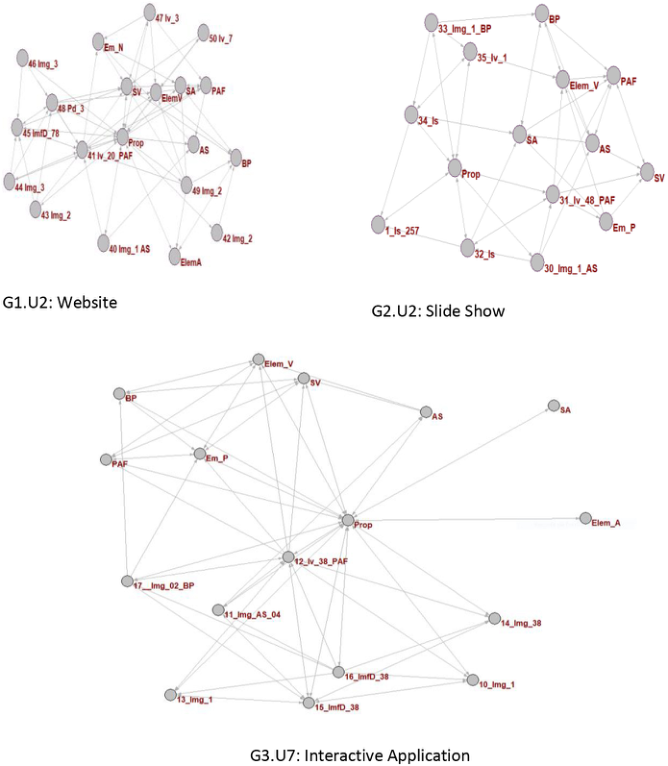
Figure 1 shows an example of the relationship between sensory mechanisms (SM) during the interaction process with three different VP in the maximum time of the cycle of interaction. The SM related to the spatial-general location of G1 were: gross motor Interaction (Img), visual Interaction (Iv), Fine motor interaction with fingers (ImfD) and digital Preassure (Pd). The SM related to the spatial-fine location related to the VP and concerning to the G1 were: Propioception (Prop), Img, Iv, ImfD, Pd. The active SM related to the spatial- general location of G2 were: Img, Iv and Sonor interaction (Is). The SMs related to the spatial-fine location of G2 were: Prop, Iv, Img, Is. The active SMs related to the spatial-general location of G3 were: Img, Iv, ImfD, and Is.
122 Tejeda and Pineda
Figure 1: Shows an example of the Cycle of interaction on T. Max. Normal Vision Users. G=group, U=User. (Elaboration Olmos P.L & Gil T.J. 2021).
The SMs related the spatial-fine location of the G3 were: Prop, Iv, Img, ImfD and Is. This shows a variability in the activation of SM related to the type of VP.
The VP that showed the highest demand for the spatial-general location were: Slide Show and the Interactive Application with a total of 2585 and 1421 correlations with Prop respectively. The VP that showed the high- est demand for the spatial-fine location were: Interactive Application and Website with a total of 3533 and 1046 correlations with Iv respectively.
Each virtual product showed the activation of various SM during the inte- raction processes, however the VP that showed a higher SM activation was the Interactive Application with the following hierarchy: Iv with 3533 cor- relations, Img with 2873 correlations, Is with 1651 correlations, Prop with 1321 and ImfD with 1169 correlations. In second place was the PPT with the following hierarchy: Img with 2585 correlations, Iv with 2495 correlations,
User Experiences Derived from Mass-Distribution Virtual Products are Integrated 123
Table 1. Total time 300 secs. U=User; G1=Group 1; G2=Group 2; G3=Group 3. (Elaboration Olmos P.L. & Gil T. J. 2021).
Table available in the original PDF paper.
Is with 1677 correlations, Prop with 1548 correlations. The VP that showed the least activation of SM was Website with the next hierarchy: Iv with 1046 correlations, Img with 888 correlations and Prop with 639 correlations.
With this description it was observed that the VPs that require a greater spatial-fine localization were: Interactive Application and Website. However, in the three VPs a prioritization is observed in the activation of the SM of the Iv related to the spatial-fine location. In addition Table 1 shows variations in relation to the interaction cycles performed by each user through the acti- vation of SM. And it is observed that during the interaction processes with the VP the spatial-fine location is positioned as a priority as long as there is a correct spatial-general location of the person in relation to the VP and consequently to its WS. With these results, it is observed that the less FAP-s is obtained in the object, the greater the activation of SM related to factors internal to the user, as is the case of the Slide Show.
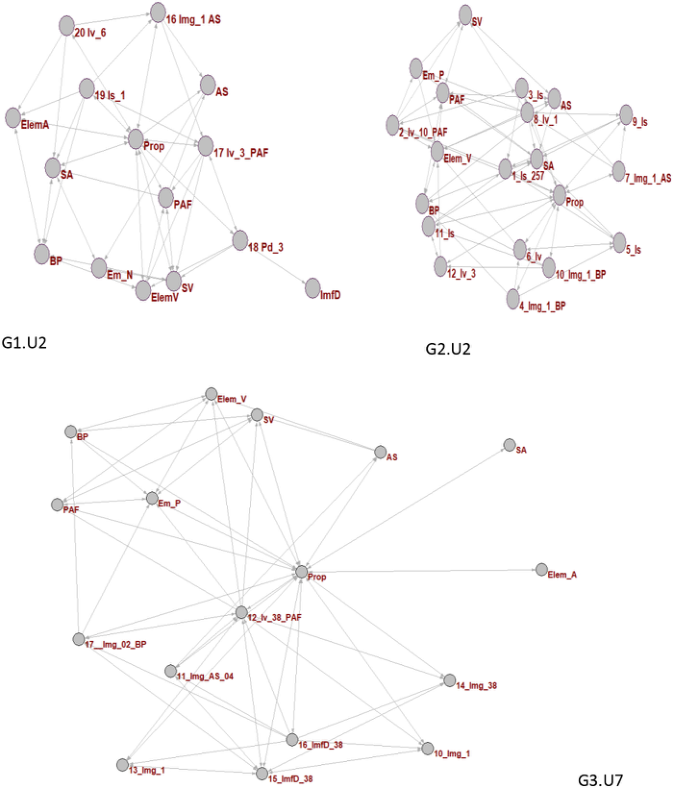
Figure 2 shows an example of the relationship between SM during the interaction process with three different VP in the minimum time of the cycle of interaction. The SM related to the spatial-general location of the person of G1 were: Img, Iv, Pd and Is. The SM related to the spatial-fine location related to the PV and concerning to the G1 were: Prop, Iv, Img, Pd, Is. The active SM related to the spatial-general location of the G2 were Img, Iv and Is. The SM related to the spatial-fine location of G2 were: Prop, Iv, and Is. The active SMs related to the spatial-general location of G3 were: Img, Iv ImfD, and Is. The SMs related the spatial-fine location of the G3 were: Prop, Iv, Img, ImfD and Is. On the example –Fig. 2- the VP that showed the highest demand in activation of SM on the spatial-general location were: Website
124 Tejeda and Pineda
Figure 2: Shows an example of the Cycle of interaction on T. Min. Normal Vision Users. G=group, U=User. (Elaboration Olmos P.L & Gil T.J. 2021).Table 2. PAF-s = Average time of FAP-S; U=User; G1= Group 1; G2=Group 2; G3=Group 3; Elaboration Olmos P.L & Gil T.J. 2021. (Elaboration Olmos P.L. & Gil T. J. 2021).
and the Interactive Application. The VP that showed the highest demand in activation of SM on the spatial-fine location were: Website and Interactive Application.
User Experiences Derived from Mass-Distribution Virtual Products are Integrated 125
Table 2 shows variations in relation to the average time of PAF-s performed by each person. The VP that was most linked to the PAF-s, -that is, with spatial-fine location processes- was the Website., While the VP that was least linked to the spatial-fine location processes was the PPT.
CONCLUSION
These studies show a difference not only in the activation of SM in relation to the VP which they interact but also with the use of certain spatial loca- tion system. All VP analyzed in this studies requires both: the spatial-general location and the spatial-fine location. The constant SM in both-Max and Min times-in relation to the general-spatial location were: Img, Iv and the Is. The constant SM that were observed in relation to the fine-spatial location in both times were the Prop, Img, Iv, Is. It is observed that the spatial-general location requires less activation of SM while the spatial-fine location requires more SM. Likewise, a correlation is observed between the PAF and the physi- cal interaction with the object. Physical interaction with the VP occurs after a general and fine spatial location. The variation occurs in relation to the acti- vation of ImfD and Pd related with the VP. In this sense the spatial location is necessary in the construction of the user experience with mass-distribution virtual products, because it is present in all phases of user interaction with the object.
REFERENCES
Frijda, Nico H.: The laws of Emotion. American Psychologist. Vol. 43. No. 5, pp. 349–358. (1988). Hatfield, G.: Helmholtz and philosophy: Science, perception, and metaphysics, with
variations on some Fichtean themes. J. History. 6(3), 11–40 (2018). Picard, R. W.: Affective Computing for HCI. In HCI. 1, pp. 829–83. (1999) Pineda, L. O., & Tejeda, J. G.: The Hierarchy in the Temporary Interaction Microprocesses that Precede the Breaking Points of Focal Attention in an Object of the New Media. In: Nunes I.L. (eds.) AHFE 2021. LNNS; vol. 265. pp. 63–68. Springer, Cham. (2021) Plutchik, R.: What is an emotion? J. Psychology. 61, pp 295–303. (1965). Tejeda J.G., Pineda L.O.: Analysis of the Work System in an Object of the New Media
and the Effects Generated in the Processes of Interaction with a User. In: Ahram T., Taiar R., Gremeaux-Bader V., Aminian K. (eds.) IHIET 2020. AISC, vol. 1152, pp. 198–203. Springer, Cham. (2020) Tuthill, J. C., & Azim, E.: Proprioception. vol. 28(5), pp. R194–R203. Elsevier. (2018)
LISTED IN THE AHFE DIGITAL BOOKSTORE CATALOGUE
Explore the complete digital volume
Usability and User Experience
Read this individual research paper free through the original publisher, or explore the full digital proceedings book.
ISBN 978-1-958651-15-5
Explore this ISBN in the AHFE Bookstore ↗Listed in the July 2026 bookstore catalogue; search by ISBN to confirm current availability · Digital book purchase optional