Lorena Olmos Pineda, Jorge Gil Tejeda (2024). Retrospective Temporal Perception with Virtual Products in Local Environments. In: Human Interaction and Emerging Technologies (IHIET-AI 2024): Artificial Intelligence and Future Applications. AHFE Open Access, vol. 120, pp. 344–350. https://doi.org/10.54941/ahfe1004585
It was observed that a group of students in a cross-sectional study perceived a rapid passage of time during the exploration of the virtual product used as a tool in the classroom. The characteristics that accompanied this temporal perception included the detection of a resource with a high percentage of spatial interaction as well as integrated by a closed linguistic system, additionally a negative valence in the emotional response in the majority of people as users in relation to the analyzed virtual product. The results indicate that a fast perception of time is not necessarily linked to activities with a positive valence in emotional response, but there are factors related to the object that contribute to this type of perception, and they could also be linked to complex cognitive processes that inhibit certain processes for the development of others.
An interesting pattern was observed regarding the perception of time in a local context. Students who interacted with a virtual product containing a moderate to high level of text mostly reported perceiving time passing quickly. However, this perception of time was associated with a negative valence in the processes of interaction with the virtual product. In this regard, it can be noted that a fast perception of time is not only linked to activities associated with a positive emotional response. Some studies developed by Mihaly Csik- szentmihalyi described the state of flow as a mental state in which a person is completely immersed in an activity. One of the most important character- istics of this state is that the person enjoys what they are doing (Beck, 1992). However, there are studies that describe the perception of time can be stud- ied from two perspectives: prospective time perception and retrospective time perception. The former is carried out using timing mechanisms, while the lat- ter requires general cognitive mechanisms that are not specifically related to time, such as memory usage (El Haj, Moroni, Samson, & Fasotti, 2013). In retrospective timing, people seemingly judge relatively long durations pri- marily based on the availability of events and contextual changes associated
Retrospective Temporal Perception With Virtual Products in Local Environments 345
with them (Block, 2003). From this perspective, it was observed that peo- ple’s time perception in this study was developed based on remembering the interaction experience with the chosen virtual product in this experi- ment and any mention of temporal analysis. Among some factors related to this type of retrospective perception in this study were cognitive effort, an emotional response, the use of a linguistic system, the use of executive attention, and age. The connection with these factors was obtained through interviews, which involved the ability to mentally project backward in time to relive past experiences, which is the main characteristic of autonoetic con- sciousness described in various studies conducted by Tulving (Tulving, 2002). Tulving describes autonoetic consciousness as a subjective experience of time that is oriented towards the past. In relation to age, it can also be a fac- tor influencing time perception, as indicated in various studies conducted by Wearden (Wearden, Wearden, & Rabbitt, 1997). Similarly, studies con- ducted by Light suggest that in younger ages, cognitive processes are faster and more efficient compared to ages categorized as aging, where a slowing down of cognitive processes is observed (Light, 1991). The intention of these studies is to observe the factors that influence time perception in a local envi- ronment, such as the classroom associated with the interaction processes with a specific product.
METHODOLOGY
The study was divided into seven phases. In the first phase, an empirical approach was used where volunteers self-reported their age, gender, and emo- tional response. The context was the classroom classified as an environment where certain control elements have been incorporated, such as the num- ber of people, lighting, sound, furniture, among other factors. The responses were recorded in the first phase on their technological device. In the sec- ond phase, the group of people was assigned a specific task: 1) Access the class website, 2) Navigate the website, 3) Locate the exercise they found most interesting. The analyzed artifact is a specialized virtual product cor- responding to the Web Page used for the Fundamentals of Design Fields course. In the third phase, the components contributing to the temporal perception to be observed were determined. In this regard, the following components were identified: executive attention, spatial and time percep- tion, closed linguistic system, cognitive effort, emotional response, and age. In the fourth phase, cognitive effort was classified as low, moderate, high, with corresponding ranges on the NASA TLX scale as follows: low = 0–33.33, moderate = 34–66.66, high = 67–100. In the fifth phase, emotions were classified into positive, negative, and neutral valence. Each emotion was self- reported based on the NASA TLX scale. In the sixth phase, an interview was conducted with each user, and the questions were linked to the assessment of the factors stated in the third phase. Since these studies focused on the retro- spective measurement of time, students were not instructed to estimate time intervals. In the seventh phase, the correlation between retrospective time perception and the factors mentioned was analyzed based on a subjective measurement of the interaction processes with the assigned virtual product.
346 Pineda and Tejeda
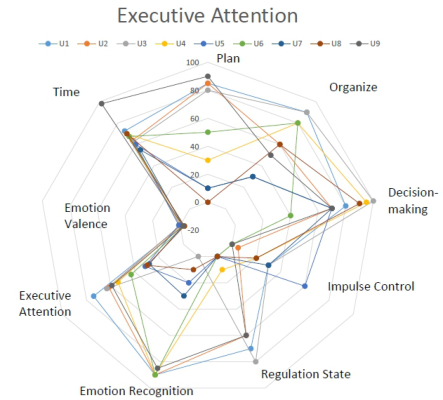
PROCESS DESCRIPTION Nine students were included, of which 44.44% corresponded to the Women sector, and 55.55% to the Men sector. 100% of the users registered a moder- ate cognitive effort, ranging between 47.9166 and 66.208 based on the scale used. Once the task was assigned to the group of students, we proceeded to record and observe the components linked to temporal perception. Regard- ing Executive Attention, five factors correlated with time perception, emotion valence, and emotion recognition were observed. The factors considered were planning, organization, decision-making, impulse control, and regulation state Fig. 1. In 88.888% of the participants, executive attention was observed at a high level, with decision-making and process organization being influ- ential factors. Both factors can be classified as complex cognitive processes involving various cognitive mechanisms. The executive attention network functions to monitor and resolve conflicts among information being pro- cessed by other brain networks (Botvinick et al., 2001). In this regard, the user first had to perceive and understand the information contained in the virtual product, evaluate options, and proceed with exploratory activities. Subse- quently, components of interaction with virtual products were identified, including Gross Motor Interaction (Img), Visual Interaction (Iv), Fine Motor Interaction with Fingers (ImfD), Digital Pressure (Pd), and Sound Interaction, with Fine Motor Interaction being the most prevalent. Fine Motor Interac- tion accounted for 7,602 out of 14,371 interactions, which is equivalent to 52.898% of the total.
Figure 1: The figure displays the record of executive attention across all users 300 secs.
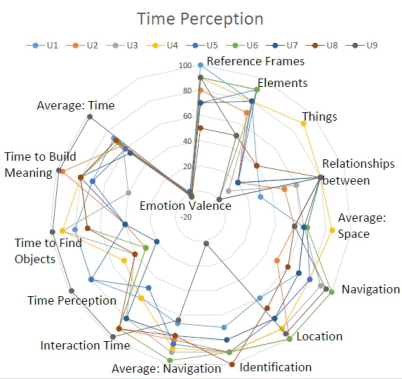
Regarding spatial perception, three categories were considered. The first of them related to the components used as reference, navigation, and the time of interaction with specific factors during the exploratory activity with the virtual product. For the most part, users’ perception of interaction processes was relatively fast, with 100 being the fastest perception of time and 0 being
Retrospective Temporal Perception With Virtual Products in Local Environments 347
the slowest on the scale used in these studies. Likewise, interaction, naviga- tion, and element identification were factors perceived as quickly locatable. The average time perception was considered to be in the moderate to fast range Fig. 2. Factors that may have contributed to the overall perception of time during the interaction included the use of reference frames, perception in meaning construction, time to find objects, interaction time, object identifica- tion time, as well as their location, navigation time, and the perception of the quantity of elements that made up the virtual product. It can be observed that the components considered for time and space perception were numerous.
Figure 2: The figure displays the record of executive attention across all users 300 secs.
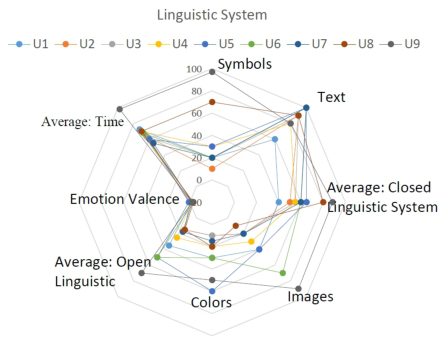
Regarding the connection with a specific linguistic system, text was clearly identified as dominant in shaping the virtual product. In this sense, retro- spective time perception is directly correlated not only with the quantity of elements identified but also with their qualities.
Figure 3: The figure displays the perception of both linguistic and non-linguistic systems in the virtual product.
348 Pineda and Tejeda
In this regard, text can be defined as a set of words that form coher- ent sentences, following grammar and syntax rules to make the message comprehensible Fig. 3.
Talmy introduced the distinction between ‘open linguistic systems’ and ‘closed linguistic systems’ based on their qualities, mode of transmission, and flexibility, all of which structure meaning (Talmy, 2006). This requires com- plex cognitive processes. Furthermore, in the Fig. 2, it can be observed how retrospective time perception is linked to the factors considered to have the most impact, with cognitive effort, spatial factor, navigation, and the linguis- tic system being the components that the user identified in their memory at a moderate to high level.
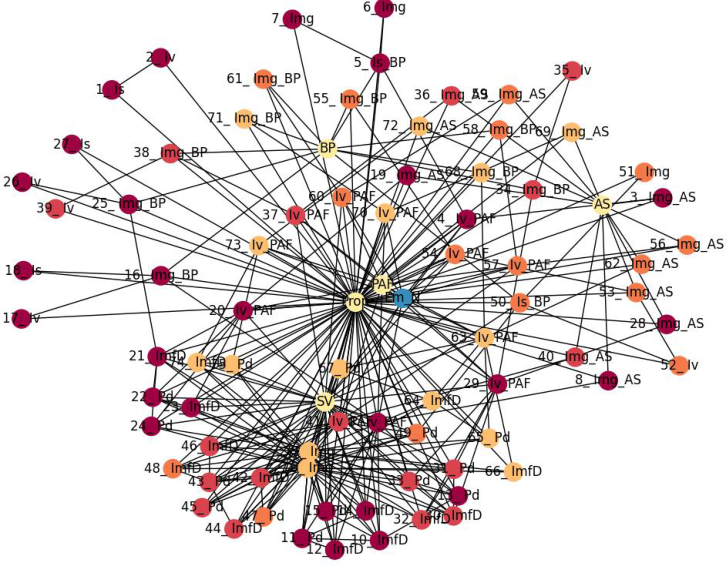
In relation to the interaction with the virtual product, it was observed through the density of networks that were constructed for each user that they had a moderate density with an average value of 0.3465. Networks with higher density correlated with users who showed a higher negative emo- tional intensity and a greater perception of the closed linguistic system. In Net 1, the network with intermediate density corresponding to user 3 is dis- played, whose interaction process consisted of 10 communities, 70 nodes, 281 connections, and a network density of 0.1164. Community detection was obtained using the Louvain algorithm.
Figure 4: The network exhibits a moderate density, which was derived from the interaction processes with the virtual product.
Retrospective Temporal Perception With Virtual Products in Local Environments 349
DISCUSSION
Each retrospective task involved a different activity. Regarding executive attention, individuals had to decide whether the interaction process with the virtual product for 300 seconds required more or less planning, activity orga- nization, decision-making, impulse control, and state regulation. In relation to time perception, individuals had to recall how the process of identifying elements, relationships between elements, use of frames of reference, object localization, object identification, time to find objects, and time to construct meaning occurred. Similarly, concerning the linguistic system, individuals had to determine which dominant linguistic system they remembered.
The analysis revealed that there were components considered relevant by the majority of users, which were somehow linked to the construction of ret- rospective temporal perception of the activity. One identified relevant factor was related to the linguistic system, particularly the dominance of text in the analyzed virtual product, where users perceived it as a fundamental element of the content, averaging 87.78%. On the other hand, other factors that drew attention and appeared to influence time perception were the localization of elements, navigation, spatial location, which users considered to be fast in execution. Similarly, the majority of users exhibited a negative valence in emotional response, which did not interfere with the rapid retrospective con- struction of time by the user. Time estimation was based on the raw score recorded for each category on the scale determined for this study. How- ever, although a negative valence of emotional response prevails, its levels are observed to be low. These results challenge the conventional notion that an accelerated perception of time is exclusively associated with positive experi- ences. On the contrary, the findings suggest that factors inherent to the virtual object can trigger this perception, even when the emotional response tends towards the negative. Thus, there is the possibility that this phenomenon is linked to complex cognitive processes that can inhibit certain processes while promoting the development of others. In this context, the study explored the complexity that defines the relationship between time perception, interaction processes with a virtual product, and emotional responses, thus challenging traditional assumptions in the virtual educational field.
CONCLUSION
Retrospective temporal perception was observed in these studies to be con- structed from multiple factors, where it was noted that not only spatial components influence temporal perception. In this regard, it is evident that the qualities of the object with which one interacts play a relevant role. In this sense, the emotional factor does not interfere with the retrospective construc- tion of time but does affect its perception. Regarding this latter factor, despite a negative valence in emotional response within the group, the perception of time was generally perceived as fast. It was observed, albeit inconclusively, that there appears to be a correlation in the perception of spatial factors deter- mined by a variety of compositional elements ranging from the use of color, identification of symbols, text, elements, among others, implying a higher cognitive expenditure. In this sense, when activities involving various spatial
350 Pineda and Tejeda
components for execution were involved, the emotional response remained at relatively low levels. This may suggest the presence of inhibitory as well as hierarchical cognitive processes during interaction with certain products of everyday life. Nevertheless, further studies are needed regarding these obser- vations. One factor that drew attention is that fine motor interaction was a very important factor in relation to retrospective temporal perception, where it seems that the cognitive processes executed by the person as a user in this type of interaction generate cognitive expenditure that inhibits temporal perception.
REFERENCES
Beck, L. (1992). Flow: The psychology of optimal experience. Mihalyi Csikszentmihalyi. Journal of Leisure Research, 24(1), 93. Block, R. (2003). “Psychological timing without a timer: The roles of attention and
memory”. Botvinick, M., Braver, T., Barch, D., Carter, C., & Cohen, J. (2001). Conflict monitoring and cognitive control. Psychological Review, 108, 624–652. El Haj, M., Moroni, C., Samson, S., & Fasotti, L. (2013). Prospective and retrospec-
tive time perception are related to mental time travel: Evidence from Alzheimer’s disease. Brain and Cognition, 83(1), 45–51. Light, L. (1991). Memory and aging: Four hypotheses in search of data. Annual review of psychology, 42(1), 333–376. Talmy, L. (2006). Toward a Cognitive Semantics. (L. O’Connor, Ed.) Journal
Pragmatics, Vol. 38(Issue 7), 1126–1134. Tulving, E. (2002). Episodic memory: From mind to brain. Annual review of psychology, 53(1), 1–25. Wearden, J., Wearden, A., & Rabbitt, P. (1997). Age and IQ effects on stimulus
and response timing. Journal of Experimental Psychology: Human Perception and Performance, 23(4), 962.
LISTED IN THE AHFE DIGITAL BOOKSTORE CATALOGUE
Explore the complete digital volume
Human Interaction and Emerging Technologies (IHIET-AI 2024): Artificial Intelligence and Future Applications
Read this individual research paper free through the original publisher, or explore the full digital proceedings book.
ISBN 978-1-958651-96-4
Explore this ISBN in the AHFE Bookstore ↗Listed in the July 2026 bookstore catalogue; search by ISBN to confirm current availability · Digital book purchase optional