Lorena Olmos Pineda, Jorge Gil Tejeda (2024). Negative Emotional Valence Shades, but Does Not Inhibit, Interaction and Spatial Processes. In: Human Factors and Systems Interaction. AHFE Open Access, vol. 154, pp. 274–280. https://doi.org/10.54941/ahfe1005375
In the context of developing new inclusive products tailored to the individual needs of users, understanding emotional valence and its influence on human interaction processes is essential. Particularly, when analyzing interaction with specific virtual products, the influence of various factors inherent to both the user and the product in obtaining the experienced emotional valence becomes evident. In a cross-sectional study involving non-equivalent user groups, it was observed that negative emotional valence derived from interaction processes with virtual products did not interfere with the retrospective spatial construction of individuals as users. For this purpose, an experimental group and three control groups were employed to compare behavior regarding spatial processes. The spatial components were derived from the virtual product analyzed in the experimental group.
An interesting pattern was observed regarding the correlations in emotional valence and various processes during interaction in non-equivalent groups of students and diverse virtual products. In this sense, it is important to try to understand what it implies to talk about an emotional valence. In the literature, the following approaches towards a definition can be found: its dimensionality, where a variety of emotional states and human affects are considered, which can be represented in a three-dimensional space referred to as emotional space (Tato, Santos, Kompe & Pardo, 2002) (Pereira, 2000); Its classification based on observation and studies related to facial expres- sions in individuals (Ekman & Friesen, 1971) which are linked to biological processes of the body (Damasio, 1994), the valence of emotion and its con- nection to specific subsystems of the brain and its processing (LeDoux, 1996); (Panksepp, 1998), its regulation and the suppression of expressions (Ekman, Levenson & Friesen, 1983), its controlled inhibition and the consequences (David, 2016), its influence on decision-making and cognitive processes (Kahneman, 2012). However, there are researchers who have differentiated
Negative Emotional Valence Shades, But Does Not Inhibit, Interaction and Spatial Processes275
an emotional state from a conscious feeling. Iversen, Kupfermann, Kandel (2000) defined that conscious feeling is mediated by the cerebral cortex, in part by the cingulate cortex and by the frontal lobes. Whereas emotional states are mediated by a family of peripheral, autonomic, endocrine, and skeletomotor responses (Iversen, Kupfermann & Kandel, 2000). From this perspective, emotional responses and emotional states are handled in the liter- ature in a similar manner, but not the concept of conscious feeling. Likewise, the detection of emotional valence in a person becomes a conscious activity where an association between experience and conscious cognitive processes is required. This process can be achieved through different relatively sim- ple, yet no less important techniques such as retrospection. This requires a conscious activity from the individual regarding the event. This has led to very valuable research in relation to explore emotions. In this sense, today we find ourselves in a hyper-segmentation, not only of markets but also in a dynamic of human-centered design. From this perspective, knowledge fields such as Design, Telecommunications, Computing, and Information Technol- ogy are adopting positions in the creation of increasingly specialized objects tailored to the needs of each individual. Consequently, it is important to observe the behavior of emotional valence in specific environments and ana- lyze their correlations and dependencies in relation to the type of objects with which one interacts. The objective of this research is to explore, through cross-sectional studies, the valence of emotional response and its influence on the retrospective construction of space based on interaction processes with mass-distributed virtual products. The relevance of linking emotional valence with spatial processes is that virtual products are highly visuospatial; hence, it is a fundamental factor in interaction (Tejeda & Pineda, 2022).
METHODOLOGY
The study was divided into eight phases. In the first phase, an empirical approach was used where volunteers self-reported their age, gender, and emo- tional response valence. The context was the classroom. These responses were recorded on their technological devices. In the second phase, the group of individuals was assigned a non-complex task: essentially the exploration of virtual products. In the third phase, the components in the retrospective con- struction of spatial processes to be observed were determined. In this sense, the following components were identified: frames of reference, object percep- tion, perception of things, relationship between objects, navigation, location, and object identification. In the fourth phase, a classification was made of all the components considered in the retrospective construction of space into spatial components, navigation, and time perception. Each component was recorded through self-report using the NASA TLX scale. In the fifth phase, a classification was made regarding the ease of identifying objects in space as low, moderate, or high, and the corresponding ranges on the NASA TLX scale were: low = 0–33.33, moderate = 34–66.66, high = 67–100. In the sixth phase, the relationship between human interaction processes such as Gross Motor Interaction (GMI), Visual Interaction (VI), Fine Motor Inter- action (FMI), and Digital Pressure (DP) was observed. In the seventh phase,
276 Pineda and Tejeda
an interview was conducted with each user, and the questions were linked to the assessment of the factors outlined in the third phase. Students were not instructed to estimate time intervals. In the eighth phase, the correla- tion between the valence of emotional response and the components in the retrospective construction of space was analyzed.
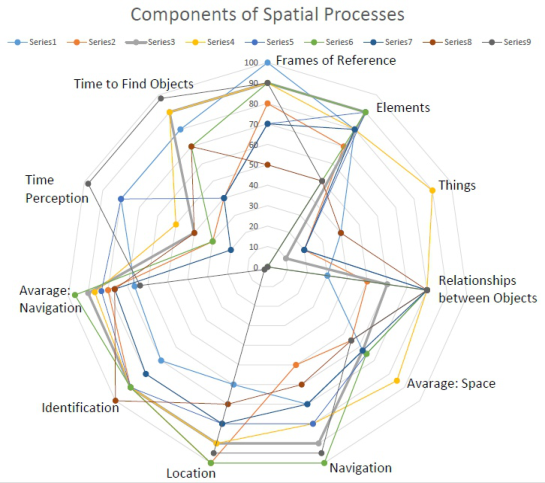
PROCESS DESCRIPTION There were a total of four groups. The experimental group consisted of 9 students, with 44.44% corresponding to a Women’s sector and 55.55% to a Men’s sector. 100% of the individuals as users recorded an emotional response, of which 66.66% recorded a negative valence, 22.22% a neutral emotional response, and 11.11% a positive valence. Regarding the intensity of emotional responses, an average of 17.69% was recorded, which, accord- ing to the scale used, was categorized as low. Once the task was assigned to the experimental group, the components related to the retrospective construc- tion of spatial processes were recorded. Furthermore spatial components, an average of 16.666% was obtained in relation to the difficulty involved in location and use of frames of reference, location of elements, and things in the virtual product. According to the scale used, this is classified as low diffi- culty. Additionally the ease of navigation in the virtual product, there was a retrospective perception of 80.074% of users who perceived easy navigation. Components such as location (85% in the perception of ease) and identifica- tion (78% in the perception of ease) were considered. Regarding the time to find objects, there was a 68.666% perception of ease Fig. 1.
Figure 1: The figure displays the components of spatial processes within the experimental group.
Negative Emotional Valence Shades, But Does Not Inhibit, Interaction and Spatial Processes277
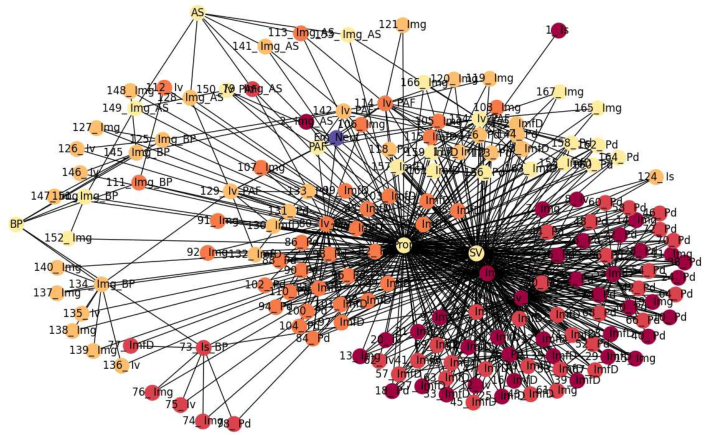
Regarding the negative emotional valence in relation to the interaction components of the experimental group, it was observed that users with higher emotional intensity were linked to networks of higher density, approx- imately 55.55%, as well as the highest number of connections. Likewise, it was observed that networks of lower density were associated with lower emotional intensity. These data were obtained through the generation of interaction process networks. Fig. 2 shows the interaction process of user 2, in which 10 communities, 178 nodes, 447 connections, and a density of 0.0284 were obtained. The two densest communities were related to fine motor interaction, composed of components GMI and DP. Both components are associated with physical interaction with the object, as well as user move- ment control. In relation to the results, the experimental group showed a high percentage of perception in the ease of locating elements in space.
Figure 2: The network displays the communities generated by the components in the interaction processes within the experimental group.
In relation to the control groups, concerning the negative valence of emotion and aspects related to focal attention processes, which include com- ponents such as spatial location, identification, and motor control, three control groups were observed, each comprised of mixed groups of 12 stu- dents. The first control group interacted with a webpage, consisting of 50% women and 50% men. All individuals recorded an emotional response as users, with 33.333% reporting a positive valence of emotion and 66.666% reporting a negative valence of emotion. The second control group interacted with a PowerPoint presentation, with 41.66% women and 58.33% men. All individuals recorded an emotional response as users, with 100% reporting a positive valence of emotion and 0% reporting a negative valence of emotion. The third control group interacted with an interactive application, consisting
278 Pineda and Tejeda
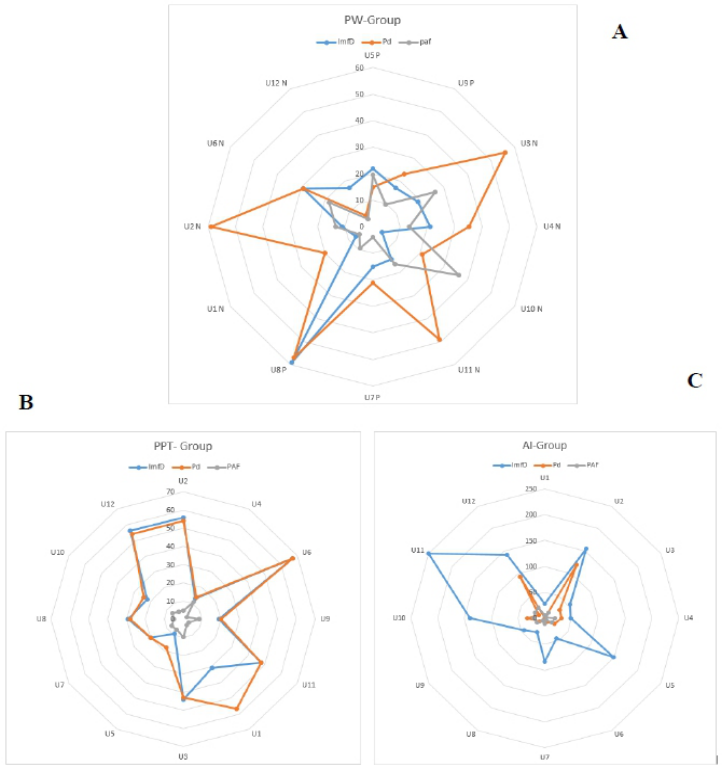
of 33.33% women and 66.66% men. All individuals, as users, recorded an emotional response, with 100% reporting a positive valence of emotion. Both the first and the last control group had autonomous interaction with tech- nological devices and virtual products. Based on this description, all control groups recorded an emotional response, with the first control group having both emotional valences. In terms of interaction qualities, a physical inter- action of 625 interactions, considering FMI and DP, and an average focal attention of 14.61 seconds were observed. In this regard, negative valence did not generate any interference in relation to focal attention processes. Regarding this factor, users who showed negative valence recorded a total of 132.884 seconds in focal attention processes, while users in this group who showed positive valence recorded a total of 42.541 seconds in focal attention processes Fig. 3A.
Figure 3: The behavior of the three control groups is shown, considering focal attention processes and physical interaction with the virtual product. Where: A = first control group, B = second control group, C = third control group.
Negative Emotional Valence Shades, But Does Not Inhibit, Interaction and Spatial Processes279
In all control groups, whether with positive or negative valence, focal atten- tion processes linked to the virtual product were recorded. The first group, due to the qualities of the virtual product and under an assigned exploratory task, recorded a total of 1628.18 seconds in focal attention. The second group recorded a total of 900 seconds in focal attention. The third group recorded a total of 2038.8 seconds in focal attention. This suggests that the valence of emotion has an effect during interaction processes but does not inhibit spatial processes. One of the most important effects is related to focal attention.
DISCUSSION
In the development of new products that can better adapt to the needs of each user, it is crucial to understand emotional valence and how it influ- ences human interaction processes with everyday products. What could be observed during the interaction processes with specific virtual products is that valence depends on factors inherent to both the user and the product. However, it was crucial to observe whether negative emotional valence inter- fered in any way with the interaction processes. In previous studies, virtual products were categorized with a high demand for visuospatial processes, so observing any factor that interferes or affects spatial interaction processes is fundamental. In relation to this experience, it is observed at a general level how emotions nuance interaction processes and decision-making during exploratory activity with virtual products. Similarly, it is important to under- stand this process from the retrospective user experience and compare these results with other methods, such as network analysis, that allow observing behavior in order to obtain data that can be contrasted with results obtained by more precise devices. In all cases, an emotional valence was recorded, and both the experimental group and the control groups engaged in activities linked to spatial processes.
CONCLUSION
During the interaction with specific virtual products, it was observed that emotional valence is influenced by a variety of factors inherent to both the user and the product in question. However, an important factor was to explore how negative emotional valence could affect or interfere with spa- tial processes. Spatial processes during human interaction comprise a wide variety of components. In these studies, the retrospective construction of both emotional valence and spatial components was analyzed. Based on the qualities of virtual products, a total of 7 components were examined. Addi- tionally, their correlation and dependence on gross motor, fine motor, and focal attention interaction processes were observed. While much exploration is still needed, the results showed that the negative valence of emotion does not interfere with the spatial construction of the individual during interaction processes with virtual products. Additionally, it was observed that emotional valences categorized as neutral, as well as positive, do not interfere with this process.
280 Pineda and Tejeda
REFERENCES
Damasio, A. (1994). El error de Descartes. Andrés Bello. David, S. (2016). Emotional agility: Get unstuck, embrace change, and thrive in work and life. Penguin. Ekman, P., Levenson, R., & Friesen, W. (1983). Autonomic nervous system activity
distinguishes among emotions. science, 221(4616), 1208–1210. Ekman, P., & Friesen, W. (1971). Constants across cultures in the face and emotion.
Journal of Personality and Social Psychology, 17(2), 124–129. Iversen, S., Kupfermann, I., & Kandel, E. R. (2000). Emotional states and feelings. Principles of neural science, 4, 982–997. Kahneman, D. (2012). Pensar rápido, pensar despacio.. Debate. LeDoux, J. (1996). The Emotional Brain: The Mysterious Underpinnings of Emo-
tional Life. (S. &. Schuster., Ed.). Panksepp, J. (1998). Affective Neuroscience: The Foundations of Human and Animal Emotions. Oxford University Press. Pereira, C. (2000). Dimensions of emotional meaning in speech. In ISCA Tutorial
and Research Workshop (ITRW) on Speech and Emotion. Tato, R., Santos, R., Kompe, R., & Pardo, J. (2002). Emotional space improves emotion recognition. In Seventh International Conference on Spoken Language Processing. Tejeda, J., & Pineda, L. (2022). User Experiences Derived from Mass-Distribution
Virtual Products are Integrated by the Spatio-Temporal Component. Usability and User Experience, 39(119).
LISTED IN THE AHFE DIGITAL BOOKSTORE CATALOGUE
Explore the complete digital volume
Human Factors and Systems Interaction
Read this individual research paper free through the original publisher, or explore the full digital proceedings book.
ISBN 978-1-964867-30-4
Explore this ISBN in the AHFE Bookstore ↗Listed in the July 2026 bookstore catalogue; search by ISBN to confirm current availability · Digital book purchase optional