Enrique Bances, Urs Schneider, Jörg Siegert, Thomas Bauernhansl (2024). Enhancing Ergonomics in Construction Industry Environments: A Digital Solution with Scalable Event-Driven Architecture. In: Human Factors and Systems Interaction. AHFE Open Access, vol. 154, pp. 103–113. https://doi.org/10.54941/ahfe1005358
The construction sector remains among the least digitized and automated industries, where human cognitive intervention is still necessary for many tasks. These tasks often entail significant physical exertion, increasing the risk of Musculoskeletal Disorders (MSDs) when workers perform unexpected movements or events. While assessment methods and technologies like wearable devices, bio-signal sensors, and digital tools enable real-time monitoring of ergonomic factors, integrating them simultaneously presents a challenge. This paper describes developing and implementing an event-based architecture to address this complexity. This architecture monitors each integrated system in real time, offering workers immediate feedback on their ergonomic behaviors and adjustments while predicting potential hazards. Furthermore, it facilitates group work by enhancing coordination and communication among team members through real-time sharing of relevant ergonomic data and insights.The architecture consists of three layers that can be scaled according to needs. 1) The physical layer manages all data sources, such as motion capture, electromyography, and external sensor systems. Each system uses the IoT messaging protocol MQTT to send and exchange data. 2) The digital layer consists of several frameworks for stream-producing data and distributing the parallel computing through several microservices, and 3) the human-system interaction layer where the results or outcome of the services go. The information could be displayed to give feedback, warning alerts, or just notifications to the worker through AR glasses, or an external monitoring system could be used for post-ergonomics analysis. Our initial findings highlight integrating a motion capture system into the architecture. This integration empowers the deployment of ergonomic evaluation methods such as RULA, REBA, and the body joint angle range classification to mitigate ergonomic risks during construction tasks effectively.
A study by the European Agency for Safety and Health at Work, Muscu- loskeletal Disorders (MSDs) stand out as the primary work-related health concern in the European Union. A substantial 60% of respondents identi- fied MSDs as their most pressing issue, and additional data underscores that MSDs account for the largest share (40%) of work-related accidents in the workplace (Kok et al., 2019). In the construction sector, workers report var- ious MSDs as follows: 52% experience backache, 54% report upper limb issues, and 41% have lower limb problems. The primary cause cited by these workers for these issues is related to carrying or moving heavy loads
(EU-OSHA, 2020). During paired or group tasks, it is common for one individual to naturally emerge as the leader, taking the initiative in mak- ing movements and applying force during object manipulation while the other individual typically assumes a follower role (Bances et al., 2023). This dynamic can potentially elevate the risk of injury for the follower or lead to accidents during the performance.
Ergonomic assessments are crucial in ensuring workplace safety and pro- moting employee health, particularly in settings where physical labor such as construction, repetitive movements, or prolonged periods of awkward positions are prevalent and often lead to the development of MSDs (Pas- cual, 2008). On the other hand, physical and mental fatigue among workers on construction sites significantly impairs work performance and poses a grave risk of reduced attentiveness and the potential for accidents (Xing et al., 2020). For instance, a study revealed that 70% of accidents in the construc- tion industry stem from the actions of individual workers or the collective efforts of the work team (Sanni-Anibire et al., 2020).
Digital Solutions for Ergonomics Risk Assessment Historically, various evaluation methods have been utilized, including tools like questionnaires, the analysis of photographs and videos, risk assess- ment filters, and detailed checklists. In addition, assessment techniques, such as Rapid Upper Limb Assessment (RULA), Rapid Entire Body Assessment (REBA), Ovako Working Posture Assessment System (OWAS), and others, have contributed to this process (Joshi, 2020). While these methods can be effective, they can also prove labor-intensive and difficult to scale, and, in the end, their relevance remains somewhat confined. However, over the past few decades, significant progress has been made in ergonomic workplace evalu- ations. These advancements enable real-time assessments of the workplace, tasks, and worker performance. For instance, one study developed a sys- tem that utilizes inertial sensors to continuously monitor worker movements during manual material handling in warehouse environments.
This system calculates the Ergonomic Risk Index (ERI) using established techniques like REBA, RULA, NIOSH lifting equations, OWAS, and oth- ers (Battini et al., 2022). In the construction sector, similar solutions have been implemented. These systems utilize Inertial Measurement Units (IMUs) and apply methods like REBA and RULA to assess ergonomic risks (Valero, 2016). Additionally, in similar works, using wearable devices, such as elec- tromyography (EMG) signals combined with a cognitive architecture to assess muscle activity, help to evaluate load distribution and ergonomics design effectiveness in a shopfloor (Oyecan et al., 2021). In summary, each of these solutions provides the ability to monitor individual tasks, track- ing workers’ movements, and postures to gain insights into ergonomic risks and potential injuries. However, these system implementations face lim- itations or increased complexity when scaling up the system to monitor multiple personnel simultaneously. Therefore, this study focuses on develop- ing an event-driven platform to address these challenges and enable efficient monitoring of several personnel concurrently.
Enhancing Ergonomics in Construction Industry Environments 105
Wearable Sensing Devices for Health and Hazard Mitigation Wearable sensing devices (WSD) (Nnaji et al., 2020) and IoT (Internet of Things) technology (Awolusi et al., 2019) hold immense potential in the con- struction industry for mitigating hazards and improving safety (Abuwarda et al., 2022) and facilitate communication and coordination among work- ers with supervisors, by instant messaging. For instance, we can monitor workers’ vital signals, environmental conditions, and movement patterns simultaneously. This allows for the early detection of potential hazards or unsafe working conditions. The most popular WSD in construction moni- tors body temperature, blood pressure, heart rate, and stress level (Ahn et al., 2019). The collected data can be analyzed to identify trends, patterns, and areas for safety improvement, deploying analytics and preventive models.
PROBLEM STATEMENT As highlighted in the preceding chapter, enhancing the safety and well-being of workers in the construction industry necessitates the simultaneous focus on two critical domains. Firstly, ergonomic risk assessment methods must yield real-time results to prevent MSDs proactively. Simultaneously, monitoring physiological parameters is crucial for accurately predicting and managing workers’ health and comfort levels during occupational tasks. Secondly, iden- tifying and communicating potential hazards to workers can significantly reduce the likelihood of accidents. Nevertheless, developing a complex plat- form enabling the integration of these diverse technologies must carefully consider the following three main challenges.
Large Amount of Data and Infrastructure Monitoring multiple workers simultaneously presents challenges in manag- ing numerous concurrent connections and data sources. In addition, due to the continuous data streams without a defined endpoint, the system must be able to store data indefinitely or for as long as needed. Handling and pro- cessing large and diverse volumes of data requires robust infrastructure and data management systems.
Stream Processing Stream processing (SP) data from wearable sensing devices in construction enhances real-time insights and decision-making, elevating safety, produc- tivity, and resource management on construction sites. However, addressing challenges such as latency management and optimizing networking commu- nication and infrastructure is imperative. Additionally, ensuring the resilience of SP systems to failures is essential, requiring measures like data replication, checkpoints, and robust recovery mechanisms to maintain system reliabil- ity and operational continuity. Moreover, SP systems must efficiently utilize computing resources to meet performance requirements. Utilizing stream processing frameworks and tools is crucial in effectively addressing these challenges, enabling organizations to leverage the benefits of real-time data analysis with precision.
Scalability and Parallel Computing As additional components, such as data sources or larger workloads, are incorporated, the system must expand or contract to handle fluctuations in demand dynamically and effectively. This adaptability ensures the efficient distribution of workloads across multiple resources, ultimately enhancing performance and responsiveness. This capability becomes especially crucial in applications where low latency is a critical requirement. On the other hand, there is a requirement to execute concurrently multiple tasks or processes, thereby enhancing overall efficiency and reducing the time required to com- plete each task. For instance, training intricate machine learning models in intense neural networks entails processing extensive datasets. Parallel pro- cessing, frequently facilitated by GPU acceleration, is employed extensively to accelerate and streamline the training process.
EVENT-DRIVEN MICRO SERVICE ARCHITECTURE This article introduces an architecture designed to achieve scalability while leveraging an event-driven approach. This platform could integrate diverse systems as data sources, thereby empowering the execution of multiple tasks or applications. The architecture is structured into three layers, each designed to accommodate varying scalability requirements:
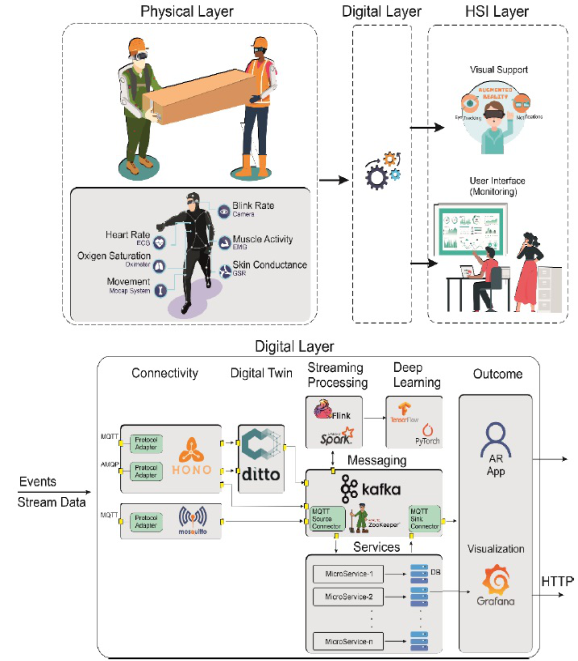
Physical Layer: This layer manages vital components, including motion capture systems and sensors that measure essential physiological signals. Uti- lizing the IoT messaging protocol MQTT, each system can transmit and share data with the following layers. This data may either be in its raw form or pre- processed. For example, we have integrated a motion capture system within the proposed ergonomics assessment platform. This system utilizes multiple inertial measurement units (IMUs) to calculate each body joint’s Euler angle position precisely. Then, these calculated angles are transmitted to the digital layer using MQTT topics, which can be consumed by specific applications or services within the platform, allowing for comprehensive analysis and assess- ment of ergonomic factors. By leveraging MQTT’s lightweight and scalable messaging protocol, we can effectively manage and distribute this critical information, enhancing the platform’s functionality and usability. More- over, MQTT’s scalability extends to future integrations, including vital signal sensors for monitoring and predicting tiredness during the task. Another potential incorporation could be a robotic exoskeleton. This advanced tech- nology integrates many sensors, encompassing force, EMGs, IMUs, joint position, pressure, and tactile sensors. These sensors enable dynamic adjust- ments of assistance levels, ensuring safety and optimizing interaction between the wearer and the robotic device. These advancements hold significant potential for enhancing ergonomics and safety during collaborative tasks.
Digital layer: Serves as the central processing hub, encompassing a compre- hensive array of frameworks, platforms, databases, and services. This layer facilitates the flow and processing of data throughout the system. Within the digital layer, the data pipeline is structured into distinct phases, each fulfilling a specific purpose in the overall data processing workflow.
Enhancing Ergonomics in Construction Industry Environments 107
- Connectivity: This architecture phase facilitates interconnection between diverse data sources, irrespective of their communication protocol. This plat- form uses Eclipse Hono, standardizing incoming data from devices into a uniform message format via protocol adapters (such as MQTT, HTTP, and CoAP). Subsequently, this standardized data is transmitted to a mes- saging system like Apache Kafka for subsequent processing. Alternatively, Apache Kafka Connectors offers an alternative method to transform data from MQTT into Kafka within this architecture directly.
- Messaging: Apache Kafka is a distributed event-streaming platform renowned for facilitating real-time data streaming across diverse applications and microservices. Its robust architecture ensures high scalability and fault tolerance, making it a preferred choice for handling large volumes of data with low latency and high throughput.
- Digital Twin: The architecture incorporates the Eclipse Ditto digital twin framework, enabling the creation of virtual representations for phys- ical assets, processes, or systems. This integration facilitates synchroniza- tion between real-world entities and their digital counterparts, facilitating real-time ergonomics monitoring, analysis, and simulation.
- Streaming Processing: The platform integrates two distributed com- puting frameworks, Apache Spark and Apache Flink, to drive real-time event-driven applications. These frameworks offer low-latency processing capabilities, scalability, and integration with diverse ecosystems. This combi- nation empowers the platform to process streaming data efficiently, ensuring optimal performance and responsiveness across various applications and use cases.
- Deep Learning: Within this architecture, the streaming processing plat- form Apache Spark integrates with two deep learning frameworks, Tensor- Flow and PyTorch. This integration harnesses the strengths of both streaming data processing and advanced deep learning capabilities, empowering the system to derive valuable insights and make informed decisions in real time.
- Services: Within the ergonomics digital platform, microservices play a pivotal role, each representing a distinct function capable of independent deployment, realdevelopment, and scaling. For example, specific microser- vices leverage Apache Kafka and Spark for efficient data ingestion and stream processing, storing the resulting outcomes in databases. When required, these outcomes are exported from the platform using Kafka sink connectors, ensuring seamless integration and data distribution across various system components.
- Outcomes: The results generated by the microservices can be accessed directly from the databases and visualized using platforms like Grafana. Moreover, immersive and interactive experiences can be provided to users through developing AR applications that consume these outputs.
Human-System Interaction (HSI) Layer: This layer serves as the interface where external users engage with the platform, monitoring ergonomics per- formance through a graphical web interface. Study participants, on the other hand, could receive pertinent information via AR glasses. This functionality empowers participants to adapt and optimize their ergonomics in real time.
Overall, this architecture enables the integration of various technologies to monitor, analyze, and optimize ergonomics in real time, contributing to improved worker well-being and productivity. A graphical description of the architecture is shown in Figure 1.
Figure 1: Graphical representation of an event-driven architecture for cooperative tasks in the construction industry. The architecture is structured into three layers: the phys- ical layer, digital layer, and HSI (human-system interaction) layer. At the core of the architecture lies a messaging broker, orchestrating the flow of real-time data originat- ing from an experimental environment where a set of sensor systems serve as data sources. For instance, a suite of microservices within the platform processes these data streams, performing tasks such as calculating ergonomics risk factors or pre- dicting muscle fatigue. The results of these computations are then transmitted to an augmented reality (AR) application, delivering feedback directly to the worker. This feedback loop enables the optimization of ergonomics and enhances the safety of task execution in the construction industry.
Architecture Deployment The architecture has been successfully deployed on our local servers. We initiated the process by constructing Docker images for each containerized component, ensuring that every image encapsulated all necessary depen- dencies and configurations. Subsequently, all components were packaged
Enhancing Ergonomics in Construction Industry Environments 109
into Docker containers. This comprehensive packaging included microser- vices, messaging brokers, stream processing modules, digital twin frame- works, deep learning frameworks, and any additional dependencies crucial for the architecture’s functionality. Following the containerization process, we leveraged Kubernetes to optimize the management of our container- ized applications. Kubernetes provides numerous benefits, such as enhanced reliability, resource efficiency, and a standardized platform for deploying and managing applications across diverse environments. It also offers hor- izontal scaling capabilities, dynamically adjusting container counts based on resource demands. This automated scaling ensures optimal performance during peak loads and efficient resource utilization during off-peak hours. Moreover, Kubernetes incorporates health checks and self-healing capabil- ities, automatically detecting and recovering from container failures. This robust feature set ensures the deployed architecture’s continuous availability and reliability.
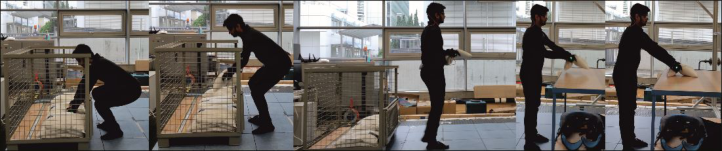
Operational Test Testing was conducted using an individual task involving lifting and trans- porting sandbags to assess the architecture’s performance and its suitability as a real-time ergonomic evaluation tool. These 8 kg sandbags were arranged in an EU-grid box and needed to be transported to a table elevated at 80 cm, located 2 meters away from the box. The task sequence involved lifting the bag from the box, transporting it to the table, placing it there, waiting for approximately 30 seconds in a static position, and returning the bag to the box in reverse sequence. The task phases are illustrated in Figure 2.
Figure 2: Sequential phases in lifting and transporting tasks for assessing architecture performance.
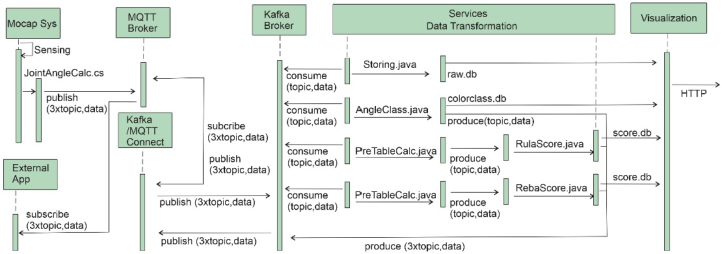
A motion capture system based on IMU sensors was integrated into the platform as a data source. Three functions were implemented and deployed into the servers to evaluate ergonomics. The first function involved classi- fying joint angles and movements using a scheme similar to a traffic light. This method allows analysts to identify potentially harmful postures or move- ments that may lead to discomfort, fatigue, or injury over time (IFA, 2015; Bances et al., 2022). This function uses a single data transformation microser- vice. The other two functions implemented the ergonomic risk assessment methods RULA and REBA. These functions were divided into two microser- vices: one for pre-calculating tables or steps of the process and another for calculating each method’s risk index or score. The data flow of these three functions can be observed in Figure 3.
Figure 3: The data flow: body-joints color classification, RULA, and REBA methods within architecture components and microservices.
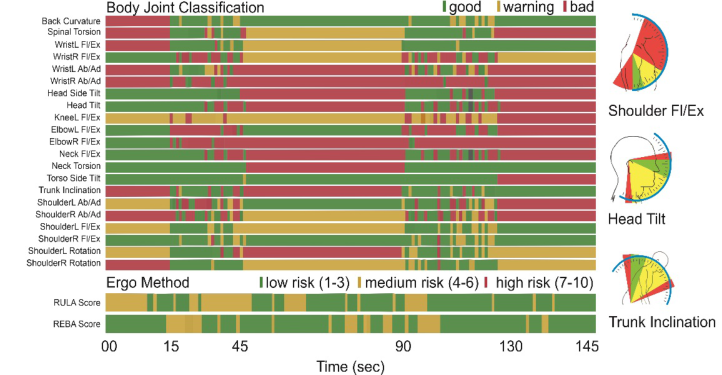
Finally, the microservices were deployed in the Kubernetes cluster with system configurations (see Table 1). The results are stored and displayed on a monitoring dashboard, as shown in Figure 5.
Table 1. Kubernetes cluster hardware settings.
Table available in the original PDF paper.
Node OS Role Qty Memory CPU (cores) Ubuntu Server 22.04 Master node 1 8 GB 4 Ubuntu Server 22.04 Worker node 3 4 GB 2
Figure 4: State timeline chart: body-joint classification, RULA, and REBA scores, with example body-joint color classifications based on traffic light schema techniques (IFA, 2015).
Enhancing Ergonomics in Construction Industry Environments 111
Future Works The next step involves assessing the scalability of the system. With the microservices for ergonomic evaluation defined, scaling up becomes feasi- ble by expanding the number of data sources and microservices to evaluate multiple individuals concurrently. The platform is further enhanced by inte- grating new functionalities, such as predicting muscle fatigue through EMG sensors and recognizing body posture to anticipate human activity. These features leverage real-time deep-learning techniques and contribute to imple- menting injury and accident prediction mechanisms during tasks. Another crucial aspect is the integration of additional data sources to analyze human behavior. These may encompass physiological signals like heart rate, body temperature, or skin conductance.
Lastly, the configuration of Kubernetes will be adjusted according to the platform’s needs. This may involve adding more memory or CPU to opti- mize all functionalities’ parallel processing capabilities or adding new worker nodes to the cluster.
CONCLUSION
The paper presents the implementation of an event-driven architecture tai- lored for real-time ergonomic assessment applications in construction tasks. This architecture could integrate multiple external systems, such as diverse data sources, and process event streams concurrently and instantaneously. A motion capture system reliant on Inertial Measurement Units (IMUs) as a primary data source was integrated to validate its efficacy. Additionally, functionalities for body-joint classification via color-coded traffic light tech- niques were deployed alongside implementing ergonomic risk assessment methods like Rapid Upper Limb Assessment (RULA) and Rapid Entire Body Assessment (REBA).
The architecture exhibits significant potential by using open-source frame- works and platforms for real-time data processing, including the ability to facilitate the development of digital twin applications. All architecture components are containerized and deployed within a Kubernetes cluster. While the paper acknowledges specific challenges, it emphasizes the archi- tecture’s intrinsic potential, which will be further explored in future research endeavors. These endeavors will involve augmenting the volume of data from multiple systems concurrently streaming events and deploying addi- tional functionalities or services to enhance ergonomics and security within construction tasks.
Finally, the overarching goal of this system is to evaluate ergonomics com- prehensively and enhance the safety and well-being of workers engaged in both individual and collaborative tasks within the construction sector. Fur- thermore, this architecture could also be applied to other industries where physically demanding tasks are prevalent.
ACKNOWLEDGMENT
Supported by the Deutsche Forschungsgemeinschaft (DFG, German Research Foundation) under Germany’s Excellence Strategy – EXC 2120/1 – 390831618.
REFERENCES
Abuwarda, Z., Mostafa, K., Oetomo, A., Hegazy, T. and Morita, P. (2022). Wearable devices: Cross benefits from healthcare to construction. Automation in Construction, 142, p. 104501. Ahn, C. R., Lee, S., Sun, C., Jebelli, H., Yang, K. and Choi, B. (2019). Wear-
able sensing technology applications in construction safety and health. Journal of Construction Engineering and Management, 145(11), p. 03119007. Awolusi, I., Nnaji, C., Marks, E. and Hallowell, M. (2019). Enhancing construction safety monitoring through the application of internet of things and wearable sensing devices: A review. ASCE International Conference on Computing in Civil Engineering 2019. Reston, VA: American Society of Civil Engineers. pp. 530–538 Bances, E., Schneider, U., Garcia, B., Siegert, J. and Bauernhansl, T. (2023). Collab-
orative Tasks in Construction: A Model for Human-Exoskeleton Interaction to Minimize Muscle Exertion. In Congress of the German Academic Association for Production Technology, Springer Nature Switzerland, pp. 34–43. Bances, E., Wortmeier, A. K., Bauernhansl, T., Garcia, B., Kropp, C., Schneider, U.
and Siegert, J. (2022). Applicability of exoskeletons in timber prefabrication: actions for exoskeleton research. Procedia CIRP, 107, pp. 1210–1215. Battini, D., Berti, N., Finco, S., Guidolin, M., Reggiani, M. and Tagliapietra, L.
(2022). WEM-Platform: A real-time platform for full-body ergonomic assessment and feedback in manufacturing and logistics systems. Computers & Industrial Engineering, 164, p. 107881. IFA-Institut für Arbeitsschutz der Deutschen Gesetzlichen Unfallversicherung (2015).
Bewertung physischer Belastungen gemäß DGUV Information 208–033 (bisher: BGI/GUV-I 7011) (Anhang 3). In Deutsche Gesetzliche Unfallversicherung, edi- tor. Belastungen für Rücken und Gelenke – was geht mich das an?. DGUV Website: https://www.dguv.de/medien/ifa/de/fac/ergonomie/pdf/bewertung_phys ischer_belastungen.pdf last access. European Agency for Safety and Health at Work, Kok, J., Vroonhof, P., Snijders, J.
et al. (2019). Work-related musculoskeletal disorders: Prevalence, costs and demographics in the EU. Publications Office. https://data.europa.eu/doi/10.2802/ 66947. European Agency for Safety and Health at Work, EU-OSHA, (2020). Prevention of Musculoskeletal Disorders in the construction sector: Examples from the INAIL incentive schemes. Publications Office. Wo verfügbar? Pascual, S. A. and Naqvi, S. (2008). An investigation of ergonomics analysis
tools used in industry in the identification of work-related musculoskeletal dis- orders. International Journal of Occupational Safety and Ergonomics, 14(2), pp. 237–245. Joshi, M. and Deshpande, V. (2019). A systematic review of comparative studies on ergonomic assessment techniques. International Journal of Industrial Ergonomics, 74, p. 102865. Nnaji, C. and Karakhan, A. A. (2020). Technologies for safety and health manage-
ment in construction: Current use, implementation benefits and limitations, and adoption barriers. Journal of Building Engineering, 29, p. 101212. Oyekan, J., Chen, Y., Turner, C. and Tiwari, A. (2021). Applying a fusion of wearable sensors and a cognitive inspired architecture to real-time ergonomics analysis of manual assembly tasks. Journal of Manufacturing Systems, 61, pp. 391–405. Sanni-Anibire, M. O., Mahmoud, A. S., Hassanain, M. A. and Salami, B. A. (2020). A
risk assessment approach for enhancing construction safety performance. Safety science, 121, pp. 15–29.
Enhancing Ergonomics in Construction Industry Environments 113
Valero, E., Sivanathan, A., Bosché, F., Abdel-Wahab, M. (2016). Musculoskeletal disorders in construction: A review and a novel system for activity tracking with body area network, Applied Ergonomics, 54, pp. 120–130. Xing, X., Zhong, B., Luo, H., Rose, T., Li, J. and Antwi-Afari, M. F. (2020). Effects
of physical fatigue on the induction of mental fatigue of construction workers: A pilot study based on a neurophysiological approach. Automation in Construction, 120, p. 103381.
LISTED IN THE AHFE DIGITAL BOOKSTORE CATALOGUE
Explore the complete digital volume
Human Factors and Systems Interaction
Read this individual research paper free through the original publisher, or explore the full digital proceedings book.
ISBN 978-1-964867-30-4
Explore this ISBN in the AHFE Bookstore ↗Listed in the July 2026 bookstore catalogue; search by ISBN to confirm current availability · Digital book purchase optional