Roland Hall, Simon Schumacher, Thomas Bauernhansl (2024). Towards Holistic Work System Design: Concept for a Method to Analyze, Represent and Evaluate Industrial Sociotechnical Work Systems. In: Human Factors in Design, Engineering, and Computing. AHFE Open Access, vol. 159, pp. 1771–1781. https://doi.org/10.54941/ahfe1005744
When designing industrial work systems, Industrial Engineering encounters many established and emerging challenges and objectives. These include, for example, the consideration of ergonomic aspects, the implementation of lean production principles and harnessing the technological potential of digital transformation. This initial situation reveals the relevance of a contemporary, holistic approach for the analysis, representation and evaluation of industrial work systems that considers enduring challenges and objectives while also addressing upcoming ones. To meet this need, the authors outline a concept for a substantial method structured around five key components.Component I encompasses an approach for modeling industrial work systems. Component II defines a comprehensive target system for industrial sociotechnical work systems. This target system ensures that the evaluation criteria considered in the method are derived in a target-oriented manner and not arbitrarily included in the analysis. While components I and II establish the theoretical foundation of the method, components III to V address operational data collection, data representation, as well as data analysis for the work system. Regarding data collection, component III comprises a maturity model that adopts the structure of component I and reflects the evaluation criteria pointed out in component II. component IV shows how the collected data based on component III can be used for the digital representation of the work system using the concept of the Asset Administration Shell (AAS). Component V includes a target-specific evaluation of the work system, including a derivation of recommendations for work system design. Although the paper focuses on explaining the concept of the method and the process followed to develop the method, it also outlines a prototypical implementation of the method.
Designing industrial sociotechnical work systems is a multifaceted challenge at the heart of Industrial Engineering (IE) and Human Factors and Ergonomics (HFE). This task has grown in complexity as it now encompasses
a wide array of considerations, ranging from ensuring ergonomic aspects to incorporating the principles of lean production. As systems become more complex, there is an increasing need for new methods (Imanghaliyeva, 2020). Furthermore, leveraging the potential of digital transformation and considering the relevance of Green transformation introduces new dimensions to work system design, making the need for a holistic approach more pronounced than ever (Bendel and Latniak, 2020; Keil and Hensel, 2019; Zhang et al., 2023). Moreover, the importance of designing contemporary industrial sociotechnical work systems is underscored by several current trends. The shortage of skilled workers in the German industry and the ageing workforce resulting from demographic change are increasing the importance of work system design that meets the requirements of employees (Müller et al., 2016). The mentioned complexity and challenges culminate in the need for new methods that integrate the relevant design paradigms and thus allow a holistic and contemporary view of industrial sociotechnical work systems (Latniak et al., 2023).
BACKGROUND OF METHOD DEVELOPMENT The underlying method for the holistic assessment of work systems was initially developed as the so-called “Future Work Check” as part of a German national lighthouse research project on the work of the future (Schumacher et al., 2023). In the context of Future Work Lab the authors identified the need for a method that integrates aspects of ergonomics, lean production, and digital transformation (Fraunhofer IPA, 2021). This method is also designed to be expandable, allowing the incorporation of additional design paradigms, such as green transformation, without the need to redevelop the method’s core structure. That integrated view on different design paradigms of work systems culminates in the requirement for a holistic method approach.
Another objective of the authors was to create a method that enables users to analyze multiple work systems efficiently within a single day (Schumacher et al., 2023). The resulting analysis should provide a comprehensive overview of the work system, providing a holistic assessment and a foundation for more detailed investigations if necessary. The method needs to be supported by a digital toolset, facilitating automated evaluations and generating automatic recommendations for work system design (Grandi et al., 2022).
Experiences with manufacturing companies highlighted the need for a digital toolset, as work system analyses are often done using paper questionnaires or Microsoft Excel. This results in inconsistent and non- interoperable data management. Finally, the requirements listed in Table 1 were established to develop the method.
Towards Holistic Work System Design: Concept for a Method to Analyze 1773
Table 1. Requirements for the method.
Table available in the original PDF paper.
R0 The method should be adaptable and expandable. R1 The method should have a comprehensible structure and be related to common work systems models. R2 The method should be target-oriented. R3 The method should pursue a holistic approach. R4 The application of the method should be as efficient as possible (feasible in less than 3 hours per work system). R5 The method should represent collected data about the work systems well-structured, digital, and interoperable. R6 The method should enable an automatic evaluation of work systems. R7 The method should provide automatic recommendations for action.
In accordance with the defined requirements, the following research question was stated: “How can a method for the efficient, holistic analysis of industrial sociotechnical work systems be designed that is based on a digital representation of the work system and enables an automatic derivation of action recommendations?”
As the central focus of the method, the term “industrial sociotechnical work system” is defined as follows: A work system involves the interaction of one or more workers with work equipment to fulfill the system’s function within the workspace under working conditions (DIN Deutsches Institut für Normung, 2016). The attribute sociotechnical emphasizes that these work systems consist of social and technical subsystems that interact with each other (Bendel and Latniak, 2020). The attribute industrial underscores that the presented method focuses specifically on sociotechnical work systems on the shop floor of manufacturing companies.
RESEARCH METHODOLOGY The research methodology of this paper is structured as follows. Building upon the existing method and identified requirements, the overall concept for the method is presented based on the author’s development. Each component is characterized in a standardized structure consisting of three sections: (1) requirements, (2) intended approach, and (3) development steps to be carried out.
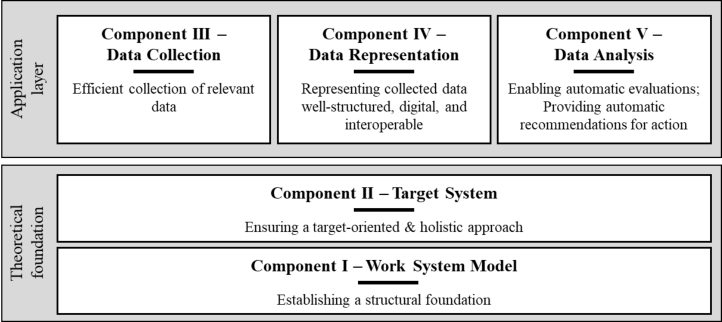
CONCEPT FOR THE METHOD The listed requirements serve as guidelines for developing the method’s concept. To meet R0, a modular approach comprising five components was selected (see Figure 1). The authors propose that this modular structure will enable the method to be adapted and expanded without requiring a fundamental redesign.
Figure 1: Overview of the method and its components.
To establish a structural foundation, component I encompasses an approach for modeling industrial sociotechnical work systems. Component II defines a comprehensive target system for industrial sociotechnical work systems to ensure a target-oriented and holistic approach. While components I and II establish the theoretical foundation of the method, components III to V build the application layer of the method by addressing data collection, data representation, as well as data analysis for the work system. Each of the individual components is explained in detail below.
Component I – Work System Model Requirements According to R1, the method should have a comprehensible structure and relate to common work systems models. It is essential to employ a well- defined model to systematically describe, analyze, and evaluate work systems.
Intended Approach Since the systematic examination of work systems is an established task in IE and HFE, various sophisticated model approaches are available. The existing models range from general frameworks of sociotechnical systems (Davis et al., 2014) to specific models for industrial work systems (REFA- Institut, 2016). Carayon (2006) provides an overview of common models for sociotechnical systems. Developing component I, a pre-existing model should be selected and adapted as necessary rather than developing a completely new one. Modeling the work system serves as the structural baseline for every other component of the method.
Development Steps As the method presented focuses on industrial work systems on the shopfloor, the model selection is restricted to models that specifically represent this application environment. An established model that adheres to this restriction is described in ISO standard 6385 (DIN Deutsches Institut für Normung, 2016). According to ISO 6385, the designable elements of a work system
Towards Holistic Work System Design: Concept for a Method to Analyze 1775
include work organization, tasks, jobs, environment, equipment, interfaces, workspace, and workstations (DIN Deutsches Institut für Normung, 2016). Since ISO 6385 emphasizes the designable elements of the work system, it is ideally suited for the method presented and is therefore used as its foundation.
Component II – Target System Requirements As shown in Table 1, two requirements are decisive for component II: a target-oriented analysis (R2) and a holistic approach (R3).
Intended Approach To address R2 and R3, component II defines a target system for industrial sociotechnical work systems. In designing complex systems such as industrial sociotechnical work systems, more than one objective is decisive (Rupp, 1984). The set of relevant objectives and their interrelationships form the target system for the work system (Eisenführ, 2010; Rupp, 1984). In the following, this target system serves as the backbone for deriving evaluation criteria. The approach of using an explicit target system as the backbone of analysis is adopted from decision theory (Eisenführ, 2010; Keeney, 1996; Keeney and Gregory, 2005).
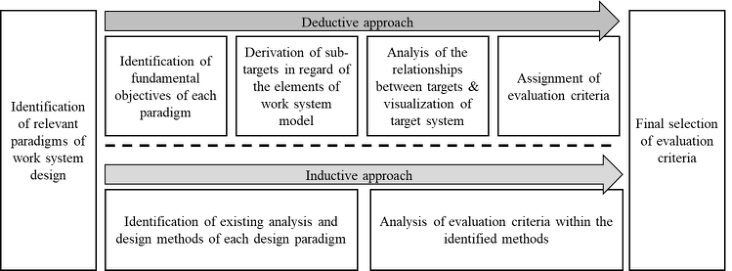
Development Steps In the first step, the relevant paradigms of work system design are defined. Ergonomics, lean production, digital transformation, and green transformation are identified as key paradigms. This consideration of different design paradigms addresses the requirement for a holistic analysis (R3). The further consideration of the design paradigms is carried out in two ways: a deductive top-down approach and an inductive bottom-up approach (Figure 2).
Figure 2: Process of developing a target system as part of the method – component II.
In the top-down approach, fundamental objectives of each design paradigm are identified, such as human well-being and system performance for ergonomics. Sub-targets linked to these objectives are then derived, forming a hierarchical target system. Relationships between objectives are
analyzed to determine homogeneity, conflict, or independence, crucial for formulating action recommendations and integrated work system design (see component V). Finally, targets are translated to quantitative and qualitative evaluation criteria. The deductive approach is complemented by an inductive examination of existing analysis methods to ensure the completeness of the evaluation criteria.
Component III – Data Collection Requirements The central function of component III is to collect data for the selected evaluation criteria. component III thus builds on the derivation and selection of the evaluation criteria from component II and needs to meet R4 that this data collection must be as efficient as possible (see Table 1).
Intended Approach The selected evaluation criteria encompass a broad range of content and include quantitative and evaluation criteria. In order to map this spectrum, a maturity model is developed for data collection. This maturity model is the central instrument for data collection. To address the requirement of efficient data collection the number of evaluation criteria is reduced. The reduction of the evaluation criteria is in apparent conflict with the demand for a holistic approach (R3) but is necessary to keep the effort for data collecting manageable (R4). In contradiction to reducing the evaluation criteria, it is necessary to collect additional information about the work system. That additional information, mainly master data and context information is not intended to evaluate but to describe and characterize the work system. To enhance efficiency, data collection is facilitated by a user-friendly digital tool with a web-based survey frontend. The actual data collection is realized via four formats, managed by one responsible person, typically from IE or HFE, and includes the analysis of work system documentation, interviews with operational managers, interviews with direct employees, and on-site inspections.
Development Steps The first step is to develop the maturity model for the work system. The development of the maturity model is based on the procedure in Becker et al. (2009). Next, the reduction of evaluation criteria is run. Experiences from prototypical applications of the presented method suggest an upper limit of 100 criteria as an orientation value, with a duration of approx. 150 minutes for data collection for a single work system. To meet this orientation value, two questions are crucial for reducing the evaluation criteria: “is the information provided by this criterion already covered by another?” and “how much informative value is lost if we omit this criterion?”. In addition to reducing the evaluation criteria, the following rule applies: “do not re-record anything that has already been recorded!”. Relevant information from existing analyses should be integrated into the
Towards Holistic Work System Design: Concept for a Method to Analyze 1777
data collection rather than newly determined. Lastly, items for collecting the necessary additional information are added.
Component IV – Data Representation Requirements The requirement for component IV is to store and represent the collected data in a well-structured, digital, and interoperable manner (see Table 1). While digital data storage is a fundamental requirement of contemporary IE methods, the need for interoperable data representation extends beyond this. The goal is to standardize diverse data to ensure its efficient reuse.
Intended Approach To fulfill the requirements of component IV, the presented method applies the concept of the Asset Administration Shell (AAS). The AAS is a standardized digital representation of an asset in the context of Industry 4.0, encapsulating all relevant information about the assets. To manage the data of complex assets, the AAS uses “submodels.” These submodels are modular elements representing different aspects of the asset, such as technical specifications or maintenance schedules (IDTA, 2022). Using the concept of AAS enables a well-structured, digital, and interoperable data representation. By developing proprietary, modular submodels, the work system model from component I can be digitally replicated. AAS ensures interoperability with a comprehensive information model that defines data structure, semantics, unique asset identifiers, and metadata and supports secure, standardized data communication using formats like CSV and protocols such as OPC UA, MQTT, and HTTPS (IDTA, 2021).
Development Steps For the conception of the AAS for the work system, existing IDTA submodel templates are first reviewed (IDTA, 2024). The development of the AAS follows Himmelstoß et al.’s approach, deriving AAS contents from a UML description (Himmelstoss et al., 2023). The resulting AAS is an abstract class, with individual instances generated for specific work systems via data collection (IDTA, 2021). Thus, each work system analysis produces an AAS instance, creating a digital representation of the work system as a “by-product” of the analysis.
Component V - Data Analysis Requirements As outlined in Table 1, two requirements are decisive for the data analysis. Firstly, there should be an automatic evaluation of the work system (R6). Secondly, automatic recommendations for action should be derived (R7).
Intended Approach R6 is addressed through a scoring model based on the maturity levels of the maturity model (see component IV). Each level corresponds to a specific score. An overall score for the work system is calculated by determining the maturity level during data collection and summing the
points achieved. Additionally, the design paradigms or individual evaluation criteria can be weighted according to the process of a utility value analysis (Eisenführ, 2010). The results of the scoring are visualized graphically. The fulfillment of R7 is also based on the maturity model. For each evaluation criterion, at least one recommendation is assigned to each maturity level, indicating the steps necessary to advance to the next level. To provide suitable action recommendations, it is crucial to consider the relationships between evaluation criteria respective their underlying objectives, especially managing conflicting objectives, as increasing one criterion’s maturity level may negatively impact one another. Conflicts can be highlighted, managed by users, resolved by prioritizing objectives, and addressed through compromises included in the action recommendations.
Development Steps To implement the scoring model, the final calculation logic must be selected and designed. Various visualization options should be examined and validated through user tests to effectively display the achieved score. For automatic action recommendations at each level of the maturity model, steps to advance to the next maturity level are defined. Additionally, potential compromises for all identified conflicting objectives are developed. Finally, the technical implementation of the data analysis must be planned and executed. The technical implementation of component V, like data collection, is conceptualized using a web application.
PROTOTYPE IMPLEMENTATION AND APPLICATION CASE STUDY This section describes a prototype implementation of the method with several deficits compared to the presented concept. The prototype was developed through the mentioned research project “Future Work Lab” and an industrial project applying the method at a German manufacturing company, specialized in construction and interior fit-out, employing around 7,500 people globally and operating in over 20 countries. The project’s goal was to create a company-specific, holistic work system analysis for diverse production sites. Table 2 describes the characteristics of the developed prototype in analogy to the five components of the presented method concept.
Table 2. Characteristics of the developed prototypical method.
Table available in the original PDF paper.
Component I – Work System Model
The chosen model was based on the model of Strohm and Ulrich: human-technology-organization (Strohm and Ulich, 1997) Component II – Target System
There was no explicit target system. In a multi-workshop approach 126 evaluation criteria were derived from the project goal “to design a holistic method for the analysis of heterogenous industrial work systems” Component III – Data Collection
Data saved as Excel-files
Readiness model based on the selected evaluation criteria. Tools for data collection: MS Excel and paper Component IV – Data Representation Component V – Data Analysis Basic realization of a scoring model, no automatic action recommendations. Action recommendations were derived manually and discussed with stakeholders
Towards Holistic Work System Design: Concept for a Method to Analyze 1779
The project focused on developing the method content, integrating existing audits and analyses. Evaluation criteria were derived from three domains— man, technology, and organization (MTO)—using a top-down approach. Fourteen categories were created to further define these domains, resulting in a hierarchical system of three domains, 14 categories, and 126 evaluation criteria. These criteria were converted into a readiness model. Data collection used interviews, document analysis, and work system inspections. Six work system analyses validated the content and procedures. Based on the insights gained from the prototypical implementation, the requirements outlined above were derived. Both the good practices and the limitations of the prototype were crucial to develop the present method concept.
LIMITATIONS The limitations described below relate to the ideal concept of the method and not to the prototypical implementation.
The presented concept aims to conduct a holistic analysis of the work system by integrating various relevant design paradigms. However, the selection of these paradigms still represents a limitation regarding the relevant objectives for the work system. This selection may not fully ensure that all relevant aspects are considered, or that they are prioritized correctly. Therefore, the method’s expandability must be considered in future development.
The requirement for a holistic approach results in a broad spectrum of evaluation criteria. These criteria should be assessable within approximately 150 minutes. This timeframe excludes the possibility of conducting an in- depth analysis of all relevant aspects within the scope of the presented method. Instead, the method is intended to serve as a starting point for more detailed analysis. The data collected through interviews are influenced by the respondents’ opinions rather than objective data. However, this limitation is explicitly intended, as the authors aim to involve individuals affected by the design of the work system as directly as possible. In data analysis, the informative value of the scoring system is particularly limited. As a constructed metric, the calculated score has little meaning on its own. It only gains significance when compared with the scores of comparable work systems. The method’s limitations are inherent in the concept and are, therefore, consciously accepted.
CONCLUSION AND FURTHER RESEARCH As a contribution to academia, this paper presents a concept for a novel approach to holistic workplace design, combining a sound work system model and related target system with an application layer based on an Industry 4.0 Asset Administration Shell data model. As a contribution to industrial practice, an early prototype of the method has been developed and applied in real environments of industrial manufacturing firms, providing evidence of the usefulness and potential of the method. Regarding further research, this paper provides a clear pathway for the development based on
the concept and its five components. The existing prototype of the method will be further refined to align with the outlined concept. To ensure quality, the method will be compared with the principles of socio-technical system design established by Cherns (1976) and subsequently updated by other authors (Clegg, 2000; Imanghaliyeva et al., 2020; Waterson et al., 2002).
REFERENCES
Becker, J., Knackstedt, R. and Pöppelbuß, J. (2009) ‘Entwicklung von Reifegradmodellen für das IT-Management’, WIRTSCHAFTSINFORMATIK, vol. 51, no. 3, pp. 249–260. Bendel, A. and Latniak, E. (2020) ‘Soziotechnisch – agil – lean: Konzepte und Vorgehensweisen für Arbeits- und Organisationsgestaltung in Digitalisierungsprozessen’, Gruppe. Interaktion. Organisation. Zeitschrift für Angewandte Organisationspsychologie (GIO), vol. 51, no. 3, pp. 285–297. Carayon, P. (2006) ‘Human factors of complex sociotechnical systems’, Applied ergonomics, vol. 37, no. 4, pp. 525–535. Cherns, A. (1976) ‘The Principles of Sociotechnical Design’, Human Relations, vol.
29, no. 8, pp. 783–792. Clegg, C. W. (2000) ‘Sociotechnical principles for system design’, Applied ergonomics, vol. 31, no. 5, pp. 463–477. Davis, M. C., Challenger, R., Jayewardene, D. N. W. and Clegg, C. W. (2014) ‘Advancing socio-technical systems thinking: a call for bravery’, Applied ergonomics, vol. 45, no. 2, pp. 171–180. DIN Deutsches Institut für Normung e. V (2016) DIN EN ISO 6385:2016-12: Ergonomics principles in the design of work systems, Berlin: Beuth Verlag GmbH. Eisenführ, F. (2010) Rationales Entscheiden, Heidelberg, Springer. Fraunhofer IPA (2021) Future Work Check: Ein Modell zur Bewertung von Industriearbeitsplätzen [Online], Fraunhofer Institute for Manufacturing Engineering and Automation IPA. Available at https://futureworklab.de/de/ideenwelt/Futureworkcheck.html (Accessed 30 July 2024). Grandi, F., Peruzzini, M., Raffaeli, R. and Pellicciari, M. (2022) ‘Trends in Human
Factors Integration for the Design of Industry 4.0’, in Rizzi, C., Campana, F., Bici, M., Gherardini, F., Ingrassia, T. and Cicconi, P. (eds) Design Tools and Methods in Industrial Engineering II, Cham, Springer International Publishing, pp. 785–792. Himmelstoss, H., Hall, R., Vojanec, B., Thieme, P. and Bauernhansl, T. (2023) Conceptualizing A Digital Twin Based On The Asset Administration Shell For The Implementation Of Use Case Specific Digital Services, Hannover : publish-Ing. IDTA (2021) Was ist die Verwaltungsschale aus technischer Sicht? [Online]. Available
at https://industrialdigitaltwin.org/content-hub/downloads. IDTA (2022) Asset Administration Shell Reading Guide [Online]. Available at https://industrialdigitaltwin.org/content-hub/downloads (Accessed: 30 July 2024). IDTA (2024) Registered AAS Submodel Templates [Online], IDTA - Industrial Digital Twin Association. Available at https://industrialdigitaltwin.org/content- hub/teilmodelle (Accessed 30 July 2024). Imanghaliyeva, A. A. (2020) ‘A Systematic Review of Sociotechnical System Methods
Between 1951 and 2019’, in Ahram, T., Karwowski, W., Vergnano, A., Leali, F. and Taiar, R. (eds) Intelligent Human Systems Integration 2020, Cham, Springer International Publishing, pp. 580–587.
Towards Holistic Work System Design: Concept for a Method to Analyze 1781
Imanghaliyeva, A. A., Thompson, P., Salmon, P. and Stanton, N. A. (2020) ‘A Synthesis of Sociotechnical Principles for System Design’, in Rebelo, F. and Soares, M. M. (eds) Advances in Ergonomics in Design, Cham, Springer International Publishing, pp. 665–676. Keil, M. and Hensel, R. (2019) ‘Das Industrial Engineering der Zukunft: Herausforderungen für die Arbeitswissenschaft’, in Gesellschaft für Arbeitswis- senschaft e. V Herbstkonferenz 2019: ERKENNEN. LERNEN. VERÄNDERN: Die Arbeit des Menschen in der digital vernetzten Welt, Dortmund. Latniak, E., Tisch, A. and Kauffeld, S. (2023) ‘Zur Aktualität soziotechnischer
Arbeits- und Systemgestaltungsansätze in Zeiten von Digitalisierung und KI’, Gruppe. Interaktion. Organisation. Zeitschrift für Angewandte Organisation- spsychologie (GIO), vol. 54, no. 1, pp. 1–8. Müller, S. L., Stiehm, S., Richert, A. and Jeschke, S. (2016) “Fit für den demografischen Wandel” – Entwicklung eines holistischen Managementansatzes für die Automobilindustrie [Online]. Available at https://www.researchgate.net/publication/312023940. REFA-Institut (2016) Arbeitsorganisation erfolgreicher Unternehmen: Wandel in der Arbeitswelt, München, Hanser. Rupp, R. (1984) Bewertung von Arbeitssystemen aus arbeitsorientierter Sicht,
Frankfurt am Main, Bern, New York, Lang. Schumacher, S., Himmelstoß, H. and Eusterwiemann, T. (2023) ‘Produktionsarbeit der Zukunft – Das Innovationslabor Future Work Lab’, in Bauernhansl, T. (ed) Handbuch Industrie 4.0, Berlin, Heidelberg, Springer Berlin Heidelberg, pp. 149–170. Strohm, O. and Ulich, E. (1997) Unternehmen arbeitspsychologisch bewerten: in
Mehr-Ebenen-Ansatz unter besonderer Berücksichtigung von Mensch, Technik und Organisation, Zürich, vdf, Hochschulverl. an der ETH Zürich. Waterson, P. E., Older Gray, M. T. and Clegg, C. W. (2002) ‘A Sociotechnical Method for Designing Work Systems’, HUMAN FACTORS, vol. 44, pp. 376–391. Zhang, X., Nutakor, F., Minlah, M. K. and Li, J. (2023) ‘Can Digital Transformation
Drive Green Transformation in Manufacturing Companies?—Based on Socio- Technical Systems Theory Perspective’, Sustainability, vol. 15, no. 3, p. 2840.
LISTED IN THE AHFE DIGITAL BOOKSTORE CATALOGUE
Explore the complete digital volume
Human Factors in Design, Engineering, and Computing
Read this individual research paper free through the original publisher, or explore the full digital proceedings book.
ISBN 978-1-964867-35-9
Explore this ISBN in the AHFE Bookstore ↗Listed in the July 2026 bookstore catalogue; search by ISBN to confirm current availability · Digital book purchase optional