Nan Hu, Jianghong Zhao, Danhua Zhao (2022). Value Analysis of Product Design by Using Bigdata Mining. In: Usability and User Experience. AHFE Open Access, vol. 39, pp. 102–111. https://doi.org/10.54941/ahfe1001696
Objective Put forward the value focus analysis and design method based on big data to help designers and enterprises effectively deal with and apply big data, anchor the design value and product definition through value focus, and develop popular products in the market.Method Mainly using the methods of literature research and case analysis, this paper studies the value focus and value transmission process of big data cleaning, and puts forward a product design method based on big data value focus. Result Based on the value focus of big data, the feasible and practical process of product design from big data analysis to value focus and then to design scheme is obtained, that is, big data cleaning, big data sorting and big data decision-making, mining business value, product value and user value and corresponding value interval, and proposing from big data cleaning to value focus (value and value interval), And the design process model of generating product definition and conceptual prototype.Conclusion By focusing on the value of big data to generate design value and product definition, and returning to the essence of design problems and value problems, it is a way and design method to fully face the market and realize the design of popular products. Product design based on big data value focus is a full design cycle design method with clear structure and strong operability, which can realize complete value transmission through effective design process.
In the era of big connected data, design has become a complex and multidi- sciplinary creative activity (Zhao, 2008). The world has entered the era of networked Big Data (Li, 2012), where the high degree of integration of the human, machine and artifacts has led to an explosion in the scale of data and a high degree of complexity in data patterns. Big Data has four characteri- stics: large sample volume, variety of data sources, velocity data generation and value. According to TDWI’s report on big data analytics, data analytics is gradually becoming essential support for corporate profits (TDWI, 2010). In the face of the rapid development of big data, cloud computing and artificial intelligence, the discipline of design has expanded into the digital and social
Value Analysis of Product Design by Using Bigdata Mining 103
sphere, and it is no longer possible to define design and design knowledge through a single description (Buchanan, 1992). The changing times have led to a diversity of sources of ‘design knowledge’. Big data is becoming an essential source of product design knowledge for companies, especially for intelligent product design. At the same time, the design problems that desi- gners need to solve are becoming increasingly complex (Bayazit, 2004). The advent of big data tools offers scientific and actionable opportunity product design. O’Reilly even asserted that “data is the next ‘Intel Inside’ and the future belongs to the companies and people who convert data into products” (Li, 2012). Therefore, it is an essential theoretical and practical issue to add big data tools into the design framework, empower design to efficiently and accurately analyze big data and focus on value, and provide a methodological basis for value design.
The study of value focus and product design based on big data is a solu- tion to the design and value problems. This view has two dimensions: first, today’s design problems, user scenarios, and design domains have changed so much that almost any design problem may be a research problem (Zhao, 2019). Secondly, digital resources have become one of the most valuable resources for social development and value generation. The so-called “produ- ction value” of design is the value generated by the study of “data” or “data development.” In the sense of value, whoever owns and controls data resou- rces may have changes to generate economic benefits, and whoever acquires “data assets.” In a capital sense, intelligent product design is particularly about transforming data resources into data assets and obtaining more excel- lent business value. Therefore, the age of intelligence is not based on material quantities, but on data quantities or data resources. Product design through effective processes for generating value through data from data resources to data assets.
“Design” is a purposeful human practice (Zhao, 2003). Big data-based value-focused product design aims to take advantage of big data resources to ‘focus’ value efficiently and accurately and provide users with products that meet their ‘design values’ through product design. As Buchanan says, design begins with the designer’s value intention (Buchanan, 1985). Dorst has argued that: we know both the value we want to create and the ‘how’ of ‘how it works’ that will help us achieve the value we seek (Dost, 2011). The design process should therefore be a complete value focus and value transmission process, in the same time, big data value-focused product design is a value- goal oriented design paradigm. After achieving value focus based on big data tools, the transfer of value is completed, and ultimately the design returns to the “design value” of the user. After achieving value focus and value transfer based on big data tools, the design is ultimately brought back to the “design value” of the user.
The design example of the thesis comes from the MIJIA Karaoke micro- phone project of the Xiaomi eco-chain company (See Figure 1). The Xiaomi eco-chain is able to rely on the value analysis and focus method of big data to achieve the whole process, the whole road chain and the whole quality control of product design. MIJIA karaoke microphone since September 27, 2021, on the Xiaomi launch, reached is only by single SKU monthly sales
Figure 1: MIJIA karaoke microphone.
of 60,000 units, become the current market value range up and down to expand 299-499 single product sales TOP 1. In this sense, value analysis and value-focused product design based on big data is not only to make one or two explosive products with good design quality, but to achieve long-term quality assurance of quality product design for hundreds of companies and thousands of products across the Xiaomi ecological chain.
Therefore, this paper proposes a value-focused analysis and design appro- ach based on Big Data to help designers and businesses address the effective handling and application of Big Data. By anchoring the design value and product definition through value focus, this paper develops products that are hot in the market and explore the feasible and practical process of product design from big data analysis to value focus to design solutions, i.e., big data cleaning, big data sorting and big data decision making, based on the value focus of big data as a theoretical basis. Then, by digging into business value, product value and user value and the corresponding value intervals, a design process model is proposed from big data cleaning to value focus (value and value intervals) and the generation of product definitions and concept pro- totypes. The basic idea of this research is that the intended value of a product can be realized through an effective design process.
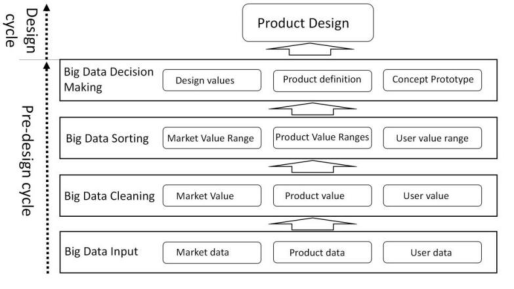
PRE-DESIGN CYCLE AND DESIGN CYCLE BASED ON BIG DATA VALUE FOCUS As shown in Figure 2, the Big Data-based value focus and product design pro- cess are divided into pre-design and design cycles. One key ‘scientific’ issue in the pre-design cycle is the ambiguity of the design problem and design obje- ctives. The key issue in the design cycle is the design value transfer process of the design concept, design iteration, and design mass production. Big Data value-focused analysis of the pre-design cycle is a way to change the previous ‘roll the dice’ approach to design, create a design approach that meets custo- mer expectations, and help designers deal effectively with the ambiguity of design and design goals. The Big Data value focus of the design cycle is an effective way of communicating and expressing the value of design.
Value Analysis of Product Design by Using Bigdata Mining 105
Figure 2: Pre design cycle and design cycle by using bigdata mining.
In Figure 2, the pre-design cycle includes big data input, big data cleaning, big data sorting and big data decision making, where the big data clean- sing layer produces three value modules, namely business, user and product value. The output of the big data sorting layer is a value interval of three value modules. The outputs of the Big Data decision layer are design values, product definitions and concept prototypes. The pre-design cycle is a big data to value process, where the final output of the pre-design cycle is “encapsula- ted”in the form of “design value”and “product definition”as the knowledge of design. The final output of the pre-design cycle is “encapsulated” in the form of “design values,” “product definitions,” as design knowledge, and from there into the design cycle.
Pre-Design Cycle Based on Big Data Value Fcous The pre-design cycle, based on the value focus of big data, is a design analysis process with a clear data logic.The design and analysis process is divided into big data input, big data cleaning, big data sorting and big data decision making. Taking the design of “Mi Karaoke Microphone” as a case study, the Xiaomi Eco-chain used to have a design cycle for the beginning of the project. This pre-design cycle consists of a four-tier structure of big data input, big data cleaning layer, big data sorting layer and big data decision layer.
Big Data Cleaning: Business Value, Product Value and User Value Big data cleansing specifically refers to the collection and collation of big data about markets, products and users.The three value modules of the product are obtained through big data cleaning: i.e. business value, product value and user value. A case study of the design of the MIJIA Karaoke Microphone is as follows.
(1) Commercial value The business value of the MIJIA Karaoke Microphone design case is the three dimensions of big data obtained by inputting and cleaning big data: The market size for this category was obtained with an analysis of trends over
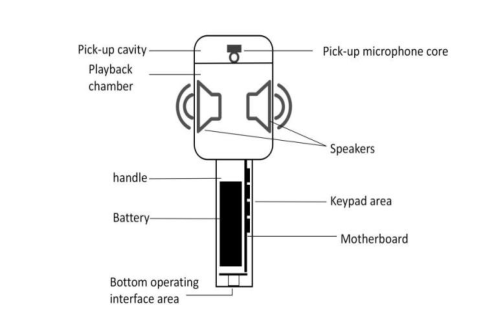
Figure 3: Prototype of MIJIA karaoke microphone.
consecutive years (broad market data), brand share data and price segment data (See Figure 3). The introduction of big data tools in the figure provides an informative and visual basis for determining business value. Large-scale data analysis to obtain the market size and trend of the product category, which is the basis of the product category market judgment data;The analysis of the brand share data indicates the market distribution of the major players in the category; Price segment data analysis is used to obtain “pricing” and “positioning” based on the distribution of sales and sales in the market in the price segments of the products in the category. Therefore, the business value of big data cleaning product categories refers more to the judgment basis for creating and obtaining business value, while the advantage of the big data analysis lies in “data resources” and “analysis tools.”
(2) Product value The product value of the MIJIA Karaoke Microphone design case refers to the product characteristics and values resulting from the product’s variety, functional performance, quality, and design in the category. Product value refers to the use-value of a product, which is essentially the value generated by meeting the user’s needs. Product value analysis compares product category characteristics, a breakdown, and a comparison of specific characteristics and attributes.Therefore,big data cleaning product value refers to the creation and acquisition of product value judgment basis,and the strength of big data analysis is “data resources” and “product prototype.”
(3) User value The user value of the MIJIA Karaoke Microphone design case is the “perceived” value of the product and service by the user. User value refers to the experience, safety and sharing of the “user,” also known as the psych- ological and spiritual value of the user. Stylidis et al. focus on the process of how users perceive (product) value through product attributes (product value), using the Volvo case study (Stylidis et al. 2014). Therefore, product value and user value are highly correlated;it is generally believed that user
Value Analysis of Product Design by Using Bigdata Mining 107
value brings business value. For example, “everything is based on user value” is Tencent’s product philosophy, so understanding users is fundamental to ensuring product success (Zhao, 2005). The main contribution to user value in the big data cleansing phase is big data to generate a “user profile.”User profiling refers to constructing a labeled user model from user characteristics, user use of product scenarios, and product behavior. According to Heskett, “there is an interplay between design intent and user needs, perceptions and goals” (Heskett. 2002). Therefore, big data cleaning user value refers to the user profile tool to outline the target users, user needs and design direction, and the advantage of big data analysis is “data resources” and “user profile.”
Big Data Sorting: Value Intervals The Big Data sorting ‘tool’ refers to the sorting of valid value bands, also known as designed value bands, based on the business, product and user value results obtained from Big Data cleaning.The delineation of value intervals points to decisions about the money design cycle and is the basis for the big data decision layer, a key step in value focus.The delineation of the value interval refers to the design cycle decision, which is the basis for the big data decision layer and is a key step in the value focus.The value range refers specifically to the business value range, the product value range and the user value range.Matching the value of the product with the value of the user, and thus the business value, is more a matter of matching the “range of product features and parameters” with the “range of user needs”.A case study of the design of the “MIJIA Karaoke Microphone” is as follows:
(1) Commercial Value Ranges The commercial value range of mikia karaoke microphone design case refers to the target commercial value range of the designed products based on the commercial value of the product categories obtained from big data clea- ning. In Figure 5, according to the characteristics of Xiaomi ecological chain and the needs of the project, the price range of 299-399 yuan with promi- nent sales volume and sales volume is locked as the target commercial value range. Therefore, the commercial value of the big data cleaning layer is only the problem of explaining “what is the market”, while the commercial value range of the big data sorting layer is the problem of explaining “what is the market opportunity”, that is, the market problem with the most commercial value.
(2) Product Value Ranges The product value range of the”MIJIA Karaoke Microphone”design case is based on a delineated commercial value range as the centre and expan- sion.The analysis of the characteristics of the products in the expanded range, which are representative of sales and quality, is known as “com- petitive analysis”.The decomposition of specific product characteristics is based on characteristics of the product value data in the previous section, with vertical decomposition of characteristics and horizontal comparative analysis, which can be used as a product value range for product design
objectives.The product value range derived from Big Data sorting therefore points more towards the “product prototype” parameter range, i.e. where the product value range matches the target business value range.
(3) User value range The user value range of the MIJIA Karaoke Microphone design case is based on the delineation of user needs within the business value range and the product value range.User research through big data sorting summarises and analyses user needs and forms textual descriptions that serve as a reference for product design. User research is about correlating and matching product value intervals with user value intervals.
Big Data Decision Making: Designing for Value and Product Definition Big Data decision making is the design of values and product definitions based on the results of value and value intervals from Big Data cleaning and sorting. The Big Data Decision is the output stage of Pre-Design.
(1) Design values The design value of the MIJIA Karaoke Microphone design case is a condensed design value based on semantic logic, i.e. the inner logic of the product design, which reflects both the user value range and the product value range.Perhaps as Simon Sinek said in his TED talk, “It’s not what you make that people buy, it’s what you believe in when you make it, and what you make just proves what you believe in.”According to Holbrook (1999), “value is not in the product purchased, not in the brand chosen, not in the object owned, but in the consumer experience derived from it” (Zhao, 2005). The advantage of big data decision-making is that design logic can be based on credible data analysis. The designer’s ‘belief’ is not only in himself, but also in the market.
(2) Product definition The product definition of the “MIJIA Karaoke Microphone” design case consists of a “product prototype” and a “concept prototype”.A product prototype is a parametric description that reflects the functional and per- formance characteristics of a Big Data-focused product, such as the intended price, the pickup microphone and lithium battery parameters used.The pro- duct prototype consists of product characteristics, materials, forms, functions and performance indicators.The product definition is therefore a parametric representation of the value of the product and the “product prototype” is oriented towards technical development and product design.
A prototype is a concept that defines the main components of a product by stacking them in a logical space, which establishes the direction of the product’s shape and is a concept that is studied in design practice. Design practice research suggests that a conceptual prototype is a body of kno- wledge that ‘encapsulates’ all the ‘knowledge’ of design practice (Argyris and Schon, 1974). Figure 3 shows the concept prototype of the Mi Kara- oke Microphone, which was obtained by stacking the core components in
Value Analysis of Product Design by Using Bigdata Mining 109
the product definition in a logical space.The concept prototype is therefore a graphic representation of the product prototype and is oriented towards product design and structural design.
VALUE-FOCUSED DESIGN CYCLES BASED ON BIG DATA Problem solving is an important way to drive design (Boztepe. 2007). The design cycle based on Big Data Value Focus is the translation of defined design values, product definitions and concept prototypes into semantic design pro- blems. The design solution process is the process of transforming a semantic design problem into a visual design solution. Design is essentially practical, design is ‘cognition in action’ (Argyris and Schon, 1974).This paper argues that the logic of popular products can be deduced from big data, but that ‘good design’ cannot be fully computed. Design is a process of design opera- tions with structured design methods and processes, but it is also a process of multi-stakeholder coordination between the designer and the ‘owners’ of the design problem (clients, consumers, etc.) (Zhao, 2005). There is both consistency and conflict between the two. As such, product and product design activities are complex systems (Boztepe. 2007). The design ends up with a ‘satisfactory solution’ that is accepted by all, rather than an ‘optimal solution’.
Concept Design of the MIJIA Karaoke Microphone The conceptual design of the MIJIA Karaoke Microphone design case refers to translating a semantic design problem into a graphical solution of a visual design solution. Concept design is a central part of the Big Data-based design cycle. Figure 9 shows an example analysis of the conceptual design process of the “Mi Karaoke Microphone”. Step 1: Generate initial concepts star- ting with a description of the design problem and initial conceptualization of the product’s morphological features and material considerations. Step 2: The design problem goes more profound for the in-depth conceptualization of the main features of the microphone device in terms of shape and mate- rial, functional domain operation, and interface concepts. Step 3: The design problem generalization closes in on the design problem and generates an ove- rall conceptual design. The session, therefore, generates a clear point of the design, and the subsequent session is a deeper detail of the conceptual design session, i.e., conceptual design is the core session of concept generation in product design.
MIJIA Karaoke Microphone Design Sought The design solution for the MIJIA Karaoke Microphone design case is the process of translating the design values and product definitions focused on by big data decisions into design problem-solving. Design problem solving tran- sforms the design values and product definition concept prototypes entered in the pre-design phase into conceptual designs and renderings, transformed from renderings into modeling entities through design operations.
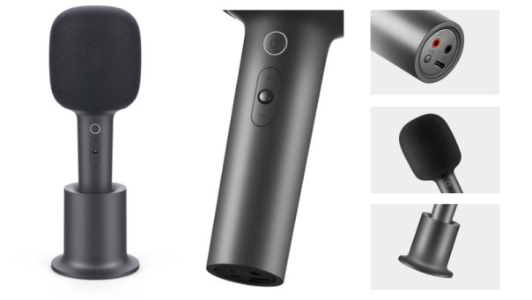
Figure 4: MIJIA karaoke microphone mass production product photo.
MIJIA Karaoke Microphone Design Iteration The design iteration of the Yemi Karaoke Microphone design case is review- ing and iterating the design solution based on a combination of factors such as market, users and other design stakeholders, aesthetics, culture, regulati- ons, experience, actual production process, cost, appearance and component yields. After passing various tests by the project team and internal testing by a hundred people within the Xiaomi eco-chain, the design was finally sealed and exported to mass production. Design project practice is usually the majority of the time chasing design proofs to facilitate design iterations. Therefore, the design iteration design cycle plays a role in carrying forward the design solution and refers more to the iteration and optimization of the design solution, a continuous “reflection” of the design (Schon, 2017). The design iterations serve to “polish” the design solution and result in a “sati- sfactory solution.” Figure 4 shows the MIJIA Karaoke microphone in mass production.
CONCLUSION
Big Data Value Focused Product Design is a data-producing value design process, a design-for-value approach. This paper proposes a value-focused analysis and design methodology based on big data, which helps designers and companies to address the effective handling and application of big data, anchor design values and product definitions through value focus, and develop marketable products.
The thesis mainly adopts literature research and case study methods to study the process of obtaining value focus and value transfer from big data cleaning and proposes a product design method based on big data for value focus. To explore the feasible and practical process of product design from big data analysis to value focus and then to design solutions based on the value focus of big data, i.e., big data cleaning, big data sorting, and big data decision making, to explore business value, product value and user value and the corresponding value intervals, and to propose a design process model
Value Analysis of Product Design by Using Bigdata Mining 111
from big data cleaning to value focus (value and value interval), and to gene- rate product definition and concept prototype. The design process model. As a result, generating design values and product definitions through big data value focus, returning to the essence of design issues and value issues is the way and design method to achieve explosive product designs that are fully market-oriented. Big Data Value Focused Product Design is a well-structured, actionable, full design cycle design approach that enables the transfer of complete value through an effective design process.
A value-focused design architecture based on big data does not mean “abandoning” the “original intent” of industrial design, the so-called demo- cratic and socialist ideology of design (Heskett, 2002). Therefore, the value of Big Data production should be economical and include user value and social and ecological value. Users are given values in line with “values.
REFERENCES
Argyris C, Schon D A. Theory in practice: increasing professiona effectiveness [M].
Oxford: Jossey-Bass, 1974. Bayazit N. Investigating design: a review of forty years of design research [J]. Design issues, 2004, 20(1): 16–29. Boztepe S. User value: competing theories and models [J]. International Journal of
Design, 2007, 1(2): 55–63. Buchanan R. Wicked problems in design thinking [J]. Design issues, 1992, 8(2): 5–21. Buchanan R. Declaration by design: rhetoric, argument, and demonstration in design practice [J]. Design Issues, 1985(9): 4–22. Dorst K. The core of ‘design thinking’ and its application [J]. Design studies, 2011,
32(6): 521–532. Heskett J. Waiting for a new design [J]. Form, 2002, 185: 92–98. Li Guojie, Cheng Xueqi. Research status and scientific thinking of big data [J].
Insitute of computing technology, 2012, 27(06): 647–657. Li Guojie. The scientific value of big data research [J]. Communication of Chinese computer society, 2012, 8(9): 8–15 Schön D A. The reflective practitioner: how pro- fessionals think in action [M].
London: Routledge, 2017. Stylidis K, Hoffenson S, Wickman C, et al. Corporate and customer understanding of core values regarding perceived quality: case studies on volvo car group and volvo group truck technology [J]. Procedia CIRP, 2014, 21: 171–176. Suzan Boztepe. Toward a framework of product development for global markets:a
user-value-based approach [J]. Design Studies, 2007, 28: 513–533. TDWI checklist report:big data analytics. http://tdwi.org/research/2010/08/Big- Data-Analytics.aspx Zhao Danhua. A Car styling-based study: the designer’s intension and user’s
interpretation [D]. Changsha: Hunan University, 2013. Zhao Jianghong, Zhao Danhua, Gu Fangzhou. Design research: review and reflection [J]. Decoration, 2019(10):12–16. Zhao Jianghong. The lifeline of design: design ethics [J]. Art Observation, 2003(6):
12–13. Zhao Jianghong. The meaning of design art [M]. Changsha: Hunan University Press, 2005: 81. Zhao Jianghong. Design and design approach research within 40 years [J]. 2008(9):
44–47.
LISTED IN THE AHFE DIGITAL BOOKSTORE CATALOGUE
Explore the complete digital volume
Usability and User Experience
Read this individual research paper free through the original publisher, or explore the full digital proceedings book.
ISBN 978-1-958651-15-5
Explore this ISBN in the AHFE Bookstore ↗Listed in the July 2026 bookstore catalogue; search by ISBN to confirm current availability · Digital book purchase optional