Ke Ma, Ren-Ke He, Meng Gao (2022). Design for Product-Service System Innovation of the New Fresh Retail in the Context of Chinese Urban Community. In: Ergonomics In Design. AHFE Open Access, vol. 47, pp. 186–193. https://doi.org/10.54941/ahfe1001936
This article probes the design elements of product-service system innovation in the new retail market of fresh food in urban communities in China in the design view. It outlines the path of evolution of modern retail structure innovation in the digital economy. The aim of the researchers is to expand the theoretical analysis horizons for the product-service method. The literature review delves deeply into fresh retail and its development process, consumer transition, and product-service system. In this study, a double-case study method is preferred to analyze the two main new retail models (Missfresh and Freshippo) in China and compare them. The researchers describe the systematic innovation of new fresh retail in urban communities under the influence of emerging technologies in products, services, scenarios, and structures. Additionally, the sameness and distinctness of different types of fresh new retail platforms are excavated. The researchers construct a three-dimensional model of product-service system innovative design of new fresh retail in urban communities, expounding it from three dimensions of satisfaction unit, horizontal aspect, and vertical aspect. The purpose of this study aims to open ideas for the research on product-service system innovation of new fresh retail in urban communities and give reference value for the design and practice of new fresh retail in the future.
The rapid growth of the digital economy injects strong power into the sustai- ned and stable development of the economy. The main driving force of system innovation and creating new value is inseparable from digital technology (Lee and Lim, 2018). In July 2020, CAICT announced in the latest “Digital Eco- nomy White Paper”that China’s digital economy last year had an added value of nearly 36 trillion-yuan, accounting for approximately 36% of 2019’s GDP (CAICT, 2020). The rapid development of emerging digital technology has changed the system and business model of the fresh food retail market in the entire Chinese urban community. At the same time, the upgrading of the consumption structure has completely changed the consumption pattern of Chinese users and the demand for fresh food. Since the reform and opening- up, China’s retail model has been evolving from small and medium-sized
Design for Product-Service System Innovation of the New Fresh Retail 187
department stores, junior specialty stores, and grocery stores to large depar- tment stores, chain supermarkets, and super shopping centers. Until recent years, the system and business model of fresh retail in urban communities have undergone tremendous changes. The emergence of new retail, a new business model, has brought more possibilities for fresh retail and has rapidly opened up the fresh retail market in urban communities in China. It can be seen from the latest report of fresh e-commerce in 2020 released by iResearch institute that the turnover of this field in 2019 is about 279.6 billion yuan, an increase of about 37% over the previous year. The total turnover is esti- mated to exceed 800 billion yuan by 2023 (iResearch, 2020), indicating that the rising trend of this field will continue to be significant for a long time to come.
At present, the research on the product-service system design of new fresh retail in Chinese urban communities is still in its infancy. Most scholars focus on the consumer experience research from the perspective of new retail, and there is not much analysis and interpretation on how to carry out the inno- vative design of the whole new retail internal system. Therefore, it is a new attempt to study the new retail market of fresh food in urban communities from system innovation design. The purpose of this paper is: (1) through lite- rature review, to understand the fresh retail and its development process, the characteristics of consumer shopping after consumption upgrading, and the overview of product-service system design; (2) using the research method of double case analysis to explore the system innovation design path of typical enterprises; (3) this paper attempts to construct the innovative design model of the new fresh retail system in Chinese urban communities.
LITERATURE REVIEW
Fresh Retail and Its Development Path Fresh food refers to the primary agricultural products made by primary pro- cessing, such as meat, fruits, vegetables, aquatic products, and the on-site processed and cooked products such as bread and cooked food (Chen, 2016). Fresh food is an indispensable category for everyone, and the demand is enormous. Buying food and cooking are the daily needs of every Chinese family. Fresh e-commerce refers to the direct sale of fresh food online (Wang, 2017). Jack Ma defines the new retail model as using technology to coor- dinate online, offline, and distribution to transform and upgrade product manufacturing, transportation, and sales.
The development of fresh retail in China can be divided into three periods. Chinese traditional community fresh food evolved from the supermarket, which is mainly for fresh food. This mode can be summarized as a single mode of selling fresh products offline without service participation. After the development of the Internet, fresh food e-commerce was born. They don’t have to consider the location of stores, but more about warehouse location and logistics distribution. Consumers log in to the app anytime and anywhere, select products and place orders, and wait for the delivery clerk to deliver the products. This mode is a single online mode of providing fresh products and services. The third is the mode of online and offline integration. The service
of this mode is more diversified. The products, services, and the whole system it creates are innovative business models.
The Transformation of Consumers With the continuous upgrading of consumption structure, consumer prefe- rences have shifted from traditional retail to online shopping and mobile commerce, and the service contact between enterprises and customers has also undergone profound changes. According to the Research Report on China’s fresh e-commerce industry 2020, the proportion of consumers who purchase fresh food once a week or more online after the epidemic in March is about 70%, indicating that users have gradually become accustomed to ordering fresh food online. The broad application of digital technology has dramatically changed consumers’ purchasing behavior, and the multi-channel purchasing mode of users also needs enterprises to change the way they provide value and experience.
Intelligent Product-Service System The product-service system has been proposed since the end of the last cen- tury, and the research on it has always been the core research and practice field in the academic and industrial circles. Tukker believed that the design would consist of products and services to meet specific user needs (Tukker, 2004). Boehm & Thomas proposed that the product-service system is an integrated package of products and services to create customer utility and cre- ate value (Boehm and Thomas, 2013). With the popularization of advanced technologies such as big data, innovation has become the driving force for industrial development in the digital age. According to the Research Report of harbor research in 2016, the intelligent product-service system is beco- ming the mainstream (Glaser and Allmendinger, 2016). Liu et al. proposed that PSS should be classified from the perspective of intelligence. He pointed out that products and services can be divided into two categories, intelligent and non-smart. According to their intelligence or not, three situations can be obtained, namely non-smart PSS, semi-smart PSS, and smart PSS (Liu et al., 2018).
METHODOLOGY
This study adopts a double-case study method to study the current situation and system design innovation of fresh retail in urban communities in China in the digital economy era. The case study method was chosen because it is most suitable for studying a contemporary phenomenon with fewer existing theories but is more complex (Bell, Bryman, and Harley, 2018).
In this paper, two representative fresh new retail platforms in China, Mis- sfresh, and Freshippo are selected as the research objects. The reason for choosing the above two companies is that firstly, both are platforms focusing on fresh products; secondly, it can be seen in the mobile Internet field report updated by Trustdata in November 2020 (the third quarter of 2020) that Missfresh continued to lead with more than 12 million monthly active users. Freshippo followed closely with 10 million monthly active users. Therefore,
Design for Product-Service System Innovation of the New Fresh Retail 189
through the case study of the two, to quickly understand the innovation mode of product-service system in this field.
Case Study of Missfresh Product-Service Missfresh focus on online and recently also opened an offline business. Using advanced technology and equipment such as big data, its product-service system model is the Missfresh app + offline warehouse + real-time cold chain logistics system, which ensures users with high-quality fresh products. A front warehouse refers to a small warehouse built near the community and core business circle to preserve fresh food to ensure its freshness and solve fresh food distribution at home in the last 1-3 km. The front warehouse only undertakes the functions of storage, sorting, packing, and distribution.
Stakeholder Interaction Missfresh makes full use of social networks to interact with consumers and quickly spreads through WeChat and other platforms through activities such as “sharing red packets” to accumulate user resources.
Scene Construction Missfresh does not set up offline stores but innovates and upgrades the con- sumption location and introduces home scene and office scene. In the home scene, after the user places an order from the app, the task is assigned to the front warehouse nearby, realizing the home service within 30 minutes after the consumer places an order. In the office scene, its large-scale layout of the convenience intelligent container business, combined with the front warehouse and cold chain logistics, will further expand the target users to the white-collar class, covering the office scene.
Structure The structure of Missfresh is the construction of a sorting center and front bin mode. The fresh food purchased directly from the producing area is tran- sported to the sorting center by cold chain and then to the community front bins distributed around the sorting center. At present, there are more than 1500 vans in more than 20 cities, and the layout has been initially formed.
Case Study of Freshippo Product-Service Freshippo redefines the online, offline, and distribution of new retail with advanced technology and equipment. The mode of the product-service system is online Freshippo + offline store + instant cold transportation. Its fresh food logistics network covers the whole country. The purchase of Freshippo is divided into origin purchase and local purchase. After quality control and different packaging, the fresh food is transported to offline stores for sale.
Stakeholder Interaction Unlike the traditional fresh supermarket, Freshippo has direct interaction with the producers of origin to purchase fresh food on demand to avoid the possible problems of high price or multi-level fresh deterioration caused by the participation of intermediaries.
Scene Construction Freshippo takes “eat” as the center and innovates the fresh consumption scene of the store into three typical applications. The first is the vegetable market scene, where consumers can buy fresh food in stores. The second is the restaurant scene, where the restaurant sets up a dining area, and the user can invite the chef to cook after selecting fresh food. The third is the logistics center scene. After the user selects fresh food for payment in the app, the nearby stores receive the orders and deliver them within a certain period.
Structure Freshippo takes the community as the center and adopts the warehouse store mode—shelf is storage. Therefore, each community-based store can independently carry out fresh food sales, provide consumer food and logi- stics distribution, and multiple stores can connect and provide fresh food and information to each other on demand. These stores form a fresh food network and can continue to connect to become a more comprehensive fresh food network to better handle logistics distribution, fresh food sharing, information, and other resources.
RESULTS AND DISCUSSIONS The two cases are sorted out according to the four aspects of product and service, stakeholder interaction, scene, and distribution structure. The com- parison shows that there are many similarities and apparent differences between them. The similarity lies in that they all maximize the use of emerging technologies, equipment, and real-time logistics to meet the needs of different users. They are all purchased and supplied directly, with the lowest price and the highest quality. They lay a network of decentralized structures. The dif- ference is reflected in the maximum use of social platform marketing and promotion of Missfresh, and in this regard, the power of Freshippo is insuf- ficient. The two companies create different consumption scenarios around the community, Missfresh creates the consumption location scenario, and Freshippo develops the consumption scenario around eating. It can be said that the mode characteristics of the two companies almost cover the existing innovation characteristics of the whole fresh new retail field.
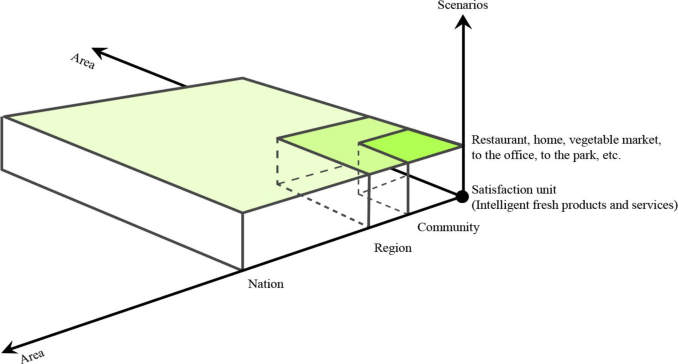
It can be concluded that the innovation path of the product-service system of fresh new retail in the urban community can be described as a satisfaction unit with the intelligent, fresh products and services as the core, which carries out the vertical innovation in the consumption scene within the scope of com- munity and business circle, and expands the contact point with consumers. These innovative community business circles can connect in a specific area to form a regional fresh food network, share information and fresh food,
Design for Product-Service System Innovation of the New Fresh Retail 191
Figure 1: The product-service system innovation design space stereoscopic model of urban community new fresh retail. Source: drawn by the author.
and present a horizontal spatial distribution layout, thus creating a three- dimensional model of the whole fresh new retail system innovation design. This paper attempts to build a three-dimensional model of product-service system innovation design of fresh new retail in the urban community and describes it from three aspects: satisfaction unit, horizontal extension, and vertical extension in Figure 1.
Satisfactory Unit Intelligent, Fresh Products, and Services Fresh as non-intelligent products with short shelf life, to provide users with high quality and reasonable price fresh products, need intelligent services to create the value that users expect. It can be said that brilliant service has become the standard configuration of fresh food platforms. The new digital technology will enable fresh product-service systems, including the Internet, big data, AI, VR, AR, IoT, and other technologies. They are flexible, fast and elastic. Secondly, the fast-changing customer preferences and personalized needs can be met in time.
Innovation Stakeholder Interaction Due to the transformation of consumers and producers, the interaction among them has changed. There is no middleman between the manufacturer and the platform, so the price of fresh food is reduced. At the same time, the fresh food is purchased on-demand to ensure that it is sold out on the same day. Platform and consumers pay more attention to consumer experi- ence and focus on innovating consumer-centered interaction, improving the breadth and depth of innovation interaction with consumers. First, through real-time logistics distribution, on-demand ordering, multi-scene exchange, to meet all the needs of consumers to eat.
Vertical Extension: Enriching Users’ Fresh Consumption Scenarios The fresh consumption scene of the new retail breaks through the boundary of the traditional retail, which is more flexible around the community and business circle. The community and business circle extend vertically from the offline contact point with users and innovates to dig out more consumption scenarios. Around “to the store” and “to the home,” it is extended to a store, covering restaurants, markets, distribution centers, and home, to the office, to the park, and other scenes, to further expand the contact point users. The “how to eat” and “where to eat” of consumers are innovated to the greatest extent. In this process, consumers’ right to choose is increased, and more diverse needs of users are met. In other words, consumers can pay online to deliver to home, buy online, pick up offline, cook offline, pick-up office, pick up the park, etc.
Horizontal Extension: Building a Decentralized Structural Layout The so-called decentralized structure is relatively centralized and distributed. The main form means that the central warehouse provides fresh products directly to users. The distributed structure refers to a forward warehouse as a producer role to produce and sell. From the perspective of the fresh field, the system of the platform has apparent characteristics of the decentralized structure. That is before fresh products arriving at users, products are stored and transferred through the intermediate warehouse. The intermediate ware- house may be a primary or secondary structure. For example, Freshippo is a primary structure - direct products are sent to the intermediate warehouse, which is used for logistics distribution; Missfresh is a two-level structure, that is, direct mining products are delivered to the sorting center first, then to the intermediate bin from the sorting center, and then to the users. These inter- mediate warehouses are centered on communities and business circles. They are distributed in a specific area. At the same time, they can be connected to share tangible resources (fresh) and intangible resources (information) when needed and generate a fresh product network in the region. In many of these regions, fresh product networks are further connected, tangible resources and intangible resources flow in the network, and form a higher-level and broa- der fresh network layout. This kind of grid structure layout is more flexible, firmly adheres to the community consumers.
CONCLUSION
Due to the development of digital technology, the improvement of infor- mation services, the upgrading of consumption, and the homogenization of traditional community fresh retail, China’s fresh retail have gradu- ally changed from the simple model of selling fresh food to the multi- dimensional model of selling fresh products and intelligent services, innova- ting consumption scenarios and building a decentralized structure connection network.
Design for Product-Service System Innovation of the New Fresh Retail 193
ACKNOWLEDGMENT
This research was supported by Hunan Provincial Innovation Foundation For Postgraduate (NO. CX20200425).
REFERENCES
Bell, E., Bryman, A. and Harley, B. (2018), “Business Research Methods.” Oxford University Press. Boehm, M. and Thomas, O. (2013), “Looking beyond the rim of one’s teacup:
a multidisciplinary literature review of Product-Service Systems in Information Systems, Business Management, and Engineering & Design.” Journal of Cleaner Production, 51, pp. 245–260. CAICT (2020), “White Paper on China’s Digital Economy Development (online).”
Available at: http://www.caict.ac.cn/kxyj/qwfb/bps/202007/t20200702_285535. htm Chen, F. J. (2016), “The Empirical Research on Influencing Factors of the Customers’ Satisfaction of Fresh Food E-commerce.” Journal of Commercial Economics, (08), pp. 49–51. Glaser, A. and Allmendinger, G. (2016), “Smart Systems Design.” Switzerland:
Harbor Research. iResearch (2020), “Research Report on China’s fresh e-commerce industry in 2020 (online).” Available at: https://www.iresearch.com.cn/Detail/report?id=3620&isfr ee=0 Lee, S. M. and Lim, S. (2018), “Living Innovation: From Value Creation to the
Greater Good.” United Kingdom: Emerald Group Publishing. Liu, C. H., Zhang Q. S., Wang, Z., et al. (2018), “Product Service System Classification Status and Intelligence.” Productivity Research, (01), pp. 141–144. Tukker, A. (2004), “Eight types of product–service system: eight ways to sustainabi-
lity? Experiences from SusProNet.” Business Strategy and the Environment, 13(4), pp. 246–260. Wang, X. P. (2017), “Research on Pricing of Fresh Products E-commerce and Profits Distribution of Logistics System.” Beijing: Beijing Jiaotong University.
LISTED IN THE AHFE DIGITAL BOOKSTORE CATALOGUE
Explore the complete digital volume
Ergonomics In Design
Read this individual research paper free through the original publisher, or explore the full digital proceedings book.
ISBN 978-1-958651-23-0
Explore this ISBN in the AHFE Bookstore ↗Listed in the July 2026 bookstore catalogue; search by ISBN to confirm current availability · Digital book purchase optional