Yixin Long, Ren-Ke He (2022). Game or Performance: The Future of Dance Under the Intervention of Digital Interactive Technology. In: Ergonomics In Design. AHFE Open Access, vol. 47, pp. 616–626. https://doi.org/10.54941/ahfe1001990
The emergence and development of digital and interactive technologies have led to new opportunities and challenges to the field of dance art. This article examines theories involving interactive systems for dance art, and reviews the development of interactive dance, while summarizes the influence of the application of digital and interactive technology on traditional dance. Relevant literature and best practice have shown that the application of digital and interactive technology in dance performances has accelerated the transformation of the traditional relationship among choreographer, performer and audience. At the same time, new technologies; such as Virtual Reality, Augmented Reality, Mixed Reality, etc., expanded further the virtualization of dance, and promoted the diversification of aesthetic experience. Virtualization shortens the distance between the audience and the work, and brings the audience an immersive experience. Meanwhile, interactive technology enriches the way of presentation of dance, giving dancers the relative freedom within the interactive framework, and induces changes in the audience's aesthetic pattern. However, the gradual loss of aesthetic distance threatens the independence of aesthetic objects, and the cognitive mechanism in which aesthetic process.
According to the theories of “game” and “playification”, this paper distin- guish between the concepts of “dance-game” and “dance playification”, and discusses the huge impact of digital interactive technology on the aesthetic pattern. In digital interactive dance, interactive technologies allowing the audience to participate in the complex presentation of works within certain rules, which breaks down the traditional viewing pattern, and personal expe- rience as well as interactive process that can occupy an important position in the new aesthetic pattern. In previous literature, Caillois and Barash (2001) and Sicart (2014) defined play as a form of human activity. Sicart (2014) they believed that play is an essential part of functioning humankind since it allows people to perceive and explore the world and the society spheres. In that sense, the new aesthetic pattern is compatible with the concept of play. Audience changes role from a simple viewing behavior to participating, perceiving, and exploring the world in the work. This kind of experience
Game or Performance: The Future of Dance Under the Intervention 617
that is based on “watching and playing” makes enhanced dance aesthetic activities, which tend to be playification. Nicholson, (2012) pointed out that playification as a concept should be used when creating playful engagement without adding game challenges. Nicholson’s concept gives more attention to game participation factors, which distinguishes it from the concept of gamifi- cation. The concept of dance playification involved in this article refers to the playification of audience experience in dance aesthetic activities. Compared with dance games, the audience does not need to deliberately give attention to accomplishing goals and getting rewards, but to experience the aesthetic fee- lings brought about by the interactive process. To summarize, the context of the digital age and experience upgrading, with artistic creation concepts and aesthetic pattern evolved accordingly. Now the question is how to combine digital interactive technologies to create future-oriented dance works which will be an issue that dance artists have to give more attention to.
The progress of art is always closely related to the innovation of tech- nology. Since the widespread use of digital and interactive technologies, the artistic and expression form, along with the aesthetic pattern of dance have been affected. Digital interactive dance can be traced back to the motion picture recording of Loïe Fuller’s Serpentine Dance in 1895, which heralded the close connection between dance and media technology (Boucher, 2011).
Back in 1920s, the Bauhaus dance represented by Oscar Schlemmer’s “Tri- adic Ballet”embodies the artistic concept of the synthesis of form, technology and art, provided preliminary practical experience for the fusion of techno- logy and dance art (Lahusen, 1986). In the 1950’, Alwin Nikolais, a famous American choreographer, tried to project slides onto dancers performing on stage, which led to the exploration and practice of “projection” by dance artist. All of the above can be seen as inspirational practices for digital interactive dance.
During the 1960’s, Noll (1967) called on everyone, especially program- mers, to regard the digital computer as a creative medium that, when fully exploited, could be used to generate entirely new art forms and potentially new aesthetic experiences. Withrow (1970), under Noll’s influence, condu- cted a study on dynamic model for computer-aided choreography, which showed that computer and other related technologies have gradually penetra- ted into the field of dance. After the 1980’s, the development and maturity of motion capture technologies led to the development of interactive systems, and digital interactive dance ushered in new opportunities. Research in motion capture technology, information processing, dance and music inte- raction, dance and computer graphics interaction and other related fields have poured out, which has promoted the upsurge of interdisciplinary rese- arch. From 1995 to 1999, Siegel (1998) conducted a digital dance research project at the Danish Institute of Electroacoustic Music (DIEM), the natio- nal center of electroacoustic music in Denmark, which explored the real-time interaction of dance and music.
This DIEM project allowed dancers to “play” the music in the rhythm of their bodies under certain rules, instead of being constrained by the music. Paradiso et al. (1999) designed and built a pair of sneakers capable of sensing
618 Long and He
16 different tactile and free-gesture parameters, they developed the intera- ctive music mapping for dance performances. In 1999, Merce Cunningham collaborated with digital artists Paul Kaiser and Shelly Eshkar of Riverbed on “Biped”, which is an exploration of the technical possibilities of motion capture and animation. In 2002, they launched “Fluid Canvas”, which explo- red the generation of fluid abstract designs through motion-captured data. Since then, the practice of digital interactive dance steps forward and with the development of VR, AR, MR technology, dance art faces new opportu- nities and challenges. The practice of digital interactive dance has continued to advance.
Until the development of VR, AR, MR and other related technologies, dance art faced challenges and received new opportunities. New technologies open-up the digitization and virtualization of dance, and promoted the diver- sification of aesthetic experience. Digitization shortens the distance between the audience and the work, and brings the audience an immersive experience.
Virtualization expands the performance space of the stage, and enriches the form of artistic expression. Meanwhile, interactive technology gives dancers relative freedom within the interactive framework, and induces changes in the audience’s aesthetic pattern. However, the disappearance of aesthetic distance and the change of aesthetic pattern lead to “playification”. Whether playifi- cation will eventually turn dance into a “dance game” is a question we must face up to now.
CHARACTERISTICS OF DIGITAL INTERACTIVE DANCE Digitization
Digitization is one of the characteristics of digital interactive dance. The impact of digitization mainly involves three aspects: 1. digitization of dance performance spaces, 2. digitization of dance communication route, and 3. avatars and virtual identities.
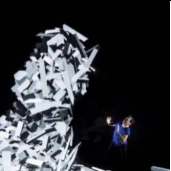
Digitization of Dance Performance Spaces Since the digital interactive technology intervened in dance performances, dance has begun to penetrate into the digital space. Traditional dance per- formances generally take place in theaters, and some may take place in open outdoor stages, or even in the environment we live in, such as squares, parks or shopping malls. These places all have one feature in common: they all belong to real physical spaces. The digitization of space breaks the limitations of physical space on traditional dance and provides a new spatial dimension for performance. Acqua Alta, created by Clair Bardainne and Adrien Mon- dot in 2019, which showed three different formats of the same work (see Figure 1), which are Ink black: a visual performance on stage, Crossing the mirror: a pop-up book in augmented reality and Tête-à-tête: an immersive experience in virtual reality (Bardainne and Mondot, 2020). As each format differs in scale, time, perspective, and light, viewers perceive the work dif- ferently. It can be said that the digital space provides a rich medium for the expression and presentation of dance.
Game or Performance: The Future of Dance Under the Intervention 619
Figure 1: Three different formats of Acqua Alta.
In addition, the digitization of performance space breaks through the restrictions encountered of viewing distance by traditional theaters, brin- ging a unique experience to the audience. In traditional theater performances, there is an invisible wall between production and audience. Due to the influ- ence of the architectural structure of the theater, the viewing angle of the audience is single, and the optimal viewing position of the theater is limited and fixed. Once audience buy tickets and take seats, it is difficult to change the angle or position during the performance. Therefore, the audience’s perce- ption and feeling of the work will be limited by the viewing position. For example, the audience on the side cannot see the overall situation of the stage, therefore, some information would be lost when watching; viewers at a distance cannot see the details clearly, which makes them feel less invo- lved. In fact, some modern artists have realized the limitations of traditional theater and found other ways to break the fourth wall between the works and the audience, allowed the audience to participate in performance. Such as the immersive drama “Sleep No More” and “Wei Shen’s” immersive art work Integrate. During the performance, the audience is allowed to move freely and choose the scene they want to see, which is similar to the impact brought by digital interactive technology. With the intervention of digital technology, the space of dance performance is gradually digitized and virtualized, and the aesthetic pattern changes from watching at a certain distance to immersive experience, the audience will no longer be limited by the physical distance in reality.
Digitization of Dance Communication Route The use of digital technology already accelerated the spread of dance. It allows us to watch live performances from the other side of the world. In addition, the severe epidemic situation promoted the digital transmission of dance. The sudden outbreak of COVID-19 in 2019 has become a pande- mic that swept the world, causing 281 million infections and 5.41 million deaths by December 2021. The fast-spreading epidemic has made people sen- sitive to larger-scale collective activities. One of the ways the performing arts has continued during the pandemic is by adapting real-life performances to the virtual world (Nuriman et al., 2020). Although on-the-spot viewing and experience make it easier for the audience to focus on the works, so that they would not be interrupted by external things during watching, the non- on-the-spot online viewing can make the works easier to spread, especially
620 Long and He
Figure 2: The immersive virtual reality contemporary dance piece VR_I.
in the current context of the pandemic. For example, during the outbreak, the National Centre for the Performing Arts of China has regularly launched high-quality dance dramas, in which audience can watch anywhere by log- ging into the WeChat App and entering the live broadcast window of the official video account of the National Centre for the Performing Arts. During the viewing process, viewers can generate a virtual identity to communicate with other online viewers.
Avatars and Virtual Identities Avatars and virtual identities can be seen as two forms of human digitiza- tion. People use digital avatars or virtual identities to move around in virtual environments.
For example, the contemporary dance piece VR_I, created by Gilles Jobin and Artanim, is the first-ever outcome of a choreographer combining dance and immersive virtual reality, provided audiences with a unique experience in watching dance (see Figure 2). VR_I allow viewers to move freely in a total virtual space while equipped with virtual reality headsets and backpack com- puters. Five viewers at a time may explore this world, each of them embody an avatar that faithfully replicates their movements, enhancing the feeling of immersion in the virtual world while also enabling them to see their peers. During the experience, participants can interact physically and even commu- nicate with the others (Swissnex, 2019). The impact of digital technology is all-round us. It not only brings dance into the digital space, providing it with new communication routes, but also brings a new aesthetic experience to the audience.
Interactivity Interactivity is another feature of digital interactive dance. In digital intera- ctive dance, the body is often the key to connect real physical environment with the digital virtual environment, as well as triggering or activating the interaction. The dancer’s body and movements only constitutes one aspect of the dance performance, while the other aspect of the performance is compo- sed of interactive, which reflects the interactivity of digital interactive dance according to Tian Tian Digital Interactive Dance (2009). On the one hand, dancers or audience who trigger the interactive behavior gain relative free- dom of movement within the interactive framework. For dancers, dance is no longer a single body movement, but a duet, or even a multiple, of the body and other computer-generated art forms. During the performance, they
Game or Performance: The Future of Dance Under the Intervention 621
have gained a wider space for secondary creation. For the audience, they are no longer a passive onlooker, but a “user” who actively participate in the interaction of the works and even influence the performance.
On the other hand, dancers or audience may gain relative temporal fre- edom within the interactive framework. In traditional dance performances, the rhythm of movement in dance is determined by the choreographers, and the dancers only need to follow their settings. However, in digital intera- ctive dance, especially in improvised interactive dance, performer’s rhythm, movement, and even the length of the work is beyond the control of the cho- reographer or director. Giving the dancer the feeling of being free in time as the single most important for working with interactive dance (Siegel, 2009). Interactive dance gives freedom of time not only to the performers but also to the audience. In traditional dance, the audience cannot influence or interfere with the linear time of the piece, but only follow it. However, digital inte- ractive dance, which frees the audience from linear time, allow audience to engage in interaction at their own pace. The use of interactive technology has made dance interactive, and shifted the focus of dance performance from the movement of the body to the interaction between body and computer. Body is no longer the only carrier for conveying artistic concept, but the key to stimulate the formation of complex language. In addition, it enables dance to cross its own borders, integrate with the language and thinking of other arts or technologies, and provide new forms and contents for art.
The Roles of Choreographer, Performer and Audience In Digital Interactive Dance In traditional dance, the roles of the choreographers, performers and audi- ence are distinct and each performing their own duties. For example, the choreographer responsible for the creation of concepts, structures, move- ments, etc.; the performer is responsible for presenting the choreographer’s arrangement and idea, and the audience’s watching and evaluating the art work. The application of digital technology and interactive technology in dance has brought new opportunities for them to break through the “boun- daries” of their respective roles, so that the distinction among choreographer and performer, or performer and audience is no longer clear.
The Relationship Between Choreographer and Performer in the Interactive Dance With the Performer as the User The application of digital and interactive technology in dance performances has accelerated the disintegration and transformation of the traditional rela- tionship among choreographer, performer and audience. On the one hand, digital interactive technology has affected the original creative method, resul- ting in a change in the relationship between the director and performer. The interactive process is the focus of the work, in the creation of digital interactive dance, the form and content of interaction between body and computer are the language of the choreographer to express emotion and intention. In creation, the choreographer or artist usually shifts the focus from dance steps, rhythm or movement combination to the form, structure
622 Long and He
and the language invention in process of human-computer interaction. The selection and invention of specific movements handed over to the performers who “trigger” the interactive behavior. This coincides with improvisational choreography. The existing literature has analyzed improvisational chore- ography and interaction techniques. Hawksley et al. (2006) argued that there is a natural connection between improvisational choreography and interactive techniques. Subsequently, some scholars further pointed out that immediacy and openness are the common characteristics of interactive instal- lation and improvisation choreography according to Yixin and Renke (2021). Therefore, improvisational choreography is a creative method that is more naturally adapted to interactive performance systems. In this type of perfor- mance, the performer does not mechanically execute the artist’s arrangement, but will be relatively free to realize the artist’s aesthetics. Although perfor- mers still participate in works as actors, the open creative space in digital interactive works attracts them to participate more actively.
In addition, interactive dance often heralds a crossover, where performers have to realize not only the ideas of the choreographer but also the ideals of other artists in the crossover field. Siege and Jacobsen (1998) have discussed the artistic roles of the choreographer, dancer, and composer in creating a work for interactive dance. They argue that the choreographer is responsible for determining the form and structure of the movement, the composer is responsible for constructing the musical form and structure, and the dancer is responsible for realize the ideas of the choreographers and the musical ideas of the composers. Furthermore, Hakanaï showed us the form of direct collaboration between visual artists and dancers. In creation, artists Adrien and Claire are responsible for conception, artistic direction scenography and stage setting, while dancers Akiko Kajihara et al. should choreograph the dance according to their concept.
In digital interactive dance with the performer as the user, the original relationship between the performer and choreographer disintegrates. They no longer mechanically execute the choreography, but creatively participate in the presentation of dance, and sometimes even work directly with new media artists to become co-creators.
The Relationship Between Audience and Performer in the Interactive Dance With the Audience as the User The development of technology, especially the realization of VR, MR and other technologies, has broken the barriers between stage and audience, shor- tened the distance between audience and dance pieces. These techniques are key to enabling viewers to enter into the virtual space created by the artist. In digital dance, which allowed the audience to participate in interaction, the identities of the audience are usually diverse, they are not only viewers, but also performers. They are viewers who explore the virtual world, but for other participants, they are also a part of the virtual world. Just as the description in the modern Chinese poem written by Pien Chih-lin:
“Fragment You take in the view from the bridge,
Game or Performance: The Future of Dance Under the Intervention 623
and the sightseer watches you from the balcony. The gracious moon adorns your window, and you adorn another’s dream.”
Digital interactive dance breaks the traditional aesthetic model, blurs the boundaries between audience and performer, and brings a new experience to the audience. However, the form that allows the audience to participate in interaction may promote the playification of digital interactive dance. Whe- ther the playified dance will completely evolve into a dance game in the future is an issue that we have to face.
Dance Playification and Dance Games Dance playification refers to dance with playful design, it mostly happens in digital dances where the audience participates in the interaction. In digi- tal interactive dance, interactive technology allows audience to participate in the complex presentation of works within certain rules, which breaks down the traditional viewing pattern, and personal experience as well as interactive process that occupy an important position in the new aesthetic pattern. For example, in virtual reality dance VR_I, the audience allowed to freely participate in the interaction of the work under the premise of wea- ring virtual reality related equipment. In the virtual environment, viewers can interact physically and even communicate with others. Sicart (2014) defines play as a form of human activity, he believed that play is an essential part of functioning humankind as it allows people to perceive and explore the world and the society. The new aesthetic pattern is compatible with the concept of play. Audience changes from a simple viewing behavior to participating, perceiving, and exploring the world in the work. This kind of experience- based “watching and playing” may make dance aesthetic activities tend to be playification.
There are certain considerations in using the concept of playification instead of gamification. Caillois (2001) explored two extremes of play acti- vities: paidia and ludus. Paidia (playing) refers to playful forms of free, improvisational, pastime and carefree joy, and ludus (gaming) refers to play- ful forms of arbitrary, imperative, purposeful and tedious. Frasca (2003) re-interpreted these two concepts on the basis of Caillois’s theory, arguing that the difference between paidia and ludus is whether the game activity produce a winner. Subsequently, Nicholson (2012) differentiated the conce- pts of playification and gamification, noting that playification should be used as a concept when creating interesting engagement without increasing the challenge of the game. This concept focuses more on the game participa- tion factor, which is different from the concept of gamification. Therefore, the use the concept playification rather than gamification when describing the playfulness of digital dance that allows the audience to participate in interaction.
Although technologies drive the playification of dance, playified dance is still different from dance games. Dance games are games based on dance that involve players in the movement of dance as a way of interacting in the game. This is different from other video games that are sedentary, so it is also
624 Long and He
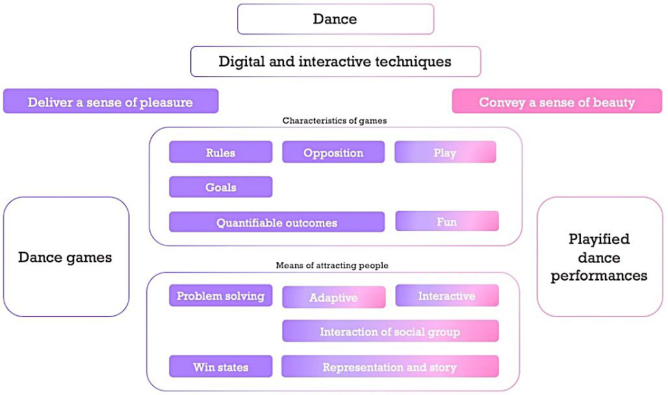
Figure 3: The differences between dance games and playified dance performance.
called exergames or exertainment (Lieberman, 2006). Such games tie toge- ther multiple senses, material bodies and interactive technologies, allowing players to regard their own bodies as both interfaces and avatars, offering them an immersive multisensory experience. Just Dance (2022), developed and published by Ubisoft, which is a motion-based dance video game for multiple players. At the beginning of the game, player first select a song, and then control the avatar on the screen through his own movement to complete the corresponding tasks. When the game ends, computer will give a score and rank according to the accuracy and completion of the player’s actions. We can find a lot of discussion about the characteristics of games. Wittgenstein (2010) argues that the elements of games are play, rules, and competition. Later, Caillois (1957) defines the characteristics that a game must have more comprehensively: fun, separate, uncertain, non-productive, governed by rules, fictitious. They thought a game should give us enjoyment and pleasure. In the context of computer and video games taking the world by storm, Prensky (2001) summarized 12 elements that make them the most attractive pastimes, as follows: fun, play, rules, goals, interactive, adaptive, outcomes and feedback, win states, conflict/competition/ challenge/opposi- tion, interaction of social groups and representation or story. Some of them are characteristics of games, while the other can be considered as the means to encourage people to actively participate in activities. We have used these elements to distinguish dance games from playified dance performances (see Figure 3).
According to Nicholson ‘s definition, dance playification is just the dance adding playful design. It does not make digital interactive dance generate clear tasks and goals, competition and challenge, or even any reward. Arti- sts or choreographers focus more on the audience’s feelings in the aesthetic process and the conveyance of aesthetic intentions. However, dance game creators are concerned with entertaining and thrilling players, and how to
Game or Performance: The Future of Dance Under the Intervention 625
keep them engaged. Therefore, playified digital interactive dance is signifi- cantly different from dance games. Although its artistic characteristics have changed a lot from traditional art, it still belongs to the category of dance performance, and will not eventually develop into dance games.
The development of digital, interactive and other related technologies not only provides technical support for the diverse presentation of dance, but also brings new opportunities for dance playification. Playification, on the one hand, allows the audience to generate a digital virtual identity, so that they can forget the troubles in life as much as possible and enjoy the beauty of art in the process of participation. On the other hand, it allows audience to “live” in the virtual world created by the artist, and experience the fun of roaming the art world. Therefore, playification might be one of the future trends of digital interactive dance.
CONCLUSION
Digital interactive technology makes traditional dance to keep up with the pace of the times. However, technology is a double-edged sword that brings both opportunities and challenges to dance. Digital technology has opened up digital space, brought the audience closer to dance and given them a new aesthetic feeling. But the disappearance of the aesthetic distance may lead the audience to lose the perspective of macroscopically judging the works. The- refore, interaction technology fuses the boundaries among choreographers, performers, and audience, while giving the actors relative freedom, it also allows the audience to participate in interaction and make dance playifica- tion. This will be one of the trends of digital interactive dance in the future. Although playification can make the audience more engaged in the experie- nce, artists or choreographers should always remind themselves that playful design might divert the audience’s aesthetic attention. In addition, they should always be aware of the boundary between playification and games when creating new work. Indeed, the problem brought about by technology is unavoidable, artist or guidance should consider whether the use of digital, interaction or other technologies is appropriate to avoid falling into the trap of infatuation with technology.
REFERENCES
Bardainne, C., Mondot, A. (2020) Acqua Alta. In Imagine Math 7. Springer, Cham.
423–433 Boucher, M. (2011) Virtual dance and motion-capture. FormaMente Rivista internazionale di ricerca sul futuro digitale, 1(2), 53–76 Caillois, R. (2001) Man, Play, and Games. University of Illinois Press, Urbana,
Chicago Caillois, R. (1957). Les jeux et les hommes. Gallimard. Frasca G. (2003) Ludologist love stories, too notes from a debate that never took place. In Digital Game Research (DiGRA). 4–6 Hawksley, S., Biggs, S. (2006) Memory maps in interactive dance environments, Inter-
national Journal of Performance Arts and Digital Media, 2(2), 123–137
626 Long and He
Just dance (video dance game) (2022). Available from Wikipedia http- s//en.wikipedia.org/wiki/Just_Dance_(video_game_series) [accessed 17 January 2022]. Lahusen, S. (1986) Oskar Schlemmer Mechanical Ballets?. Dance Research, 4(2), 65–77 Lieberman, D. A. (2006) Dance games and other exergames What the research says. Long Yixin, He Renke (2021) The role of the choreographer under the influence of
interactive technology. Journal of Beijing Dance Academy, (03), 95–98 Nicholson, S. (2012) A User-Centered Theoretical Framework for Meaningful Gamification. In Proceedings of Games+Learning+Society 8.0. Madison, WI. Noll, A.M. (1967) The digital computer as a creative medium. IEEE Spectrum, 4(10),
89–95 Nuriman, H., Sabana, S., Mutiaz, I. R., Kusmara, R. A. (2020) From real to virtual adaptation model of performance arts during Covid-19 Period. Jurnal Sosioteknologi, 19(2), 162–169 Paradiso, J., Hsiao, K. Y., Hu, E. (1999) Interactive music for instrumented dancing
shoes. In ICMC. Prensky, M. (2001) Fun, play and games What makes games engaging. Digital gamebased learning, 5(1), 5–31 Siegel, W. (2009) Dancing the music interactive dance and music. na. 4. Siegel, W., Jacobsen, J. (1998) The Challenges of Interactive Dance: An Overview
and Case Study. Computer Music Journal, 22(4), 29–43 Siegel, W., Jacobsen, J. (1998) The challenges of interactive dance: An overview and case study. Computer Music Journal, 22(4), 29–43 Swissnex. (2019). VR_I a contemporary dance piece in immersive virtual rea-
lity [online]. Available from https//swissnex.org/china/event/vr_i-a-contemporary- dance-piece-in-immersive-virtual-reality/ [accessed 28 December 2021] Tian Tian Digital Interactive Dance (2009) Context, Principle and Chinese Practice.
Chinese Literature and Art Review. (07), 66–76(2021) Withrow, C. (1970) A dynamic model for computer-aided choreography. UTAH UNIV SALT LAKE CITY SCHOOL OF COMPUTING. Wittgenstein, L. (2010). Philosophical investigations. John Wiley & Sons.
LISTED IN THE AHFE DIGITAL BOOKSTORE CATALOGUE
Explore the complete digital volume
Ergonomics In Design
Read this individual research paper free through the original publisher, or explore the full digital proceedings book.
ISBN 978-1-958651-23-0
Explore this ISBN in the AHFE Bookstore ↗Listed in the July 2026 bookstore catalogue; search by ISBN to confirm current availability · Digital book purchase optional