Jeferson Ccorisapra, Joaquin Machaca, Grimaldo Quispe, Heyul Chavez, Elva Castaneda (2021). Influence of Work Incentives on the Normative Commitment of Financial Personnel of Municipal Savings Banks. In: Human Systems Engineering and Design (IHSED2021): Future Trends and Applications. AHFE Open Access, vol. 21. https://doi.org/10.54941/ahfe1001199
The main objective of this research is to determine the Influence of work incentives on the regulatory commitment of financial personnel of rural municipal banks. The study contemplates a quantitative approach, ex post facto design, cross-sectional and explanatory level, with a convenience sample of 94 employees. The variable "work incentives" is made up of 7 items and the normative commitment with 6 items; making a total of 13 items and analyzed in the SmartPLS (v.3.3.2). Regarding the determination of the influence of incentives on normative commitment, an effect of 0.556 ** was identified, with a level of significance (p ≤ 0.05). Finally, it is stated that work incentives positively influence the regulatory committee of finance personnel.
Human Systems Engineering and Design (IHSED 2021) https://openaccess.cms-conferences.org/#/publications/book/978-1-7923-8987-0
INTRODUCTION
The stimuli in an organization are the essence of the economics of social scienc-es, they assume an important role in today's companies (Malcomson, 1984). Most of the employ-ees' interests are not always equal to those of the organization, therefore there is an abundant literature that makes it easier for us to know and understand how a company offers contracts and salaries in order to understand how employees can follow the interests of the company business. (Nadler and Tushman, 1999), explain that incentives are part of the support processes with the conviction of strengthening structural relation-ships through the organization, considering that they are motivational factors.
Some authors express that there must be an eminent degree of balance and in- tegrity between the incentives that are granted; If not, conflicts and performance will yield negative and inappropriate results for the organization. In the labor field, certain factors that concern the employee in their progress and develop-ment within an organization have been studied in order to identify which ones have an impact on business results; namely, organizations mostly seek higher productivity and this should be reflected in higher profits. Once the factors have been determined, the human talent units must develop, plan and manage new career plans; propose attractive financial incentive plans, improve working hours and, therefore, the quality of life of employees (Madero, 2010). The research developed by (Stezano and Millan, 2014) refers to Taylor's model with the vision of increasing productivity and per- formance, and also highlights that it is appropriate to have qualified personnel to achieve the objectives.
During the last decades in the labor field, a particular interest has been given to the study of human talent, recognizing that factors such as the work environ-ment and others are of vital relevance for the development of any organization (Fonseca et al. 2019). The current environment of financial institutions shows constant technologi- cal changes where high competition is evident. Motivation, commitment and sat- isfaction are factors that directly affect the strategic objectives. Human talent is a crucial piece for the development of these entities and customer service is a re-sult of this, the image achieved by a bad decision can put the continuity of the entity in the financial market at risk (Gaona and Pertile, 2019). Consequently, there are other factors that disturb commitment, uncertainty, layoffs and the threat of losing them, gen-erate negative motivation, which causes distancing in their work and with the organization. In addition, salary dissatisfaction and, above all, the feeling of in-justice that comes from the salary gap within the organization, can generate up-rooting and as a consequence low levels of organizational commitment (Herrera and Roman, 2019).
Human Systems Engineering and Design (IHSED 2021) https://openaccess.cms-conferences.org/#/publications/book/978-1-7923-8987-0
LITERARY REVIEW Labor incentives
In recent decades, a series of stimuli have emerged in the workplace that encour-age employees to perform their activities satisfactorily, in such a way that their productivity is increasing for the organization. An incentive is the condition to satisfy the need that is deliberately controlled to increase both the productivity and the integration or the morale of the workers (Flores et al. 2008). Years later (Madero, 2010), he expresses that an organization increases its productivity and performance when it grants incentives to its employees (Dessler and Varela, 2011) in order to compensate for their effort in the activities that it is responsible for. In addition, (Chiavenato, 2011) argues that they are incen-tives that are granted to employees (Werther et al. 2014) for the achievement of goals that are not necessarily referred to money.
Financial incentives. (Mukherjee, 2005) points out that financial stimuli are closely linked (Idowu et al. 2019) with the remuneration increases that an organization grants to the employee for carrying out their activity in an efficient and productive way (Dessler and Varela, 2011). Financial in-centives include (Mukherjee, 2005) salaries, additional benefits, bonuses, salaries and others of the same nature. This type of incentives (Madero, 2010) are identified in the literature as monetary and economic stimuli, which includes remuneration for performance, an increase in the starting salary and benefits that stimulate a beneficial perfor-mance; They are also explicitly understood as contingent compensation where the employer must comply with the company's demands (Alnsour and Kanaan, 2021). There is research that analyzes at a high level the participation of employees in benefits, the fact arises from the increase in certain salaries. The fact that employees are part of the profits means that employees are directly the basis of increased profits for an organization, something very different from what happens in other organizations that are focused more on the hierarchical levels.
Non-financial incentives. (Mathauer and Imhoff, 2006) are stimuli that do not involve money. The indica-tors that contemplate this type of incentive are: flattery, training, training, career lines, work balance, recreation and among others that do not include money (Madero, 2010). The incentives are focused on the development and growth of the employee, and above all they are used to integrate financial incentives (Alnsour and Kanaan, 2021), because it is of the utmost importance to recognize the productivity exercised by employees. The study by (Kompaso and Sridevi, 2010) sustains that managers should be based on promoting non-financial stimuli, with the intention of increasing commitment to their organizations. Im-proving incentives also requires increasing individual motivation, satisfaction and performance. Non- financial incentives (Idowu et al. 2019) compose factors such as praise from bosses, opportunities for job escalation, transportation for staff, and food.
Human Systems Engineering and Design (IHSED 2021) https://openaccess.cms-conferences.org/#/publications/book/978-1-7923-8987-0
Regulatory commitment In organizational commitment, the definitions that frame the most are those of (Mowday et al. 1979), the authors show an approach of linking the worker with the organization, and define what commitment is to identify and believe in the work they perform in the organization. job; while (Allen and Meyer, 1990), emphasize a psychological state of belonging of the employee to the organization; but (Cotton, 1993), expresses a procedural approach where incentives stimulate the attachment and participation of collaborators to achieve the success of the organization. In short, commitment is a state of rele-vance and desire that people show an organization, accept the normative and procedural documents with the obligation to obey and fulfill the strategic objec-tives and not to defraud the trust aimed. In the literature, the normative commit-ment the concept has also been understood and used by the denomination of ob-ligation commitment. The normative commitment contemplates responding to the opportunity that the entity offers an employee, specifically it is reflected in reci-procity (Meyer et al. 1993) and in the power to commit morally (Gonzales and Guillen, 2008).
RESEARCH METHOD Show
The research considers the financial personnel of the municipal savings and credit banks (CMAC) by population objective. Globally, the Andahuaylas district comprises 05 branches of CMAC, the information of the CMAC is verified and registered (Superintendencia de Banca Seguros y AFP, 2019). Regarding the sample, the use of a convenience sample was used, which is made up of 94 people (loan analysts, operations assistants, administra-tors, and others) from the 05 branches of CMAC. The total of participants com-pleted a physical and virtual survey with clear guidelines regarding the filling, at the same time, the total of the personnel had knowledge of the scientific purposes of the study.
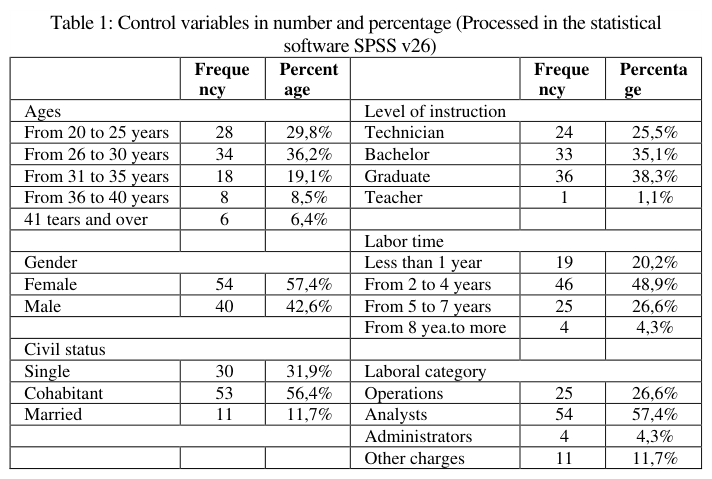
Instrument Due to the fact that the research infers a quantitative approach, the questionnaire was used as a fundamental construct, in such a way as to differ the hypotheses. The construct to measure work incentives was adapted and translated into Span-ish from (Stefanovska and Bojadziev, 2017) structured in 3-factor financial incentives; non- financial incentives 4 factors, under a Likert scale measure (Point 1 = Totally disagree and Point 5 = totally agree); and to measure normative commitment, it was translated into Spanish and adapted from (Meyer et al. 1993) structured by 6 factors, under the same scale pro-posed in work incentives. In addition, Table 1 shows a synthesis of the main control variables or charac-teristics of the research participants (Gonzales and Guillen, 2008).
Human Systems Engineering and Design (IHSED 2021) https://openaccess.cms-conferences.org/#/publications/book/978-1-7923-8987-0
Table 1: Control variables in number and percentage (Processed in the statistical software SPSS v26) Freque
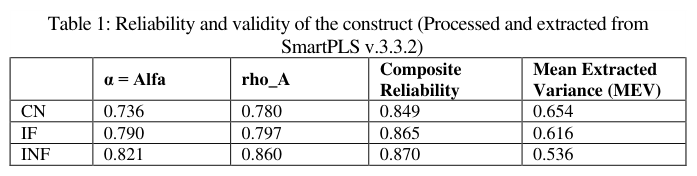
DATA ANALYSIS To determine the reliability of the data, the Cronbach's alpha, the composite reli- ability and the mean variance extracted (MEV) had to be calculated. Table 1 de-tails an alpha of 0.736 for regulatory commitment and for work incentives (fi-nancial incentives 0.790 and non-financial 0.821). Alpha values are found at levels above 0.700; therefore, they are considered acceptable (Oviedo and Campo, 2005). Next, the re-sults focus the HR above 0.7, accepting the reliable reliability of the instrument. Finally, to appreciate the MEV, the table shows values of 0.654 for the regulatory commitment and for work incentives (financial 0.616 and non-financial 0.536), the calculations are acceptable because they meet the rule of being above 0.5, in such a way, the validity of the instrument is reaffirmed (Ali et al. 2018).
Table 1: Reliability and validity of the construct (Processed and extracted from SmartPLS v.3.3.2) α = Alfa rho_A Composite Reliability Mean Extracted Variance (MEV) CN 0.736 0.780 0.849 0.654 IF 0.790 0.797 0.865 0.616 INF 0.821 0.860 0.870 0.536
Human Systems Engineering and Design (IHSED 2021) https://openaccess.cms-conferences.org/#/publications/book/978-1-7923-8987-0
Table 2: Discriminant validity (Processed and extracted from SmartPLS v.3.3.2) Commitment N Incentives F Incentives NF Compromise N ( 0.732 ) Incentives F 0.589 ( 0.808 ) Incentives NF 0.704 0.541 ( 0.785 )Table 3: R squared of the model (Processed and extracted from SmartPLS v.3.3.2) Variable explained R squared R squared adjusted Regulatory commitment 0.556** 0,546**Figure 1. Chi square of the proposed model.
Figure available in the original PDF paper.
Figure 2. Chi square with control variables.
RESULTS
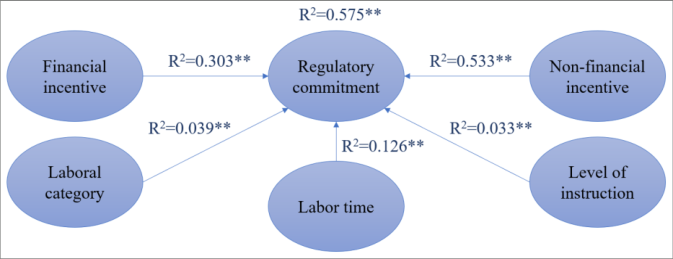
The results of the analysis (see Figure 1) used in the SmartPLS (v.3.3.2) show that work incentives influence the regulatory commitment with an R2 = 0.556; meanwhile, the financial and non-financial incentives in the normative commitment show an effect of R2 = 0.294 and R2 = 0.554, the calculations prove to be very significant for the model. On the other hand, the model (Figure 3) expresses a significant improvement of influence both in the labor objective by demonstrating an effect of R2 = 0.575 of the work incentives in the normative commitment; on the other hand, there is an increase of R2 = 0.303 and R2 = 0.533 of financial and non- financial incentives in the regulatory commitment. The increasing improvement is relevant because the control variables (job category, time of work and level of education) have a significant influence. Consequently, the model evidenced an
Human Systems Engineering and Design (IHSED 2021) https://openaccess.cms-conferences.org/#/publications/book/978-1-7923-8987-0 adjusted R-squared of 0.546 ** denoting the significant influence of work incen-tives on the regulatory commitment of financial personnel of municipal savings banks.
DISCUSSION
This research has sought to explain the effect of work incentives on regulatory commitment. The results achieved by some researchers show that non-economic incentives tend to show a relevant role in identifying loyalty to the organization, but in the study of (Delic et al. 2014) they support that incentives are essential factors for a collaborator the banking sector achieves satisfaction for what it does, the level of effect it achieves in its study differs much similarity; (Mukherjee, 2005) showed that employees do not receive any type of incentives, which leads to employees resigning from their positions; Meanwhile (Kefay and Kero, 2019) argue that the application of economic and non-economic incentives are motivating factors to achieve that an employer shows an obligation to belong to the bank. However, (Khan et al. 2020) explain that collaborators show loyalty when they are committed, and the work they perform is more effective than that of an unfair collaborator, thus also adding that if the incentives meet the expectations of the employer, this It causes adequate motivation and leads to having employees loyal to the company. As can be seen, there are still questions to be resolved when analyzing these two variables, it should be added that the study is a starting point to continue enriching the knowledge of incentives and commitment, in such a way that organizations can consider the most entrenched studies that are made in your sector. Finally, we believe that the effort given in the execution of the research has been worthwhile to contribute to the scientific community.
CONCLUSIONS
The municipal funds at the study level tend to the fact that the personnel who are in them are the effect of the stimuli that it gives them, in order to generate reci-procity and contribute to performance. The purpose of the research was to know the influence that exists between work incentives and regulatory commitment, obtaining a significant and assessable result in the sector (see Figure 1); at the same time, it is important to highlight that the job category, the time of work and the level of instruction generate a positive increase in the model (see Figure 2). So, if the municipal funds used to have better degrees of education in professionals, it is possible that a better increase will emerge. In addition, in this sector the work of the personnel implies a lot of pressure and very hectic schedules, which means that the personnel cannot professionally escalate in their training. It has also been shown that financial incentives are not essentially a determining factor for staff reciprocity with the entity. Finally, it was noted that non-financial incentives tend to be more relevant for staff to respond to what the municipal funds grant them. Therefore, the praise and other factors that the organization can give to the staff are important for there to be a greater increase in normative commitment.
Human Systems Engineering and Design (IHSED 2021) https://openaccess.cms-conferences.org/#/publications/book/978-1-7923-8987-0
REFERENCES
Ali, F., Rasoolimanesh, S. M., Sarstedt, M., Ringle, C. M., and Ryu, K. (2018), “An assessment of the use of partial least squares structural equation modeling (PLS-SEM) in hospitality research.” International Journal of Contemporary Hospitality Management, 30(1), 514- 538. Alnsour, A.S., and Kanaan, O.A. (2021), “The effects of financial and non-financial incentives
on job tenure.” Management Science Letters, 11(3), 729-736. Chiavenato, I. (2011), Administración de recursos humanos. El capital humano en las organizaciones. México: McGraw-Hill/Interamericana. Cotton, J.L. (1993), Employee involvement: Methods for improving performance and work
attitudes. United States: Sage Publications Delic, A., Kozarevic, E., Peric, A., and Civic, B. (2014), The Monetary and Non-Monetary Incentives Impact on Job Satisfaction: Evidence from Bosnia and Herzegovina Banking Sector.” Conference: Annual Paris Business and Social Science Research Conference, Theme “Research for Advancement, 1–16. Dessler, G., and Varela, R. (2011), Administración de Recursos Humanos Enfoque
Latinoamericano. México: Pearson Education Flores, R., Abreu, J.L., and Badii, M.H. (2008), “Factores que originan la rotación de personal en las empresas mexicanas.” Daena: International Journal of Good Conscience, 3(1), 65- 99. Fonseca, H.J.M., Cruz, T.C.E., and Chacón, G.L. (2019), “Validación del instrumento de
compromiso organizacional en México: evidencias de validez de constructo, criterio y confiabilidad.” Revista De Psicología, 37(1), 7-29. Gaona, S. D. B., and Pertile, S. (2019), “Impacto de buenas prácticas de recursos humanos en el comportamiento de los colaboradores de dos entidades financieras en Paraguay.” Revista Científica En Ciencias Sociales, 1(1), 25–35. González, T.F., and Guillén, M. (2008), “Organizational commitment: A proposal for a wider
ethical conceptualization of “normative commitment.” Journal of Business Ethics, 78(3), 401-414. Herrera, J., and Roman, A. (2019), “Organisational commitment in working environments with extrinsic motivational factors.” Revista Espacios, 40(28), 1-27. Idowu, H.A. O., Soyebo, K.O., and Adeoye, E.A. (2019), “Incentives as correlates of
employees loyalty towards management in organisation.” African Journal of Business Management, 13(12), 407-414. Kefay, K., and University, J. (2019), “The Effect of Non-Financial Incentive Scheme on Employees’ Motivation (in Case of Commercial Bank of Ethiopia in Jimma Town).” In International Journal of Commerce and Finance, 5(2), 76-86. Khan, M., Daniyal, M., and Ashraf, M.Z. (2020), “The Relationship Between Monetary
Incentvies and Job Performance: Mediating Role of Employee Loyalty.” Educational Research (IJMCER), 2(6), 12-20. Kompaso, S.M., and Sridevi, M. S. (2010), “Employee Engagement: The Key to Improving Performance.” International Journal of Business and Management, 5(12), 89-96. Madero, G.S. (2010), “Factores relevantes del desarrollo profesional y de compensaciones en
la carrera laboral del trabajador.” Contaduría y Administración, 232, 109-130. Malcomson, J.M. (1984), “Work Incentives, Hierarchy, and Internal Labor Markets.” Journal of Political Economy, 92(3), 486-507 Mathauer, I., and Imhoff, I. (2006), “Health worker motivation in Africa: The role of non-
financial incentives and human resource management tools.” Human Resources for Health, 4(24), 1-17.
Human Systems Engineering and Design (IHSED 2021) https://openaccess.cms-conferences.org/#/publications/book/978-1-7923-8987-0
Meyer, J., and Allen, N. (1990), “The measurement and antecedents of affective, continuance and normative commitment to the organization.” Journal of Occupational Psychology, 63, 1-18. Meyer, J.P., Allen, N.J., and Smith, C.A. (1993), “Commitment to Organizations and
Occupations: Extension and Test of a Three-Component Conceptualization.” Journal of Applied Psychology, 78(4), 538–551. Mowday, R.T., Steers, R.M., and Porter, L. (1979), “The measurement of organizational commitment.” Journal of Vocational Behavior, 14(2), 224-247. Mukherjee, S. (2005), Organization & Management and Business Communication. India. New
Age International Publisher. Nadler, D., and Tushman, M. (1999), El diseño de la organización como arma competitiva : el poder de la arquitectura organizacional. Reino Unido: Oxford University Press Oviedo. H., and Campo, A. (2005), “Aproximación al uso del coeficiente alfa de Cronbach.”
Revista Colombiana de Psiquiatría, 34(4), 572-580. Stefanovska, M., and Bojadziev, M. (2017), “Cash or compliment? Older employees preference of financial versus non-financial incentives.” Montenegrin Journal of Economics, 13(1), 63–71. Stezano, P.F.A., and Millán, V.A.O. (2014), “Incentivos que encuentran los académicos
mexicanos para adoptar relaciones de transferencia de conocimientos y tecnología con el sector empresarial.” Sociológica, 29(83), 47–85. Superintendencia de Banca Seguros y AFP. (2019), Cajas Municipales. Superintendencia de Banca, Seguros y AFP. Werther, W.B., Davis, K., and Guzmán, B.M. (2014), Administración de recursos humanos :
gestión del capital humano. México: McGraw-Hill Interamericana.
Human Systems Engineering and Design (IHSED 2021) https://openaccess.cms-conferences.org/#/publications/book/978-1-7923-8987-0
LISTED IN THE AHFE DIGITAL BOOKSTORE CATALOGUE
Explore the complete digital volume
Human Systems Engineering and Design (IHSED2021): Future Trends and Applications
Read this individual research paper free through the original publisher, or explore the full digital proceedings book.
ISBN 978-1-7923-8987-0
Explore this ISBN in the AHFE Bookstore ↗Listed in the July 2026 bookstore catalogue; search by ISBN to confirm current availability · Digital book purchase optional