Md Asfaqur Rahman, Md Masum Billah, Md Shahadat Hossain, Md Ahnaf Shahriar Tanim, Mohammed Munif Hasan, Wenhao Yang, Yueqing Li (2026). A Human-Centered AI Task Management System for Cognitive Load Reduction and Decision Support in Industrial Plant Management. In: Human Factors and Systems Interaction. AHFE Open Access, vol. 230, pp. 18–26. https://doi.org/10.54941/ahfe1007973
Industrial plant management environments are becoming more complicated, with managers having to integrate production operations, maintenance activities, safety compliance, manpower allocation, and operational documentation across many digital platforms. The extensive use of fragmented tools including spreadsheets, emails, dashboards, and calendars frequently results in information overload, an increased cognitive effort, and reactive decision making. To solve these issues, this article introduces AI TaskManager, a human-centered, AI-assisted task and workflow management system intended to aid plant managers in manufacturing and industrial settings. AI TaskManager was built with Google AI Studio, which allows for the rapid creation of a high-fidelity prototype without the need for traditional software development. The system supports important management workflows with natural-language interface and multimodal AI capabilities, such as AI-assisted task creation, automated budget estimation from structured data, technical drawing interpretation, and adaptive job prioritizing. These functions are combined into a single interface to improve situational awareness, minimize cognitive load, and maintain human decision authority. A usability and human performance evaluation was conducted with ten participants, including plant supervisors, engineering professionals, and graduate researchers with experience in operational task management. With an average job execution time of 2.4 minutes, a 93% task completion rate, and a 6% mistake rate, the findings show excellent system performance. The findings demonstrate that AI TaskManager effectively facilitates cognitive ergonomics, decision support, and human–AI collaboration in industrial plant management, underscoring the promise of human-centered AI systems to improve managerial performance and operational resilience.
Manufacturing plant managers face growing complexity in their day-to- day work. They must oversee production schedules, maintenance, safety compliance, and workforce coordination, often using several disconnected tools such as spreadsheets, dashboards, emails, and ERP systems. However, many manufacturing environments still rely on fragmented systems where production, logistics, maintenance, and quality management operate independently with limited interoperability, forcing managers to manually gather information from disparate sources and tools (Pereira et al., 2025). These fragmented systems force managers to manually piece together information from multiple sources, which increases cognitive load, causes frequent context-switching, and leads to reactive rather than proactive decision-making (Carvalho et al., 2020).
From a human factors’ perspective, this kind of information overload raises stress, reduces situational awareness, and increases the risk of errors in time-sensitive environments (Sharma, 2025). Situational awareness— the ability to perceive, understand, and anticipate operational states—is particularly impaired when managers cannot access integrated, real-time information (Endsley, 1995). Despite this, most industrial management tools still prioritize data availability over usability, offering little support for attention management or adaptive prioritization.
Recent advances in AI offer a practical path forward. AI-driven systems can reduce cognitive fragmentation by integrating task prioritization, predictive alerts, and decision support into a single interface. However, for such systems to be effective, they must be designed around human needs—keeping humans in control, maintaining transparency, and supporting rather than replacing judgment (Gladysz et al., 2023; Shneiderman, 2020; Xu et al., 2025). This human-centered approach has become a core principle of Industry 5.0, which explicitly calls for technology that serves worker well-being alongside operational efficiency (Leng et al., 2022).
Despite growing interest in cognitive AI and adaptive decision support, empirical studies specifically evaluating AI-assisted task management tools for plant managers remain limited (Carvalho et al., 2020). To address this gap, this study presents AI TaskManager, a human-centered AI system developed using Google AI Studio that combines natural language task creation, intelligent prioritization, automated budget estimation, and drawing analysis in one unified interface. The goal of this study is to assess its usability, task performance, and cognitive support value through scenario-based testing with industrial professionals.
BACKGROUND AND RELATED WORK Cognitive Workload and Situational Awareness
Manufacturing systems are intricate socio-technical settings where managers’ performance is greatly impacted by situational awareness and cognitive effort. Excessive demands on information processing raise the probability of errors, decrease concentration, and increase mental effort, especially in time-sensitive
situations, according to cognitive ergonomics research (Fogelberg et al., 2025; Wickens, 2008). Plant managers are particularly susceptible to task saturation because they have to assess production, maintenance, safety, and people data across many platforms.
Effective decision-making is hampered by fragmented information settings, as explained by situational awareness theory. Perception, understanding, and projection of system states are all components of situational awareness, according to Endsley’s paradigm (Endsley, 1995). These procedures are hampered by disconnected technologies, requiring managers to manually integrate data, which decreases their capacity to foresee errors or scheduling conflicts and increases reliance on reactive decision-making (Kozjek et al., 2020; Wickens, 2008).
Human Factors Engineering and Human-Centered Design In order to maximize performance and well-being, human factors engineering places a strong emphasis on creating systems that complement human cognitive and physical capacities (Karwowski, 2005). Human-centered design plays a crucial role in manufacturing by lowering mental strain, promoting attention control, and enhancing decision-making (Kadir & Broberg, 2021; Ngoc et al., 2022). However, a lot of industrial management solutions place more emphasis on system-level optimization and data availability than on usability, which adds to the cognitive load on plant managers (Dörner et al., 2024).
Human–AI Interaction and Adaptive Decision Support Research on human-automation interaction suggests that selecting appropriate levels of automation across different functions is crucial, as automation changes rather than simply replacing human activity and can impose new coordination demands on operators (Parasuraman et al., 2000). Overzealous or ambiguous automation might weaken user trust and situational awareness. Therefore, current research on human–AI interaction promotes AI systems that serve as cooperative cognitive partners, offering explainable, adaptable, and context- aware support while maintaining human agency (Zhao et al., 2025).
Adaptive decision-support systems that learn from user behaviour and operational environment are made possible by recent developments in cognitive AI (Shneiderman, 2020). These systems can facilitate proactive decision-making, predictive alerting, and job prioritizing when they are in line with human factors principles (Romero & Stahre, 2021). This reduces cognitive burden and improves situational awareness. However, AI applications in manufacturing have mostly concentrated on predictive maintenance and production optimization, paying little attention to the cognitive requirements of specific plant managers (Barua et al., 2025; Dörner et al., 2024).
Research Gap Despite established research on cognitive ergonomics, human-centered design, and adaptive AI, studies exploring AI-assisted task management
A Human-Centered AI Task Management System 21 systems specifically to support plant managers’ cognitive and decision-making processes are still emerging (Dörner et al., 2024). However, comprehensive empirical assessments of human-centered AI technologies that seamlessly combine cognitive assistance, task management, and prioritizing within a unified interface, particularly for plant managers, remain limited and challenging (Denno, 2024; Sidorenko et al., 2023). To bridge this gap, this study presents AI TaskManager, a human-centered AI task and workflow management system intended to support managerial judgment in intricate industrial settings.
METHODOLOGY
Human-Centered Design Framework Human-centered design and cognitive ergonomics concepts served as the foundation for the development and assessment of AI TaskManager, which was specifically intended to assist plant managers in making decisions in challenging industrial settings. The system was not intended to be an independent control mechanism, but rather a cognitive support system. Enhancing situational awareness through integrated visualization dashboards and predictive alerts aligns with research showing that AI-augmented visualization systems enable proactive monitoring by projecting future system states and highlighting conditions requiring operator attention (Endsley, 1995; Sharma, 2025). Moreover, lowering cognitive load through AI-driven task prioritization helps in reducing information overload and decision fatigue (Shahrzadi et al., 2024), and promoting successful human–AI collaboration by guaranteeing that AI-generated recommendations remain advisory and preserve human decision authority (Peng et al., 2024), which were all important human factors considerations (Endsley, 1995). Explainable AI outputs and adaptive system nudges were used to address trust and transparency (Hoffman et al., 2018), while interface design placed an emphasis on simplicity and lower attentional demand to increase cognitive efficiency (Wickens, 2008).
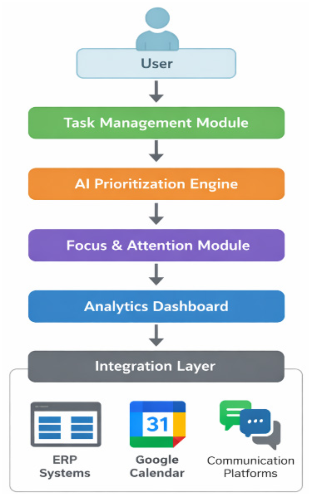
System Architecture/Prototype Development A high-fidelity prototype of AI TaskManager was developed using Google AI Studio to simulate AI-driven workflows and user interactions. The system architecture (Figure 1) consists of five core modules designed to provide adaptive intelligence while maintaining transparency and user autonomy:
Task Management Module for centralized scheduling, progress monitoring, and task input.
AI Prioritization Engine for creating adaptive work priorities.
Focus & Attention Module for facilitating focus session control and distraction management.
Analytics Dashboard for showing trends in task completion, productivity measures, & cognitive workload indications.
Integration Layer for synchronizing with Google Calendar, ERP dashboards, & platforms for company communication.
Prompt-based AI workflows in Google AI Studio were used to simulate user interaction behaviour and system logic in the prototype. Key system functionalities, such as work prioritizing, project and budget estimation, drawing analysis, and natural-language task generation, were defined using structured prompts. This method supported high-fidelity prototype without the burden of specialized backend implementation, allowing for quick iteration, flexible system behaviour adaption, and effective investigation of human–AI interface design options.
Figure 1: AI TaskManager architecture.
Study Design and Procedure Scenario-based task execution and structured user testing were used in usability and human performance evaluation research. Through the completion of predefined activities intended to mimic actual plant management workflows, participants engaged with the AI TaskManager prototype. These included creating projects using AI-based budget prediction, creating tasks in plain language using the AI assistant, and analysing drawings using AI. While engaging with the system naturally, participants finished each activity on their own. Subjective feedback was gathered once the work was finished, while objective performance data was captured throughout task execution.
Participants Ten participants were recruited with expertise in operational task management in manufacturing or industrial settings, including 6 plant supervisors, 1 engineer, 2 supervisors and 1 technician. Every participant has previously used operational support systems or digital task management. This allocation guaranteed that both operational and decision-making viewpoints had fair input.
A Human-Centered AI Task Management System 23 Measures and Instruments
System efficacy and human-centered performance were assessed using both objective and subjective metrics. Task completion rate, task completion time and task error rate were objective measurements. Subjective metrics include Likert-scale satisfaction questions, and NASA Task Load Index (NASA- TLX). NASA-TLX was used to evaluate participants perceived cognitive workload during interaction with the AI TaskManager prototype.
RESULTS
Task Performance Strong system efficacy is shown by objective task performance metrics in every evaluation scenario (Table 1). With a high completion rate of 93%, participants successfully finished the tasks, proving that the system enabled task execution in practical plant management workflows. All activities took an average of 2.4 minutes to complete, indicating effective communication and minimal operational friction. The mistake rate was kept at 6%, suggesting that there were few problems with job performance in terms of usability or interpretation.
Table 1: Summary of task performance and user satisfaction.
Table available in the original PDF paper.
Metric Value Task Completion Rate (%) 93
Error Rate (%) 6
2.4
Average Task Completion Time (minutes) User Satisfaction (1–5) 4.4
User Satisfaction A high degree of user acceptability is shown by subjective user satisfaction scores (Table 1). Participants scored a mean user satisfaction score of 4.4 out of 5. According to their feedback, perceived ease of use and overall system efficacy were positively impacted by the AI-driven job prioritization, natural language interface, and integrated workflow architecture.
Based on the questionnaire responses, participants reported that the AI tool reduced their mental workload compared to the tools they previously used. The system helped them understand tasks more easily and make decisions faster. Users experienced less effort in managing information and completing tasks. Overall, the AI tool made their work more efficient and less mentally demanding.
Cognitive Workload
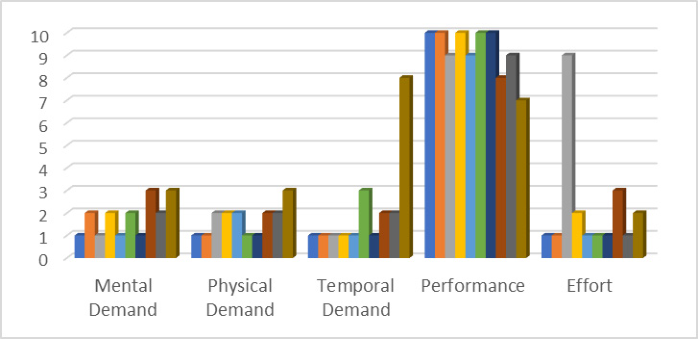
Figure 2 visualizes the cognitive workload distribution across all participants. The NASA-TLX workload assessment (N = 10) indicated generally low perceived workload across all dimensions. Participants reported low mental
demand (mean = 1.8/10), physical demand (mean = 1.6/10), and temporal demand (mean = 1.3/10), suggesting minimal cognitive and time pressure during task execution. Effort levels remained low (mean = 1.7/10), and frustration scores were minimal (mean = 1.2/10), indicating a comfortable user experience. In contrast, perceived performance ratings were high (mean = 9.8/10), reflecting strong confidence in successful task completion. Overall, the results demonstrate that the AI TaskManager enabled effective task performance while maintaining a low cognitive workload.
Summary of Key Results Following system familiarization and scenario-based task execution, participants successfully completed operational tasks using the AI TaskManager prototype with high efficiency and low error occurrence. Performance analysis showed an average task execution time of 2.4 minutes, a completion rate of 93%, and a low interaction error rate of 6%. Post- task assessments indicated low cognitive workload across NASA-TLX dimensions, alongside high perceived performance and minimal frustration. User satisfaction responses demonstrated strong user satisfaction (4.36/5), suggesting that the system effectively supports task management while reducing cognitive burden. Overall, the evaluation confirms the usability and user satisfaction of the human-centered AI task management approach.
DISCUSSION
Interpretation of Findings The results show that the AI TaskManager helped participants complete tasks effectively while maintaining a low cognitive workload. Users reported high levels of user satisfaction and described a comfortable and efficient working experience. The tool improved performance by combining task management and decision support within a single, easy-to-use interface. This reduced the need to switch between multiple tools and made information
A Human-Centered AI Task Management System 25 easier to understand. The AI assistant helped users organize and prioritize tasks, allowing them to work faster with less mental effort. Clear visuals and simple interactions helped users stay focused and make decisions more confidently. Additionally, the system generated weekly performance reports with suggestions, allowing participants to review their progress and identify areas for improvement, which further supported effective task management.
CONCLUSION
This study sets out to address a genuine challenge faced by plant managers in complex manufacturing environments, the cognitive burden of managing competing tasks, time pressures, and information overload in real time. By introducing AI TaskManager, a human-centered AI-assisted task management solution grounded in cognitive ergonomics, we demonstrate that AI can meaningfully support human decision-making without undermining human authority or responsibility. Participants reported improved task efficiency, reduced cognitive load, fewer errors, and high overall satisfaction with the system. That said, we acknowledge that our evaluation relied on a prototype tested in a simulated environment with a limited number of participants, which naturally restricts how broadly these findings can be generalized to real-world industrial settings. These are important boundaries to be transparent about. Looking ahead, we believe the next most valuable steps are deploying AI TaskManager in live industrial environments, conducting longer-term studies with more diverse participant groups, and exploring more sophisticated explainability features to deepen user trust and confidence. Ultimately, this work contributes to a growing body of evidence that well- designed, human-centered AI systems have a meaningful role to play in making industrial workplaces not only more efficient, but more manageable for the people working within them.
REFERENCES
Barua, D. A., Sami, S. A., & Barua, L. (2025). Leveraging artificial intelligence for smart production management in Industry 4.0. Scientific Reports, 15, 41559. Carvalho, A. V., Chouchene, A., Lima, T. M., & Charrua-Santos, F. (2020). Cognitive
manufacturing in Industry 4.0 toward cognitive load reduction: A conceptual framework. Applied System Innovation, 3(4), 55. Castañé, G., Dolgui, A., Kousi, N., Meyers, B., Thevenin, S., Vyhmeister, E., & Östberg, P.-O. (2023). The ASSISTANT project: AI for high-level decisions in manufacturing. International Journal of Production Research, 61(7), 2288–2306. Denno, P. (2024). Cognitive work in future manufacturing systems: Human-
centered AI for joint work with models. Journal of Integrated Design and Process Science. Dörner, A., Bures, M., Simon, M., & Pirkl, G. (2024). Making cognitive ergonomics in the human–computer interaction of manufacturing execution systems assessable. Machines, 12(3), 195. Dul, J., Bruder, R., Buckle, P., Carayon, P., Falzon, P., Marras, W. S., Wilson, J.
R., & van der Doelen, B. (2012). A strategy for human factors/ergonomics. Ergonomics, 55(4), 377–395.
Endsley, M. R. (1995). Toward a theory of situation awareness in dynamic systems.
Human Factors, 37(1), 32–64. Fogelberg, E., Cao, H., & Thorvald, P. (2025). Cognitive ergonomics: Triangulation of physiological, subjective, and performance-based mental workload assessments. Frontiers in Industrial Engineering, 3, 1605975. Gladysz, B., et al. (2023). Current development on Operator 4.0 and transition
towards Operator 5.0: A systematic literature review in light of Industry 5.0. Journal of Manufacturing Systems, 70, 160–185. Hoffman, R. R., Mueller, S. T., Klein, G., & Litman, J. (2018). Metrics for explainable AI: Challenges and prospects. arXiv Preprint arXiv:1812.04608. Kadir, B. A., & Broberg, O. (2021). Human-centered design of work systems in the
transition to Industry 4.0. Applied Ergonomics, 92, 103334. Karwowski, W. (2005). Ergonomics and human factors: The paradigms for science, engineering, design, technology and management of human-compatible systems. Ergonomics, 48(5), 436–463. Kozjek, D., Vrabič, R., Rihtaršič, B., Lavrač, N., & Butala, P. (2020). Advancing
manufacturing systems with big-data analytics: A conceptual framework. International Journal of Computer Integrated Manufacturing, 33(2), 169–188. Leng, J., et al. (2022). Industry 5.0: Prospect and retrospect. Journal of Manufacturing Systems, 65, 279–295. Nguyen Ngoc, H., Lasa, G., & Iriarte, I. (2022). Human-centred design in Industry
4.0. Journal of Intelligent Manufacturing, 33, 35–76. Parasuraman, R., Sheridan, T. B., & Wickens, C. D. (2000). A model for types and levels of human interaction with automation. IEEE Transactions on Systems, Man, and Cybernetics Part A, 30(3), 286–297. Peng, L., et al. (2024). Human–AI collaboration in intelligent decision support
systems. International Journal of Industrial Ergonomics, 103, 103627. Pereira, M. Â., Vieira, G., Varela, L., Putnik, G., Cruz-Cunha, M., Santos, A., Dieguez, T., Pereira, F., Leal, N., & Machado, J. (2025). Manufacturing management processes integration framework. Applied Sciences. Romero, D., & Stahre, J. (2021). Towards the resilient Operator 5.0. Procedia
CIRP, 104, 1065–1070. Shahrzadi, L., Mansouri, A., Alavi, M., & Shabani, A. (2024). Information overload: Causes and strategies. International Journal of Information Management Data Insights, 4(2), 100261. Sharma, R. (2025). Dynamic visualization frameworks for smart factories:
Enhancing decision-making through cognitive-centered design. Journal of Information Systems Engineering & Management, 10(60s), 1153–1161. Shneiderman, B. (2020). Human-centered artificial intelligence: Reliable, safe & trustworthy. International Journal of Human–Computer Interaction, 36(6), 495–504. Sidorenko, A., Motsch, W., van Bekkum, M., Nikolakis, N., Alexopoulos, K., &
Wagner, A. (2023). The MAS4AI framework for human-centered agile and smart manufacturing. Frontiers in Artificial Intelligence, 6, 1241522. Wickens, C. D. (2008). Situation awareness: Review of Mica Endsley’s 1995 articles on situation awareness theory and measurement. Human Factors, 50(3), 397–403. Xu, J., Sun, Q., Han, Q.-L., & Tang, Y. (2025). When embodied AI meets Industry
5.0: Human-centered smart manufacturing. IEEE/CAA Journal of Automatica Sinica, 12(3), 485–501. Zhao, M., Simmons, R., & Admoni, H. (2025). The role of adaptation in collective human–AI teaming. Topics in Cognitive Science, 17(2), 291–323.
LISTED IN THE AHFE DIGITAL BOOKSTORE CATALOGUE
Explore the complete digital volume
Human Factors and Systems Interaction
Read this individual research paper free through the original publisher, or explore the full digital proceedings book.
ISBN 979-8-950676-06-2
Explore this ISBN in the AHFE Bookstore ↗Listed in the July 2026 bookstore catalogue; search by ISBN to confirm current availability · Digital book purchase optional