Michael Oehl, Rainer Höger (2022). Affective States and Driving Behavior of Novice and Young Drivers. In: Advances in Human Aspects of Transportation: Part III. AHFE Open Access, vol. 17. https://doi.org/10.54941/ahfe100744
Although general car safety has increased considerably and at the same time accident numbers have decreased remarkably on average in the European Union during the last years, the percentage of novice and young car drivers involved in heavy car accidents is still remaining dramatically high, e.g., in Germany more than twice as high compared to older and more experienced drivers based on their proportion of the driving population. Traffic psychological research shows that maladjusted driving behavior caused by affective states is a main contributor to traffic accidents. Therefore, our current experimental study analyzes this influence of affective states on driving performance with regard to novice and young drivers. In an experimental scenario affective states (positive vs. negative valence) were induced in participants and subjects were then asked to drive predefined routes in a driving simulator. Results indicated that drivers drove significantly faster in a positive affective state compared with drivers in a negative affective state. This effect was pronounced by trend for novice drivers.
In recent years the number of road fatalities across the European Union significantly decreased (European Commission, 2013). To achieve this aim European politics like the European Road Safety Action Program 2011- 2020 are focusing on improving safety measures that are implemented in the traffic surroundings, e.g., guard railing, while car manufacturers have improved passenger protection (European Commission, 2001; 2010). However, despite these improvements the numbers of accidents and fatalities of young, novice drivers are remaining still high. Young, novice drivers are significantly more likely to be injured or even killed in car accidents than older, more experienced drivers. For example in Germany the risk of getting involved in an accident or being killed in accident is much higher for young, novice drivers than for the rest of the driving population, and at the same time young, novice drivers are mainly responsible for about two-thirds of these car accidents (DESTATIS, 2013). This phenomenon of increased numbers of accidents and fatalities for young, novice drivers is globally comparable high (ECMT, 2006).
Another important human factor in traffic is the emotional or affective state of the driver. Research suggests that emotions or in general affective states are a main cause for maladjusted driving that might lead to accidents (e.g., Arnett et al., 1997; Deffenbacher et al., 1994; 2003; Mesken et al., 2007; Nesbit et al., 2007; Stephens and Groeger, 2009). Maladjusted driving can include risk taking, driving at high speeds, fast acceleration, and poor lateral control (Dula and Ballard, 2003). This might be intensified by negative affective states such as anger (Stephens and Groeger, 2009). Especially anger has been a well-researched affective state in traffic. Research suggests that anger is an important negative affective state that can increase risky driving behaviors such as driving at high speeds, speeding, traffic violations, and/or recklessly driving (e.g., Abdu et al, 2012; Arnett et al., 1997; Deffenbacher et al., 2003; Lajunen and Parker, 2001; Maxwell et al., 2005; Mesken et al., 2007; Nesbit et al., 2007; Roidl et al., 2013b; Sümer, 2003). Moreover, Jallais et al. (2014) found that anger-induced drivers were slower to locate road elements and hence to detect atypical hazards. This might be especially crucial for inexperienced novice drivers.
However, while there has been much progress in the research of the relation between especially anger, maladjusted driving, and accident risk, very little attention has been paid to positive affective states and their impact on driving behavior. Nevertheless, research indicates that a greater variety of emotions besides anger is likely to be experienced in everyday traffic (Levelt, 2003; Mesken et al., 2007; Roidl et al., 2013a). Since there is no data to support the claim that only a certain valence (positive or negative) of affective states leads to maladjusted driving, we have chosen happiness as a prototypical positive affective state, and anger as a prototypical negative affective state to be induced in our experiment. Moreover, these two emotions are experienced very frequently by drivers in traffic (Levelt, 2003; Mesken et al., 2007; Roidl et al., 2013). We classified these both affective states following the approach of Scherer’s multi-dimensional emotion space (Scherer, 2005). Scherer suggests that emotions can be classified by several dimensions. Anger and happiness rate high on arousal, while anger ranks negative, and happiness ranks positive on the valence dimension. Additionally, happiness might be a relevant affective state for young, novice drivers since they are very likely to drive accompanied by other car passengers in a more or less ‘party mood’, e.g., after clubbing or under substance abuse.
So our current experimental study focused on evaluating these findings on maladjusted driving in an anger-related negative affective state as well as on extending the knowledge on affective driving by contrasting them with driving in a happiness-related positive affective state. In addition, the second central research question addressed to this study was if there are any differences in driving behavior between young drivers with at least some driving experience and young novice drivers with nearly no driving experience driving in these both affective states of anger versus happiness (positive vs. negative).
METHOD
This experimental study was based on a 2x2-factorial design. The first factor was the driving experience, i.e., the length of time since drivers have gotten their driver’s license. Two groups were formed within the range of student participants as novice drivers (≤ 1 year of driving experience) and young drivers (> 1 year of driving experience). The second factor was the affective states (positive vs. negative) drivers drove the routes in the driving simulator.
In this study participated N = 80 novice and young drivers (60% female). They were all students recruited at the university and the novice drivers were partly recruited at grammar schools. The group of the novice drivers n = 25 (60% female) had a mean age of M = 18.00 years (SD = 0.76) and the kilometers driven since they had acquired their license were MD = 800.00 km. On five point Likert scales for this novice group in general driving cars was moderately important M = 3.52 (SD = 0.87), but they always fairly enjoyed it when they had the opportunity to drive a car M = 3.88 (SD = 1.24). The second group of the young drivers n = 55 (60% female) had a mean age of M = 21.56 years (SD = 2.91) and the kilometers driven since they had acquired their license were MD = 8000.00 km. On five point Likert scales for this young group in general driving cars was moderately important M = 3.29 (SD = 1.08), but they always fairly enjoyed it when they had the opportunity to drive a car M = 4.11 (SD = 0.916). With regard to these both questions the novice and the young participant groups were very similar and not significantly different (both p > .05). All participants volunteered and received no compensation.
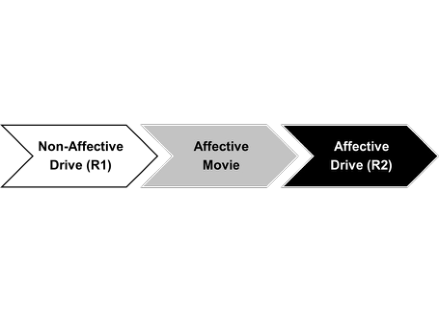
Figure 1. Schematic experimental procedure (left) and setting in the driving simulator (right).
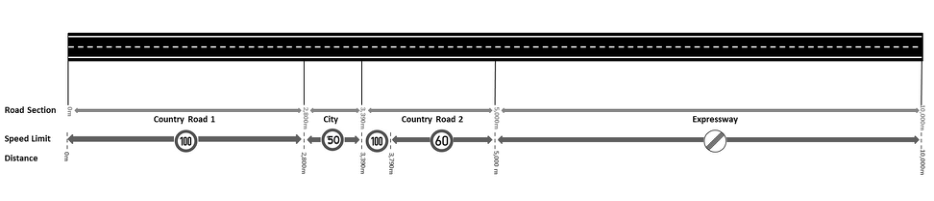
Members out of both participant groups (novice vs. young drivers) were randomly assigned to one of two experimental affective conditions: ‘Positive affective state’ or ‘negative affective state’. Participants were asked to drive predefined routes in a driving simulator StiSim W100 from System Technology Incorporated. A Volkswagen Golf cockpit with original steering wheel and instrument panel was used to control the simulation (Figure 1). During the simulation, the StiSim W100 registered all driving activities (i.e., velocity, acceleration, and lateral position). The routes consisted of country roads, city roads as well as expressways and there was sparse oncoming traffic (Figure 2). The design of the routes was modeled after real life traffic routes to ensure high validity. Each participant drove a practice route to get used to the driving simulator. After this practice route, the two experimental routes followed in repeated measurements. The second affective experimental route was comparable to the first non- affective route, but this time the surroundings of the road and the appearance of the cars on the road were changed. The affective states (positive vs. negative) were induced with specific film clips shown right before the affective, familiar drive (Figure 1). These film clips are an efficient method to elicit defined affective states (Rottenberg et al., 2007) in general as well as by trend in a traffic psychological research setting with emotional focus in a driving simulator (Roidl et al., 2013b). We used up-to-date evaluated clips out of film sets which were specific for and ranked highest on the intended target affective state. The stimulus materials, i.e., the film clips, were as follows: ‘When Harry met Sally’ (positive affect, i.e., happiness and joy related; Hewig et al., 2005), and ‘Schindler’s List’ (negative affect, i.e., anger related; Schaefer et al., 2010). We evaluated the induction of affective states in pre-tests. Comparable to Roidl et al. (2013b), the chosen film clips turned out to be effective at least by trend for inducing specific target affective states in terms of moods in the participants. As the pre-test has shown that it was difficult to keep these young participants in the second drive in a neutral affective state serving as a baseline, we decided to focus on the contrasting cases of positive versus negative affective states. Additionally, we applied the Self- Assessment Manikin (SAM) as a non-verbal pictorial assessment technique to measure participants’ affective reactions with a ten points Likert scaling (Bradley et al., 1994; Lang, 1980).
Figure 2. Schematic route in the driving simulator with relevant road sections, speed limits, and distances.
Participants’ driving patterns served as experimental measures. They were recorded throughout the experiment and the mean velocity (km/h), acceleration (m/s2), and lateral acceleration (m/s2) were assessed (Stephens and Groeger, 2009). These parameters are recognized as sensitive performance measures in traffic situations (Bouchner et al., 2006; Deery and Fildes, 1999). Driving violations were represented by the occurrence of speeding in the country road (100 km/h and 60 km/h restricted) and city (50 km/h restricted) sections.
To control for the influence of personal characteristics with regard to negative affect, trait driving anger was measured with a German version of the Driving Anger Scale (DAS; Deffenbacher et al., 1994; Steffgen et al., 2008). This scale includes 33 items that measure six subscales: Hostile gestures, illegal driving, police presence, slow driving, discourtesy, and traffic obstructions. Age, gender, and kilometers participants’ have driven since they have gotten their driving license completed the measurement of personal characteristics.
RESULTS
For the data analyses we used in general suitable parametric tests, but non-parametric tests when it came to direct comparisons of the novice and the young drivers to give consideration to the unequal sample sizes of novice and young drivers in this experimental study.
With regard to the manipulation check, i.e., the Self-Assessment Manikin (SAM) as a non-verbal pictorial self- assessment technique to measure participants’ affective reactions, especially the valence of affective reactions is of interest to distinguish between positive and negative affective states. For the first non-affective drive (R1) participants of both later affective experimental conditions reported no significant differences for the valence of affective states (t(78) = 1.60; p > .05). But for the second affective drive (R2), after the target affective states were induced through the film clips, we observed a significant difference of the self-reported valence (t(78) = 2.32; p < .05). Compared to the non-affective drive (R1) the ratings for the affective drive (R2) were slightly higher on a ten-points-scale M = 6.53 (∆ +0.10; SD = 1.38) in the condition with the positive affective state, and lower in the condition with the negative affective state M = 5.79 (∆ -0.21; SD = 1.44). This indicates at least by trend an effective induction of the affective states and a carry-over effect of the target affective states in the films for the affective drives in the simulator.
To control for the influence of personal characteristics especially with regard to negative affect, trait driving anger was measured with a German version of the Driving Anger Scale (DAS). Results showed no differences of participants’ trait anger with respect to the affective experimental conditions (t(78) = -0.84; p > .05). The positive affect group had a mean score of M = 105.25 points out of max. 165 points (SD = 15.61) and the negative affect group M = 108.32 points (SD = 16.55). With respect to the experimental conditions of driving experience, i.e., novice vs. young drivers, there were no significant differences observable as well (Z = 0.90; p > .05). The novice drivers had a mean score of M = 108.48 points (SD = 16.71) and the young drivers M = 105.88 points (SD = 15.80).
The driving parameters acceleration, and lateral acceleration, as well as possible driving violations in terms of speeding in the speed limited sections indicated no significant differences (all p > .05). However, driving speed, i.e., mean velocity, across all experimental conditions showed significant differences. So in the following, we will have a closer look at the results of driving speed which showed differences for the complete route overall, and especially significant differences for the expressway section where drivers were free to choose their driving speed which is frequently the case on German expressways. The other sections, i.e., speed limited country roads and city, showed no significant differences (all p > .05) for driving speed.
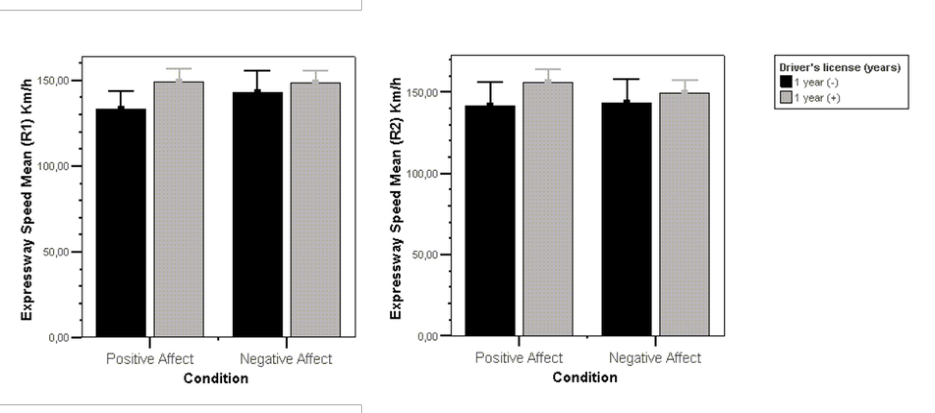
First, we will have a general look at the differences in driving speed between novice and young drivers without considering the affective states. For the first non-affective drive (R1) young drivers showed a significantly (Z = 1.37; p < .05) faster driving behavior MY = 110.39 Km/h (SDY = 9.19 Km/h) across the complete first route compared to the novice drivers MN = 104.46 Km/h (SDN = 8.71 Km/h). This was even pronounced for the expressway section (Figure 3) with speeds of MY = 148.01 Km/h (SDY = 19.05 Km/h) for the young drivers versus MN = 137.51 Km/h (SDN = 18.74 Km/h) for the novice drivers (Z = 1.40; p < .05). For the second affective drive (R2) as well young drivers in general showed again a significantly (Z = 1.52; p < .05) faster driving behavior MY = 112.59 Km/h (SDY = 9.50 Km/h) across the complete second route compared to the novice drivers MN = 107.47 Km/h (SDN = 10.50 Km/h). Here again, this was observable for the expressway section (Figure 3) with speeds of MY = 152.31 Km/h (SDY = 20.85 Km/h) for the young drivers versus MN = 142.37 Km/h (SDN = 23.48 Km/h) for the novice drivers, but just marginally failed to be significant (Z = 1.36; p = .05). In general for the repeated measurements, we observed within both groups of the young (t(54) = -4.16; p < .001) and the novice (t(24) = -3.34; p < .01) drivers higher driving speeds on the second affective route (R2) compared to the first non-affective route (R1). This effect was also observable for the expressway section again for the young (t(54) = -2.57; p < .05) and for the novice (t(24) = -2.29; p < .05) drivers. By trend, this effect was more pronounced for the novice drivers (Figure 4).
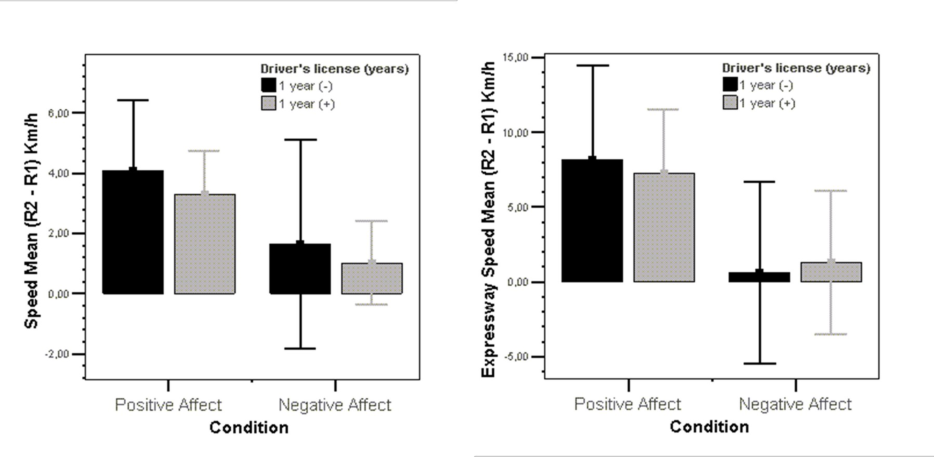
Second, we will have a closer look at the differences of driving speed due to drivers’ affective states. In general, we did not find significant differences in driving speed for the second affective (positive vs. negative) route (R2; all p > .05) between the affective conditions. But when we controlled for driving experience, the young drivers drove significantly faster than the novice drivers in the positive affective state on the complete route (R2; Z = 1.39; p < .05) as well as on the expressway section (Z = 1,48; p < .05). We found no significant differences in this respect for the negative affective state (all p > .05). When we calculated again the differences (∆ R2-R1; Figure 4) of mean speed of the first non-affective drive (R1; we controlled the first drive for any possible differences of driving speed of the later affective groups; p > .05) versus the affective drive (R2) for all road sections overall (t(78) = 2,75; p < .01) and the expressway section (t(78) = 2.66; p < .01) significant differences in driving speed appeared. On the second route (R2) drivers drove significantly faster in a positive affective state compared with drivers in a negative affective state. This effect was pronounced for novice drivers again by trend.
Figure 3. Novice versus young drivers' mean speeds on the expressway sections of the first non- affective drive (R1 with participants' prospective affective conditions; left) versus the affective drive (R2; right).Figure 4. Differences (∆ R2-R1) of novice versus young drivers' mean speeds of the first non-affective drive (R1) versus the affective drive (R2) for all road sections overall (left) and the expressway section (right).
Since gender effects have been frequently reported in previous anger and aggression research in general (e.g., Hyde, 1984) as well as in affective (e.g., Roidl et al., 2013b) driving situations (e.g., DeJoy, 1992; Scott-Parker et al., 2013b; Shinar et al., 2001), we additionally controlled our data for those. However, there was no significant difference of the affective states between female and male participants for the non-affective first drive (R1), nor for the second affective drive (R2) in terms of the measured Self-Assessment Manikin (SAM). Moreover, we did not find any significant gender differences with respect to trait anger measured by the Driving Anger Scale (DAS). Even the kilometers driven since they had acquired their license, the importance of driving in general, and the joy of driving a car revealed no gender differences (all p > .05). And in addition, there were no gender differences observable for the driving parameters (all p > .05).
CONCLUSIONS
This experimental study focused on evaluating findings on maladjusted driving in an anger-related negative affective state as well as on extending the knowledge on affective driving by contrasting them with driving in a happiness-related positive affective state. In addition, the second central research question addressed to this study was if there are any differences in driving behavior between young drivers with at least some driving experience and young novice drivers with nearly no driving experience driving in these both affective states (positive vs. negative).
The driving parameters acceleration, and lateral acceleration, as well as possible driving violations in terms of speeding in the speed limited sections revealed no significant differences. Only driving speed showed significant differences for the complete route overall, and especially for the expressway section where drivers were free to choose their driving speed. For the first non-affective drive young drivers showed a significantly faster driving behavior across the complete first route and on the expressway section compared to the novice drivers. For the second affective drive young drivers in general showed again a significantly faster driving behavior across the complete second route as well as by trend on the expressway section compared to the novice drivers. In general, both groups of the young and the novice drivers drove at higher speeds on the second affective route compared to the first non-affective route. Especially the young drivers drove significantly faster than the novice drivers in the positive affective state on the complete route as well as on the expressway section. No significant differences were observed for the negative affective state. With respect to the differences of mean speed of the first non-affective drive in contrast to the affective drive for all road sections overall and the expressway section significant differences in driving speed appeared. Drivers drove significantly faster in a positive affective state compared to drivers in a negative affective state. This effect was pronounced by trend for novice drivers. In contrast to previous research we did not find any gender differences with respect to the experience of neither affective states nor driving behavior in the driving situations under research.
One limitation of our findings might be the rather weakly experienced affective states in our study. A possible explanation for this effect could be the change of contexts from watching a film clip to driving in the simulator. This change in context might imply a change in participants’ affective states and hence might have weakened the affective state induced by the film clip. A second possible explanation for the rather low levels of self-reported affective states might be that driving in a simulator can be an entertaining and exciting event especially for young participants as our pre-tests showed. And a third possible explanation might be that affective states were reported retrospectively after the experiment. Nevertheless, to avoid interruptions or providing potential behavioral cues, this procedure of post-hoc assessment seemed to be pragmatic. However, this phenomenon of weakly self-reported affective states seems to be a problem with several studies performed in a driving simulator (e.g., Roidl et al., 2013b) and in real traffic experiments (e.g., Mesken et al., 2007). A second limitation of our findings for the anger- related negative affective condition might be some arguments in literature for an anger threshold suggesting that traffic participants have to experience a certain level of anger to show risky driving and perhaps exceeding this threshold could lead to more and stronger changes in driving behavior. Additionally, our participants were quite moderate in terms of trait driving anger and hence maybe rather moderate in terms of generally experiencing anger. Further research should address this issue.
But for all that, even these rather weakly self-reported affective states provoked both young participant groups, i.e., the novice as well as the young drivers, to drive at significantly higher speeds. This concerns especially the very young novice drivers in a positive affective state, which might be even intensified under special social conditions, e.g., like peer passengers or substance abuse. Further research needs to deepen our insight in the impact of positive affective states on driving behavior. At the same time our findings on the effect of happiness-related affective states suggest that driving instructors as well as driving supervisors should create awareness and sensitize novice drivers to the negative impact of affective states on maladjusted driving behavior.
Acknowledgements
This research was funded by grant FS-Nr. 2006.63 from the ‘Arbeitsgruppe Innovative Projekte’ (AGIP) of the Ministry of Science and Culture, Lower Saxony, Germany. We would like to thank the Volkswagen Group (Group Research Electronics and Vehicle Research / HMI and Human Factors) for technical support.
REFERENCES
Abdu, R., Shinar, D., & Meiran, N. (2012). Situational (state) anger and driving. Transportation Research Part F: Traffic Psychology and Behaviour , 15(5), 575-580. Arnett, J. J., Offer, D., & Fine, M. A. (1997). Reckless driving in adolescence ‘state’ and ‘trait’ factors. Accident Analysis and
Prevention, 29(1), 57-63. Ballesteros, M. F., & Dischinger, P. C. (2002). Characteristics of traffic crashes in Maryland (1996-1998): Differences among the youngest drivers. Accident Analysis and Prevention, 34(3), 279-284. Bouchner, P., Pieknik, R., Novotny, S., Pekny, J., Hajny, M., & Borzova, C. (2006). Fatigue of car drivers - Detection and
classification based on the experiments on car simulators. WSEAS Transactions on Systems, 5(12), 2789-2794. Bradley, M. M., & Lang, P. J. (1994). Measuring Emotion: The Self-Assessment Manikin and the Semantic Differential. Journal of Behavior, Therapy & Exp. Psychiatry. 25(1), 49-59. Chaudhary, N. K., Ferguson, S. A., & Herbel, S. B. (2004). Tennessee’s Novice Driver Safety Project: A Program to Increase
Parental Involvement. Traffic Injury Prevention, 5(4), 356-361. Deery, H. A. (1999). Hazard and risk perception among young novice drivers. Journal of Safety Research, 30(4), 225-236.
Deery, H. A., & Fildes, B. N. (1999). Young novice driver subtypes: Relationship to high-risk behavior, traffic accident record, and simulator driving performance. Human Factors, 41(4), 628-643. Deffenbacher, J. L., Deffenbacher, D. M., Lynch, R. S., & Richards, T. L. (2003). Anger, aggression, and risky behavior: A
comparison of high and low anger drivers. Behavior Research and Therapy, 41, 701-718. Deffenbacher, J. L., Oetting, E. R., & Lynch, R. S. (1994). Development of a driving anger scale. Psychological Reports, 74, 83-
91. DeJoy, D. M. (1992). An examination of gender differences in traffic accident risk perception. Accident Analysis and Prevention, 24(3), 237-246. DESTATIS – Statistisches Bundesamt (2013). Unfallentwicklung auf deutschen Strassen 2012 [Development of traffic accidents
on German Roads 2012]. Wiesbaden, Germany: Statistisches Bundesamt – DESTATIS. Dula, C., & Ballard,M. (2003). Development and evaluation of a measure of dangerous, aggressive, negative emotional, and risky driving. Journal of Applied Social Psychology, 33(2), 263-282. ECMT – European Conference of Ministers of Transport (2006). Young Drivers: The Road to Safety. Paris, France: OECD
Publishing. Retrieved from: http://www.internationaltransportforum.org/Pub/pdf/06YoungDrivers.pdf (last access on 6th March 2014). European Commission (2001). White Paper European Transport Policy for 2010: Time to decide. Brussels, Belgium: European
Commission. Retrieved from: http://ec.europa.eu/transport/themes/strategies/doc/2001_white_paper/lb_com_2001_0370_ en.pdf (last access on 6th March 2014). European Commission (2010). Towards a European road safety area: Policy orientations on road safety 2011-2020. Brussels, Belgium: European Commission. Retrieved from: http://ec.europa.eu/transport/road_safety/pdf/com_20072010_en.pdf (last access on 6th March 2014). European Commission (2013). Road safety: EU reports lowest ever number of road deaths and takes first step towards an
injuries strategy. Brussels, Belgium: European Commission. Retrieved from: http://europa.eu/rapid/press-release_IP-13- 236_en.pdf (last access on 6th March 2014). Hewig, J., Hagemann, D., Seifert, J., Gollwitzer, M., Naumann, E., & Bartussek, D. (2005). A revised film set for the induction of basic emotions. Cognition & Emotion, 19(7), 1095-1109. Hyde, J. S. (1984). How large are gender differences in aggression? A developmental meta-analysis. Developmental Psychology,
20(4), 722-736. Lajunen, T., & Parker, D. (2001). Are aggressive people aggressive drivers? A study of the relationship between self-reported general aggressiveness, driver anger, and aggressive driving. Accident Analysis and Prevention, 33, 243–255. Lang, P. J. (1980). Behavioral treatment and bio-behavioral assessment: Computer applications. In J. B. Sidowski, J. H. Johnson,
and T. A. Williams (Eds.). Technology in mental health care delivery systems (pp. 119-137). Norwood, NJ:Ablex. Levelt, P. B. M. (2003). Praktijkstudie naar emoties in het verkeer [Emotions in Traffic]. SWOV Report R-2003-08.
Leidschendam, Netherlands: SWOV. Jallais, C., Gabaude, C., & Paire-Ficout, L. (2014). When emotions disturb the localization of road elements: Effects of anger and sadness. Transportation Research Part F: Traffic Psychology and Behaviour, 23, 125-132. Maxwell, J. P., Grant, S., & Lipkin, S. (2005). Further validation of the propensity for angry driving scale in British drivers.
Personal and Individual Differences, 38, 213-224. Maycock, G., Lockwood, C. R., & Lester, J. F. (1991). The accident liability of car drivers (TRRL Research Report 315).
Crowthorne, UK: Transport and Road Research Laboratory. Mesken, J., Hagenzieker, M. P., Rothengatter, T., & De Waard, D. (2007). Frequency, determinants, and consequences of different drivers' emotions: An on-the-road study using self-reports, (observed) behaviour, and physiology. Transportation Research Part F, 10, 458-475. Nesbit, S. M., Conger, J. C., & Conger, A. J. (2007). A quantitative review of the relationship between anger and aggressive
driving. Aggression and Violent Behavior, 12(2), 156-176. Pradhan, A. K., Hammel, K. R., DeRamus, R., Pollatsek, A., Noyce, D. A., & Fisher, D. L. (2005). Using eye movements to evaluate effects of driver age on risk perception in a driving simulator. Human Factors, 47(4), 840-852. Roidl, E., Frehse, B., Oehl, M., & Höger, R. (2013a). The Emotional Spectrum in Traffic Situations: Results of Two Online-
Handbook of Emotion Elicitation and Assessment (pp. 9-28). Oxford, UK: Oxford University Press. Schaefer, A., Nils, F., Sanchez, X., & Philippot, P. (2010). Assessing the effectiveness of a large database of emotion-eliciting films: A new tool for emotion researchers. Cognition & Emotion, 24(7), 1153-1172. Scherer, K. R. (2005). What are emotions? And how can they be measured?. Social Science Information 44(4), 695-729. Scott-Parker, B., Hyde, M. K., Watson, B., & King, M. J. (2013a). Speeding by young novice drivers: What can personal
characteristics and psychosocial theory add to our understanding?. Accident Analysis and Prevention, 50(1), 242-250. Scott-Parker, B., Watson, B., King, M. J., & Hyde, M. K. (2011). Mileage, car ownership, experience of punishment avoidance, and the risky driving of young drivers. Traffic Injury Prevention, 12(6), 559-567. Scott-Parker, B., Watson, B., King, M. J., & Hyde, M. K. (2013b). A further exploration of sensation seeking propensity, reward
sensitivity, depression, anxiety, and the risky behavior of young novice drivers in a structural equation model. Accident Analysis and Prevention, 50(1), 465-471. Shinar, D., Schechtman, E., & Compton, R. (2001). Self-reports of safe driving behaviors in relationship to sex, age, education and income in the US adult driving population. Accident Analysis and Prevention, 33(1), 111-116. Steadman, M., Bush, J. K., Thygerson, S. M., & Barnes, M. D. (2014). Graduated Driver Licensing Provisions: An Analysis of
State Policies and What Works. Traffic Injury Prevention, 15(4), 343-348. Steffgen, G., Recchia, S., & Ludewig, J. L. (2008). Deffenbacher driving anger scale: Psychometric properties of a German version. International Journal of Psychology, 43(3/4), 20-25. Stephens, A. N., & Groeger, J. A. (2009). Situational specificity of trait influences on drivers' evaluations and driving behavior.
Transportation Research Part F: Traffic Psychology and Behaviour, 12(1), 29-39. Stiensmeier-Pelster, J. (2007). Abschlussbericht zum Niedersächsischen Modellversuch ‚Begleitetes Fahren ab 17‘. Hanover, Germany: Niedersächsisches Ministerium für Wirtschaft, Arbeit und Verkehr. Sümer, N. (2003). Personality and behavioral predictors of traffic accidents: Testing a contextual mediated model. Accident
Analysis and Prevention, 35, 949-964.
LISTED IN THE AHFE DIGITAL BOOKSTORE CATALOGUE
Explore the complete digital volume
Advances in Human Aspects of Transportation: Part III
Read this individual research paper free through the original publisher, or explore the full digital proceedings book.
ISBN 978-1-4951-2099-2
Explore this ISBN in the AHFE Bookstore ↗Listed in the July 2026 bookstore catalogue; search by ISBN to confirm current availability · Digital book purchase optional