Stephan Hörold, Cindy Mayas, Heidi Krömker (2022). Passenger Needs on Mobile Information Systems – Field Evaluation in Public Transport. In: Advances in Human Aspects of Transportation: Part III. AHFE Open Access, vol. 17. https://doi.org/10.54941/ahfe100729
Passenger information is an essential part of public transport and mobility in general. Enabling passengers to plan their journey, to check travel times and routes as well as prices and local information. Technological developments have made information available, e.g. real-time information of vehicles, which supports seamless information before and during the trip. These developments have lead to new information systems along the travel chain, e.g. real-time information displays at stop points, interactive public displays or mobile passenger applications. In this regard, mobile passenger information systems often serve as personal assistants along the journey, providing necessary information for the individual journey of each passenger. Designing these systems for different users and for different journeys, requires knowledge about when and where information and functions are needed along the journey. This knowledge enables developers to design these systems more in regard to the user’s needs. This paper shows a user and context depended evaluation of a mobile passenger information system and an assessment of twenty different functions, related to the fulfillment of information needs along the journey and the creation of added value.
Presently, in modern public transport systems, mobile passenger information applications are developing into an important part to fulfill the information needs (Hörold et al., 2012) of the passengers. As a personal assistant, these applications can provide specific information for an ongoing journey, including real-time information, individual disturbance information, foot path rooting and many more. Starting as a simple trip planning application, nowadays a wide range of different functions and information can be found throughout these applications (Wirtz and Jakobs, 2013). Actual developments indicate that more and more functions are added to existing systems, e.g. weather forecasts, tourist information, shopping advices and other local based services, making it difficult for passengers to extract basic public transport information. An approach and knowledge are needed in order to be able to identify basic functionality, to satisfy the information needs and to develop new kinds of personal assistants, which provide functionality and information, based on the actual stage of the travel chain and the context in general (Hörold et al., 2013a).
Travel Chain and Environmental Context A typical journey with public transport or a mix of public and individual means of transportation consists of different stages which shape the journey itself, along with the performed tasks and information needs of the passengers (Hörold et al., 2012). When analyzing which functionality and information is needed along the journey and for mapping the user requirements to functionality and information, a deep understanding of these stages and the context is needed.
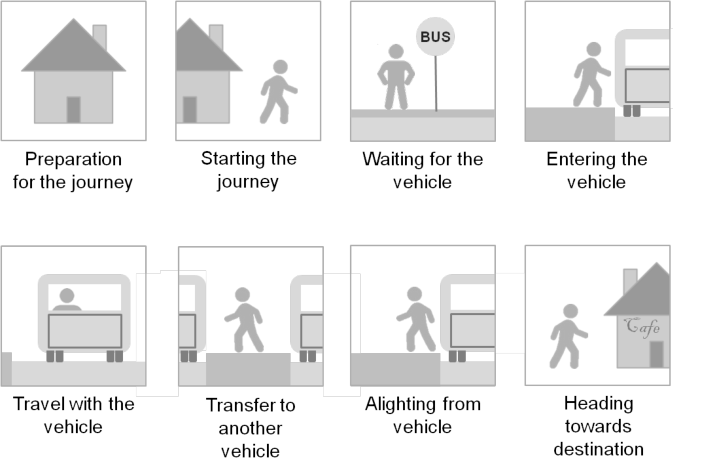
The travel chain consists of eight stages, with one stage only applying when the passenger is transferring between vehicles or means of transportation (VDV, 2001). Figure 1 shows the stages of the travel chain covering the journey from preparation to reaching the desired destination (Hörold et al., 2013a).
Figure 1. Travel chain in public transport. (Hörold et. al., 2013a)
The stages of the travel chain provide a basic structure for task and context analysis. Both having a strong impact on the identification of functions and information needs. The environmental context along the travel chain can differ widely and depends on different mobile context factors, as described by Krannich (Krannich, 2010). Mobile passenger information and its functionality as well as the information needs of the passengers are influenced by the dynamic environmental context e.g. by the kind of stop point and other information systems (Hörold et al., 2013a).
Considering new mobility behavior, especially multimodal and intermodal mobility (Beckmann et al., 2006), the travel chain can be adapted easily and additional tasks and information needs can be identified as well.
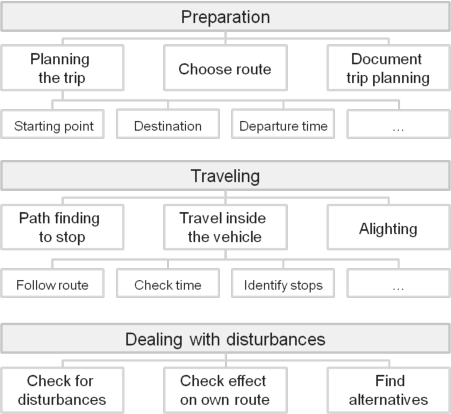
Tasks and Goals of Passengers Along the journey passengers are confronted with several cognitive and physical tasks in order to reach their desired destination (Hörold et al., 2013b). Physical tasks range from walking to the stop point to carrying luggage, while cognitive tasks include the search and use of information. Which information is needed, depends not only on the tasks at hand or the context, but on the individual passenger as well (Mayas et al., 2012). Figure 2 shows an extract of a HTA - Hierarchical Task Analysis (Annet, 2005), especially describing the cognitive tasks along the journey.
The basis for the described physical and cognitive tasks, is the passenger’s goal to reach a specified destination with public transport, or a mix of different means of transportation. This goal normally arises from the passenger personal agenda, which requires him or her to physically move to the destination (Wienken et al., 2014). While using public transport to reach the destination, additional goals, e.g. selecting a fast or comfortable route and being informed along the journey, guide the passenger’s individual behavior and use of information systems. Figure 3 shows an extract of a GDTA - Goal Directed Task Analysis (Endsley and Jones, 2012).
Figure 2. Extract of public transport HTA (Hörold et. al., 2012) Figure 3. Extract of Goal Directed Task Analysis Tasks, goals and information needs along the travel chain provide the necessary base for the identification of suitable functionality and provided information at the different stages of the travel chain. How functions should be linked to each other and which additional information can support the mobility information from a user perspective as well as the assessment of the importance of different functions, can not be determined by this analysis alone. To answer these questions, users have to be integrated and real public transport usage behavior has to be observed. The following described field test is an approach to assess different mobile passenger information functions from a user point of view.
METHOD
The functionality assessment of mobile passenger information system in public transport is divided into two parts. The first part includes a field test in public transport with 36 passengers (Hörold et al., 2014) while the second part consists of a functionality rating of 20 different functions.
Field Test Functionality Assessment The first part of the functionality assessment of mobile passenger information systems involves a mobile passenger information system prototype, including five main functions typically used before and during the trip. Despite the discussion about disadvantages and advantages of field tests compared to lab-based tests (Kjeldskov et al., 2004; Nielsen et al., 2006; Sun and May, 2013), a field test was choosen to include physical tasks, time pressure and a real context of use, in order to secure a realistic function use along the journey.
The test object is a prototype of a new mobile passenger information application, based on a new information communication interface standard for public transport in Germany, providing a wide range of different mobility information. The mobile application includes the following five main functions and integrated sub-functions, supporting the primary information task of the main function:
Trip planning o Start- and destination input support o Trip preferences o Connection overview
Stop point sequence
Footpath routing
Journey map
Weather information o Push-Information subscription o Ticket information
Travel information o Route overview
Footpath routing
Stop point sequence
Journey map o Weather information
Departure timetables o Stop point sequence o Map overview
Event and disturbance information
o Disturbance overview o Individual disturbance information (Push-Service) o Alternative routing
Vehicle information o Stop point sequence o Stop request
Whenever possible, the information regarding departure and arrival times is provided in real-time and the stop point sequence, within travel information and vehicle information, is updated based on the actual stop point of the journey. The vehicle information is provided directly by the vehicle, through wireless LAN and can only be used when inside a vehicle.
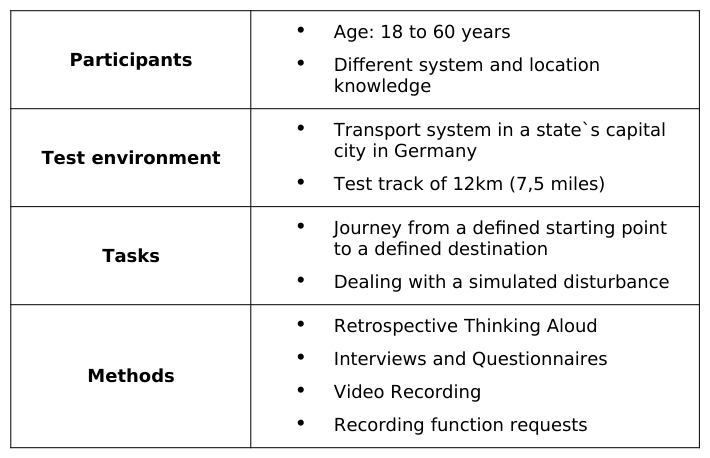
Table 1 shows a brief overview of the test concept. The assessment of the function use is based on the recording and evaluation of the smartphone screen and the interaction of the passenger through screen capturing and video cameras equipped on a backpack and integrated into sunglasses. In addition, the position along the journey and the use of the five main functions is recorded by the server, which provides the requested information.
Table 1: Field test concept (Hörold et al., 2014)
Functionality Rating The second part of the process includes a comparative rating process of 20 potential functionalities of mobile passenger information. In order to compare items in general, three different questioning techniques are established:
One-to-one-comparison: According to the amount of functions, a one-to-one-comparison, which would comprise of 190 single comparisons of each function to another, is not manageable for the users. Due to the side effects of large questionnaires and the required large number of users, to ensure random based orders, the one-to-one-comparison was not suitable to produce reliable results with 36 users.
Item sequencing: Test persons are able to manage up to seven single items and order them according to their personal preferences. For larger item sets, as the presented set with 20 items, a free sequencing is not manageable for test persons and is subject to many side effects.
Independent scale rating: A single independent rating of each of the 20 functions on a Likert scale is more manageable by the users, but allows a high range of equal rating for many functions. In addition, the independent rating is more susceptible to positive or negative attitudes of the test persons. Due to the mentioned problems within each single method, the functionality rating was conducted with a combination of the described methods in three steps. Firstly, the main functions were compared in a direct item sequencing, which could be arranged by drag and drop by the test persons. In the second part, the users conducted a one-to-one-comparison with five functions, which comprised of ten single decisions. In a last step, the users assessed the remaining functions by an independent scale rating on a five point-scale. The reliable combination of the methods was assured by reference functions, which were assessed with each method and defined the weighting factor to be able to combine the results. In general, the required weighting factors were very low, due to the fact, that each method produced very similar ratings of the reference functions in reference to a 5-point-rating.
RESULTS
In total, over 1500 function uses were recorded during the field evaluation. A clear separation of functions into essential and non-essential functions as well as a location specific use of these functions could be identified by combining the function usage with video footage, retrospective thinking aloud recordings and the results of the questionnaire. In the following, we describe the results in regard to the different stages of the travel chain and an overall user function rating.
Stage specific Function Usage Results from function uses, retrospective thinking aloud and video footage show that trip planning and travel information are used across the different stages of the travel chain. The results also show that vehicle information is intensively used within vehicles, where the information is available. Departure timetables with real-time information are used mainly, when waiting for a vehicle at the stop point, especially when the passenger is unsure, if the vehicle was missed. Functions providing updated information along the journey, e.g. dynamic stop point sequences, are used more often in terms of usage, than other functions which are used only once or twice at a specific stage.
Figure 1. Stage specific function usage along the journey.
Figure available in the original PDF paper.
Figure 1 shows the results of the five main functions, trip planning, travel information, departure timetables, disturbance information and vehicle information. For the analysis of the function usage along the travel chain, the eight stages where reduced to four essential phases of the field evaluation. The first phase covers all activities of trip planning before starting the journey. The second phase includes all activities from entering to leaving the city-rail vehicle. The transfer between city-rail and bus is covered in the transfer phase and all activities regarding the bus are pooled within the last phase. As the second and last stage of the travel chain were very short, no reliable results can be presented for these stages. Figure 1 shows the results of the four phases of the field test and describes the percentage of our test persons which used one of the five main functions and when they did, how often it was used within the respective phase.
Trip Preparation Phase Different knowledge of the system and of a place, strongly reflects on the trip preparation phase, as experienced users of public transport with good local orientation need less information during trip planning than less frequent users. The test track was chosen to cover a typical journey with public transport, integrating different vehicles and a transfer. Since the test track was not located in the center of the city but in an outskirt, the majority of the test users needed the trip planning functionality to start their journey.
The results of the conducted field study show that the trip planning functionality was used by all test users. Test users with middle to low knowledge of the system and of a place additionally used those sub-functions which provide a more detailed insight into the trip. Fifty percent of the test users used the travel information function to receive real-time information. Depending on available time before actually starting the journey, few users informed themselves about disturbances and checked the real-time departure time of their vehicle, within the departure timetable function.
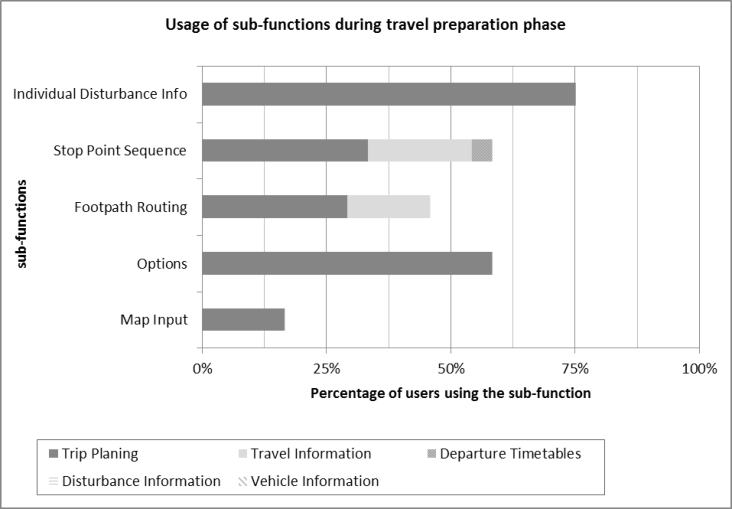
Figure 2. Usage of sub-functions during travel preparation phase
In addition to the usage of the main functions, figure 2 shows the results for selected sub-functions used within the five main functions. As described within the test object, some main functions include the same sub-functions to provide information in different phases of the journey. Only few of the test users entered the starting point and the destination, using the map-based input support, while seventy-five percent subscribed to individual disturbance information. Detailed information was mainly obtained through trip planning and travel information.
In regard to the design of mobile information systems, the evaluation shows, that within the first phase, three typical questions can be identified:
How to enter my starting position or actual position and my desired destination?
Which connection serves my needs best?
Are there any disturbances along the journey?
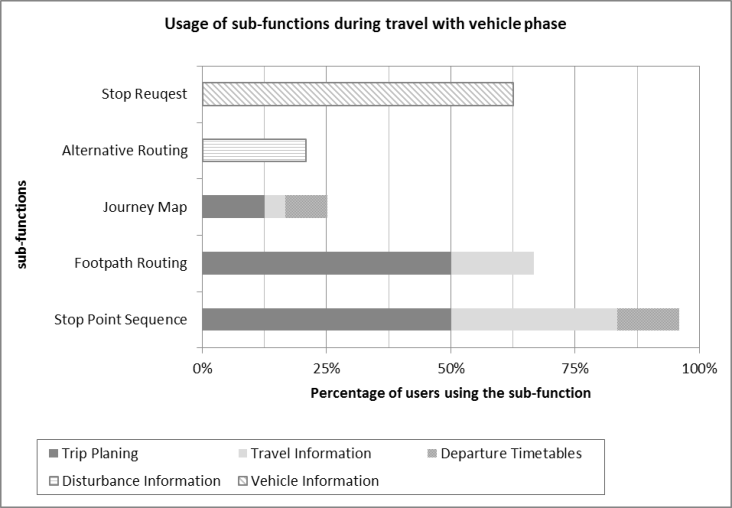
Travel with Vehicle Phase In both traveling phases inside a vehicle, the usage of provided functionality was similar. A slight reduction of functionality use and the use of the mobile application in general could be observed as a result of the increasing security of being able to reach the target.
During the first ride inside the city-rail, a disturbance information was sent to those passengers who decided to receive individual disturbance push-messages. Some passengers decided to use the alternative routing function to deal with the disturbance. Others started a new trip planning, while some test users did not take any actions further than reading the message and later asking the bus driver about alternatives. The integrated vehicle information functionality was used intensively during the two rides. Mainly to check the actual position within the dynamic stop sequence and to activate the stop signal within the bus. Within the additional function, the dynamic stop sequence was used within in different main functions. Figure 3 shows the results of selected sub-functions. The stop point sequence within the vehicle information is not listed, as this function was displayed as a main information whenever the function was used and therefore could not be analyzed separately as a sub-function.
Figure 3. Usage of sub-functions during travel preparation phase.
In regard to the design of mobile information systems, the evaluation shows, that within the vehicle, the actions of the users and the use of different functions is driven by five questions:
Where am I at the moment?
When do I have to alight from the vehicle?
Is the vehicle stopping at my stop or do I have to take any action before it arrives?
How do I get to the next vehicle when I have left this one?
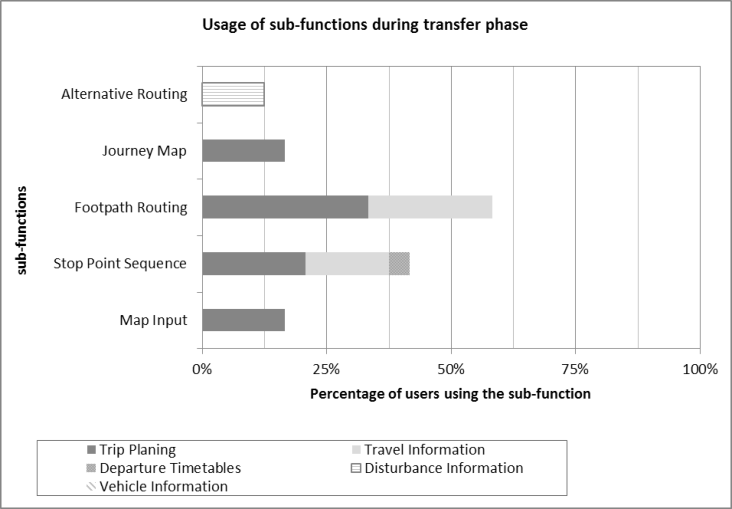
What can I do if a disturbance is occurring now? Transfer Phase During the transfer between city-rail and bus, diverse usage behavior and strategies of the test users could be observed. Many test users managed the transfer without information from the application, e.g. by reading signs and other local information. Sometimes this resulted in detours and missed vehicles. Fifty percent of the test users managed a fast and straight transfer, resulting from prior knowledge about the station and information they obtained from the application. The built-in footpath routing was the top sub-function as shown in figure 4.
Figure 4. Usage of sub-functions during transfer phase.
In regard to the design of mobile information systems, the evaluation shows, that within the transfer phase, the actions of the users and the use of different functions is driven by three questions:
Which direction do I have to go to (after leaving a vehicle)?
How much time do I have until my next vehicle will leave?
Where exactly will the vehicle be stopping?
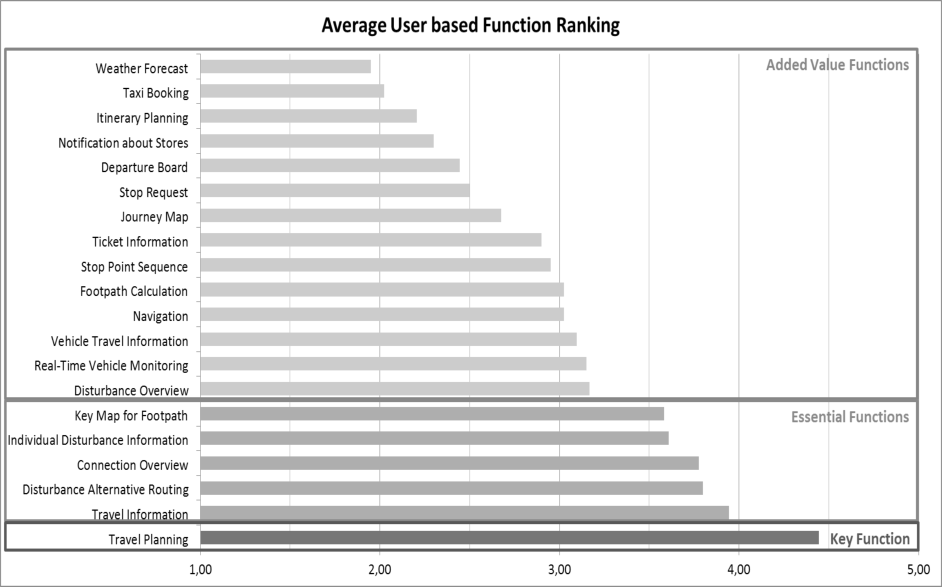
Rating of Functions In addition to the actual usage of the functions integrated into the test application, the functionality rating provided insight into the importance of different functions for journey. Clearly indicating that trip planning is a key function for mobile passenger information systems and necessary for other functions as well. Figure 5 shows the results of the users’ average function rating. Within the essential functions, disturbance information is rated as very important by the users. A high individuality of disturbance information and alternative routing is preferred over an overview of all disturbance information. Travel information and its sub-function, which provide information on the trip, e.g. real- time information, are considered important as well. The stop point sequence is not within the first half of the twenty functions, but considering the high usage within the field test, as described earlier, this function can serve as an anchor within the travel information.
Figure 5. Average user based function ranking
Within the added value functions, weather forecast is seen as least important information, especially for short distance trips in cities. Most of the test persons within the field test stated, that they have other application for such information and prefer their mobile passenger information application to focus on good mobility information instead of weather, stores and other local based information. Dynamic departure timetables were mainly used by high frequent users and when test users thought a vehicle may have been missed. The rating clearly indicates, that it is not viewed as essential functionality.
CONCLUSION
The results clearly indicate that a user-oriented mobile passenger information application should continuously provide the necessary information for the journey, depending on the stage of the travel chain. Actual mobile application design provides many different functions that are often not clearly separated and are hard to use in mobile situations. The evaluation shows that this leads to missed information, high cognitive load, while searching for information, and mistrust towards the application and provided information.
Different functionalities have to be integrated into one basic setup and into a design which represents the information and detail level, dependent on the stage of the journey and the individual user. The differentiation into essential functions to fulfill the information needs and functions for the creation of added value, is the basis for the development of smart passenger information applications. While the dynamic stop point sequence was not rated as essential function by the users, the results of the field test show, that this function can serves as center for additional and stage specific information.
ACKNOWLEDGEMENTS
Part of this work was funded by the German Federal Ministry of Economy and Energy grant number 19P10003L within the IP-KOM-ÖV project. The project develops a communication interface standard for passenger information in German public transport.
REFERENCES
Annet, J. (2005), “Hierarchical Task Analysis (HTA)”, in: Handbook of Human Factors and Ergonomics Method, Stanton, Neville et al. (Ed.). pp. 33-1 – 33-7. Boca Raton, F: CRC Press. Beckmann, K. J., Chlond, B., Kuhnimhof, T., Ruhren, S. von der, Zumkeller, D. (2006), “Mobilität - Everyday users of
multimodal means of transport”, in: Internationales Verkehrswesen. Transport and mobility management 58(4), Deutsche Verkehrswissenschaftliche Gesellschaft (Ed.). pp. 138 – 145. Hamburg, F: DVV Media Group. Endsly, M.R., Jones, G. (2012), “Designing for situation awareness: an approach to user-centered design”, Secon Edition. Boca Raton: CRC Press. Hörold, S., Mayas, C., Krömker, H. (2012), “Identifying the information needs of users in public transport”, in: Advances in
Human Aspects of Road and Rail Transportation, Stanton, Neville (Ed.). pp. 331-340. Boca Raton: CRC Press. Hörold, S., Mayas, C. and Krömker, H. (2013), “Analyzing Varying Environmental Contexts in Public Transport”, in: Human- Computer Interaction. Human-Centred Design Approaches, Methods, Tools, and Environments. Lecture Notes in Computer Science Volume 8004, Kurosu, Masaaki (Ed.). pp. 85-94. Heidelberg: Springer. Hörold, S., Mayas, C., Krömker, H. (2013), “User-oriented development of information systems in public transport”, in:
Contemporary Ergonomics and Human Factors 2013, Anderson, Martin (Ed.). pp. 160-167. Boca Raton: CRC Press. Hörold, S., Mayas, C., Krömker, H. (2014), “Guidelines for Usability Field Tests in the Dynamic Contexts of Public Transport”, 16th International Conference on Human-Computer Interaction, Greece. (accepted) Kjeldskov, J., Skov, M., Als, B., Høegh, R. (2004), “Is It Worth the Hassle? Exploring the Added Value of Evaluating the
Usability of Context-Aware Mobile Systems in the Field”, in: Mobile Human-Computer Interaction - MobileHCI 2004. Lecture Notes in Computer Science Volume 3160, Brewster, Stephen (Ed.). pp. 61-73. Heidelberg: Springer. Krannich, D. (2010), “Mobile System Design – Herausforderungen, Anforderungen und Lösungsansätze für Design, Implementierung und Usability-Testing Mobiler Systeme“. Norderstedt: Books on Demand GmbH. Mayas, C., Hörold, S., Krömker, H. (2012), “Meeting the Challenges of Individual Passenger Information with Personas”, in:
Advances in Human Aspects of Road and Rail Transportation, Stanton, Neville (Ed.). pp. 882-831. Boca Raton: CRC Press. Nielsen, C. M., Overgaard, M., Pedersen, M. B., Stage, J., Stenild, S. (2006), “It's worth the hassle!: the added value of evaluating the usability of mobile systems in the field”, in: Proceedings of the 4th Nordic conference on Human-computer interaction: changing roles, NordiCHI '06. Sun, X., May, A. (2013), “A Comparison of Field-Based and Lab-Based Experiments to Evaluate User Experience of
Personalised Mobile Devices”, in: Advances in Human-Computer Interaction, vol. 2013, Article ID 619767. doi:10.1155/2013/619767 VDV - Association of German Transport Companies (2001), “Telematics in Public Transport in Germany”, Düsseldorf: Alba Fachverlag Wienken, T., Mayas, C., Hörold, S. (2014), “Model of mobility oriented agenda planning”, 16th International Conference on
Human-Computer Interaction, Greece. (accepted) Wirtz, S., Jakobs, E.-M., (2013), “Improving User Experience for Passenger Information Systems. Prototypes and Reference Objects”, in: IEEE Transactions on Professional Communication, vol.56, no.2. pp. 120-137. doi: 10.1109/TPC.2013.2257211
LISTED IN THE AHFE DIGITAL BOOKSTORE CATALOGUE
Explore the complete digital volume
Advances in Human Aspects of Transportation: Part III
Read this individual research paper free through the original publisher, or explore the full digital proceedings book.
ISBN 978-1-4951-2099-2
Explore this ISBN in the AHFE Bookstore ↗Listed in the July 2026 bookstore catalogue; search by ISBN to confirm current availability · Digital book purchase optional