Cindy Mayas, Stephan Hörold, Tobias Wienken, Heidi Krömker (2022). One Day in the Life of a Persona – A Framework to Define Mobility Agendas. In: Advances in Human Aspects of Transportation: Part III. AHFE Open Access, vol. 17. https://doi.org/10.54941/ahfe100738
This paper extends the approach of personas in public transport with a framework to define different mobility agendas. These mobility agendas aim to support the development of mobility information systems and mobile applications, in general, by strengthening the understanding of different mobility behaviors in combination with the advantages of personas. The presented results are based on a representative broad dataset and the analysis of agenda items in daily life. The described approach consists of three steps, which provide the necessary variables and values, as well as patterns to describe mobility agendas.
Nowadays, mobility becomes a more and more important aspect in the structure of daily routines (Wirtz and Jakobs, 2013). Mobility interrelates agenda items, which describe different tasks of a day and are related to a place, time, and several resources, for instance working, going shopping, seeing a doctor, or taking part in public life. Mobility does not only mean traveling from A to B, but also is a part of our life, representing flexibility, participation, viability, and quality of living (Goddard, 2013).
Up to the present day, personas, which are archetypes constructed from the characteristics and behavior of real people (Cooper, 1999), consider mobility often as isolated single trips, such as personas for public transport (Mayas et al. 2012a). In addition, it is necessary to consider the mobility agenda of entire days within a week or year, in order to derive requirements for prospective systems. The trend of system development shows, that systems become more complex and adaptive, requiring more differentiated input data with semantic linking. Mobility also becomes more and more flexible, due to the growing variety of transport possibilities and combinations, e.g. car sharing and ride sharing, and the growing flexibility of planning and communication services.
These developments require a more holistic approach of mobility analysis, which also has to include further elements and restrictions in reference to the journey, e.g. the flexibility of time and place of agenda items, which influence the planning and traveling process of a journey. This paper classifies the criteria of mobility items and develops a framework to facilitate the definition process of mobility agendas for personas. The revealed mobility agendas, which are based on the purpose of mobility, instead of the used means of transport, also support conclusions about prospective user requirements on more flexible and intermodal mobility, which include different means of transport.
Mobility Agenda Typically, a daily agenda covers appointments and tasks, e.g. meetings, leisure time activities or shopping, and defines how a day will be structured and when it is needed to change locations or remember certain tasks (Wienken et al., 2014). With the exception of long journeys, e.g. holidays or business trips, the mobility part of these agendas is not planned as detailed as the appointments and tasks, which are usually remembered or noted differently by the user. In a modern society, where the need and wish for mobility increases (Zierer and Zierer, 2010) and new means of transportation allow for intermodal and multimodal mobility behavior (Beckmann et al., 2006), the mobility part becomes more important when analyzing daily routines and agendas. Soon new applications and systems will arise to support intermodal mobility planning, dynamic agenda planning, as well as location-based services, which provide information for different tasks, e.g. buying bread. Therefore, and in regard to a user-centered development and the fulfillment of user needs, a more detailed look at mobility agendas is needed.
A strong similarity between agenda planning elements and mobility planning elements enables a combined approach (Wienken et al., 2014), to define mobility agendas. A mobility agenda typically consists of the agenda items and means of transportation used, as well as the influencing factors for the selection of different means of transportation. Agenda items are defined by the purpose, which initiates an appointment or task, the date and time as well as the location. While an appointment is considered as not flexible with respect to date, time and location, a task, respectively to-do, can be considered flexible at least for one of the factors date, time or location (Wienken et al., 2014). Means of transportation can differ widely, including walking, public transport, riding a bicycle or driving a car as well as car and bike sharing concepts. The reason as to why someone changes differing means of transportation provides insight into mobility behavior and the differentiation of the mobility agenda.
Therefore, the definition of mobility agendas requires knowledge about user group specific agenda items, especially the purpose, means of transportation used and influencing factors.
DEFINING STEREOTYPE MOBILITY AGENDAS
Method
The challenge of the definition process of mobility agendas is the diversity of aspects and characteristic attributes. There is a wide variety of detailed mobility agendas for each person. Even if key agenda elements seem to be similar, the mobility agendas might change slightly from day to day, or from person to person, e.g. regarding times and durations, detailed purpose of mobility, and means of transport.
In order to manage this specific variety of aspects, the definition process of mobility agendas is conducted in reference to the persona definition process of Cooper (Cooper et al., 2007) and Pruitt (Pruitt and Adlin, 2006). Personas are an established method, which integrates qualitative and quantitative data, in order to support the involvement of user requirements in the development process. The developed personas are fictitious stereotype users (Cooper, 1999), which are devised from the characteristics and behavior of real people. The stereotypical character of personas is distinguished by concentrating on specific aspects and dropping redundant and unessential information. Due to the vivid, precise, and illustrated descriptions, personas encourage empathizing effects for the development team members.
These advantages of personas can be transferred to mobility agendas, which enable a more complex differentiation of user profiles and personas. The development procedures of personas differ slightly from author to author (Cooper et al., 2007), (Pruitt and Adlin, 2006), (Baumann, 2010), but in general, all procedures consist of the three key stages ‘identify variables and values’, ‘identify patterns’ and ‘describe personas’ (Mayas et al. 2012a), which are shown in figure 1.
Figure 1. Generalized procedure model to construct personas (Mayas et al. 2012)
Figure available in the original PDF paper.
This procedure model of personas is adapted to the development of mobility agendas (see figure 2). As a first step, the variables and values of mobility items are identified. The classification is based on a secondary analysis of the “Mobilität in Deutschland 2008 (MID)” research study (Follmer et al., 2010), which includes a nationwide dataset of over 25.000 mobility diaries in Germany and allows conclusions about the mobility behavior.
Secondly, typical patterns of values of the mobility items are identified in focus groups and joined to typical mobility agendas. As a result, a framework of typical characteristics and combinations of mobility items is derived.
Finally, stereotype mobility agendas are described and combined with personas for public transport (Mayas et al., 2012a), (Mayas et al., 2012b). The extension of personas or user profiles with stereotype mobility agendas for their daily routine enables the elicitation of more detailed requirements for the further development of intermodal adaptive systems.
Figure 2. Adapted procedure model to develop mobility agendas
Figure available in the original PDF paper.
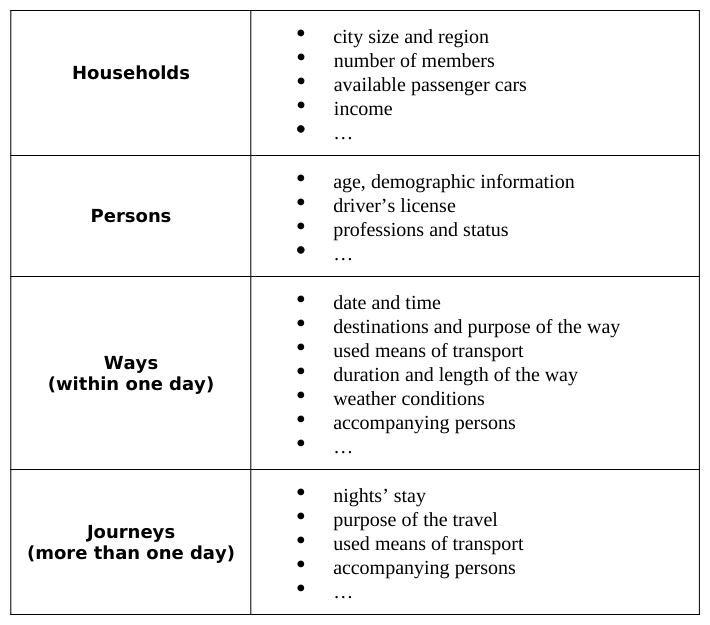
Identify Variables and Values In a representative nationwide study (Follmer et al., 2010) involving more than 25.000 households data regarding 193.000 ways travelled are collected. The dataset includes four categories of information: households, persons, ways, and journeys. Exemplary variables of the categories are shown in table 1. The analysis differentiates between ways, which are conducted intra-daily and usually start or end at home, at the beginning or the end of the day, and journeys, which last at least two days or more. The following analysis especially focuses on dependencies between the personal data and the data of ways within a day.
The secondary data analysis of the dataset examined the dependencies of different variables in reference to the choice of means of transport. The most important values, which influence the chosen means of transport, are shown below.
Personal profile: The personal profile includes information about demographic data, information about the familiar situation, available vehicles, driver’s license, phase of life, and profession status.
Purpose of the way: In most cases, mobility is just a means to an end. This purpose can be categorized in different groups, e.g. go to work, business, trips, go to school, shopping, private transactions, free time activity, way home. These purposes can be distinguished in appointments with a specific time and location and tasks with flexible times and or locations.
Length of the way
Date and time
Conditions: Each way can be influenced by further conditions, e.g. weather and accompanying persons.
Table 1. Categories and excerpt of exemplary variables (Follmer et al., 2010)
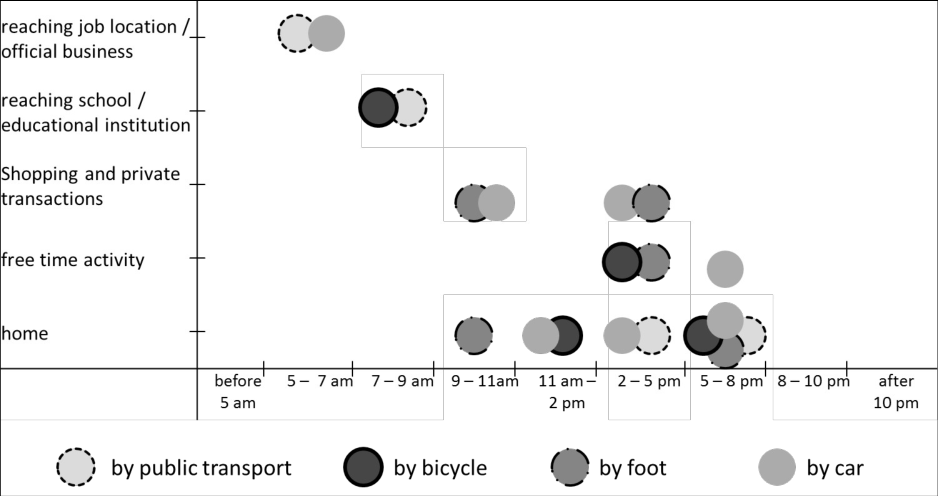
Identify Mobility Patterns Based on the identified key variables for mobility items, typical mobility clusters are identified. In reference to the most relevant variables “date and time” and “purpose of the way”, the typical means of transport, length of the way, and the way conditions of the most common ways are analyzed. The most frequent combinations of variable values result in the mobility patterns.
Figure 3 shows an extract of the analyzed mobility pattern, which is reduced to four means of transport: by foot, by bicycle, by public transport, and by car (driver). In addition, also other means of transport, e.g. by car (car passenger) or by plane, and combinations of different means of transport for intermodal ways are analyzed, but actually revealed to be less relevant.
The revealed mobility patterns show, that different means of transport are used for the same purpose at the same time of the day. The used means of transport are more dependent on personal factors and the length of the way. As a consequence, the identified typical mobility items are also discussed in focus groups with participants from different mobility profiles and matched to typical daily agendas.
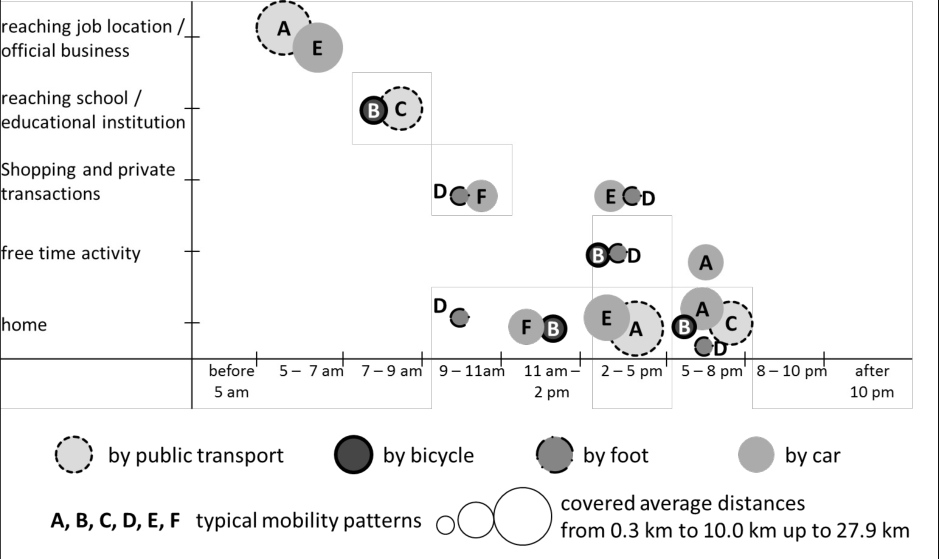
Based on these results of the mobility patterns and additional qualitative research, the mobility agendas are deduced. As a result, the mobility patterns of single ways are combined to stereotype mobility agendas of a whole day, including several ways, partly with different means of transport and conditions. Figure 4 shows the six derived typical mobility agendas regarding time, purpose, means of transport, and distances of the ways. Typically, a mobility agenda consists of one main purpose a day, e.g. go to work or to educational institution with a defined time and location, and the way back home. In addition, some agendas include more flexible tasks, e.g. shopping or free time activities, which could be reached with other means of transport than the main travel purpose and differ more within a day. Actually, most mobility agendas focus on one means of transport.
Figure 3. Most typical single ways in daily lifeFigure 4. Mobility patterns
Describe Mobility Agendas
Based on the additional qualitative data, the mobility agendas are enriched in reference to existing mobility personas (Mayas et al., 2012a), in order to achieve a holistic view and to encourage more empathy. Typical elements of the persona description, e.g. a name, demographic data, and characteristics, are adapted to the appropriate mobility agenda. As a result, each mobility agenda consists of the following parts:
a meaningful name with additional terms related to the key behavior
an overview of personal information
an illustration
a mobility description of a typical day
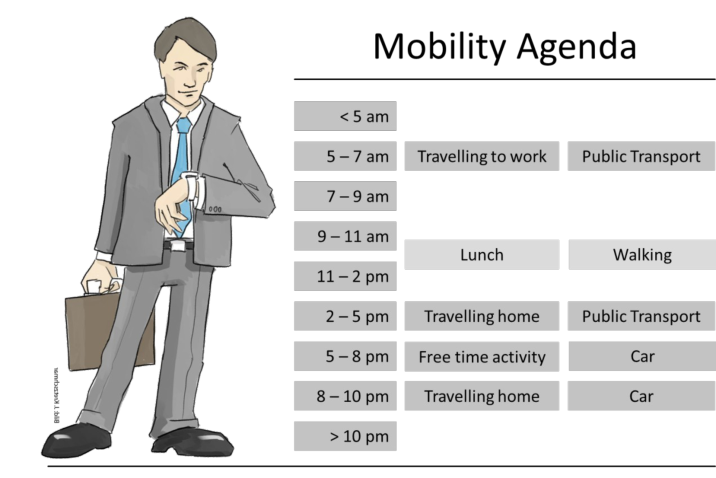
a summarizing mobility agenda overview An example of the mobility agenda description is presented in figure 5.
Michael Baumann - Public Transport Commuter … 34 years old and single. … likes biking and gliding. … lives in Stuttgart. … is punctual, ecology-minded … is corporate consultant. and technophile.
Agenda
Figure 5. Mobility Agenda of a persona
DISCUSSION
The identification of the influencing variables for mobility agendas is based on the MID dataset. The data was collected in 2008; as a consequence, the analyzed data is over 5 years old, today. Due to the fact that the changes of mobility behavior are only concomitant with changes of the phases of life (Generali Zukunftsfonds et al., 2012), mobility behavior changes very slowly in a society. Thus, the analysis of the dataset can still represent actual trends.
In contrast, the past five years are characterized by a fast growing velocity of communication technologies and, as a consequence thereof, the planning process of mobility becomes more and more flexible und intermodal. These trends will advance in the following ten years. Due to new technologies, fulfilling the information needs (Hörold et al., 2012) will become easier but more complex, in regard to individual and flexible mobility behavior. The process is still not concluded regarding how new mobility offers will change mobility behavior and how traditional mobility providers will adapt their offerings, but it may result in a more ecological mobility behavior, after all.
Therefore, the framework of mobility agendas should be revised with new datasets, in order to compare the results and analyze shifts within typical mobility agendas. An update of the MID dataset is already planned for 2015 (Follmer, 2014) and may provide further insight into intermodal and multimodal mobility behavior and changes due to new communication technologies and new mobility offerings.
In addition, mobility aspects become more important for different areas of software. Nowadays, software is not only used at a specified office or home computer, but on the way or at different locations, with laptops, tablets and smartphones. In this way, mobility not only concerns mobility providers and developers of mobility information systems, but all kinds of developments for mobile software. Especially for the continuous development of adaptive systems, the results enable the initiation of optimization processes. The application of the results in the current research project “Dynapsys”, which develops an agenda planning system for individual task and mobility planning from “door to door”, should reveal more insight into the applicability of mobility agendas in practice.
CONCLUSION
The results show that mobility agendas provide essential insights into the mobility behavior, especially why and how mobility is shaped by external influences, and in which manner mobility influences daily life. The integration of mobility agendas into personas might result in the derivation of requirements, focusing on the whole mobility process. In addition, mobility agendas provide another perspective into the context of use. Combined with personas, task analysis and analysis of the environmental context (Hörold et al., 2013), mobility agendas provide a wider understanding of reasons and purposes for the use of different mobility offers and information needs over a longer period of time. This understanding may enable developers to think of more dynamic and adaptive systems, which include functionality for different mobility offers, without forcing the user to search for the needed information within a wide range of different functions, but provide information when it is really needed.
Considering intermodal and multimodal mobility behavior, and how and why users choose different means of transport, the individual combinations take on greater significance, in the future. Even if this kind of mobility behavior is not prevalent at the moment, the described approach allows a first insight and the creation of a basis for further studies and comparison, as mobility behavior is changing. In the area of mobility information systems design, these new mobility behaviors are already considered within the development process, but often are based on assumptions. A persona based approach, as shown in this paper, enables development teams to imagine different mobility behaviors for different users, based on actual usage and typical daily agendas, pointing out possible alternative mobility choices.
ACKNOWLEDGEMENTS
Part of this work was funded by the German Federal Ministry of Economy and Energy grant number 19P10003L and 19P12013B within the IP-KOM-ÖV und Dynapsys project. The IP-KOM-ÖV project develops a communication interface standard for passenger information in German public transport. The Dynapsys project develops an agenda planning system for individual task and mobility planning from “door to door”.
REFERENCES
Baumann, K. (2010), “Personas as a user-centred design method for mobility related service”, in: Information Design Journal 18(2). pp 157-167. Beckmann, K. J., Chlond, B., Kuhnimhof, T., Ruhren, S. von der, Zumkeller, D. (2006), “Mobilität - Everyday users of
multimodal means of transport”, in: Internationales Verkehrswesen. Transport and mobility management 58(4), Deutsche Verkehrswissenschaftliche Gesellschaft (Ed.). pp. 138 – 145. Hamburg, F: DVV Media Group. Cooper, A., (1999), “The inmates are running the asylum. Why High-Tech Poducs Drive Us Crazy and How to Restore the Sanity”. New York: Macmillan. Cooper, A., Reimann, R., Cronin D. (2007), “About face 3: the essentials of interaction design”. Indianapolis. Ind.: Wiley. Follmer, R., Gruschwitz, D., Jesske, B., Quandt, S., Lenz, B., Nobis, C., Köhler, K., Mehlin, M. (2010), “Mobilität in
Deutschland 2008: Ergebnisbericht”. Mobility in Germany Website: http://www.mobilitaet-in-deutschland.de Follmer, R. (2014), “Mobility in Germany 2008”. Mobility in Germany Website: http://www.mobilitaet-in-deutschland.de/engl %202008/index.htm Generali Zukunftsfonds, Institut für Demoskopie Allensbach (eds.) (2012), “Generali Altersstudie 2013: „Wie ältere Menschen
leben, denken und sich engagieren”. Frankfurt: Fischer Taschenbuch Verlag. Goddard, S. (2013), “What kind of city do you want?” in: Praxisforum Verkehrsforschung 2013, presentation. The INFAS- Website: http://www.infas.de/themen/ praxisforum [13.11.2013] Hörold, S., Mayas, C., Krömker, H. (2012), “Identifying the information needs of users in public transport”, in: Advances in
Human Aspects of Road and Rail Transportation, Stanton, Neville (Ed.). pp. 331-340. Boca Raton: CRC Press. Hörold, S., Mayas, C., Krömker, H. (2013), “User-oriented development of information systems in public transport”, in: Contemporary Ergonomics and Human Factors 2013, Anderson, Martin (Ed.). pp. 160-167. Boca Raton: CRC Press. Mayas, C., Hörold, S., Krömker, H. (2012a), “Meeting the Challenges of Individual Passenger Information with Personas”, in:
Advances in Human Aspects of Road and Rail Transportation, Stanton, Neville (Ed.). pp. 882-831. Boca Raton: CRC Press. Mayas, C., Hörold, S., Krömker, H. (eds.) (2012b), “Das Begleitheft für den Entwicklungsprozes -. Personas, Szenarios und Anwendungsfälle aus AK2 und AK3 des Projektes IP-KOM-ÖV”. The Website of “Digitale Bibliothek Thüringen”: http://www.db-thueringen.de/ urn:nbn:de:gbv:ilm1-2012200028 Pruitt, J., Adlin, T. (2006),” The persona lifecycle: keeping people in mind throughout product design”. Amsterdam: Elsevier. Wienken, T., Mayas, C., Hörold, S. (2014), “Model of mobility oriented agenda planning”, 16th International Conference on
Human-Computer Interaction, Krakow: Poland. (accepted) Wirtz, S., Jakobs, E.-M. (2013), “Improving User Experience for Passenger Information Systems. Prototypes and Reference Objects”. in: IEEE Transactions on Professional Communication, Volume 56, Issue.2, pp.120-137 Zierer, M. H., Zierer, K., (2010): “Zur Zukunft der Mobilität: eine multiperspektivische Analyse des Verkehrs zu Beginn des 21.
Jahrhunderts”. Wiesbaden: VS, Verl. für Sozialwiss.
LISTED IN THE AHFE DIGITAL BOOKSTORE CATALOGUE
Explore the complete digital volume
Advances in Human Aspects of Transportation: Part III
Read this individual research paper free through the original publisher, or explore the full digital proceedings book.
ISBN 978-1-4951-2099-2
Explore this ISBN in the AHFE Bookstore ↗Listed in the July 2026 bookstore catalogue; search by ISBN to confirm current availability · Digital book purchase optional