Marcelo Sagot Better, Agata Gawlak, Agnieszka Ptak-wojciechowska, Dariusz Brzeziński (2025). The influence of Non-park urban greenery on the pedestrian mobility of seniors: A methodological framework for the analysis of affective states. In: Affective and Pleasurable Design. AHFE Open Access, vol. 164, pp. 191–198. https://doi.org/10.54941/ahfe1006075
The project aims to investigate specific physiological and cognitive aspects of Non-Park Urban Greenery (NPUG) and its effects on the pedestrian mobility of seniors. The interdisciplinary empirical work combines physiological data collection, self-reported emotional evaluations and, age-simulation technology. From a theoretical standpoint, the measuring of affective states was developed by answering a neuro-physiological declarative assessment based on voluntary re-orientation of attention . As part of the proposed framework, a self-evaluating matrix was developed in a mobile application to guide individuals to identify and register insights on their interior states of emotion. The app is a 2-dimensional digital matrix, adapted from the Russell grid for Affective States. The ‘bingo grid’ was exchanged for a more intuitive color grid with 8 regions arguing that it will guide seniors to easily evaluate affect: considering at the same time both the intensity (arousal) and the pleasantness (valence). The affective responses were recorded at specific points of a predefined pedestrian route in the campus of the university. The original hypothesis considered that a point within the regions could describe more accurately the affective state of the experience, while the app codes the numerical values. Real-time responses are from participants navigating a predefined route. Consequently, the paper provides the results of the experiment while outlining the preliminary guidelines to apply the methodological framework in the analysis of other green spaces. This novel approach that integrates technology with human-centered research aims to enhance our understanding of NPUG and its correlation to wellbeing.
The focus of environmental psychology is to explore the relationship between human beings and our surroundings. Its role is an increasingly relevant field of research when considering current societal challenges like climate change, resource depletion and urban migration. More importantly, it considers how we shape our natural and built environments – and how those environments shape us in turn (Diaz, 2022). By extension, both the natural and built environment influence how we as individuals feel and behave. Understanding human responses to both environmental conditions is not only key to designing spaces that improve mental health but also to sustain their impact and foster healthier cities. The following paper aims to contribute to our understanding of this phenomenon. By integrating insights from urban planning and computer sciences, it aims to create an empirical methodological framework and develop a novel means to analyse the reciprocal interactions between people and their surroundings.
In Antonovsky’s salutogenic theory, maintaining and promoting health is part of a dynamic interplay between individual resources and the environment (1993). The Sense of Coherence (SOC) in his theory is put forward to describe a person’s continuous state of improvement and to effectively maintain good mental health (Lindström & Eriksson, 2010). One specific way to strengthen the SOC is both provided by or mediated through the surrounding environment, namely the availability of green areas that people associate to healthy living and social inclusion (Felix et al., 2015; Stephens et al., 2015; Yu et al., 2019). With extensive research developed on city parks, communal allotments and therapeutics gardens; increasing attention is now being directed towards the planning of Non-Park Urban Greenery (NPUG). This concept includes those green elements we encounter daily while walking on sidewalks, crossing vacant plots, or simply passing in front of residential gardens, post-industrial sites or river wetlands. While this type of urban greenery is often overlooked in assessments of accessibility (Sikorska et al., 2020), it actually plays a crucial role in addressing inequities as NPUG is more evenly distributed in cities and more frequently encountered during daily commutes (Sikorski et al., 2021). This paper deals with the design of a methodological framework to precisely address wider research projects on NPUG.
METHODOLOGICAL DESIGN It has been stablished that the exposure to green ecosystems positively influences cognitive well-being. Consequently, the research hypothesis asserts that the planning of urban areas with more spontaneous and consistent interactions with NPUG will supplementarily foster these benefits. In other words, letting non park green areas in cities become wider and wilder will bring more cognitive benefits to the people in regular contact with these spaces.
This effort is part of a larger objective that addresses the shift in methodological perspectives towards NPUG (Sikorski et al., 2021; Ke et al., 2023). A shift that requires advancements towards more technical means
The Influence of Non-Park Urban Greenery on the Pedestrian Mobility of Seniors 193
of analysis in order to deal with larger data and simulate real-time changes in our cities. This scope is particularly relevant when considering that the objective of the project is twofold: understanding how green entropy relates to mental wellbeing, and to what extent design could mediate this nexus.
The following section address the empirical considerations to collect and analyse data from people in contact with NPUG. It is worth mentioning that an additional stage of the methodology will address the remaining part of the objective above, by adopting a complementary approach that leverages GPS data with cloud-point modelling to determine the types and location of NPUG sites in the city of Poznan.
NPUG AND GREEN AFFECT DATA The first part of this double methodological framework focuses on examining the physiological and cognitive effects of NPUG on psychological and emotional states of pedestrians in contact with these elements. As part of this problem area, the design of the empirical analysis combines methods for the collection of physiological and psychological data, in order to extrapolate results from quantitative and qualitative sets. The two key methodological questions at this stage are: 1) How to measure physiological variations when individuals navigate urban green settings? and 2) How to collect data on the emotional and perceptual effects greenery has on individuals?
Greenery has the capacity to reduce stress levels by influencing affective states and physiological arousal (Ulrich et al., 1991). For instance, the innate tendency to respond positively to nature should potentially trigger a spontaneous state of fascination that would lead people to more positive perceptions of their environment (Kaplan, 1992; Berto, 2014; Berto et al., 2014). Nonetheless, it is necessary to determine if NPUG could offer a similar input in which mental fatigue, attentional effort and cognitive loads are reduced through sporadic exposure to green elements in our cities.
These restorative benefits have physiological-affective and psychological- cognitive components that can be objectively tracked and measured by adopting a mixed-methods approach. The methodology integrates physiological monitoring and self-reported assessments to congruently measure the mental and physical load experienced by the participants of the experiment.
For the physiological-affective monitoring, the first chosen method for data collection is a wearable tracking device. The SAMSUNG Galaxy Smartwatch FE SM-R861 is used to collect objective the real-time physiological data from the participants. The device records the necessary photoplethysmography data: body temperature (BT), heart rate (HR) and number of steps. In the absence of cables, it offers free movement and accurate measurements of cardiac responses that facilitates the preparation and execution of the experiment.
Regarding the data, the recording happens at peak intervals and gathered at specific evaluation points on a designated self-guided pedestrian route. All signal processing steps are collected using a software package.
The evaluation psychological-cognitive states takes place alongside the collection of the physiological data. The selected tool for this stage of the experiment is a proprietary neuro-physiological declarative assessment. A self-evaluating matrix has been designed for this purpose, aiming to guide individuals to identify and register insights on their interior states of emotion. Accordingly, it is based on two theoretical models: A) voluntary re-orientation of attention that focuses on affective responses at specific points of a predefined pedestrian route (Barrett & Bliss-Moreau, 2009); and B) the Perceived Restorative Scale implemented through an environmental questionnaire used to measure the perceived restoration capacity of landscapes (Korpela & Hartig, 1996; Berto 2005). The psychological responses to the environment can be allocated in four categories:
Table 1: Index of NPUG measurement equivalents for the study (Sagot-Better, 2024).
Table available in the original PDF paper.
Separation NPUG that disconnects users from environmental demands and supports relaxation Fascination NPUG that enables users to discover and be curious about
perceived elements. Extent NPUG that orders and organizes activities and items to be recognizable. Compatibility NPUG that enhances use and freedom of choice
How people perceive NPUG affects street desirability, cognitive comfort and even the perception of safety. As part of the methodology, it was necessary to assign values to each of these four categories in the index. Two measurable parameters have been selected in relation to the affective states (Russel, 1989; Brossard & Delevoye-Turrell, 2022): arousal (physiological levels of activation) and valence (perceived quality of a stimulus). The Pleasure-Arousal is a psychological model used to describe and measure emotional states according by assigning numerical values to these two dimensions. In cognitive psychology, valence is mainly quantified through self-declared questionnaires, whereas arousal can be assessed objectively through the measurement of heart rate (Wang et al., 2018). The combination of declarative and objective measurements is recommended today in the affective field of sciences for a better description of changes in users’ affective states (Kondo et al., 2018).
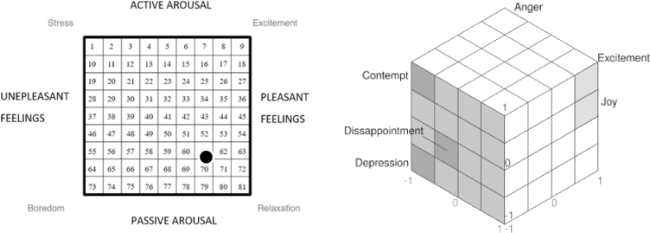
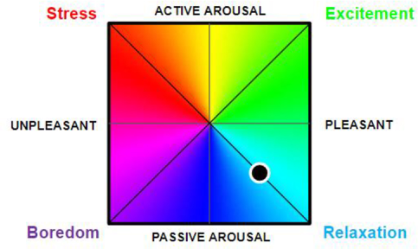
The affective experiences are collected with a mobile application based on the Affect Table (Figure 1). However, the app is a simplified version of the two-dimensional matrix created by Mehrabian, Russell, (1974). The 9-by-9 bingo table is exchanged for a colour grid with 8 regions that guides users to easily evaluate affect: considering at the same time both the intensity (arousal) and the pleasantness (valence).
By pressing the point within the region that better describes their affective state, the program assigns a numerical value that gives a quantitative representation of the experience at a given moment in time during the walk in NPUG settings.
The Influence of Non-Park Urban Greenery on the Pedestrian Mobility of Seniors 195
Figure 1: Affect two-dimensional and three-dimensional numerical evaluation scale (Mehrabian & Russell, 1974).Figure 2: Adapted feeing and affect matrix to evaluate arousal and appraisal (adapted from Russell, 1974).
EXPECTED RESULTS AND KEY FINDINGS Urban environments are constantly evolving to accommodate the needs of growing populations. One critical aspect of urban planning is the integration of natural elements within cityscapes, often referred to as Nature-Integrated Public Urban Greenery (NPUG). Research suggests that the inclusion of NPUG elements in urban settings has profound effects on individuals’ psychological and physiological well-being. By examining emotional responses, physiological variations, mobility and perception differences, and urban design implications, we can better understand the significance of green spaces in modern cities.
A key benefit of NPUG is its positive impact on emotional well-being. Studies indicate that individuals exposed to green urban environments experience higher levels of positive affective states compared to those in non-green urban settings. This suggests that greenery has the potential to elevate mood, reduce feelings of anxiety, and contribute to an overall sense of happiness and relaxation. The presence of trees, plants, and water features in urban landscapes creates a soothing atmosphere that fosters emotional resilience.
Beyond emotional well-being, NPUG influences physiological responses. Variations in heart rate and electrodermal activity among individuals exposed to natural elements indicate relaxation and stress mitigation. Green spaces
have been shown to reduce physiological markers of stress, leading to lower cortisol levels and improved cardiovascular health. The calming effect of nature can be attributed to its ability to reduce sensory overload and promote mental restoration, ultimately contributing to overall physical health.
Another critical aspect of NPUG is its influence on perception and mobility. Individuals navigating through green urban environments demonstrate enhanced spatial awareness and a greater sense of ease compared to those in non-green settings. Greenery not only improves cognitive mapping and navigation but also promotes social interactions and community engagement. Accessible green spaces encourage movement, provide safe pathways, and create inclusive environments that cater to diverse populations, reinforcing their importance in urban planning. The findings from studies on NPUG elements offer valuable insights for urban design strategies. By emphasizing the psychological and physiological benefits of greenery, city planners can develop more sustainable and human-centered environments. The integration of parks, tree-lined streets, and green rooftops in urban areas can enhance residents’ quality of life, reduce urban heat islands, and improve air quality. Prioritizing NPUG in city planning ensures that urban spaces remain not only functional but also conducive to human health and well-being.
CONCLUSION
In conclusion, the integration of NPUG elements in urban environments has significant psychological and physiological benefits. From promoting emotional well-being and reducing stress to enhancing mobility and informing better urban planning, the presence of greenery in cities is essential for creating healthier, more liveable spaces. As cities continue to expand, prioritizing green infrastructure will be crucial in fostering sustainable and thriving urban communities.
The research is crucial as it advances the understanding of urban greenery’s role in promoting well-being, particularly for aging populations. The project builds upon previous studies on affective states and physiological responses by integrating with wearable technology and affective evaluation apps that can be applied to further participatory studies.
After the empirical findings, we will move forward to a final stage of design guidelines for NPUG and collect feedback from a first disclosure of findings. Scaling up the methodology is fundamental to achieve more consistent findings that will contribute to urban planning, landscape architecture, and healthcare by offering insights into designing age-friendly environments that foster positive emotional experiences and mobility.
It is fundamental to carry empirical research on urban greenery in order to promote accessibility to a broader variety of spaces that might benefit people. It has been stablished that new methodological approaches are necessary towards planning methods more supportive of the natural environment and hence, the mental well-being of the inhabitants. Overall, the research is one more step towards understanding the nexus between urban greenery and well-being. With 70% of the world’s population projected to live in
The Influence of Non-Park Urban Greenery on the Pedestrian Mobility of Seniors 197
metropolitan areas, green spaces are expected to be central to urban planning efforts in Poland. Consequently, NPUG is set to play a more pivotal role in urban planning hence, gaining heightened importance in academic research.
REFERENCES
Antonovsky, A. (1996). The salutogenic model as a theory to guide health promotion.
Health Promotion International, 11(1), 11–18. Bonenberg W., 2010. Mapy emocjonalne jako metoda diagnozy przestrzeni publicznych na przykładzie miasta Poznania. Czasopismo Techniczne. Architektura 107 (2-A), 33–39. Buttazzoni, A., Parker, A., & Minaker, L. (2021). Investigating the mental health implications of urban environments with neuroscientific methods and mobile technologies: A systematic literature review. Health & Place, 70, 102597. Cooper Marcus, C., & Barnes, M. (1999). Healing gardens: Therapeutic benefits and
design recommendations. Wiley. Cooper Marcus, C. & Sachs, N. (2014). Therapeutic landscapes. An evidence-based approach to designing healing gardens and restorative outdoor spaces. Wiley, New York. Capolongo S, Rebecchi A, Dettori M, Appolloni L, Azara A, Buffoli M, Capasso
L, Casuccio A, Conti Oliveri G, D’Amico A, Ferrante M, Moscato U, Oberti I, Paglione L, Restivo V, D’Alessandro D (2018). Healthy design and urban planning strategies, actions, and policy to achieve salutogenic cities. 15(12):2698. Eriksson, M. & and Lindström, B. (2005). Validity of Antonovsky’s sense of coherence scale: A systematic review. Journal of Epidemiology & Community Health 59.6: 460–466. Hartig, T., Mang, M., & Evans, G. W. (1991). Restorative effects of natural
environment experiences. Environment and Behavior, 23, 3–26. Hartig, T., Kaiser, F. G., & Bowler, P. A. (2001). Psychological restoration in nature as a positive motivation for ecological behavior. Environment and Behavior, 33, 590–607. Hartig, T., Mitchell, R., de Vries, S., et al. (2014). Nature and health. Annu. Rev.
Public Health 35, 207–228. Hartig, T. (2021). Restoration in nature: beyond the conventional narrative. In: Schutte, A. R., Torquati, J., Stevens, J. R. (Eds.): Nature and Psychology: Biological, Cognitive, Developmental, and Social Pathways to Well-being (Proceedings of the 67th Annual Nebraska Symposium on Motivation). Springer Nature, Cham, Switzerland. Hartig, T., Cox, D. T., et al. (2021). Pathways linking biodiversity to human health:
a conceptual framework. Environ. Int. 150, 106420. Jabbar, M., Yusoff, M. M., & Shafie, A. (2021). Assessing the role of urban green spaces for human well-being: A systematic review. GeoJournal, 1–19. Kaplan, S. (1995). The restorative benefits of nature: Toward an integrative
framework. Journal of Environmental Psychology, 15(3), 169–182. Ke, X., Huang, D., Zhou, T., & Men, H. (2023). Contribution of non-park green space to the equity of urban green space accessibility. Ecological Indicators, 146, 109855. Lindström, B., & Eriksson, M. (2010). The hitchhiker’s guide to salutogenesis:
Salutogenic pathways to health promotion. Folkhälsan Research Center. Markevych, I., Schoierer, J., Hartig, T., et al. (2017). Exploring pathways linking greenspace to health: Theoretical and methodological guidance. Environ. Res. 158, 301–317.
Marselle, M. R., Hartig, T., Cox, D. T., De Bell, S., Knapp, S., Lindley, S.,... & Bonn, A. (2021). Pathways linking biodiversity to human health: A conceptual framework. Environment International, 150, 106420. Meier Magistretti, C. (2022). The Sense of Coherence in the Life Course. In:
Mittelmark, M. B., Eriksson, M. et al. (ed.) The handbook of salutogenesis. Cham (CH): Springer. Mensah, C. A., Andres, L., Perera, U., & Roji, A. (2016). Enhancing quality of life through the lens of green spaces: A systematic review approach. International Journal of Wellbeing, 6(1). Mittelmark, M. B., & Bull, T. (2013). The salutogenic model of health in health
promotion research. Global Health Promotion 20(2):30–38 Sikorska, D., Łaszkiewicz, E., Krauze, K., & Sikorski, P. (2020). The role of informal green spaces in reducing inequalities in urban green space availability to children and seniors. Environmental science & policy, 108, 144–154. Sikorski, P., Gawryszewska, B., Sikorska, D., Chorma´nski, J., Schwerk, A.,
Jojczyk, A.,... & Łaszkiewicz, E. (2021). The value of doing nothing—How informal green spaces can provide comparable ecosystem services to cultivated urban parks. Ecosystem services, 50, 101339. Stephens, C., Breheny, M., & Mansvelt, J. (2015). Healthy ageing from the perspective of older people: A capability approach to resilience. Psychology and Health, 30(6), 715–731. Wolch, J. R., Byrne, J., & Newell, J. P. (2014). Urban green space, public health,
and environmental justice: The challenge of making cities ‘just green enough’. Landscape and urban planning, 125, 234–244. Yu, R., Wong, M., & Woo, J. (2019). Perceptions of neighborhood environment, sense of community, and self-rated health: An age-friendly city project in Hong Kong. Journal of Urban Health, 96, 276–288. Von Lindern, E., Lymeus, F., & Harting, T. (2016). The restorative environment: a
complementary concept for salutogenesis studies. In: Mittelmark, M. B., Eriksson, M. et al (ed.) The handbook of salutogenesis. Cham (CH): Springer. Vaandrager, L., & Kennedy, L. (2022). The application of salutogenesis in communities and neighborhoods. In: Mittelmark, M. B., Eriksson, M. et al (ed.) The handbook of salutogenesis. Cham (CH): Springer. Vaandrager, L. (2022). Salutogenesis Theory and Methods: Developments, Innovations and Next Steps. In: Mittelmark, M. B., Eriksson, M. et al. (ed.) The handbook of salutogenesis. Cham (CH): Springer.
LISTED IN THE AHFE DIGITAL BOOKSTORE CATALOGUE
Explore the complete digital volume
Affective and Pleasurable Design
Read this individual research paper free through the original publisher, or explore the full digital proceedings book.
ISBN 978-1-964867-40-3
Explore this ISBN in the AHFE Bookstore ↗Listed in the July 2026 bookstore catalogue; search by ISBN to confirm current availability · Digital book purchase optional