Zerong Yang, Jason Germany (2022). Bespoke and Repetitive: Converging Technologies in the Design of Custom Products. In: Ergonomics In Design. AHFE Open Access, vol. 47, pp. 323–328. https://doi.org/10.54941/ahfe1001952
The growth in Industry 4.0 marks a change in some ways that products will be created as well as the ways in which professions like industrial design will continue to grow. Advances in technology, data, and analytics will increasingly give designers the ability to develop customized or bespoke products for a range of end users. Specifically, the intersection of 3D surface scanning, generative design and digital fabrication could trigger this growth. This paper examines how the intersection of these technologies is currently being leveraged by designers for bespoke solutions and identifies growing opportunities and attributes that make the design of customized repetitive use products a strong candidate for adoption of these digital tools.
Advances in technology, data, and analytics will increasingly give designers the ability to develop customized or bespoke products for a range of end users. The traditional ways of designing customized products require a relatively larger amount of time and cost but the potential growth in persona- lization is coming as the result of a set of advancing and potentially disruptive digital design tools that have been evolving over several decades. This shift in opportunity as well as the convergence of technologies can broadly be con- sidered to be part of a larger growth in Industry 4.0 (Kumar, et al., 2019). This growth in Industry 4.0 marks a change in some ways that products will be created as well as the ways in which professions like industrial design will continue to grow. Many design professions have their founding in the industrial revolution and the division of labor from design and production but perhaps none more than the field of industrial design (Gorman, 2003). As industrial designers navigate the 21st century, they may find more in com- mon with the crafts people they replaced in Industry 2.0 as a movement from mass production to mass customization and ultimately individualized and bespoke products emerges. Although researchers have proposed the idea of the bespoke designer over the years (Campbell, et al., 2003) the continued advancement of various technologies have brought the reality of this design approach closer today than ever before. Specifically, the growth of 3D surface
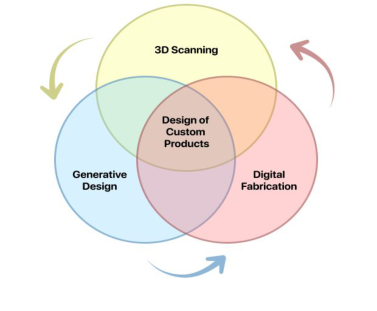
scanning, generative design and digital fabrication have come to impact pro- duct design in different ways yet the intersection of these three technologies could trigger a growth in designing for individualize and custom products (figure 1). Although these tools provide a growing opportunity in product design there are also challenges as an approach to design for the custom and individualized may not be effective for all products or every product cate- gory. To be a truly ‘collaborative customization’ (Gilmore & Pine, 1997) the product type and co-creative effort has to leverage the advantages of the tech- nology with new design methods. The overall advantages of this approach have the potential to yield better fit with the user, improved performance, error reduction, increased user satisfaction and deliver a more sustainable product life to name a few.
BACKGROUND
As a means of highlighting the way surface scanning, generative design and digital fabrication are converging in support of bespoke design, the following section reviews some of the background and advances in these individual technologies.
3D Surface Scanning 3D scanning has been in use starting as early as the 1960’s (Edl, et al., 2018) but in recent years the range of scanning hardware, reduction in price and improvements in software have made this technology more accessible to industrial designers as well as the average end user. In the context of this research, 3D scanning is a way to capture a physical object’s surface, exact size and shape as a form of digital data or 3-dimensional representation. In the broad sense, there are a range of applications for this type of scanning, specific to the field of product design the content that is often being scan- ned falls into three types including surface data from environments, objects and people with the two most common applications being reverse enginee- ring or human body scanning. In the particular application of designing for
Bespoke and Repetitive: Converging Technologies in the Design of Custom Products 325
ergonomic fit, scanning end users body or bodily features is increasingly leve- raged in two main ways. The first way is finding the most suitable design for a wide range of people based on a variety of 3D scans and can include a multiple step process (Lee, et al., 2015) often utilizing a database like the CAESAR project (Robinette, et al., 1999). The second approach is made-to- measure products for specific users. Based on the 3D scans of the user’s body, a bespoke product may be made to custom fit the user. These kind of design methods have been growing within the fashion and apparel design industry (Black & Eckert, 2009).
The growth of scanning and its application is connected to advances in the types of scanning technology. 3D scanning devices are divided into two categories: contact and non-contact scanners. The non-contact scanners that capture geometry through lasers and optics, computer vision, photogramme- try, light detection and ranging (LiDAR), and imaged based techniques are the area relevant to this discussion as the access to these devices is changing. Although LiDAR type scanners have challenges (Helle & Lemu, 2021) seve- ral of these challenges are being overcome through improvements in software making them more useful for product design (Lee, 2019). Perhaps the biggest impact on future bespoke design is the ability for the average end user to scan and collect surface data to collaborate with a designer in the develo- pment of a customized product. Currently, mobile devices like the iPhone and certain consumer tablets have the ability to collect surface scanning data thus eliminating the costly hardware barrier.
Generative Design Generative design is a technology in which 3D models are created and opti- mized by computer software. It has been an important tool since 1970’s and was adopted in computer science, architecture, engineering, and constru- ction. In recent years, it has become popular in product design disciplines (Lobos, 2018) and a portion of this growth is directly tied to the advances in software itself. There are a range of generative and parametric design sof- tware on the market including Autodesk Fusion 360, Solidworks Topology Optimization, Grasshopper in Rhino, and nTopology. In some cases, and certain applications, these programs can require significant labor investment and levels of visual coding. That being said, the future of these platforms is becoming clearly more accessible to designers over time will be disruptive. This is particularly the case when one considers how automation of any kind, might impact a market or profession. None more relevant that the design of customized or in some cases the design of mass customized products that leverage end user input either directly or indirectly. Ultimately it will be a balance as disciplines ranging from architecture (Salta, et al., 2020) to jewelry design (Di Nicolantonio, et al., 2019) explore the potential between automa- ting portions of the design process to better support customization efforts. When it comes to product design, these systems will clearly present advanta- ges to the designer as it will allow some end user parameters to be added as a potential constraint in the generative platform. This coupled with the use of generative design as a means of increasing design concept output while
326 Yang and Germany
balancing time and costs to the design team, bringing the cost of custom products within reach of the everyday consumer.
Digital Fabrication Digital fabrication being a set of tools for prototyping or production and commonly used several design and engineering fields. These systems of addi- tive and subtractive digital tools have been described as disruptive in their own right and are a part of the Industry 4.0 shift. Like the previous two technologies covered in this paper, digital fabrication has evolved over deca- des to become distributed and in some cases desktop solutions. From laser cutting and CNC to a range of 3D printing platforms, each of these are disti- nctly data and computationally driven. As the machines have evolved so have the sources of the data that drives them. Inherently flexible in their applica- tion compared to tooled mass production methods, design practitioners have continued to move from utilizing these for prototyping to actual product pro- duction in the case of bespoke solutions. Digital fabrication has had a long history of use for producing customized product solutions but it has scaled up to include building custom houses (Lojanica, et al., 2018) or down to deliver vascular tissue for medical applications (Han, et al., 2019). Digital fabrication and in particular 3D printing, has decentralized and distributed the source of parts combined with eliminating the barrier of tooling costs that are associated with mass production while allowing repeated fabrication by the end user or designer.
CATEGORIES OF CONVERGENCE In an effort to better understand how individual designers and design groups were approaching the use of these technologies, this research included inte- rviewing several design teams who were creating bespoke solutions in a range of markets. An interview with designers from Dive Design revealed that they are utilizing 3D surface scanning done by the end user in conjunction with generative design methods from the design team to develop bespoke animal prosthetics for individual pet owners (Bionic Pets, 2022) Similarly a conver- sation with a team member at Ultimate Ears revealed that their approach to design and developing their custom UE Pro IEM series (Ultimate Ears, 2022) has evolved to leverage a specially developed inner ear surface scanner to col- lect accurate data that is ultimately used to generate 3D printed and perfectly fit in-ear monitors. Lastly, a visit to Sanders’ Lab at the University of Wash- ington (Sanders’ Lab, 2022) provided insights into the design and fabrication of the next generation of human prosthetics where the team there. In each of these cases, design teams were moving from a point of data capture (scan) to CAD design (generative or conventional) to digital fabrication and in several cases there was a feedback loop generative another cycle of iteration.
In considering the application of these technologies in the service of a bespoke design strategy, it is clear that not all product categories or problems are best served by this customized approach. Performance, cost, time or use are but a few of the driving factors that may delineate a product from being developed for mass production vs designed as a truly custom and bespoke
Bespoke and Repetitive: Converging Technologies in the Design of Custom Products 327
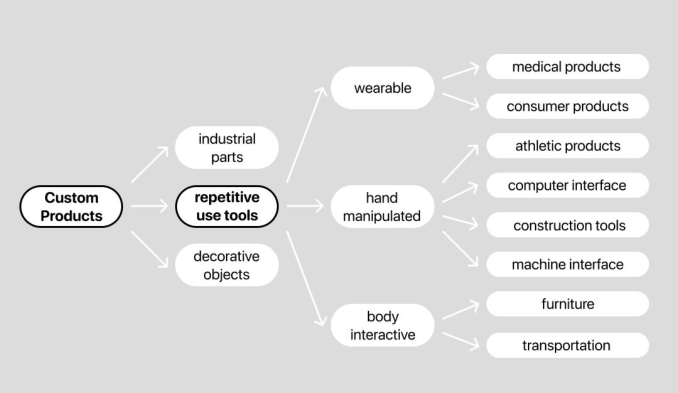
Figure 2: Categories of custom/bespoke products.
device. Growth in this design approach will not only be connected to the advance of digital tools but also the types of problems that they may aid in addressing.
By examining how the intersection of these technologies is currently being leveraged by designers in combination with larger market, an effort was undertaken to categorized to potential for custom product into three groups: industrial parts, decorative objects and repetitive use tools (figure 2). From a design standpoint, decorative objects refer to the customization of the aesthe- tically variable elements like color, print pattern, and in some cases materials without impacting the geometric or functionality. Repetitive use tools on the other hand encompass a product category where the geometry, materials, and components may require unique designs to fit the individual end user and contextual application. This category could then be classified into three sub- categories: wearable, hand-manipulated, and body-interactive. These three sub-categories aim to encompass areas of use that have the strongest room for growth in future bespoke scenarios as they all have a high degree of interface with the human body and require high level of precision in their performance as a tool.
CONCLUSION
As part of Industry 4.0, advances in technology, data, and analytics will incre- asingly give designers the ability to develop customized or bespoke products for a range of end users. Specifically, the intersection of 3D surface scanning, generative design and digital fabrication could trigger this growth. Access to 3D scanning hardware and software will move from the designer collecting user data to the end user generating the scans themselves. This coupled with the use of generative design as a means of increasing design concept output while balancing time and costs to the design team thus bringing the cost of
328 Yang and Germany
custom products within reach of the everyday consumer. Lastly, digital fabri- cation and in particular 3D printing, has decentralized and distributed the source of parts combined with eliminating the barrier of tooling costs that are associated with mass production while allowing repeated fabrication by the end user or designer. Not all products will fit a bespoke approach but repetitive use tools show the most potential for growth in this area.
REFERENCES
Bionic Pets, 2022. Dive Design. [Online] Available at: https://www.divedesignco.com/work/bionic-pets [Accessed 14 December 2021]. Black, S. & Eckert, C., 2009. Developing Considerate Design: Meeting Individual Fashion and Clothing Needs Within a Framework of Sustainability. Handbook of Research in Mass Customization and Personalization. Campbell, I., Richard, J., Bahar, S. & Wormald, P., 2003. The potential for the
bespoke industrial designer. The Design Journal, 6(3). Di Nicolantonio, M., Rossi, E. & Stella, P., 2019. Generative Design for Printable Mass Customization Jewelry Products. s.l., Springer. Edl, M., Mizerak, M. & Trojan, J., 2018. 3D laser scanners: history ad applicatios.
International Scientific Journal About Simulation, 4(4). Gilmore, J. & Pine, B., 1997. The four faces of mass customization. Harvard Business Review, 75(1). Gorman, C., 2003. The Industrial Design Reader. New York: Allworth Press. Han, S. et al., 2019. Recent advances in 3D printing: vascular network for tissue and
organ regeneration. Translational Research, Volume 211. Helle, R. & Lemu, H., 2021. A case study on use of 3D scanning for reverse engineering and quality control. Chandigarh, Materials Today Proceedigs 45. Kumar, V. et al., 2019. Ontologies for Industry 4.0. The Knowledge Engineering
Review, 34(17). Lee, W. et al., 2015. 3D Scan to Product Design: Methods, Techniques, and Cases.
Lugano, s.n. Lee, W. M. J. G. L. J. A. S. Y. G. R., 2019. Application of 3D scanning in design education. DHM and Posturography, pp. 721–732. Lobos, A., 2018. Finding Balance in Generative Product Design. Linkoping, Design
Society. Lojanica, V., Colic-Damjanovic, V. & Jankovic, N., 2018. Housing of the Future: Housing Design of the Fourth Industrial Revolution. Rome. Robinette, K., Daanen, H. & Paquet, E., 1999. The CAESAR project: A 3D surface
anthropometry survey. Ottawa. Salta, S., Papavasileiou, N., Pyliotis, K. & Katsaros, M., 2020. Adaptable emergency shelter: A case study in generative design and additive manufacturing in mass customization era. Procedia Manufacturing, Volume 44. Sanders’ Lab, 2022. Sanders’ UW Lab. [Online] Available at: https://depts.washington.edu/jsweb/ [Accessed 14 December 2021]. Ultimate Ears, 2022. Ultimate Ears. [Online] Available at: https://custom.ultimateears.com/pages/ue-pro-iems [Accessed 14 December 2021].
LISTED IN THE AHFE DIGITAL BOOKSTORE CATALOGUE
Explore the complete digital volume
Ergonomics In Design
Read this individual research paper free through the original publisher, or explore the full digital proceedings book.
ISBN 978-1-958651-23-0
Explore this ISBN in the AHFE Bookstore ↗Listed in the July 2026 bookstore catalogue; search by ISBN to confirm current availability · Digital book purchase optional