Shuangxu Li, Zhaolin Lu, Jingwen Liang, Jingjing Li, Jianan Xv (2022). Where does the "Mukbang" boom go? Research based on Use and Gratifications. In: Ergonomics In Design. AHFE Open Access, vol. 47, pp. 747–753. https://doi.org/10.54941/ahfe1002006
This paper aims at studying the influence of young people's needs on the number of clicks on "Mukbang", and to understand the characteristics of their audiences. The method is based on the theory of Uses and Gratifications in mass communication theory. The questionnaire is designed and distributed from cognitive needs, emotional needs, personal integration needs, social integration needs, having watched "Mukbang" videos on video websites, and the need to relieve stress. And use statistical software to analyze the results, and empirically test the relationship between the needs of young people and the number of clicks on "Mukbang". The results showed that: ①In the user's physiological needs, being attracted by the appearance of food and the frequency of clicking "Mukbang" showed a significant positive impact; being attracted by the appearance of the anchor showed a significant positive correlation with the degree of necessity to watch "Mukbang"; ② Among the psychological needs of users, the psychology of weight loss, the psychology of recreation and entertainment is significantly positively correlated with the frequency of clicking "Mukbang"; the need to enjoy the companionship of "Mukbang" is significantly positively correlated with the necessity of watching "Mukbang"; it is inferred that the two Large categories of people who watch "Mukbang" have made design innovations in the design practice according to the characteristics of different groups of people.
The “Mukbang” is a live broadcast of eating, in which the hosts show their private life time and eating status to the viewers through the online plat- form, allowing the audience to gain various psychological compensations and visual and auditory stimuli during the viewing process, thus getting psycho- logical satisfaction (Wang, 2020). In 2014, “Mukbang” was born in South Korea (Yao, 2020), and soon became popular worldwide because of its novel video genre and huge revenue. In the development of “Mukbang”, the low entry barrier, the serious homogenization, and the bad behavior of some bloggers to gain attention, such as fake eating and vomiting, have brought serious impact. Based on this background, we discuss how “Mukbang”attra- cts young people to watch, and what kind of needs young people have that lead to the success of “Mukbang”(Song, 2020).
The motivation of the audience varies from person to person, what influ- ences the successful spread of “Mukbang”? There is still a lack of research and data on this issue. Based on Uses and Gratifications, this study exami- nes the psychological and behavioral effects of “Mukbang” on the audience by analyzing the motivation and satisfaction of young audiences for watch- ing “Mukbangg”. We explore how the needs of young audiences affect the number of “Mukbang” hits, and find out how different physiological and psychological motivations are related to the spread of “Mukbang”. We hope that we can gain insights from this study, and from the surface to the inside, we can guide the development of a healthier and more positive media culture by exploring the needs of the audience and thus changing the mindset of the viewers (Li, 2020).
RESEARCH DESIGN A Model of the Factors Influencing the Number of Clicks on “Mukbang” Based on Uses and Gratifications
Uses and Gratifications (Yin, 1999) is put in the position of the audience and examines the psychological and behavioral utility of mass communication for human beings by analyzing the audience’s motivation to use the media and obtain need satisfaction (Zeng, 2021). This theory divides the 35 most basic human needs into five categories - cognitive needs for information, knowledge and understanding; affective needs for emotional, pleasurable or aesthetic experiences; personal integration needs to secure status, social integration needs to strengthen social relationships, and stress relief needs to escape and divert attention (Gan, 2018).
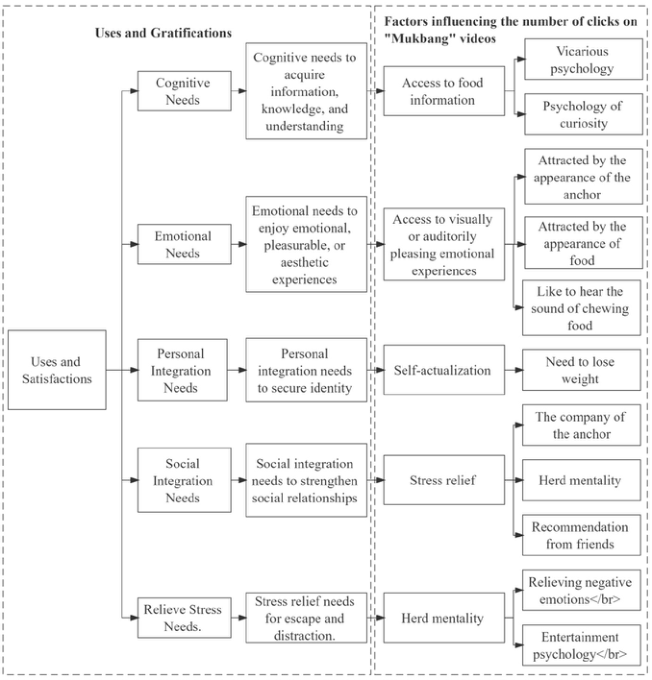
For the research topic of “the influence of young people’s needs on the number of clicks of ‘Mukbang’”, I will analyze the needs of young audi- ences from the perspectives of obtaining food information, gaining visual or auditory pleasant emotional experience, self-actualization, herd mentality and stress relief based on the five categories of needs of use and satisfaction theory, and further manipulate each need to obtain the influencing factors that affect the users’ watching of ‘Mukbang’ videos, as shown in Figure 1.
Questionnaire Design According to the construction of the theoretical model, I divided the variables in the problem of “the influence of young people’s demand on the number of ‘Mukbang’ video clicks” into three types: independent variables, control variables, and dependent variables. (see Table 1).
RESULTS & ANALYSIS This study uses intentional sampling and snowball sampling, targeting young people who have watched “Mukbang” videos in the past week, and distri- buting online questionnaires mainly among college students and under the “Mukbang” super-talk on Weibo, and spreading them among college
Where Does the “Mukbang” Boom Go? Research Based on Uses and Gratifications 749
Figure 1: A Model of the factors influencing the number of clicks on “Mukbang”. (Adapted from uses and gratifications).
students. A total of 251 questionnaires were collected. Finally, 251 question- naires were collected. There were 116 invalid questionnaires and 135 valid questionnaires.
Reliability & Validity Analysis The reliability and validity of the 15 five-degree scale questions in the que- stionnaire were analyzed using SPSS, and the results showed that the validity of the study data was of high quality and could be used for further analysis. (See Table 2).
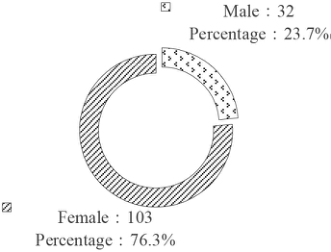
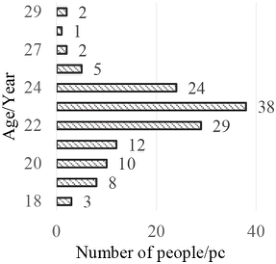
The gender situation of the survey sample (see Figure 2), women accounted for 76.3% of the total number of respondents and men accounted for 23.7%. The age of the survey sample (see Figure 3), the age of the respondents was concentrated around 22-24 years old, and the variance was relatively small.
Multiple Regression Analysis The frequency of clicking on “Mukbang” as the dependent variable was analyzed by linear regression, and from the analysis in Table 3, it can be
Table 1. Variable definitions.
Table available in the original PDF paper.
Variable Symbols Variable Name Variable Definitions Continuous Variable
Attracted by the appearance of the anchor
Independent variable 1: Physiological motivation for watching “Mukbang”
Continuous Variable
Attracted by the appearance of food
Continuous Variable
Like to listen to the sound of chewing food
Independent variable 2: Psychological motivation for watching “Mukbang”
Continuous Variable
Vicarious Psychology Continuous Variable Curiosity Continuous Variable Weight loss Continuous Variable Enjoying the company of “Mukbang” Relieving negative emotions Continuous Variable Entertainment Continuous Variable Herd mentality Continuous Variable Control variable: access to “Mukbang” video channels
Continuous Variable
Frequency of clicking on “Mukbang” videos
Platform recommendation Continuous Variable Self-search Continuous Variable Recommended by friends Continuous Variable Dependent variable: the number of “Mukbang” video hits
Continuous Variable
Necessity of watching “Mukbang” for daily life
Demographic characteristics
Gender Categorical Variable Year of birth Continuous Variable
Table 2. Reliability and validity analysis.
Table available in the original PDF paper.
Reliability Analysis Validity Analysis Cronbach’s α KMO Bartlett’s Test
Chi-squared Degree of Significance approximation freedom
0.855 0.799 683.829 105 0.000
Figure 2: Gender profile of the samples.
Where Does the “Mukbang” Boom Go? Research Based on Uses and Gratifications 751
Figure 3: Age profile of the samples.Table 3. Multiple regression analysis.
Table available in the original PDF paper.
Unstandardized
t p
Regression Coefficient
Standardized Regression Coefficient B SEM Beta
0.407 0.11 0.327 3.702 0.000**
Constant 0.868 0.476 - 1.824 0.071 2) Attracted by the appearance of food
3) Psychology of weight loss 0.154 0.084 0.18 1.83 0.07* 6)Entertainment Psychology 0.306 0.148 0.231 2.065 0.041* Dependent variable: 1. How often do you click on “Mukbang”?
* p<0.05 ** p<0.01
seen that: 1 Attracted by the appearance of food, the psychology of dieting, and the psychology of entertainment have a significant positive effect on the frequency of clicking on “Mukbang” as the dependent variable. 2 where being attracted to the appearance of the food has the greatest effect on the dependent variable.
The linear regression analysis of the degree of necessity of watching “Muk- bang” for daily life as the dependent variable, as shown in Table 4, shows that: 1 Attracted by the appearance of the anchor, curiosity, and enjoying the company of “Mukbang” will have a significant positive effect on the degree of necessity of watching “Mukbang” for daily life. “Mukbang” has a significant positive effect on the necessity of watching “Mukbang” for daily life. 2 Enjoying company of “Mukbang” has the greatest influence on the dependent variable.
CONCLUSION
(1) Attracted by the appearance of food (Bate = 0.327) has the greatest effect on the dependent variable, which means that beautiful visual images of food bring audiences a pleasant aesthetic experience and stimulate them to click on the “Mukbang” video.
Table 4. Multiple regression analysis.
Table available in the original PDF paper.
Unstandardized
t p
Regression Coefficient
Standardized Regression Coefficient B SEM Beta
0.196 0.087 0.206 2.264 0.025*
Constant 1.431 0.416 - 3.442 0.001** 1) Attracted by the appearance of the anchor 0.207 0.087 0.256 2.386 0.019*
2) Curiosity 0.16 0.093 0.179 1.723 0.087* 4)Enjoying the company of “Mukbangt” Dependent variable: 2. How necessary is watching “Mukbang” to your daily life?
* p<0.05 ** p<0.01
(2) Attracted by the appearance of the anchor (Bate = 00.216) and enjo- ying the company of the anchor (Bate = 0.256) are significantly and positively correlated with the necessity of watching the anchor. This indicates that the good appearance of the anchor is more attractive to the audience who often feel lonely inside. (3) Based on the above findings, we found that there are two main groups of people who have an influence on the number of clicks on “Mukbang”: those who are simply interested in the food itself, who watch “Muk- bang” as a hobby to spend their time, and those who have a special need for food because of dieting during the dieting period; and those who need a sense of companionship, who tend to value the appeara- nce of the anchor more than the food itself, and the better the personal condition of the anchor, the higher the user stickiness (Hu, 2020).
According to the data analysis, we also found an interesting phenome- non, that is, in the control variable: the first contact with the “Mukbang” approach, it is believed that 67% of the platform recommendations are in line with the platform recommendation, and 55.63% are in line with the independent search, which is reflected in the users of this test, and it can be considered that watching the “Mukbang” behavior is the real needs of the user group, and the common result of the demand created by commercial promotion(Wang, 2021).
ACKNOWLEDGMENT
Thanks to Professor Zhaolin Lu for his valuable suggestions.
REFERENCES
Gan, M.T., Liang, X.Y. and Li, T.T. (2018). Understanding User Behavior of Social Networking Service from the Persepective of Uses and Gratifications: A Con- tent Analysis of 54 Empirical Studies. Library and Information Service. 62(7). pp. 134–143.
Where Does the “Mukbang” Boom Go? Research Based on Uses and Gratifications 753
Hu, J.H., Long, S.F. (2020) The phased evolution of my country’s “eating and broadcasting”. New Media Research. 6(14). pp. 69–70. Li, B.R. (2020). Correlation analysis between the viewing motivation of eating
broadcast and the impact of eating broadcast on viewers. PR Magazine. (04). pp. 13–14. Song, S.W. (2020). On the Survival Opportunity and Development of Short Video from the DouYin App. Jilin University. Wang, C.(2020). Psychological analysis of eatcast audience under use and satisfaction
theory. Radio & TV Journal. (11). pp. 165–166. Wang, P.L. (2021). The Review and Criticism of the User’s Psycholgy of Eating Video- Taking Bilibili as an Example. Anhui University. Yao, L.(2020). Research on Network Eating and Broadcasting under the Vision of
Media Consumption Culture. Changchun University of Technology. Yin, X.R. (1999). An Important Turn in U.S. Communication Audience Research: A Deeper Look at the “Uses and Gratifications”. Academic Journal of Zhongzhou. (05). pp. 58–61. Zeng, T. (2021). Museum audience research from the application of use and
satisfaction theory. New Media Research. 7(20). pp. 14–16.
LISTED IN THE AHFE DIGITAL BOOKSTORE CATALOGUE
Explore the complete digital volume
Ergonomics In Design
Read this individual research paper free through the original publisher, or explore the full digital proceedings book.
ISBN 978-1-958651-23-0
Explore this ISBN in the AHFE Bookstore ↗Listed in the July 2026 bookstore catalogue; search by ISBN to confirm current availability · Digital book purchase optional