Xuandong Zhao, Pan Wenjuan, Pang Huimin, Zihe Zhou, Yuehua Liu, Wankun Feng, Zhaolin Lu (2023). The influence of member matching degree on interdisciplinary team collaboration efficiency. In: Ergonomics In Design. AHFE Open Access, vol. 77, pp. 279–287. https://doi.org/10.54941/ahfe1003385
In order to explore the effect of team members’ matching degree on the efficiency of interdisciplinary team collaboration. This study has utilized Likert Scale to make questionnaires, which were then tested and corrected by simple reliability and validity analysis. The questionnaires were distributed online to investigate the correlation between matching degree and collaboration efficiency. A total of 402 questionnaires were collected and screened. Finally, 346 questionnaires were testified as valid. The SPSS software was then utilized to test the reliability and validity of the data and also make multiple regression analysis. The conclusions were drawn as followed: ① The matching degree of members affects the team collaboration efficiency of interdisciplinary teams. ② The matching degree of behavior and disciplinary knowledge have a positive and significant impact on the efficiency of interdisciplinary team collaboration. ③ Goal matching has a significant impact on the execution efficiency of interdisciplinary teams, but has no outstanding impact on the communication efficiency. ④ Compared with matching of communication behavior, the matching of execution behavior has a more significant impact on the collaboration efficiency of interdisciplinary teams. ⑤ The frequency of team members participating in team collaboration has a significant impact on the matching degree of disciplinary knowledge and communication efficiency.
With the emergence of more and more cross-domain problems in research, the degree of specialization segmentation and complexity is increasingly enh- anced, researchers in order to break disciplinary boundaries, integrate the knowledge of different disciplines, and jointly propose solutions. In order to better cope with the complex, fuzzy, fast-changing and uncertain envi- ronment, the interdisciplinary team is gradually emerging. How to build an efficient interdisciplinary team is the focus of practice. Based on this, this paper conducted a quantitative study on the relationship between member matching degree and interdisciplinary team cooperation efficiency, intended to find the relationship between member matching degree and team efficiency
in interdisciplinary teams, so as to provide relevant support for promoting interdisciplinary team cooperation in universities.
RESEARCH BACKGROUND AND SIGNIFICANCE This topic studies the influence of member matching degree on the effici- ency of interdisciplinary team cooperation. With the gradual deepening of globalization and the rapid development of economy, countries and enter- prises have put the cultivation of innovative talents in the first place. In this context, higher education is transforming from “basic support service” to “innovation-leading power” (Su Xiaoqiong 2021). In order to effectively improve the innovation ability of talents, teamwork, which is commonly used to improve the production efficiency of enterprises, has increasingly become an indispensable mode of college students’ learning.
At the same time, with the deepening of discipline construction and the further clarification of industrial development strategy, all walks of life put forward more urgent requirements for the cultivation of high-end interdi- sciplinary talents in the field of higher education, expecting them to have diversified, comprehensive and interdisciplinary abilities to adapt to the complex and changeable competitive environment. Based on this, interdi- sciplinary collaboration has become one of the important modes of college students’ teamwork. For example, the Industrial Design Department of Tsin- ghua University has cooperated with the School of Materials and the School of Medicine to enhance the interdisciplinary cooperation opportunities for graduate students majoring in design. However, the special nature of interdi- sciplinary determines that it can not only promote team members to broaden their knowledge breadth and develop their skills, but also affect college students’ learning willingness and efficiency to some extent.
Some scholars have clearly pointed out that the degree of matching betw- een individuals and the environment is an important factor affecting the individual behavior and work performance of members (Cao Han. 2021). When the team atmosphere is good, members have a strong sense of belon- ging to the team and trust each other, communication and sharing become more frequent, and they are satisfied at the psychological level, so that they can devote themselves to the work with a positive attitude and create more value. On the contrary, the low matching degree of members is not conducive to the creativity of members.
In previous researches, the academic circle has paid much attention to the member matching degree, mainly studying the relationship between the indi- vidual and the team effectiveness, while the research on the matching degree among the team members is less. However, interdisciplinary collaboration is a special form of team cooperation, and there are relatively few researches on the relationship between them at home and abroad. Therefore, based on the investigation of the member matching degree, this study intends to take college students (including undergraduates and postgraduates) as the research object, aiming to investigate the influence of the member match- ing degree at the team level on the cooperation efficiency of college students’
The Influence of Member Matching Degree 281
interdisciplinary team, that is, to explore the influence of the matching degree among team members on the team efficiency.
Research Theory Member Matching Degree Matching degrees, due to personal environment interaction theory, it consi- ders personal attitude and behavior depends on the individual characteristics of compatibility with the environment. Person-Team fit refers to the com- patibility between individuals and their teams (Cai Di 2019). In proposing this concept, the author emphasizes the issue of hierarchy, placing matching at the team level, that is, focusing on the interaction between people in the team. Therefore, this study puts forward the member matching degree at the team level to clarify the matching relationship between team members.
Interdisciplinary and Interdisciplinary Teams Interdisciplinarity is a research method to break the original disciplinary barriers, and to solve complex problems and achieve innovation by inte- grating multidisciplinary knowledge, tools and structures (Wu Zhaoyang, 2016). Interdisciplinary team is a new organizational model that gathers multidisciplinary knowledge resources. Its advantage lies in overcoming the insufficient stock of individual or single discipline knowledge and ultimately realizing knowledge or technology innovation through the communication and collaboration of team members (Guan Hui, 2015).
Research Significance The matching at the level of interdisciplinary teams is the complementary matching that is achieved on the basis of consistent matching. Compared with the traditional scientific research team with a single form, the inter- disciplinary team in universities has some new characteristics. The benign development of interdisciplinary teams can enable team members to expand the breadth of knowledge of different disciplines, develop skills, such as teamwork, critical thinking, and effectively improve their abilities. It is convenient to propose creative solutions by integrating perspectives from multiple fields and perspectives, and effectively promote the cultivation of interdisciplinary talents.
However, the interdisciplinary teams of universities in our country have some problems, such as uncertain organizational goals and lack of vitality (Zhang Xinggui, 2012). How to ensure the long-term healthy operation of interdisciplinary teams still needs further exploration, which has important practical significance for promoting the innovation and transformation of sci- entific research achievements, cultivating innovative talents, and improving the level of social science and technology.
In this study, by collecting the data of three quantifiable dimensions of “member matching degree” in the index of “member matching degree” : goal matching degree, behavior matching degree (which can be divi- ded into communication behavior and execution behavior) and discipline knowledge matching degree, the influence of member matching degree on
Table 1. Variable definition.
Table available in the original PDF paper.
Variable symbol Variable name Independent variable: Member matching degree
Target matching degree Our team can set a common goal Our team is always consistent with our goals Behavior matching degree Communication behavior matching degree Our team members are able to listen to others very well The communication atmosphere within our team is pleasant
Executive behavior matching degree
In the process of completing the work tasks, our team can solve the problems that arise together During the completion of the work tasks, our team members can coordinate each other’s work Matching degree of subject knowledge
I was able to learn new subjects from other team members The subject knowledge of our team members matches the team’s work tasks
Communication efficiency
We were able to respond very quickly
Dependent variable: Teamwork efficiency
In communication, we can get results quickly
Execution efficiency
We can finish the task on time We are able to do high-quality work interdisciplinary team collaboration efficiency is analyzed from different angles. It provides strong support for the important factors affecting the effi- ciency of interdisciplinary team cooperation and helps to expand the theory of individual environment matching.
Research Method This study uses the method of combining theory and empirical research, qua- litative and quantitative research. Specific research methods and tools are as follows: A five-point Likert scale ranging from 1 (strongly disagree) to 5 (strongly agree) was used to design the questionnaire. The main contents include target matching degree (2 questions), team behavior matching degree (4 questions), subject knowledge matching degree (2 questions); Communication efficiency (2 questions), execution efficiency (2 questions).
After the questionnaire was collected, the preliminary invalid question- naire was excluded, and then the valid questionnaire data were tested for
The Influence of Member Matching Degree 283
reliability, validity, multiple linear regression analysis, variance analysis, etc., using SPSS software.
Research Design Through in-depth analysis of member matching degree, the research elements of the topic “Research on the impact of member matching degree on interdi- sciplinary team cooperation Efficiency based on multiple regression model” are divided into independent variables and dependent variables. The indepen- dent variable is divided into three measures, namely, goal matching degree, behavior matching degree and discipline knowledge matching degree, and the dependent variable is communication efficiency and execution efficiency. See Table 1 for details.
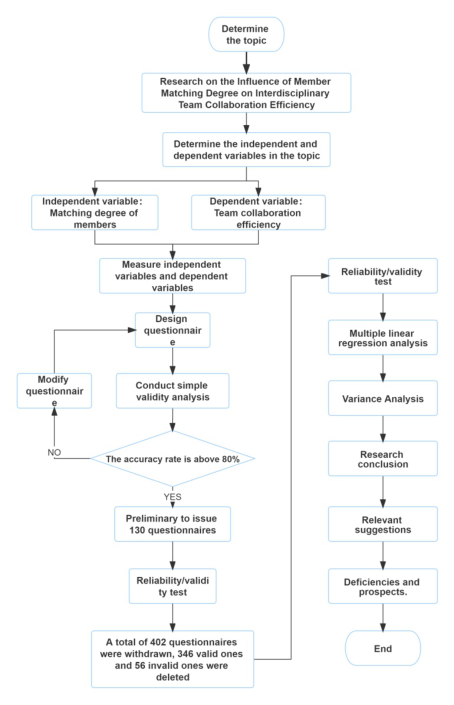
Research Process The questionnaire was compiled according to specific measurement items. The questionnaire was tested for simple validity. A total of 130 questionnaires were collected after the initial release, among which 119 were valid. The correct rate of each item reached 80% or above. The flow chart of this study is shown in (see Figure 1).
Figure 1: Study flow chart.
DATA ANALYSIS Questionnaire Reliability and Validity Test
The reliability of 12 items in the questionnaire was tested using SPSS and the results are detailed in (see Tables 2, 3). The total clonal Bach α coefficient was 0.907, greater than an acceptable criterion of 0.7. This indicates that the study data has high reliability and allows analysis of valid data.
SPSS was used to test the validity of 12 items of the 5 scale questions in the questionnaire. The KMO value is 0.948, which is greater than the standard of 0.7. The significance level of Bartlett’s value Sig is infinitely close to 0.000, indicating that the validity of the study data is high and can be used to analyze the valid data.
Descriptive Statistics The study period of the respondents covered undergraduate, master’s and doctor’s degrees. Among them, 178 were postgraduate students, accounting
Table 2. Total reliability test of effective questionnaire (364 copies).
Table available in the original PDF paper.
Sample size Number of items Cronbach’s alpha
346 12 0.907
Table 3. Total reliability test of effective questionnaire (364 copies).
Table available in the original PDF paper.
α Dimension Question item α after deleting item Q7: Our team can set a common goal 0.892 0.907
Q9: Our team members can listen to others’ opinions well
0.893
Q10: The communication atmosphere within our team is pleasant
0.889
Q11: In the process of solving the work tasks, our team can solve the problems together
0.892
Q12: During the task process, our team members can coordinate each other’s work
0.903
Q13: I can learn new subject knowledge from other team members
Independent variable 3: The matching degree of subject knowledge
0.893
Q14: The subject knowledge of our team members matches the work tasks of the team Q15: We can respond quickly 0.892
Dependent variable 1: Communication efficiency
0.892
Q16: In the communication, we can quickly get the results Q17: We can finish the task on time 0.895
Dependent variable 2: execution efficiency
Q18: We can do high-quality work 0.893
The Influence of Member Matching Degree 285
for 51.4% of the total number surveyed; The sample of undergraduate stu- dents was 165, accounting for 47.7% of the total number investigated; The sample of doctoral candidates was 3, accounting for 0.9% of the total num- ber of respondents; As can be seen from the pie chart, the respondents of this survey are mainly undergraduates and postgraduates, with the largest number of respondents being first-year postgraduate students.
Among the respondents, 133 people occasionally participated in interdi- sciplinary teams, accounting for 38.4% of the total number of respondents; Sometimes participating in the interdisciplinary team sample of 90 people, accounting for 26% of the total number investigated; The sample of 85 peo- ple who often participate in interdisciplinary teams, accounting for 24.5% of the total number surveyed; The sample that always participated in the inter- disciplinary team was 38 people, accounting for 10.5% of the total number surveyed; See the figure on the left for specific data. It can be seen that all interviewees have participated in interdisciplinary teams.
Multiple Regression Analysis of the Member Matching Degree and the Efficiency of Interdisciplinary Teamwork Multiple linear regression analysis is a statistical analysis method to establish the quantitative relation of linear mathematical model among multiple varia- bles and analyze it with sample data. In this paper, SPSS was used to establish and solve the multiple regression model of the relationship between indepen- dent variables and dependent variables. The results can be used for prediction and evaluation.
In order to explore the impact of member matching degree on interdiscipli- nary team cooperation efficiency, this study divided member matching degree into three measures, namely, goal matching degree, behavior matching degree and discipline knowledge matching degree, which are three independent vari- ables. Team cooperation efficiency is divided into communication efficiency and execution efficiency, which are two dependent variables. Aiming at the two dependent variables of communication efficiency and execution efficie- ncy, this paper adopts SPSS 27.0 to establish multiple regression models for them respectively. At the same time, in order to facilitate the measurement of behavior matching degree, behavior matching degree is divided into commu- nication behavior matching degree and execution behavior matching degree. Multiple linear relationships between independent variables and dependent variables were established twice to facilitate the exploration of the influ- ence of communication behavior matching degree and execution behavior matching degree on dependent variables.
The multiple linear regression relationship between target matching, beh- avior matching and subject knowledge matching and communication effici- ency was explored, and the regression results are shown in Table 4.
The significance value of the behavioral matching degree and subject knowledge matching degree was less than 0.001, indicating that the two independent variables had a significant impact on the communication effici- ency, and the target matching degree was 0.282, greater than 0.05, indicating
Table 4. Analysis results.
Table available in the original PDF paper.
Model Unstandardized coefficient Standardized t P coefficient Beta B Standard error
that the target matching degree did not have a significant impact on the communication efficiency.
According to multiple regression analysis, both behavior matching degree and subject knowledge matching degree have significant positive influe- nce on communication efficiency, and behavior matching degree has more significant influence on communication efficiency.
Similarly, goal matching degree, behavior matching degree and subject knowledge matching degree all have significant positive influence on execu- tion efficiency, and behavior matching degree has more significant influence on execution efficiency.
Study Results and Discussion The degree of member matching has a significant impact on the efficiency of interdisciplinary team cooperation, that is, the higher the degree of member matching in interdisciplinary team, the higher the efficiency of team coope- ration. The higher the matching degree of the members, the higher the unity degree of the goals of the members and the team, the more consistent the team concept is with the psychological expectations of the members, so that the members and the team are more identified, trusted and supported, and the members have a stronger sense of belonging to the team, so the team atmosphere is more harmonious, and the harmonious atmosphere makes the members have a positive emotional state. As a result, more frequent know- ledge sharing and less internal conflicts are generated, which improves the enthusiasm of members to cooperate and enables them to work more freely and boldly, and the efficiency of team cooperation is higher.
Compared with other influencing factors, behavior matching degree has a more significant impact on team cooperation efficiency. Among them, com- pared with communication behavior matching, executive behavior matching has a more significant impact on team cooperation efficiency. In the process of communication and interaction with individuals who are similar to them, team members can realize the confirmation of their own views and behavi- ors, while the matching of disciplinary knowledge and professional ability is more based on the team standpoint, emphasizing what members need to do and what requirements they need to achieve. In terms of meeting the needs of individual members, it has little impact on them. Therefore, the matching of goals and behaviors among members is more indispensable than the com- plementation of skills and knowledge. Only when the team members achieve
The Influence of Member Matching Degree 287
a high degree of matching, and supplemented by scientific work and com- plementary knowledge and skills, can the efficiency of team cooperation be effectively improved.
Communication is the basis of improving executive power. Good com- munication behavior matching degree will stimulate the improvement of executive behavior matching degree to a certain extent, thus improving the efficiency of team cooperation. Therefore, if the team can maintain a coordi- nated atmosphere at the execution level, its team cooperation efficiency will be improved to a greater extent.
CONCLUSION
The results fully show that it is feasible to measure the teamwork efficiency by the matching degree of communication behavior and execution behavior, and the member-team matching degree, as a new variable, can indeed improve the teamwork efficiency. Therefore, members and teams of interdisciplinary cooperation should clarify each other’s core values, team culture and goals when forming and recruiting new members, so that the whole team can ach- ieve a high degree of consistency and matching. Meanwhile, supplemented by scientific work and complementary knowledge and skills, the efficiency of team cooperation can be effectively improved.
REFERENCES
Cai Di, Xu Ruobing, Sun Yan & Ma Jinpeng. (2019). The power of “seeking common ground while shelving Differences”: The impact of individual-team matching on employees’ proactive behavior. Journal of Lanzhou University (Social Sciences Edition)(04), 65–72. doi:10.13885/j.issn.1000–2804.2019.04.009. Cao Han. (2021). The dynamic mechanism of interdisciplinary team development (a
master’s degree thesis, Harbin industrial university). https://kns.cnki.net/KCMS/ detail/detail.aspx?dbname=CMFD202202&filename=1021898736.nh Guan Hui. (2015). Dynamic problems and balance mechanism of university interdisciplinary organization development. Exploration of Higher Education (06), 10–13+19. Su Xiaoqiong, Chen Zhiyou & Wu Guoqing. (2021). Research on the Cultivation
of applied Civil engineering Talents’ Innovation Ability under the background of New Engineering. Journal of Yichun University (06), 123–125. Wu Zhaoyang, Shao Yunfei & Zhao Weidong. (2016). The influence of memberteam matching and atmosphere on entrepreneurial team performance. Technical Economics and Management Research (02), 30–34. Yu Guangrong & Huang Ping. (2011). Approaches to interdisciplinary research
of Social sciences in universities. Journal of Jishou University (Natural Science Edition)(04), 120–124. Zhang Xinggui, Luo Zhongzheng & Yan Baobin. (2012). Employee Happiness from the perspective of individual-environment (organization) matching. Advances in Psychological Science (06), 935–943.
LISTED IN THE AHFE DIGITAL BOOKSTORE CATALOGUE
Explore the complete digital volume
Ergonomics In Design
Read this individual research paper free through the original publisher, or explore the full digital proceedings book.
ISBN 978-1-958651-53-7
Explore this ISBN in the AHFE Bookstore ↗Listed in the July 2026 bookstore catalogue; search by ISBN to confirm current availability · Digital book purchase optional