Xinheng Song, Zhaolin Lu (2022). Design of museum science popularization interactive installation based on embodied cognition theory. In: Ergonomics In Design. AHFE Open Access, vol. 47, pp. 275–281. https://doi.org/10.54941/ahfe1001946
Combining embodied cognition theory and exploring innovative forms of interaction in the context of smart manufacturing, a Chinese Fan Museum science popularization interactive device was designed to provide an embodied experience. A usability evaluation model is constructed for the interactive device to evaluate the usability of the device, which will help to improve the product in the early and middle stages of its development and identify usability problems. Embodied cognition theory is applied to the interactive design of the museum science popularization information. Kansei Engineering evaluation and fuzzy analytic hierarchy process are used to evaluate and analyze the usability of the product. A usability evaluation system was constructed. The results show that the overall usability of the product is between good and excellent, and is satisfactory to users. It is feasible to explore the design of museum science popularization interaction with embodied cognition theory, and the evaluation system constructed for this product can also provide an accurate evaluation of the usability of the product and provide a reference for product upgrading and innovation.
The China Fan Museum in Hangzhou presents the precious Chinese fan cul- ture through historical relics and craftsmanship. With the rapid development of information and communication technology, both vertical industries and traditional fields are facing a huge technical revolution, and the traditional way of cultural exhibitions in museums is also facing an impact. Culture is a product of human society and is regarded as a spiritual activity. Therefore, combining digital technology with culture is of great importance and beco- ming a promising trend in recent years. This trend can be found in cultural exhibitions in museums (Tian C, Xiong W & Tong Y, 2021), where a glo- bal understanding of contemporary museum design is a synthesis that serves multiple purposes (Isikoren & Aygenc, 2018). In this era, new media such as interactive technologies are more relevant than ever to people’s daily lives. New technologies are characterized by improved interactivity and presenta- tion. Interaction design is human-centered, which can also be understood
as the design of behavior between people and everything else (Brinkerink & Drost, 2019).
Combining embodied cognition to study the application of interaction technology in museum cultural displays can create a better viewing expe- rience for people to appreciate historical or cultural exhibitions in a more immersive and vivid way (Sooai & Purnomo, 2017). Using innovative meth- ods to enhance subjective experiences helps us to learn and understand history and culture more easily and is more likely to make us interested in history and culture. The research design challenge for this project is to enable visitors to more authentically engage with and experience Chinese fan culture to quickly learn about it. The aim is to provide the Chinese Fan Museum with effective user insight materials, interesting forms of cultural science intera- ction, and to provide visitors with an embodied science interaction design that allows them to interact with the fan through gamification and further test the usability of the product (Rowe et al., 2017).
MUSEUM SCIENCE POPULARIZATION FROM EMBODIED COGNITION For a long time, cognition was thought to be reflection of internal brain processes, i.e., the processes by which the brain receives and organizes information (Fodor, 1975). It was not until the early 1990s that embodied cognition theory was proposed, suggesting that the sensorimotor processes of the body have an impact on cognition (Gover, 1996). Merleau-Ponty put forward the concept of “body-subject”, he believed that “I”is not an abstract subject of consciousness, “I” is my “body”. The body is the subject and has the ability to know and interact with the world directly. This idea rejects Descartes’ mind-body dualism, in which people acquire knowledge of their external environment through bodily perception. As evidence from cognitive science continues to accumulate in support of embodied cognition theory, embodied cognition theory has developed from an early philosophical musing into a new research paradigm in cognitive psychology (Prinz, 2004), social cognition, and other fields. From a comprehensive perspective, the core ideas of embodied cognition include three components: (1) the physical structure of the body, body movement and other characteristics influence the generation and development of cognition; (2) the environment and situation in which the body is located influence the generation and development of cognition; (3) the special sensory-motor channel neural system of the brain and the body influence the generation and development of cognition.
Since the 1980s, embodied cognition has gradually shifted from meta- physical discourse to evidence-based empirical research and entered the stage of scientific verification. Numerous scholars have continued to argue for the importance of the body and its interaction with the environment for human understanding of the world. Empirical research on embodied cognition has also helped us to gain a more comprehensive understanding and appreciation of embodied cognition, applying it to different domains (McCarthy & Ciolfi, 2008).
Design of Museum Science Popularization Interactive Installation 277
In the field of education, scholars have developed the concept of embo- died learning. Embodied cognition theory inspires the creation of contextual teaching and learning environments, and museums, as subjective learning venues, can create multisensory science knowledge and learning activities for visitors to enhance their experience. Through embodied learning, the visitor’s body is mobilized to form a responsive relationship with the environment, creating an immersive learning situation. Professor Abrahamson, an inter- nationally renowned scholar in the field of learning science, points out that embodied cognitive theory is influenced by cognitive developmental psych- ology and sociocultural theory, and is not only a methodology to rethink teaching and learning, but also a cognitive theory that can develop a uni- que learning theory. For the design of science-based interactions in museum scenarios, shaping good museum interaction scenarios includes the follow- ing experiential dimensions: relational, open, sense-making, narrative, and Spatio-temporal.
The existing researches on digital museums are mainly divided into two aspects: (1) focus on technology and interaction process (2) focus on audience-centered interactive experience. For the former one, systematic analysis and scenario application have already existed. For the latter one, existing studies analyze it from the perspective of embodied cognition by combining its theoretical framework with people’s experience in the process of interaction. The existing research lack analysis combined with embodied cognition from the perspective of people themselves as well as the relationship between people’s cognition, understanding, emotions and actual interactive experiences.
Combined with the embodied learning experience, a model of customer value perception is established and put into design experiments and evalua- tions. It can provide customer value model reference and design guidance for museum-related design evaluation and improve design quality and efficiency (Zhu, Y et al., 2021).
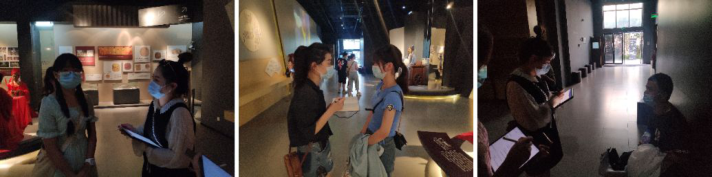
QUALITATIVE RESEARCH ANALYSIS METHODS Based on the theme of “Chinese Fan Culture”, the researcher first designed an outline for the interviews, using an “hourglass structure”, i.e., “peripheral questions −→core questions −→peripheral questions”. After the preven- tive interview, the researcher went to the Chinese Fan Museum to conduct semi-structured interviews with 10 visitors (see Figure 1). After completing the interviews, the qualitative data obtained from the visitors were coded and analyzed using Nvivo software to classify the different visitors. By comparing the coding nodes of various types of visitors and analyzing their differences, user characteristics were extracted, and persona was depicted on this basis. Finally, the storyboard is formed: visitors enter the museum exhibit. Firstly they are watching and learning carefully, and after some time they will com- municate and share with their friends by shooting videos, excitedly trying to interact with the exhibits, but they find that the interactive forms are less available and not attractive enough. At the same time, exhibits are usually
278 Song and Lu
Figure 1: Interviews with museum visitors. (Photo by author).
displayed with very small text information boards and huge screens, lacking articulation.
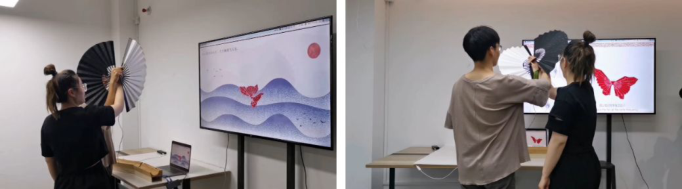
DESIGN STRATEGY The design takes the classical Chinese folk love story “Liang Zhu” as the theme, and in the drama “Liang Zhu”, a folding fan is used as a prop, and the fan sometimes turns into a butterfly and dances, sometimes acts as a book to create a lively learning scene, which is very interesting. The central visual scene of this interactive science design is the scene in “Meeting on the Terrace”: two visitors arrive at the booth, and the text “Please follow the instruction and wave the fan”is displayed on the left side of the screen with an illustration. On the right side, a butterfly flutters with the text “Please wave the fan at the same frequency”. When the visitors wave the fan, they control the left and right wings of the butterfly respectively, and when the frequency reaches within the tolerance of the set similar frequency, the content of the screen changes to an animation of a butterfly fluttering from the mountains, and continue to play the clip of the drama “Liang Zhu” (see Figure 2).
The design uses Processing and Arduino for interactive design, attracts visi- tors’ attention through an interactive game, gives them interesting feedback after they complete the set actions, and then popularizes fan culture with the help of the drama “Liang Zhu” after they focus on it.
USABILITY EVALUATION The perceptual vocabulary represents the consumer’s subjective impressions of the product and reflects the psychological impact of product usability on the user. The user’s use of this museum science popularization interactive installation involves the user’s instinctive layer, behavioral layer, reflective layer and ergonomics. An initial vocabulary of 80 perceptual terms was sum- marized based on these aspects. In this paper, using the Delphi method, 10 experts were invited to judge these 80 perceptual words. Finally, 15 perce- ptual words that best represent users’ impressions of usability were selected as evaluation indexes.
The multi-level index model of the museum science popularization inte- ractive installation was divided into three levels using hierarchical analysis: target level A, criterion level B and index level C. The target level is the ove- rall usability of the museum science popularization interactive installation;
Design of Museum Science Popularization Interactive Installation 279
Figure 2: Design images and interactive prototypes. (Photo by author).
the criterion level is the appearance usability, operation usability and percei- ved usability; and the index level is the specific index factors for evaluating each usability, which constitute the basic 3 levels of usability indexes of the product.
The five-level scale method was used to compare the target and criterion levels and construct a judgment matrix. Designers and expert users were invi- ted to form a panel of experts to conduct a comparative analysis and collect their questionnaires, and the Delphi method was used to focus the opini- ons of the panel until the final results were consistent. Finally, the judgment matrix is tested for consistency, and the consistency ratio formula is calcu- lated as follows(In the equation: λmax - maximum eigenvalue; n - matrix order. RI - average random consistency index. CI - consistency index. when CR < 0.1, the consistency test is passed, otherwise the judgment matrix will be re-corrected until it is passed.):
Equation reproduced from the original PDF.
According to the fuzzy values in the judgment matrix, the weight values of each layer of indicators are solved with the help of the hierarchical analy- sis software Yaahp. The weight values reflect the degree of influence and importance of each perceptual evaluation index on the overall usability of this museum science popularization interactive installation. The results show that users attach the most important to the perceived usability of this design, followed by the operational usability (see Table 1).
The product was evaluated by 30 users who were selected to test the product. The users were introduced to the product through the product demonstration video and experienced the product operation interaction pro- cess, and then rated the product based on 15 typical terms of the 3-level index.
280 Song and Lu
Table 1. Multi-level index model of product availability and data of weight distribution (Data from Yaahp).
The users were selected by Likert scale of excellent, good, moderate, quali- fied and poor to evaluate the level. The rating levels correspond to a score of 5-1. By calculation, the final total score of all users, which is the rating of the overall usability of the product was obtained. The average of the overall usability comprehensive evaluation score of 30 users: A = 4.6461, according to the correspondence between the fuzzy evaluation grades and scores, it can be seen that the overall usability of this museum science interactive device is between good and excellent. It is closer to excellent (5.00 points), indicating that users are basically satisfied with the usability of the design. From the statistics of users’ ratings of typical perceptual terms, there is still a need to improve and refine the reliability and response sensitivity of the product.
CONCLUSION
The design of the Chinese Fan Museum science popularization interactive installation broadens the way of museum science knowledge. Two visitors interact with the fan and watch the butterfly animation on the display, using interesting human-computer interaction to help visitors get a personal lear- ning experience. They can understand the “Liang Zhu transformed into a butterfly”, an ancient Chinese folk story related to the fan. So that the Chi- nese traditional culture is well inherited. This study uses hierarchical analysis to effectively test the usability of the product and provide directions for product design iterations.
ACKNOWLEDGMENT
We are very grateful to the Chinese Fan Museum in Hangzhou for provi- ding venue assistance and cultural interpretation. Thanks to all members
Design of Museum Science Popularization Interactive Installation 281
of the Center for Design Cognition and Computation Research, School of Design and Art, Beijing Institute of Technology for their support of this research.
REFERENCES
Brinkerink, M. and Drost, K., 2019. Labs as an Agile Instrument to Supercharge the Development of a Tech Heavy Museum: Making informed choices by failing early and learning by doing. MW19: MW. Fodor, J.A., 1975. The language of thought (Vol. 5). Harvard university press. Gover, M.R., 1996. The embodied mind: Cognitive science and human experience
(book). Mind, Culture, and Activity, 3(4), pp. 295–299. Isikoren, S.H. and Aygenc, E., 2018. Sustainability of Exhibition Halls while adapting to Design Concept and Technology in Museums: St. Barnabas Icon and Archaeological Museum Examples. Revista de Cercetare si Interventie Sociala, 62, p.331. McCarthy, J. and Ciolfi, L., 2008. Place as dialogue: Understanding and suppor-
ting the museum experience. International Journal of Heritage Studies, 14(3), pp. 247–267. Prinz, J.J., 2004. Furnishing the mind: Concepts and their perceptual basis. MIT press. Rowe, J.P., Lobene, E.V., Mott, B.W. and Lester, J.C., 2017. Play in the museum:
Design and development of a game-based learning exhibit for informal science education. International Journal of Gaming and Computer-Mediated Simulations (IJGCMS), 9(3), pp. 96–113. Sooai, A.G., Nugroho, A., Al Azam, M.N., Sumpeno, S. and Purnomo, M.H., 2017, December. Virtual artifact: Enhancing museum exhibit using 3D virtual reality. In 2017 TRON Symposium (TRONSHOW) (pp. 1–5). IEEE. Tian, C., Xiong, W. and Tong, Y., 2021, August. The Influence of Emotional Psycho-
logy on Museum with Interactive Design. In 2021 16th International Conference on Computer Science & Education (ICCSE) (pp. 177-182). IEEE. Zhu, Y., Luo, S., Zhang, Z. and Fan, M., 2021, November. Customer Value Co-creation and Perception in Museum Cultural and Creative Product Design. In 2021 International Conference on Culture-oriented Science & Technology (ICCST) (pp. 249–252). IEEE.
LISTED IN THE AHFE DIGITAL BOOKSTORE CATALOGUE
Explore the complete digital volume
Ergonomics In Design
Read this individual research paper free through the original publisher, or explore the full digital proceedings book.
ISBN 978-1-958651-23-0
Explore this ISBN in the AHFE Bookstore ↗Listed in the July 2026 bookstore catalogue; search by ISBN to confirm current availability · Digital book purchase optional