Noriko Okabe (2022). Interactions of job satisfaction with personality could avoid emotional exhaustion among customer service employees. In: Cross-Cultural Decision Making. AHFE Open Access, vol. 44, pp. 59–67. https://doi.org/10.54941/ahfe1001856
The Organization for Local Collaboration Networking, Center for Economic Growth, Strategy, Yokohama National University, 79-4, Tokiwadai, Hodogaya-Ku, Yokohama, 240-8501, Japan ↗
This study examined the link between personality characteristics and emotional exhaustion among customer service workers. The live survey application S was employed to conduct a web-based questionnaire survey of customer service workers in the United States in March 2021 with 50 questions related to the COVID-19 pandemic. Most respondents (65.78%) reported that they had felt emotional exhaustion. This study used descriptive statistics, correlation analysis, and moderated regression analyses to test the hypotheses. Results suggested that employee emotional exhaustion was caused by environmental, situational, and social phenomena such as the COVID-19 pandemic at the time rather than individual characters. The result also indicated that employees with high levels of agreeableness, conscientiousness, and job satisfaction can quickly reduce and control their emotional exhaustion when experiencing conflicts.
Emotional exhaustion is characterized by a lack of energy and depleted emo- tional resources (Cordes & Dougherty, 1993). When employees working in an organization are emotionally exhausted, their job performance deteriora- tes. As a result, they are more likely to resign or change jobs, which may pose a severe problem for organizations needing to retain human resou- rces (Lee & Ashforth, 1996). Moreover, previous studies have suggested that employees who frequently interact with customers tend to experience emotional exhaustion due to their occupational characteristics and work environment (Maslach & Jackson, 1984). Other studies focused on role ambiguity, role conflicts, workload, and work pressure in an organization as causes of emotional exhaustion.
Further, studies find that variables related to individual differences, such as personality, play a direct role in determining or moderating emotional exhaustion, thus indicating that some workers are more likely to experience
emotional fatigue than others. Licata et al. (2003) describe the key personality traits that customer service employees can apply to their work environ- ment: knowledge of how to best utilize scarce resources when pursuing work-related goals and a tendency to overcome obstacles in performing their duties.
In this study, the author first tries to identify what customer service worker personality types tend to experience emotional exhaustion and what perso- nality types try to avoid it. Second, based on data of US customer service workers, the author examines whether the interaction between employee personalities and job satisfaction has the effect of moderating emotional exhaustion.
LITERATURE REVIEW AND HYPOTHESES CONSTRUCTION Customer Service Employees
Customer service employees are sometimes referred to as frontline employees because they serve customers at the forefront of the service industry. Custo- mer service employees deal directly with customers who visit an organization. In the modern Internet environment, customer service employees in call cen- ters deal with customers in a virtual space. Customer service employees are the primary interface between service providers and their customers and play an essential role in influencing customer satisfaction.
Many customer services have a defined work routine. For example, air- line flight attendants perform regular duties of checking security equipment, ensuring safety, and maintaining a positive customer service experience. In addition, they take care of many customers at once when flying on large aircraft. Call center employees also follow a routine utilizing scripted interactions delivered continuously and automatically through the center’s underlying technology (Rod & Ashill, 2009). Although the number of custo- mers served at once is small, the call center employees frequently deal with a high volume of customers each day.
In such workplaces, their work is demanding and employees perform repe- titive and stressful tasks. If an employee answers too many calls or has too many customers, they might suffer physical and mental strain, which can lead to emotional exhaustion and eventually burnout (Cordes & Dougherty, 1993; Maslach, 1978). According to Maslach (1982), emotional exhaustion is the earliest symptom of burnout and refers to the depletion of an employee’s emotional resources.
Conservation of Resources Theory Hobfoll (1989) used the conservation of resources (COR) theory as a basis for understanding the impact of emotional exhaustion (Lee & Ashforth, 1996). According to COR theory, when individuals lack the resources to perform their jobs, they become emotionally exhausted. There are different types of such resources: social support, autonomy, participation in decision-making, and control (Cordes & Dougherty, 1993). Environmental factors that negati- vely impact job performance include role conflicts, role ambiguity, workload,
Interactions of Job Satisfaction with Personality Could Avoid Emotional Exhaustion 61
and work pressure. According to COR theory, job performance deteriorates when the job’s demands exceed the available resources. In response to the chronic emotional strain in daily interactions, customer service employees may feel emotionally overextended and drained by their interactions with others. As a result, these employees may be unable to perform adequately, which, in turn, may result in a decline in their personal sense of professional efficacy and job satisfaction. The COR theory serves as the basis for under- standing emotional exhaustion, based on which the following hypothesis is proposed.
Hypothesis 1: Emotional exhaustion of customer service employees is negatively related to their job satisfaction.
Big Five Personality Model Since the mid-1980s, the interest in personality has been revived as a para- digm for controlling variation in job performance due to individual differe- nces (Barrick et al., 2001), and many researchers have adopted a five-factor model of personality (Big Five) as a method of classifying characters (Gold- berg, 1992). This model offers five different characteristics relating to work: extraversion, agreeableness, conscientiousness, emotional stability, and open- ness to experience. In addition, this model suggests that these traits can predict attitudes and behaviors (Witt et al., 2002).
The Big Five personalities can be described as follows: (1) extraversion, representing the degree to which a person is outgoing; (2) agreeableness, representing a general warmth of feeling toward others; (3) conscientious- ness, representing the degree of orderliness, organization, and precision; (4) emotional stability, representing evenness and steadiness of a person’s general emotional makeup; and (5) openness (or creativity), representing the person’s degree of imagination or originality.
Big Five Personalities and Customer Service Employees In the present study, the author related an integral model of personality to emotional exhaustion and job satisfaction among customer service emplo- yees. Such studies will help us identify individuals who might be at risk of developing emotional exhaustion and potentially avoid this situation.
Extraversion: Individuals with this personality trait have a tendency to be self-confident, dominant, active, and excitement-seeking. Extraverts show positive emotions, a higher frequency and intensity of personal interactions, and a higher need for stimulation (Bakker et al., 2006).
Agreeableness: Individuals with this personality trait present a caring nature and nurturance, and have greater motivation to achieve interpersonal intimacy, which should lead to greater level of well-being.
Conscientiousness: This personality trait is associated with problem- solving, self-discipline, and striving for achievement.
Emotional stability (opposite of neuroticism): Watson and Clark (1984) referred to neuroticism as negative emotionality. Conversely, due to the stres- sful nature of customer service work, individuals should have an emotionally stable personality to effectively control their emotions.
62 Okabe
Openness to Experience: This trait is related to science and artistic creativity, divergent thinking, low religiosity, and political liberalism.
The author proposes the following hypotheses adapting the Big Five personality theory to customer service employees.
Hypothesis 2: Emotional exhaustion of customer service employees and all dimensions of Big Five personalities have a negative relation.
Hypothesis 3: Job satisfaction of customer service employees and all dimensions of Big Five personalities have a positive relation.
Hypothesis 4: The interaction between customer service employees’ job satisfaction and Big Five personalities moderates their emotional exhaustion.
METHODS
In this study, the author used the live survey application S to conduct a web-based questionnaire survey of customer service employees throu- ghout the United States using a questionnaire containing 50 questions at COVID-19 in March 2021. As a result, responses were obtained from 350 people and excluding those with incomplete answers (31), 319 (204 fema- les and 115 males) were finally analyzed (valid response rate 91.1 %). Respondent lived in Southern Pacific (22.67%), Pacific States (17.44%), Mid-Atlantic coast (17.15%), North Central East (14.24%), South Central West (8.72%), North Central West (7.27%), South Central East (5.81%), Mountain States (4.07%), New England (2.62%). Regarding the type of device, respondents used iPhone or iPad (70.29%), Android mobile phone or tablet (28.86%), MacOS desktop or notebook (0.57%), Win- dows desktop or notebook (0.29%). The average age was 27.6 years (SD = 13.2), and the average length of service was 7.8 years (SD = 14.48). Regarding the survey items, personality was ten items of personality inven- tory (TIPI) by Gosling et al. (2003), emotional exhaustion was four items from Pines & Aronson (1988), and job satisfaction was two items from Robinson & Rousseau (1994).
RESULTS
The majority of respondents (65.78%) reported that they had, at some time, felt emotional exhaustion. The mean response score for emotional exhaustion was 3.56 (SD = 0.93) on a 5-point Likert scale, indicating that the average employee reported emotional exhaustion during the COVID-19 pandemic in March 2021. This study relating essential personality to emotional exh- austion informed insights into whether emotional exhaustion was a social phenomenon or was more related to individual characteristics. Moreover, such studies identified personal characteristics that would put an individual at risk of developing emotional exhaustion.
Table 1 shows the means SDs, intercorrelations, and internal consistencies (Cronbach’s alpha) among all variables used in this study. As predicted by Hypothesis 1, customer service employees’ emotional exhaustion showed a significantly negative relationship with job satisfaction (r = −.30, p < .001);
Interactions of Job Satisfaction with Personality Could Avoid Emotional Exhaustion 63
Table 1. Descriptive statistics and correlations.
Table available in the original PDF paper.
Table 2. Moderated regression analyses.
Table available in the original PDF paper.
thus, Hypothesis 1 was supported. Hypothesis 2 predicted that emotional exhaustion and all dimensions of Big Five personalities are negatively rela- ted. Table 1 shows that there were significant negative correlations between emotional exhaustion and Extraversion (r = −.26, p <.001), Agreeableness (r = −.21, p <.001), Conscientiousness (r = −.20, p <.001), and Emoti- onal stability (r = −.22, p <.001); however, a significant correlation was not found with Openness; thus, Hypothesis 2 was only partially supported. As Hypothesis 3 predicted, employees’ job satisfaction showed a significant positive relation with Extraversion (r = .23, p <.001), Agreeableness (r = .29, p <.001), Conscientiousness (r = .17, p <.001), Emotional stability (r = .21, p <.001), and Openness to experience (r = .21, p <.001); thus, Hypothesis 3 was supported.
64 Okabe
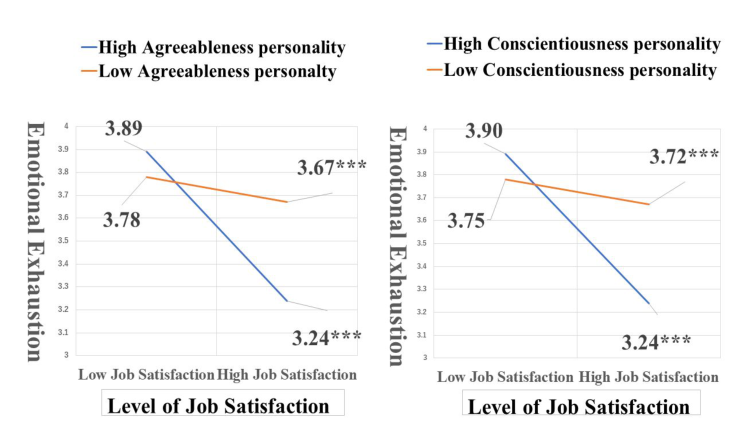
Figure 1: Interactions of job satisfaction and personalities: Job satisfaction and Agreeableness (left) & Job satisfaction and Conscientiousness (right).
Interactions of Job Satisfaction and Personalities Hypothesis 4 predicted that the interaction of job satisfaction and dimen- sions of Big Five personalities moderates emotional exhaustion in customer service employees. Table 2 shows a significant interaction of job satisfaction with Agreeableness (B = −.662, p <.05, 1F=4.760, 1R2= .008), as well as with Conscientiousness (B = −1.114, p <.01, 1F=2.877, 1R2= .031 ); thus, Hypothesis 4 was partially supported concerning the interactions of job satisfaction and Agreeableness, as well as with Conscientiousness.
Figure 1 shows the interaction of job satisfaction with Agreeableness (Figure 1, left) and job satisfaction with Conscientiousness (Figure 1, right). When employees’ high job satisfaction and high Agreeableness interact, the interaction shows an effect whereby employees’ emotional exhaustion is significantly moderated and reduced. Conversely, low job satisfaction and low Agreeableness interaction do not affect emotional exhaustion (see Figure 1, left).
Figure 1 also shows the interaction of job satisfaction with Conscienti- ousness. High job satisfaction and high Conscientiousness interaction show an effect wherein employees’ emotional exhaustion is significantly modera- ted and reduced. Conversely, low job satisfaction and low Conscientiousness interaction do not affect emotional exhaustion (see Fig. 1, right).
DISCUSSION AND IMPLICATIONS Previous studies show that employees in any profession are at risk of emo- tional exhaustion (Brotheridge & Grandy, 2002). However, human service employees or customer service employees are at high risk of being emotionally depleted (Schaufeli, 2003). One of the reasons may be that customer service
Interactions of Job Satisfaction with Personality Could Avoid Emotional Exhaustion 65
employees are subject to the emotional display rule. The emotional display rule explains that employees display emotions using attitudes, facial expres- sions, and conversations to achieve the goals of an organization (Ekman & Friesen, 1975). The emotional display rule is a behavioral standard that indi- cates what emotions are appropriate, how employees should publicly express their emotions in a given situation, and how those emotions are commu- nicated (Ekman, 1973). Therefore, customer service employees must show appropriate emotions to customers by using attitudes, facial expressions, and conversations; this may be one of the causes of stress.
Study results indicated that most participants (65.78%) perceived that they had experienced emotional exhaustion; their collective emotional exhaustion yielded a mean score of 3.56 on a 5-point Likert scale, indicating that the employees perceived emotional exhaustion during the COVID-19 pandemic in March 2021.
The primary purpose of this study was to identify the personality traits of customer service employees who are more likely to experience emotio- nal exhaustion from interacting with customers and identify characteristics of individuals who can avoid emotional exhaustion. The results indicated that almost all Big Five personalities except openness to experience were equally and negatively related to emotional exhaustion. Therefore, environ- mental, situational, and social factors during the COVID-19 pandemic might influence employees’ emotional exhaustion rather than their personality traits. Conversely, previous research on the Big Five personality dimensions repeatedly found that neuroticism (the opposite of emotional stability) was positively related with emotional exhaustion (Bakker et al., 2006).
The second purpose of this study was to examine the interaction effects of the personalities and job satisfaction on emotional exhaustion to determine whether those interaction effects could reduce their emotional fatigue. The results showed that Agreeableness was negatively related to emotional exhau- stion. Especially, a high score in Agreeableness interacting with a high score on job satisfaction indicated that an employee easily moderates and reduces emotional exhaustion (see Figure 1, left). This result is consistent with pre- vious research indicating that individuals with high levels of agreeableness accomplish their tasks even when confronting many stressful experiences. Cropanzano et al. (2003) found conceptually similar effects that were parti- cularly beneficial to service workers’ resources. This result also showed that Conscientiousness was negatively related to emotional exhaustion. A high score in Conscientiousness interacting with a high score in job satisfaction indicated that an employee easily moderates and reduces their emotional exh- austion (see Figure 1, right). This result is consistent with a previous study that described that highly conscientious individuals are involved in their work and are persistent, reliable, hardworking, well-organized, and purposeful employees. Storm and Rothmann (2003) found associations between high conscientiousness and lower emotional exhaustion.
Finally, similar surveys and analyses should be carried out in other coun- tries and their results compared with this study to determine future research directions.
66 Okabe
ACKNOWLEDGEMENT
JSPS KAKENHI Grant Number JP19K13800 supports this work.
REFERENCES
Bakker, A. B., Dollard, M. F., Lewig, K.A. & Van Der Zee, K. I., (2006). The relationship between the big five personality factors and burnout: A study among volunteer counselors. The Journal of social psychology, 146(1), pp. 31–50. Barrick, M. R., Mount, M. K., & Judge, T. A., (2001). Personality and performance
at the beginning of the new millennium: What do we know and where do we go next? International Journal of Selection and Assessment, 9(1-2), pp. 9–30. Brotheridge, C. M., & Grandey A. A., (2002). Emotional labor and burnout: Comparing two perspectives of “people work”. Journal of Vocational Behavior, 60(1): pp. 17–39. Cordes, C. L., & Dougherty, T. W., (1993). A review and an integration of research
on job burnout. Academy of Management Review, 18(4), pp. 621–656. Cropanzano, R., Rupp, D. E., & Byrne, Z. S., (2003). The relationship of emotional exhaustion to work attitudes, job performance, and organizational citizenship behaviors. Journal of Applied Psychology, 88(1), p. 160. Ekman, P., (1973). Cross-cultural studies of facial expression. P.Ekman (Ed.), Darwin
and facial expression: A century of research in review: pp. 169–222. New York: Academic Press. Ekman, P. & Friesen, W.V., (1975). Unmasking the face: A guide to recognizing emotions from facial cues. Englewood Cliffs, NJ: Prentice Hall. Goldberg, L. R., (1992). The development of markers for the Big-Five factor
structure. Psychological Assessment, 4(1), p. 26. Gosling, S. D., Rentfrow, P. J., & Swann Jr, W. B., (2003). A very brief measure of the Big-Five personality domains. Journal of Research in personality, 37(6), pp. 504–528. Hobfoll, S. E., (1989). Conservation of resources: A new attempt at conceptualizing
stress. American psychologist, 44(3), p. 513. Lee, R. T., & Ashforth, B. E., (1996). A meta-analytic examination of the correlates of the three dimensions of job burnout. Journal of Applied Psychology, 81(2), p. 123. Licata, J. W., Mowen, J. C., Harris, E. G., & Brown, T. J., (2003). On the trait ante-
cedents and outcomes of service worker job resourcefulness: A hierarchical model approach. Journal of the Academy of Marketing science, 31(3), pp. 256–271. Maslach, C., (1978). The client role in staff burnout. Journal of Social Issues, 34(4), pp. 111–124. Maslach, C., (1982). Burnout: The cost of caring. New York: Prentice-Hall. Maslach, C., & Jackson, S. E., (1984). Patterns of burnout among a national
sample of public contact workers. Journal of Health and Human Resources Administration, pp. 189–212. Pines, A., & Aronson, E., (1988). Career burnout: Causes and cures. New York: Free Press. Rice, S., Winter, S. R., Doherty, S., & Milner, M. (2017). Advantages and disadvan-
tages of using internet-based survey methods in aviation-related research. Journal of Aviation Technology and Engineering, 7(1), 5. Robinson, S.L. & Rousseau, D.M., (1994). Violating the psychological contract: Not the exception but the norm. Journal of Organizational Behavior, 15(3): pp. 245–259.
Interactions of Job Satisfaction with Personality Could Avoid Emotional Exhaustion 67
Rod, M., Ashill, N. J., Shao, J., & Carruthers, J., (2009). An examination of the relationship between service quality dimensions, overall internet banking service quality and customer satisfaction: A New Zealand study. Marketing Intelligence & Planning. Schaufeli, W. B., (2003). Past performance and future perspectives of burnout
research. SA Journal of Industrial Psychology, 29(4), pp. 1–15. Storm, K., & Rothmann, S., (2003). The relationship between burnout, personality traits and coping strategies in a corporate pharmaceutical group. SA Journal of industrial psychology, 29(4), pp. 35–42. Watson, D., & Clark, L. A., (1984). Negative affectivity: The disposition to
experience aversive emotional states. Psychological Bulletin, 96(3), p. 465. Witt, L. A., Burke, L. A., Barrick, M. R., & Mount, M. K., (2002). The interactive effects of conscientiousness and agreeableness on job performance. Journal of Applied Psychology, 87(1), p. 164. Wright, K. B. (2005). Researching Internet-based populations: Advantages and disa-
dvantages of online survey research, online questionnaire authoring software packages, and web survey services. Journal of computer-mediated communica- tion, 10(3), JCMC1034.
LISTED IN THE AHFE DIGITAL BOOKSTORE CATALOGUE
Explore the complete digital volume
Cross-Cultural Decision Making
Read this individual research paper free through the original publisher, or explore the full digital proceedings book.
ISBN 978-1-958651-20-9
Explore this ISBN in the AHFE Bookstore ↗Listed in the July 2026 bookstore catalogue; search by ISBN to confirm current availability · Digital book purchase optional