Ifumi Akasaka (2022). On Localization Design in Transnational Marketing - The Example of Starbucks. In: Cross-Cultural Decision Making. AHFE Open Access, vol. 44, pp. 16–23. https://doi.org/10.54941/ahfe1001851
Under the impact of the economic globalization across the world and the dual incentive of the flourishing information exchange, local multinational enterprises begin to emerge. Nowadays, the enterprises from all walks of life are under ever increasing pressure from competition at home and abroad. Under such background, let’s take Starbucks as an example herein to specify the cross-cultural barriers the multinational companies have to tackle in their marketing, such as language differences, religious beliefs, cultural values, etc., and interpret their marketing strategies in China in view of such differences: how to well understand accurate market positioning and market segmentation, attach importance to brand localization design to improve the popularity and recognition of multinational enterprises in China, and then consolidate and expand the brand consumer market. The Chinese elements with regard to localization design will be exemplified in aspect of application strategy, festival strategy and regional strategy, with the classified research through the analysis and presentation of these strategies.The localization design of Starbucks is of great help and enlightenment to the brand shaping and marketing strategy of Chinese local coffee brands. China's local coffee brands should pay close attention to transnational marketing strategies, and constantly innovate design to keep up with the market progress and consumer demand, in an effort to balance the localized design and the service of enterprises, and discover the connotation of localized design under the trend of globalization.
With the economic growth of China and the improvement in consumers’ living standards, coffee has become the increasingly popular beverage of Chinese. Moreover, based on Chinese people’s pursuit and affection of “tea culture”, the coffee industry has developed rapidly in China in recent years. The broad market prospect of China’s coffee industry has attracted many internationally prestigious brands to settle in and grab the shares of Chi- nese market, including Starbucks-a current household international brand. International economic and trade exchanges are booming. However, due to the great differences in national culture and social culture among different regions, how to do well in overseas operations of enterprises under different regional cultural backgrounds is a problem that every multinational enter- prise should seriously consider. Therefore, under the background of world economic integration, the “localization design” of enterprises and brands has become one of the important ways to solve cultural differences in transna- tional marketing. If enterprises can fully understand and integrate into local culture in transnational marketing, then culture will become the driving force of enterprises’ transnational operations. Starbucks, the world’s largest coffee
On Localization Design in Transnational Marketing: The Example of Starbucks 17
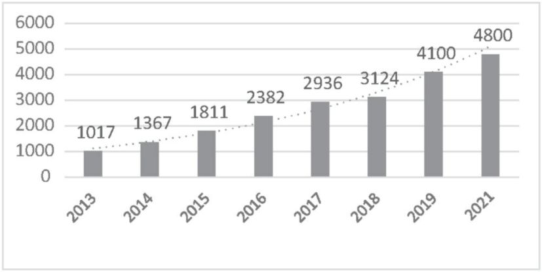
Figure 1: Growth of Starbucks branches in the Chinese market.
chain at present, has its unique cultural marketing method since it entered the Chinese market in 1998. The Starbucks can win the hearts of consumers and brand loyalty in China due to its localization design strategy.
Localization design is necessary for multinational enterprises under the background of huge differences between Chinese and western cultural envi- ronments. By analyzing and summarizing localization marketing strategies of Starbucks in different cultures, enterprises can have a good understan- ding of the inter-cultural operation problems that they should pay heed to in the actual transnational market environment, which has certain practical significance and reference value for them.
OVERVIEW OF STARBUCKS Current Status of Starbucks in China
Starbucks, established in the United States in 1971, is the world’s largest cof- fee chain at present. Its headquarter is located in Seattle, Washington, USA. In 1998, Starbucks entered Taiwan, marking its official entry into the Chinese market. Since Starbucks entered the Chinese market, it has been welcomed by many consumers due to its unique brand personality, various coffee products, thoughtful services and contents. Starbucks pays heed to cultural marketing on the basis of product marketing in this process. Starbucks has designed traditional and fashionable stores and products with local characteristics and in line with the original brand orientation through organic integration of local cultural elements, making consumers experience a fusion of coffee culture and local culture. Such consumption experience has resonated with consumers psychologically and emotionally.
The success of a multinational enterprise at abroad depends on its achie- vements. Starbucks has operated 4,800 branches by 2021 (see Fig. 1) since it opened its 1st store in Beijing in 1999. The market share of Starbucks has reached half of that of international brands in China’s coffee market, and the top three international chain coffee brands are Starbucks, UBC Coffee and Mc Cafe, with market shares of 51%, 12.8% and 6.2% respectively. (CAI, 2021)
18 Ifumi
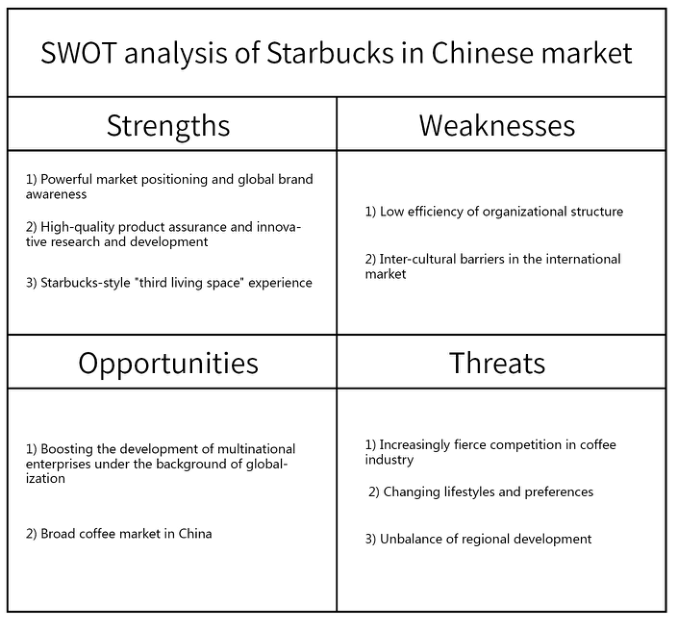
SWOT Analysis of Starbucks in Chinese Market SWOT analysis is a method that can be used to objectively and accurately analyze and study the reality of an enterprise. It organically combines the Company’s strategy with the internal resources and external environment of the company, compares the strengths, weaknesses, opportunities and threats of competitors, and then selects the appropriate development strategy. With the help of SWOT analysis, we can analyze the strengths, weaknesses, oppor- tunities and threats of Starbucks in the Chinese market from the aspect of internal and external environment.
Strengths Powerful market positioning and global brand awareness: For the coffee retailing, Starbucks is currently the world-leading coffee retailer and brand owner as well as the favorite coffee brand. High-quality product assurance and innovative research and development: From the aspect of the product, Starbucks accommodates the research and development and innovation of new products while pursuing excellence in quality, and insists on providing consumers with novel and valuable experiences.
Starbucks-style “third living space” experience: Starbucks changes its brand orientation while marketing its products, reshapes the “coffee cul- ture”, and shifts consumer demands from products to services, and then to experiences. Customers can taste mellow coffee in Starbucks stores which are characterized with high-end atmosphere creation, personalized design, warm lights and soft music. Starbucks has created a warm and belonging culture, giving people a unique “third space” experience.
Weaknesses Low efficiency of organizational structure: Starbucks has more than 1,000 stores in China, and managing so many stores uniformly and efficiently is a challenge for any enterprise. Facing various partners in different regions of China, Starbucks needs to carefully adjust its localization strategy in terms of coordination and unified management. (Xu, 2011).
Expensive products: Starbucks may impede its progress in developing countries for its high pricing. According to China’s national conditions, pro- duct pricing can be mulled on the basis of the purchasing power of local consumer market.
Inter-cultural barriers in the international market: cultures are diverse. Different countries and nationalities vary in cultures under different geogra- phical environments and historical backgrounds. Coffee culture of Starbucks has not been widely accepted in Asia. In the inter-cultural field, enterprises are required to formulate marketing strategies on the basis of cultural diversity, so as to meet local cultural needs in different regions.
Opportunities Boosting the development of multinational enterprises under the background of globalization: the acceleration of worldwide population mobility brings opportunities for Starbucks to promote international brand chain. Globali- zation will increase the scale and frequency of population mobility in different
On Localization Design in Transnational Marketing: The Example of Starbucks 19
Figure 2: SWOT analysis of Starbucks in Chinese market.
regions and countries, and improve the synergy effect of trans-regional and transnational brands.
Broad coffee market in China: tea culture has always been popular in China. In recent years, the development and progress of China has spawned a market with great potential, and coffee culture has become increasingly popular in Chinese consumer market. With the acceptance of different cultu- res in the world and the growing demand of coffee, the huge business space makes China an important development target of Starbucks.
Threats Increasingly fierce competition in coffee industry: The coffee industry mar- ket is almost saturated at present, and fierce competition exists among peers. Furthermore, potential competitors, such as convenience stores, fast food restaurants, designated coffee machines, are squeezing Starbucks’ market share by means of price wars.
Changing lifestyles and preferences: With rising middle class in China, we should be alert to the risk of switching to healthier alternative products while increasing consumption power, which is a future threat to Starbucks in China.
Unbalance of regional development: The development in different regi- ons of China is seriously unbalanced, which leads to differences in people’s
20 Ifumi
incomes in different regions. This threats the unified price of Starbucks in China. In addition, the management, operation and strategy for localization are more important.
ANALYSIS OF STARBUCKS’ LOCALIZATION DESIGN STRATEGY IN CHINESE MARKET Localization refers to the translation, integration and extension of foreign resources to give them local characteristics. The localization of internatio- nal brands is the organic integration of product brands and local culture for enterprises to adapt to the existing market environment, helping customers eliminate their rejection of “foreign goods” psychologically. Localization design is the optimum application of this concept. A good localization design strategy can make the brand integrate into each target market more smoothly, enhance the brand image and complement its image shaping in the internatio- nal market (Chen and Li, 2016). Let’s take the Chinese market as an example. Under the guidance of localization strategy, Starbucks actively integrated into the local culture of the Chinese market in the process of expanding the mar- ket, and made localization improvement in marketing strategy as per different markets.
The chapter will emphasize on expounding the localization design strategy of Starbucks brand and the corresponding case analysis.
Product Design by Use of Chinese Elements For coffee brands, brand products are closely related to the brand image. Outstanding product design can make consumers loyal to the brand. For the core product of Starbucks-coffee, localization has also been carried out by Starbucks as per the Chinese characteristics. Some concrete cases are listed here.
Starbucks® South of The Clouds Blend™, the Starbucks’ first coffee blend to feature coffee beans from China, made its debut to celebrate Chinese New Year at the 10th anniversary celebration of Starbucks’ entry into Chinese mainland market. The design of its packaging is just as its name suggests, adopting the dancing Phoenix and cloud patterns. It is known to all that Phoenix has an excellent implication in Chinese history, and the cloud is also an auspicious image in Chinese traditional culture, both of which are repre- sentative Chinese cultural symbols. As representative colors, red and yellow are widely used on the basis of the rich implications of Phoenix and cloud, and the color saturation is adjusted to make the two colors more harmonious and jubilant and noble at the same time. In other words, it is a product full of Chinese flavor from the inside (Chen and Li, 2016).
Apart from the core product-coffee, Starbucks has tried to take Chinese traditional festivals as an important opportunity to design and roll out new products tailored to local tastes, which is also one of the important means of product design localization of Starbucks. Starbucks has developed a delicacy which is served during the Dragon Boat Festival for Chinese, namely Starbu- cks Dragon Dumpling. After several years of promotion and precipitation, it
On Localization Design in Transnational Marketing: The Example of Starbucks 21
has also become a classic product of Starbucks in the Chinese market. Starbu- cks Dragon Dumplings advertise the marketing slogan of “ingenious festival gifts and also coveted sweets in the afternoon”. It combines the shape and production form of traditional Zongzi (glutinous rice dumplings wrapped in reed) with non-traditional fillings (such as mocha chocolate, mango, coffee, matcha red bean) wrapped by the transparent ice skin, forming a distinctive delicacy. Moreover, the environmental protection bag designed with the ele- ment of reed adopts the fresh and bright theme for Dragon Boat Festival, with the emerald reed as the main element and color, and a variety of designs for selection.
Starbucks is not limited to the original brand positioning and product features, actively upgrades its products, and product design innovations including the products and packaging, so as to meet the shopping needs of consumers and attract more consumers.
Localization Design in Experiential Marketing The key to Starbucks’ success is the “experiential marketing”: to focus mar- keting on service and cultural value while striving to provide consumers with high-quality products, and create an experiential “third space” for consu- mers. The core of consumers’ demand has shifted from product to service, and then to experience. The integration of local cultural elements while cre- ating experience space is an important means of localization marketing for Starbucks. Dedicated designers are available in the Starbucks team, and each store not only retains a unified brand image style, but also highlights the application of local cultural elements.
Let’s take Starbucks (Xintiandi) as an example. Xintiandi retains and cre- atively develops the characteristics of Shikumen architecture in Shanghai, while Starbucks (Xintiandi) is transformed from several existing townhouses in the base. On the premise of simplicity and beauty of Shikumen building, the storefronts choose colors that are in harmony with the black, white and gray of Shikumen building, as well as the black and white photos of old Shanghai to complement the original charm of the building. These localized architectural designs are not merely local traditional symbols collages, but also works that really integrate brand culture with local culture after having a deep understanding of local culture (Hu and Ling, 2009). Consumers can enjoy the historical stance of the city and immerse themselves in the unique regional culture while consuming.
Let’s take another Starbucks “Zhenxuan” baking workshop in Shanghai as an example. It is the first coffee baking shop in China to open its pro- duction line in a shopping mall, and is designed on the theme of “baking workshop”, showing the whole production process from raw coffee beans to coffee. The coffee bean production line presenting in the business store is not the only innovation. The store has incorporated many ingenious local inno- vative designs into its space design, for example, the design of the in-store bar combines the inspiration of traditional Chinese tea sets, and simulates the image characteristics of Chinese trapezoidal tea fields in texture, crea- ting a unique oriental meaning. The in-store ceiling boards simulate lanterns
22 Ifumi
during Chinese Lantern Festival, and the visual design takes Chinese elements as the main expression form (Li and Shang, 2021). Starbucks places the coffee production line into the baking workshop, and consumers get a brand-new coffee experience of “third space” full of localization. This localized experi- ential marketing model represents humanistic care for local consumers, and imperceptibly promotes consumption.
Establishment of Brand Localization Image After Starbucks entered the Chinese market, it does not simply copy exi- sting products and experiential marketing to foreign cultural soil and give Chinese cultural symbols. From the perspective of the organic integration of visual culture, design aesthetics and product marketing, symbolization can make products and buildings exude local charm and then stimulate consum- ption. But the localization of the brand can give consumers a deep impression emotionally.
For example, integrating local traditional culture into the brand logo to create a brand image characterized with localization. The brand image logo of Starbucks is unique, i.e., image of a twin-tailed mermaid. The design aesth- etics of Starbucks culture has been favored by consumers in virtue of the familiar romantic story “Mermaid”, and Starbucks has been committed to creating its own “Mermaid” brand consumption culture. In the marketing model of China, Starbucks will unveil a variety of ritualized insulated cups and drinking cups with seasonal changes, regional festivals and anniversaries. Specific Chinese festival elements are added to the original theme of “Mer- maid”. In recent years, Starbucks has attached great importance to bringing “ethnic elements” into the visual culture system of Chinese products, such as the moon cake gift box for Mid-Autumn Festival, which combines the Chi- nese folk tale of “Chang’e Flies to the Moon” with the element of “mermaid” of Starbucks. Another example is the Chinese-style “Zodiac Cup” products rolled out by Starbucks, in which “Zodiac Cup” for the Year of the Rooster also combines Starbucks’ core brand image of “Mermaid” with “Chinese Zodiac” culture.
The same localization method is also applied in Starbucks’ new media promotion. For instance, Starbucks’ official WeChat account. Starbucks has followed the festival strategy for product design in the design and publicity strategy of its official WeChat account, i.e., taking local traditional festivals as the selling point, the local culture is integrated into the interface design and content design of official WeChat account to highlight the brand characteri- stics (Xu, 2014). That is to say, traditional festivals used as the selling points while maintaining the unity with the overall brand design, has successfully created a brand image tailored to Chinese consumers, tying brand image of Starbucks with local culture over time to win the affection and trust of local consumers and stimulate consumption.
RESEARCH CONCLUSION AND FUTURE PROSPECT Through the analysis of Starbucks localization design strategy, it is not diffi- cult to notice that the localization design strategy of “When in Rome, do as
On Localization Design in Transnational Marketing: The Example of Starbucks 23
Romans do” has become the only way for enterprises with the inter-cultural deep promotion of brand. In transnational marketing strategy of Starbucks in China, Starbucks respects local culture and combines with different design concepts, so that it could develop rapidly in China’s local market, and win the opportunity to display other cultures or products for itself, which was recognized by consumers. The product design strategy of traditional Chinese elements, the experience space strategy of creating localized atmosphere, or the brand image propaganda strategy rooted in traditional festivals reflect Starbucks’ respect for the local culture of the Chinese market. Similarly, domestic brands that are about to enter the international market or have already entered the international market should respect the local culture of the target market.
Therefore, if Chinese local coffee brands want an ever-expanding market, the inter-cultural localization design of brands is vital, which requires local coffee brands to keep the traditional elements of design together, but also to follow the trend of the times, meet the needs of consumers, constantly inject new elements and vitality into brand and product design, and expand the design vision. In addition, the design of art and service should be refined in modern society where global cultures and products conflict.
REFERENCES
Cai, Z.R. and Cai, L.W. (2021). Research on the Marketing Strategy of Starbucks in Chinese Market. Chinese Commerce, 20, pp. 52–55. Chen, X.H. and Li, X. (2016). Analysis on the Design Strategy of the Chinese
Localization of Starbucks Coffee. Journal of Brand Research, 03, pp. 71–76. Hu, D. and Ling, L. (2009). Starbucks in China, Local Relevance of Global Brands.
Time+Architecture, 03, pp. 126–127. Li, Q. and Shang, Y.N. (2021) Research on the third space design based on user emotional experience -- Taking Starbucks and Hey Tea as an example. Beauty and Times, 02, pp. 53–56. Xu, J. (2014). Study on Starbucks’ Experiential Marketing on Weibo and We-
chat[online]. Available from: https://kns.cnki.net/kcms/detail/detail.aspx?FileN ame=1015397614.nh&DbName=CMFD2016 [accessed 01 October 2014]. Xu, S.H. (2011). SWOT analysis and strategic countermeasures of Starbucks based on core competitiveness. Modern Business, 09, pp. 20–21.
LISTED IN THE AHFE DIGITAL BOOKSTORE CATALOGUE
Explore the complete digital volume
Cross-Cultural Decision Making
Read this individual research paper free through the original publisher, or explore the full digital proceedings book.
ISBN 978-1-958651-20-9
Explore this ISBN in the AHFE Bookstore ↗Listed in the July 2026 bookstore catalogue; search by ISBN to confirm current availability · Digital book purchase optional