Mohammad Rashed Khan (2024). Application of Artificial Intelligence for Talent Management: Challenges and Opportunities. In: Intelligent Human Systems Integration (IHSI 2024): Integrating People and Intelligent Systems. AHFE Open Access, vol. 119, pp. 324–329. https://doi.org/10.54941/ahfe1004496
Artificial Intelligence (AI) is a rapidly advancing field encompassing different applications across different industries. Managements of big multinational organisations and even local medium-sized enterprises are using AI for improving efficiency, productivity, decision-making, and overall business performance. Firms’ human resource management (HRM) integrates AI and other applications based on AI for managing people within organisations. Utilising AI for talent management involves leveraging artificial intelligence techniques and tools to optimise various aspects of the employee lifecycle, from recruitment and selection to employee development and engagement. leveraging AI in talent management can update recruitment processes, enhance decision-making, and enable personalised employee development. It has the potential to optimise HR operations and improve overall workforce management for organisations. While AI offers numerous benefits in talent management, challenges arise in terms of data quality and privacy, potential lack of human judgment in complex decisions, ethical considerations related to biases in AI algorithms, user acceptance and trust, and the need for a skilled and adaptable workforce. This study aims to investigate the challenges and opportunities of using AI for talent management within organisations to assist them in making informed decisions and implementing effective strategies to harness the potential of AI in optimising their talent acquisition and development efforts. Both primary and secondary data will be collected. An interview method will be applied to collect primary data from different organisations’ HR managers. Secondary data will be gathered from different organisations’ published reports and articles along with other academic reliable resources. The findings of this research will provide valuable insights for companies aiming to apply AI effectively in talent management strategies by overcoming the challenges.
In the era of rapid technological advancement, the integration of Artificial Intelligence (AI) has revolutionised various facets of organizational manage- ment (DSouza, 2019). One such critical domain undergoing transformation is Talent Management (TM), a core function of Human Resources (HR) (Abdeldayem and Aldulaimi, 2020). This paper delves into the challenges
Application of Artificial Intelligence for Talent Management: Challenges and Opportunities 325
and opportunities presented by the application of AI in TM, drawing insights from a comprehensive systematic literature review. As organizations strive to optimize their human capital and adapt to the evolving landscape of the future workforce, the role of AI in TM becomes paramount. The synergy of advanced algorithms, data analytics, and machine learning offers unprece- dented capabilities for identifying, acquiring, developing, and retaining top talent (Alexandru et al. 2022). However, this transformation is not with- out its complexities. The purpose of this paper is to critically examine the existing body of literature, providing a nuanced understanding of the chal- lenges and opportunities associated with the infusion of AI in TM practices. From addressing ethical considerations to navigating privacy concerns and exploring the potential biases inherent in AI algorithms, this review aims to shed light on the multifaceted dimensions of this dynamic intersection. By unravelling the complexities surrounding AI’s role in TM, this paper seeks to contribute valuable insights to practitioners, researchers, and policymakers navigating the ever-evolving landscape of HR technology. Through a sys- tematic exploration of the current state of literature, we aim to provide a foundation for future research endeavours and strategic decision-making in the realm of talent optimization.
METHODOLOGY
The research adopts a secondary data collection approach and compre- hensively analyses existing scholarly works by systematically reviewing the literature, ensuring a rigorous and structured examination of the application of AI in TM (Tranfield et al. 2003). The systematic approach enhances the reliability and validity of the findings, enabling a nuanced understanding of challenges and opportunities.
Electronic databases, including but not limited to PubMed, IEEE Xplore, Scopus, and Google Scholar, are systematically queried using a combination of keywords such as “Artificial Intelligence,” “Talent Management,” “HR Tech,” and related terms. The search is not restricted by publication date to encompass a broad temporal scope (James et al. 2012).
Articles and papers are included if they focus on the application of AI in TM, addressing challenges and opportunities. Exclusion criteria involve works not available in English, those lacking peer review, or those not directly relevant to the specified research focus.
The quality of selected literature is assessed using established criteria, con- sidering factors such as research design, methodology, and the rigour of analysis (Tranfield et al. 2003). This step ensures the inclusion of high-quality studies, enhancing the robustness of the review.
A thematic analysis approach is employed to identify patterns, trends, and consistencies within the literature. Emerging themes related to challenges and opportunities in the application of AI for TM are synthesized and presented.
While every effort is made to ensure a comprehensive review, limitations include potential publication bias and the dynamic nature of technological advancements. These limitations are acknowledged to provide transparency regarding the scope of the study (Moher et al. 2010).
326 Khan
WHAT IS TALENT MANAGEMENT?
The term Talent Management (TM) is not a recent creation; it has histori- cal roots dating back to a 1957 document from the American Management Association (Dooher and Marting, 1957 cited from Ansar and Baloch, 2018). Different scholars variously explained this term. According to Sloan et al (2003) TM is “Managing leadership talent strategically, to put the right per- son in the right place at the right time” (P. 236). Pascal (2004) states that Talent Management comprises “managing the supply, demand, and flow of talent through the Human Capital Engine” (p. 9).
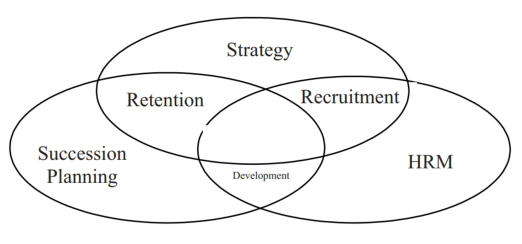
Blass (2009) created an illustrative model depicting the domain of Tal- ent Management (TM) and its various constituent factors, as illustrated in Figure 1.
Thus, TM is a comprehensive organizational strategy that involves attract- ing, developing, and retaining skilled individuals to ensure sustained business success (Quilliam, 2023). It encompasses a range of human resource practices designed to identify and nurture high-potential individuals, align their skills with organizational goals, and foster their career progression within the com- pany. There are three key aspects of TM: i) employee acquisition, ii) employee development, and iii) employee retention (Faqihi and Miah, 2023).
AI APPLICATIONS IN TALENT MANAGEMENT Artificial Intelligence involves the endeavour to create intelligent machines, where intelligence is defined as the ability of an entity to function effec- tively and with foresight in its surroundings (Wang et al. 2015 cited from Abdeldayem and Aldulaimi, 2020). AI has emerged as a transformative force in TM, revolutionizing traditional human resource practices (Charlwood, 2021). The integrations of AI technologies into Talent Management systems are as follows.
Recruitment and Candidate Screening: AI-driven tools are increasingly utilized for automating recruitment processes. Automated screening algo- rithms, leveraging machine learning, analyze resumes and candidate profiles, streamlining the initial stages of recruitment (Davenport and Ronanki, 2018).
Application of Artificial Intelligence for Talent Management: Challenges and Opportunities 327
Employee Performance Analysis: AI contributes significantly to the anal- ysis of employee performance. Predictive analytics models utilize historical performance data to forecast future outcomes, aiding in identifying high- potential individuals and areas for improvement (Marler and Boudreau, 2017). Learning and Development: AI-powered learning platforms offer person- alized training experiences. Machine learning algorithms assess individual learning patterns, tailoring content to meet specific needs (Van Dam, 2019).
Succession Planning: In the realm of succession planning, AI assists in identifying and nurturing future leaders. Predictive modelling, coupled with performance data, helps organizations identify employees with the potential for leadership roles (Davenport and Ronanki, 2018).
The integration of AI applications across these facets of TM underscores the transformative impact of technology in shaping the future of workforce management.
SYNTHESIS OF LITERATURE The synthesis of literature unveils a comprehensive understanding of the current landscape surrounding the application of AI in TM. As we delve into the synthesized findings, distinct patterns and themes emerge, shed- ding light on the challenges and opportunities inherent in this transformative intersection.
Advantages and Opportunities: Numerous studies underscore the myriad advantages presented by AI in TM. The seamless integration of AI-driven recruitment tools such as recruiting chatbot and CV-screening software expe- dites the hiring process, ensuring a more efficient and objective candidate selection (Davenport and Ronanki, 2018; Van Dam, 2019; Ore and Sposato, 2022). AI tools enhance objectivity, reduce bias, and accelerate the identifi- cation of suitable candidates. Furthermore, AI’s role in predicting employee performance and identifying high-potential individuals enhances strategic decision-making in talent development and succession planning (Marler and Boudreau, 2017). The application of Artificial Intelligence facilitates proac- tive talent development strategies within organizations. Human resource managers are deploying technology, including AI and TM applications, to implement effective retention strategies, leveraging predictive analytics and pulse surveys for early intervention and insight into employee senti- ments (Faqihi and Miah, 2023). The synthesis reinforces the notion that AI, when applied judiciously, offers unparalleled opportunities for optimizing talent-related processes.
Challenges and Ethical Considerations: However, the synthesis also unrav- els the intricacies and challenges associated with the adoption of AI in TM. The pervasive concern of algorithmic bias looms large, raising questions about the fairness and equity of AI-driven decision-making processes (Vanian, 2018). The drawbacks of using AI in recruitment and selection include the potential erosion of human qualities like empathy and emotion crucial for cultural fit assessments and interpersonal activities. Ethical concerns, par- ticularly regarding bias and discrimination, arise with the use of AI. Studies
328 Khan
warn that AI, if not carefully managed, could introduce biases that dispropor- tionately affect underrepresented groups, leading to potential lawsuits and irreparable brand damage due to discriminatory practices (Upadhyay and Khandelwal, 2018). Another disadvantage is low trust in AI-driven decisions which can have a negative impact on talent development and retention. Stud- ies indicate that individuals frequently harbour scepticism towards AI due to a lack of comprehension regarding its functioning, the relinquishment of deci- sion control, and the perception of algorithmic decisions as impersonal and overly simplistic (Schmid and Raveendhran, 2022).
The literature emphasizes the urgency of addressing these challenges to foster a responsible and inclusive AI-powered TM ecosystem. The synthe- sis further illuminates the imperative of seamless integration and ongoing refinement. Organizations aspiring to harness the full potential of AI in TM must prioritize the integration of these technologies into existing systems (Davenport et al. 2018). To alleviate algorithm aversion, a viable approach involves educating users on how to engage with AI tools. TM leaders uti- lizing AI tools for decision-making should undergo statistical training. This training can empower them to interpret algorithmic recommendations with confidence. Another way to reduce the challenge of AI research suggests that people are more comfortable with algorithmic decisions when they have some control, even minimal, over the final decision. Trust in AI-driven decisions is higher in objective domains. Thus, strategically choosing TM decisions suit- able for AI and involving HR professionals in co-creating solutions with AI recommendations are key to building trust (Schmid and Raveendhran, 2022).
CONCLUSION
In conclusion, this systematic literature review provides a panoramic view of the current applications, challenges, and opportunities associated with the integration of AI in Talent Management. While the potential benefits are substantial, a cautious and ethical approach is paramount to navigate the complexities and ensure a fair, inclusive, and efficient TM process.
REFERENCES
Abdeldayem, M. M., and Aldulaimi, S. H. (2020). Trends and opportunities of artificial intelligence in human resource management: Aspirations for public sector in Bahrain. International Journal of Scientific and Technology Research, 9(1), 3867–3871. Alexandru, B. V., Arabela, B., and Daiana, M. M. (2022). Advantages and Disadvan-
tages of Using Artificial Intelligence in the Recruitment and Selection Processes in the Context of COVID-19. Labour Market New Challenges: The COVID-19 Pandemic Context, 3. Ansar, N. and Baloch, A. (2018). Talent and talent management: definition and issues. IBT Journal of Business Studies (JBS), 1(2). Available at: 14.pdf (ilmau- niversity.edu.pk). Charlwood, A. (2021). Artificial intelligence and talent management. Digitalised
talent management, 122–136.
Application of Artificial Intelligence for Talent Management: Challenges and Opportunities 329
DSouza, P. K. (2019, November). Absolute answerability in the Era of Artificial Intelligence and Machine Learning: A talent management perspective. In 2019 International Conference on Digitization (ICD) (pp. 8–13). IEEE. Davenport, T. H. and Ronanki, R. (2018). Artificial intelligence for the real
world. Harvard business review, 96(1), pp. 108–116. Faqihi, A., and Miah, S. J. (2023). Artificial Intelligence-Driven Talent Management System: Exploring the Risks and Options for Constructing a Theoretical Foundation. Journal of Risk and Financial Management, 16(1), 31. James, M. S., Marrissa, C., Mark, S., and Anthea, B. (2021). Systematic Approaches
to a Successful Literature Review. Systematic Approaches to a Successful Litera- ture Review, 1–100. Marler, J. H., and Boudreau, J. W. (2017). An evidence-based review of HR Analytics. The International Journal of Human Resource Management, 28(1), 3–26. Moher, D., Liberati, A., Tetzlaff, J., Altman, D. G., and Prisma Group. (2010). Pre-
ferred reporting items for systematic reviews and meta-analyses: The PRISMA statement. International journal of surgery, 8(5), 336–341. Ore, O., and Sposato, M. (2022). Opportunities and risks of artificial intelligence in recruitment and selection. International Journal of Organizational Analysis, 30(6), 1771–1782. Pascal, C. (2004). Foreword. In A. Schweyer (Ed.), Talent management systems:
Best practices in technology solutions for recruitment, retention, and workforce planning. Canada: Wiley. Quilliam, G. G. (2023). Factsheet: Talent Management, The Chartered Institute of Personnel and Development, Talent Management | Factsheets | CIPD. Schmid, J., K. and Raveendhran, R. (2022). Talent Management, Where AI Can —
and Can’t — Help Talent Management, Harvard Business Review Where AI Can — and Can’t — Help Talent Management (hbr.org). Sloan, E. B., Hazucha, J. F. and Van Katwyk, P. T. (2003), “Strategic Management of Global Leadership Talent”, Advances in Global Leadership (Advances in Global Leadership, Vol. 3), Emerald Group Publishing Limited, Leeds, pp. 235–274. Tranfield, D., Denyer, D., and Smart, P. (2003). Towards a Methodology for Develop-
ing Evidence-Informed Management Knowledge by Means of Systematic Review. British Journal of Management, 14(3), 207–222. https://doi.org/10.1111/1467- 8551.00375 Upadhyay, A. K., and Khandelwal, K. (2018). Applying artificial intelligence: implications for recruitment. Strategic HR Review, 17(5), 255–258. Van Dam, R. (2021). Predicting Employee Attrition (Doctoral dissertation, Tilburg
University). Wang, D., Han, H., Zhan, Z., Xu, J., Liu, Q., and Ren, G. (2015). A problem solving oriented intelligent tutoring system to improve students’ acquisition of basic computer skills. Computers & Education, 81, 102–112.
LISTED IN THE AHFE DIGITAL BOOKSTORE CATALOGUE
Explore the complete digital volume
Intelligent Human Systems Integration (IHSI 2024): Integrating People and Intelligent Systems
Read this individual research paper free through the original publisher, or explore the full digital proceedings book.
ISBN 978-1-958651-95-7
Explore this ISBN in the AHFE Bookstore ↗Listed in the July 2026 bookstore catalogue; search by ISBN to confirm current availability · Digital book purchase optional