Ramon Moreno Bravo, Rodolfo Martinez Gutierrez, Roberto Castro Bojorquez, Juan Gualberto Flores Velazquez (2023). QHS methodology to develop competency standards for talent management in customs agency. In: Human Systems Engineering and Design (IHSED 2023): Future Trends and Applications. AHFE Open Access, vol. 112, pp. 528–533. https://doi.org/10.54941/ahfe1004166
A customs agency that integrates the services of tariff classification, maritime clearance and supply chain services, must comply with regulations of legal requirements, implying a constant specialization in the management of talent in operations management, the development of a quality management system contributes to continuous improvement processes, with the implementation of the QHS methodology, competency standards will be developed to certify the specialized talent of the staff, ensuring the learning curve and generational change to consolidate the KPIs of customer satisfaction.
In foreign trade business, customs agencies represent the solution to compa- nies on the challenges of importing, dispatching, transporting, marketing and providing logistics services for products and merchandise, derived from this, the processes of continuous improvement at each stage of the development of operations in a customs agency represents an opportunity for operational excellence through projects in procedures and optimization of activities to comply with the level of customer satisfaction. This article represents the efforts of a master’s thesis research project in administration to design a proposal for a standard of talent management competencies in a customs agency.
Since the publication in the official badge of the federal government in Mexico, the Mexican Standard NMX-R-026-SCFI-2016 has become a ref- erence for continuous improvement practices and proposals for new NMX and Standards of labor competencies for certification programs of knowl- edge, skills and attitudes as is the case of the standards issued by the National Council for Standardization and Certification (CONOCER); The standards of competencies for customs agencies that have been characterized by con- tributing to the empowerment of knowledge, skills and attitudes; one of the first competency standards developed and published was position-oriented
QHS Methodology to Develop Competency Standards for Talent Management 529
with the function of Tariff Classifier, Merchandise Classifier and Customs Classifier; persons who work in the activities of tariff classification of goods, foreign trade, verification of customs documentation, inspection of foreign trade goods, merceological identification of goods and the assignment of tariff classification to foreign trade goods, contributing strategically to the strengthening of the competitiveness of the value chain of the supply chain sector of customs agencies (Madrigal, 2017).
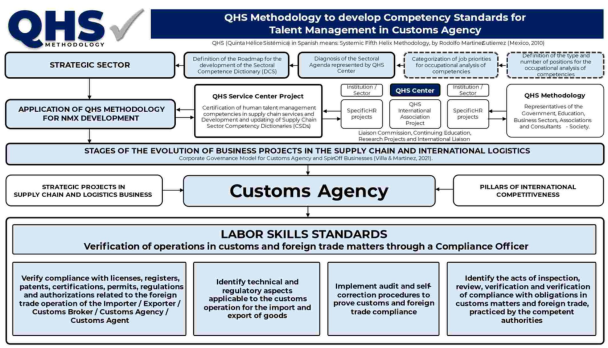
QHS Methodology as Support to Build Labor Standards The initial challenge is to build the intervention instruments with specialists and opinion leaders from all sectors of society with experience in customs agencies, applying the QHS Methodology (2010, 2022), for in-depth inter- views and oriented surveys to determine the functional map of knowledge, skills and attitudes necessary for the functions considered as the requirements indicated in NMX-R-026-2016 and with a Business Model approach. Cus- toms Agency (Garcia, 2021), the roadmap presented in Figure 1 was carried out to contribute to the design of standards that strengthen the competitive- ness of customs services; representing the activity of Tariff classification of foreign trade goods; one of the main topics of specialty required in the Cus- toms Agencies, even in the academic training of the students of Engineering in Logistics with specialty in Tariff Classification becomes a challenge play correctly this critical operation, likewise the knowledge of the merceologicall science is a competence required at the level of expert in a customs agency. For the design of new standards of competences, the importance of consid- ering three key axes has been considered: 1) Administration of operations of the customs agency, 2) Quality Management System of the Customs Agency and 3) Develop a System of Social Responsibility of the Customs Agency. As a comprehensive strategy of the Business Model oriented to good practices of Corporate Governance in the value chain of a customs agency. The proposals of Mexican Standards and Competency Standards are models of good prac- tices of systematic work supported by methodologies and specialists. (Rios, 2022).
Figure 1: QHS methodology. (Adapted from Martinez, 2010.)
Table 1 presents the results of the standards selected as good practices to make new proposals according to the Mexican Standard of requirements for a Quality System in a Customs Agency (NMX-R-026-SCFI-2016), a challenge that many customs agencies require to prepare a human talent management model by preparing a training and certification process in knowledge, skills, and attitudes necessary to achieve the business philosophy of a customs agency with its clients and society in general.
Table 1. Standards of competences for customs agencies of CONOCER.
Table available in the original PDF paper.
Code Standard name Elements of the standard EC0396 Representation of the customs broker in the acts and formalities of the clearance customs
1. Supervise the acts prior to the dispatch Customs 2. Prepare the customs pediment 3. Dispatch of goods before customs 4. Supervise the acts derived from dispatch Customs EC0432 Tariff classification of foreign trade goods
1. Verify the customs documentation of foreign trade goods 2. Inspect foreign trade goods prior to tariff classification 3. Identify foreign trade goods merceologi- cally 4. Assign tariff classification to foreign trade activities EC1301 Identification, prevention, and mitigation of risks in customs matters and Foreign Trade
1. Identify administrative, criminal, and patrimonial risks in customs and foreign trade matters, in accordance with the legislation and regulations applicable at the federal and local level 2. Establish controls and mitigants through a Compliance program that allows to prevent and avoid the risks previously detected 3. Identify the acts of inspection, review, verification, and verification of compli- ance with obligations in customs matters and foreign trade 4. Implement best corporate practices for the efficient control and management of risks in customs and foreign trade EC1487 Assistance to the customs broker / customs agency as a clerk in the clearance Customs of goods subject to foreign trade
1. Support in the acts derived from the cus- toms clearance of goods for foreign trade purposes 2. Manage the procedures before the dependencies, where their interven- tion is required, for compliance with non-tariff regulations and restrictions
QHS Methodology to Develop Competency Standards for Talent Management 531
DEVELOPMENT OF INNOVATIVE PROPOSALS TO STRENGTHEN CUSTOMS AGENCY BUSINESS
Table 2 describes the compliance requirements for a customs agency to main- tain a Quality Management System and comply with its policies and make a presence in the market of reliability of its operations, finally the business card of a company is proportional to the level of satisfaction of its customers, in terms of quality, Service, cost and delivery time of its services to its cus- tomers, considering the factor of operations management, where planning, organization and control are key points.
Table 2. Mexican standard NMX-R-026-SCFI-2026 for customs agencies.
a) Lines of authority, responsibilities, and assignment of functions of all staff, including managers b) Lines of authority, responsibilities, and assignment of functions of all staff, including managers Inventory Inventory of: a) Real estate, work areas and associated services of customs agency personnel b) Process equipment: hardware and software; considering security keys and systems, maintenance programs, soft- ware licenses used and support services, transportation, communication, or information systems Personnel Personnel: a) Document profiles and job descriptions for key posi- tions such as: Commodity Sorter, Agent, Documenter and Capturist b) Document recruitment, selection and hiring policies and procedures c) Ensure psychotechnical assessment in key positions d) Provide induction and detection of training needs to staff e) Ensure staff are aware of their responsibilities at the customs agency f) Implement job skills certification program g) Implement performance evaluation and monitoring pro- gram h) Manage the work environment i) Maintain records of staff competencies Policy Establishment and Strategic Planning
Establish strategic planning, impartiality, and confidentiality a) Determine mission, vision, and values b) Determine and meet your goals c) Commitments to customers, authorities, peers, and society in general for continuous improvement d) Establish policies of impartiality in the services, confiden- tiality, code of ethics, customs broker services e) Establish Quality Management System
CONCLUSION
Innovation efforts require leadership, teamwork and strategic planning ori- ented to corporate governance practices (Larenas, 2017). Systematizing learning curves contributes to generating operations indicators (Munger, 2022), The implementation of labor and professional competency standards are strategies of the senior management of customs agencies to empower key personnel in critical operations and thereby consolidate business operations with KPIs before the market and customers (Bernard, 2018). The value chain in customs agencies is traditionally characterized by a generational crossing learning style, therefore the training systems are personalized, via the four- step method (Perilus, 2021), where the first step; the instructor or expert performs the activity, second step; the apprentice carefully observes how it is done, third step; the learners develop the activity as instructed, and finally the fourth step; The instructor or expert evaluates under the certification scheme their knowledge, performances and products or services developed, as well as the attitudes and behaviors with which the demonstrative effect of the activity of their functions of the position was developed. The activities of strategic planning, Development of business policies under the approach of the organizational structure, contributes to a solid and successful transition to corporate governance practices, in the face of the challenges of increas- ingly competitive supply chain services in the world of trade and customs (Madrigal, 2017).
REFERENCES
Bernard M. (2018) Key performance indicators. The 75 keys that the administrator must know. Trillas DOF 2016 Declaration of validity of the Mexican Standard NMX-R-026-SCFI-2016,
Customs Services - Quality of services provided by the customs broker (quality of the customs broker) - Requirements https://www.dof.gob.mx/nota_detalle.php?co digo=5464149&fecha=06/12/2016#gsc.tab=0 EC0396 Representation of the customs broker in the acts and formalities of the clearance customs https://conocer.gob.mx/RENEC/fichaEstandar.do?method=obtener PDFEstandar&idEstandar=1655 EC0432 Tariff classification of foreign trade goods https://conocer.gob.mx/RENEC
/fichaEstandar.do?method=obtenerPDFEstandar&idEstandar=1698 EC1301 Identification, prevention, and mitigation of risks in customs matters and Foreign Trade https://conocer.gob.mx/RENEC/fichaEstandar.do?method=obten erPDFEstandar&idEstandar=2944 EC1487 Assistance to the customs broker, customs agency as a clerk in the clearance
Customs of goods subject to foreign trade https://www.conocer.gob.mx/conteni do/publicaciones_dof/2022/EC1487.pdf Garcia, J., Gutierrez, R. (2021). Corporate Governance Model for Customs Agency in accordance with Federal Customs Law Article 167-D in Mexico. In: Walde- mar Karwowski, Tareq Ahram, Mario Milicevic, Darko Etinger and Krunoslav Zubrinic (eds) Human Systems Engineering and Design (IHSED2021): Future Trends and Applications. AHFE (2021) International Conference. AHFE Open Access, vol 21. AHFE International, USA. Website: http://doi.org/10.54941/ahfe 1001203
QHS Methodology to Develop Competency Standards for Talent Management 533
Gutierrez, R. (2020) Methodology of the Fifth Helix Systemic, A Decade of Sectorial Investigations 2010-2020, IOP Conference Series: Earth and Environmental Website: https://ui.adsabs.harvard.edu/abs/2021E%26ES..690a2061M/abstract Larenas, R. (2017) Corporate Governance for Medium Enterprises, directory for
profitable and enduring companies. USA Martinez-Gutierrez, R. (2020). Methodology of Dictionaries of Sector Competences (DCS), to Design Standards of Professional Competences, Research and Labor. In: Nazir, S., Ahram, T., Karwowski, W. (eds) Advances in Human Factors in Training, Customs Services- Quality of services provided by customs broker (quality of customs broker) Computing, vol 1211. Springer, Cham. Website: https://doi.org/10.1007/978-3-030-50896-8_46 Martinez-Gutierrez, R., Ibarra-Estrada, M. E., Carey-Raygoza, C. E., Hurtado-
Sanchez, C., Chavez-Ceja, B. (2022). Observatory of Labor, Professional and Research Competencies of the Economic Sectors in Baja California. In: Ahram, T., Taiar, R. (eds) Human Interaction, Emerging Technologies and Future Systems V. IHIET 2021. Lecture Notes in Networks and Systems, vol 319. Springer, Cham. Website: https://doi.org/10.1007/978-3-030-85540-6_164 Martinez-Gutierrez, R., Carey-Raygoza, C. E., Hurtado-Sanchez, C., Chavez-Ceja, B., Lara-Chavez, A. (2021). Business Management Engineers: Profile and Compe- tencies of Generations X, Y and Z. In: Trzcielinski, S., Mrugalska, B., Karwowski, W., Rossi, E., Di Nicolantonio, M. (eds) Advances in Manufacturing, Production Management and Process Control. AHFE 2021. Lecture Notes in Networks and Systems, vol 274. Springer, Cham. Website: https://doi.org/10.1007/978-3-030- 80462-6_36 Madrigal-Torres, B. (2017) Management Skills, McGrawHill Munger K. (2022) Generation Gap. Why the Baby Boomers Still Dominate, American
politics and Culture, Columbia University Press NMX-R-026-SCFI-2016 Customs Services- Quality of services provided by customs broker (quality of customs broker) – Requirements. Website: https://www.dof.go b.mx/nota_detalle.php?codigo=5464149&fecha=06/12/2016#gsc.tab=0 Perilus B. (2021) Four generations under one organization’s roof. A resource for
leading and managing the Baby Boomers, Generation X, The Millennials, and Generation Z. Rios Garcia, D. J., & Hernández Leal, A. (2022). Labor competencies within customs agencies pre and post Covid 19. Vinculatégica EFAN, 8(4), 15–25. https://doi.or g/10.29105/vtga8.4-197
LISTED IN THE AHFE DIGITAL BOOKSTORE CATALOGUE
Explore the complete digital volume
Human Systems Engineering and Design (IHSED 2023): Future Trends and Applications
Read this individual research paper free through the original publisher, or explore the full digital proceedings book.
ISBN 978-1-958651-88-9
Explore this ISBN in the AHFE Bookstore ↗Listed in the July 2026 bookstore catalogue; search by ISBN to confirm current availability · Digital book purchase optional