Jorge Vicente Villa Garcia, Rodolfo Martinez Gutierrez, Rodolfo Martinez Solis, Grecia Arisbeth Hernandez Castañeda (2023). QHS Methodology for Business Intelligence with CRM in Warehouse Services and Foreign Trade Logistics. In: Human Interaction & Emerging Technologies (IHIET 2023): Artificial Intelligence & Future Applications. AHFE Open Access, vol. 111, pp. 872–877. https://doi.org/10.54941/ahfe1004095
Business-oriented companies in the foreign trade supply chain that involve the phase of Merchandise Warehouses and Logistics Services as an added value; They generate, due to their highly specialized nature of the context of global trade, security control implications through risk control systems and integral security of all the processes of the services of the value chain. For the purposes of this study, a research proposal is made through an eclectic methodological proposal combining the QHS methodology and elements of the Business Intelligence methodology, to analyze the information variables of various sources of information of a company; With a multidimensionality approach to find correlation of success in the achievement of operational performance indicators, productivity, and customer satisfaction levels, under a systemic approach.
Innovation processes represent a strategy for strengthening business operati- ons in the value chain of foreign trade and international logistics, generating challenges in applied research processes through postgraduate projects spe- cifically master’s thesis in administration, developed with the purpose of designing proposals for improvement through initiatives of Mexican Stan- dards (NMX) to be used as a guide to good practices in the Administrative and operational management, contributing to the optimal performance of the main performance indicators in companies dedicated to supply chain services, highlighting customs agencies, cross-border transport of goods, warehouses and international logistics.
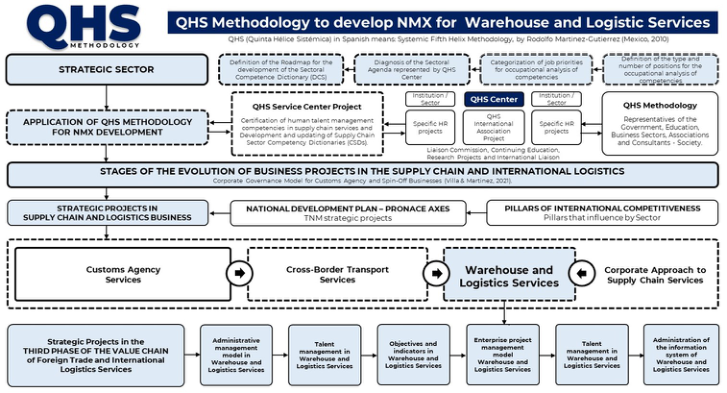
The proposal of Mexican Standard (NMX) for companies of warehouses of goods and provision of logistics services of international trade is presented in Figure 1, representing the roadmap of the strategies to be developed and the eclectic actions of the application of the QHS Methodology that consi- ders the experience of focus groups of the representatives of the society; as
QHS Methodology for Business Intelligence With CRM in Warehouse Services 873
Figure 1: QHS methodology (adapted from Martinez, 2010).
are specialists from government, academia, companies, associations-business chambers and specialized consultants involved in Customer Relationship Management (CRM) models and Business Intelligence models that integrate information from Databases and their systematization into performance indicators.
The referential support that aroused the interest to develop actions of rese- arch projects and improvement initiatives for the warehouse and logistics services sector began with the publication of the Mexican Standard NMX- R-026-SCFI-2016, which represents an alternative State of the Art in the referential context of good practices in companies in the supply chain of foreign trade.
QHS Methodology and Business Intelligence an Eclectic Strategy For conceptual purposes, the strategy developed involves the combination of styles and tools of the QHS Methodology which focuses on identifying and developing the variables for in-depth interview processes and instruments with key questions are applied to the different sectors that are linked to the companies under study; in this case the companies specialized in Warehou- ses and Logistics services for foreign trade, in such a way that interviews are carried out with specialists from the Government, Academia, Compa- nies, Associations-Business Chambers and specialized Consultants, and on the other hand complementary instruments of support of the Business Intel- ligence Methodology are proposed; as is the case the phases of Planning, Requirements and Analysis, Design, Construction and Deployment. This is linked to the approach of the Corporate Governance Model for Customs Agencies proposed by Garcia and Martinez (2021) that considers the inte- gral model of the value chain of the supply chain and international logistics. The services of Warehouse of goods and Logistics represent great challenges in the performance indicators for customers, in terms of satisfaction levels
Table 1. Methodological elements for creating research instruments.
Table available in the original PDF paper.
Type of Business Elements of QHS Methodology
Elements of Business Intelligence
Data storage
Merchandise Warehouses
Opinions of sectoral experts representing
Built-in analytics
Ad Hoc Reports
Government
Academy
International Logistics
Control panels and interactive reports
Enterprises
Associations
Specialized consultants
of quality traceability, services, cost and delivery times, to maintain the level of reliability of companies with their customers and the image of credibility of their policies and objectives that support their business philosophy in an increasingly competitive international market.
Table 1 presents the strategy of the development of the instruments with the combination of styles and elements of the QHS Methodology (Gutierrez 2010, 2021) and the Business Intelligence Methodology, the approach of each element and its conceptual approach is initially considered; the first element is the Data Warehouse to support decision making and data mining gene- ration. of the operations of the companies, the second concept is Embedded Analysis of information and aims at analysis to help frontline hierarchical per- sonnel and the managers to make decisions through integration and online application, the data warehouse in an interactive way and with a summa- rized or contextualized approach. A third element is the development of ad hoc reports with graphic support of the indicators of administrative and ope- rational operations in real time, so that you can have efficient feedback to make decisions and thereby identify business needs and ensure the conti- nuity of the business plan. The fourth element is the generation of reports in interactive formats with performance metrics that reflect in control panels responsibilities and actions of improvement opportunity and do not affect the commitments of satisfaction levels of customer services.
DEVELOPMENT OF STRATEGIC PROJECTS AS AN INNOVATION TOOL IN THE WAREHOUSES AND LOGISTICS BUSINESS The challenges of implementing actions of continuous improvement, change of paradigms, in the face of stereotypes in the types of businesses, especially those businesses that traditionally start as family businesses and over time are consolidated, usually go through a chronology of operational processes in the minds of the founders of the business, and little by little transmit the procedures of the different operations to the relatives that make up the com- pany, As the years of operation go by, learning curves, operating styles, and an image of business philosophy are generated. Properly a business model is generated to later form a documented system with its performance indica- tors and the elements of systematic articulation that implies the link with all sectors of society, as is the case of the Government sector for the management
QHS Methodology for Business Intelligence With CRM in Warehouse Services 875
of authorization procedures and management with government agencies; in the case of the Academic sector for the processes of human resources that implies the management of the human talent of profiles of necessary positi- ons of positions to be recruited and hired, in the case of the Sector Companies implies the analysis of the market and the companies that represent to be the competition of the business, the sector of Associations - Business Chambers represents the opportunity to have a common agenda for legal compliance and common interests, in the case of the sector of specialized consultants of the sector of Warehouses and Logistics Services, it represents the opportunity to have advisors to develop diagnostic processes, identification of gaps vs. objectives and business goals to develop continuous improvement projects.
Table 2 describes the strategic projects in the supply chain associated in the value chain of Warehouses of goods and Logistics Services; complementing the services of Customs Agency and Cross-Border Transport. The projects proposed from the Corporate Governance model, considers the development of Business Intelligence Model in the Supply Chain, Logistics Services for cross-border administration. In the International Logistics Services business, a Customer Services Model and the Administration of human talent mana- gement are proposed through certification of competencies in the supply chain.
Table 2. Corporate governance model for customs agency (Villa and Martinez, 2021).
Table available in the original PDF paper.
Value Chain Strategic projects in the supply chain business Merchandise Warehouses Supply chain business intelligence model Administration of cross-border logistics services International Logistics Customer service model in logistics services Certification of human talent management competencies in supply chain services
CONCLUSION
The challenge of proposing new alternatives of guides and good practices in operational and administrative management in business from the systematic and strategic approach leads to the creation of management systems models (Larenas, 2017), contributing to the establishment of management indicators (Bernard, 2018). The Mexican Standards (NMX) have become strategies of innovation and competitiveness in the different strategic sectors of Mexico, so the NNX-026-R-SCFI-2016 is a benchmark of good practices in the Customs Agencies (Larena, 2017), contributing to operational strengthening (Nava, 2019). Learning curves contribute to the development of systemic models that integrate specialized talent management systems (Munger, 2022). Under the premise of “Knowledge generates knowledge” has developed the efforts of innovative proposals for postgraduate thesis projects of master’s degree in administration to contribute to competitiveness (Hernandez, 2012), likewise contributes to the models of specialized talent management and intellectual
requirements in integral competences (Perilus, 2021) not only knowledge competences, if not competencies of skills and abilities necessary in compete- ncies of customer service, government relations, public relations, commercial, and under the focus of the proposal of this article, competencies for empower- ment in design and administration of Business Intelligence Models (Madrigal, 2017) to successfully achieve the operations and administration of a busi- ness and its eventual Spin-Off. The business link with the academic sector is essential to update the professional profiles of the graduate, the rele- vance of academic programs and properly the suitable profiles in the job descriptions for the processes of specialized talent, as well as updating the consulting mechanisms in the strengthening of corporate management (Garcia & Martinez, 2021).
ACKNOWLEDGMENT
Special thanks to Engineer Jorge Vicente Villa Garcia, Supply Chain Services specialists. As well as for Engineer Jose Guillermo Cardenas Lopez Director of the Tijuana Institute of Technology (ITT) for its support to the develo- pment of Specialized Talent Management projects with international scope in the Center for Research and Innovation of the ITT.
Sincerely Dr. Rodolfo Martinez Gutierrez Member of the National System of Researchers SNI Level 2 – CONACYT Mexico
REFERENCES
Bernard M. (2018) Key performance indicators. The 75 keys that the administrator must know. Trillas. Garcia, J., Gutierrez, R. (2021). Corporate Governance Model for Customs Agency
in accordance with Federal Customs Law Article 167-D in Mexico. In: Waldemar Karwowski, Tareq Ahram, Mario Milicevic, Darko Etinger and Krunoslav Zubri- nic (eds) Human Systems Engineering and Design (IHSED2021): Future Trends and Applications. AHFE (2021) International Conference. AHFE Open Access, vol. 21. AHFE International, USA. Website: http://doi.org/10.54941/ahfe1001203 Gutierrez, R. (2021) Methodology of the Fifth Helix Systemic, A Decade of Sectorial Investigations 2010-2020, IOP Conference Series: Earth and Environmental Website: https://ui.adsabs.harvard.edu/abs/2021E%26ES..690a2061M/abstract Hernández, Valentín; Daniel Jafet (2012) Analysis and requirements for the implementation of the standard NMX-R-026-SCFI-2009 (Quality Customs Brokers) in customs agency, Thesis https://repositorio.unam.mx/contenidos/ana lisis-y-requisitos-para-la-implementacion-de-la-norma-nmx-r-026-scfi-2009-qu ality-customs-brokers-en-agencia-aduanal-3536829?c=pn52Ra&d=false&q=*: *&i=1&v=1&t=search_0&as=0 Larenas, R. (2017) Corporate Governance for Medium Enterprises, directory for
profitable and enduring companies. USA. Madrigal-Torres, B. (2017) Management Skills, McGrawHill Martinez-Gutierrez, R. (2020). Methodology of Dictionaries of Sector Competences (DCS), to Design Standards of Professional Competences, Research and Labor. In: Nazir, S., Ahram, T., Karwowski, W. (eds) Advances in Human Factors
QHS Methodology for Business Intelligence With CRM in Warehouse Services 877
in Training, Customs Services- Quality of services provided by customs broker (quality of customs broker) Computing, vol. 1211. Springer, Cham. Website: https://doi.org/10.1007/978-3-030-50896-8_46 Martinez-Gutierrez, R., Carey-Raygoza, C. E., Hurtado-Sanchez, C., Chavez-Ceja, B., Lara-Chavez, A. (2021). Business Management Engineers: Profile and Compe- tencies of Generations X, Y and Z. In: Trzcielinski, S., Mrugalska, B., Karwowski, W., Rossi, E., Di Nicolantonio, M. (eds) Advances in Manufacturing, Production Management and Process Control. AHFE 2021. Lecture Notes in Networks and Systems, vol. 274. Springer, Cham. Website: https://doi.org/10.1007/978-3-030- 80462-6_36 Martinez-Gutierrez, R., Esther Ibarra-Estrada, M., Hurtado-Sanchez, C., Galvan-
Sanchez, R., & Ernesto Jimenez-Bernardino, A. (2023). Perspective Chapter: Prospective of Sectoral Competences for the Design of Dictionaries of Profes- sional Competences and Research. Education and Human Development. doi: 10.5772/intechopen.109457 https://www.intechopen.com/online-first/85569 Martinez-Gutierrez, R., Ibarra-Estrada, M. E., Carey-Raygoza, C. E., Hurtado- Sanchez, C., Chavez-Ceja, B. (2022). Observatory of Labor, Professional and Research Competencies of the Economic Sectors in Baja California. In: Ahram, T., Taiar, R. (eds) Human Interaction, Emerging Technologies and Future Systems V. IHIET 2021. Lecture Notes in Networks and Systems, vol. 319. Springer, Cham. Website: https://doi.org/10.1007/978-3-030-85540-6_164 Munger K. (2022) Generation Gap. Why the Baby Boomers Still Dominate, American
politics and Culture, Columbia University Press. Nava Nieto, Nayeli (2019) The Mexican Standard NMX-R-026-SCFI-2016 applied to the Agencia Aduanal del Valle Centro S. C. Thesis http://ri.uaemex.mx/handle/ 20.500.11799/106201?show=full NMX-R-026-SCFI-2016 Customs Services- Quality of services provided by customs
broker (quality of customs broker) – Requirements. Website: https://www.dof.go b.mx/nota_detalle.php?codigo=5464149&fecha=06/12/2016#gsc.tab=0 Perilus B. (2021) Four generations under one organization’s roof. A resource for leading and managing the Baby Boomers, Generation X, The Millennials, and Generation Z.
Read this individual research paper free through the original publisher, or explore the full digital proceedings book.
ISBN 978-1-958651-87-2
Explore this ISBN in the AHFE Bookstore ↗Listed in the July 2026 bookstore catalogue; search by ISBN to confirm current availability · Digital book purchase optional