Rafael Solaiza Olachea, Rodolfo Martinez Gutierrez, Efren Plata Casas, Alfonso Alvarez Juan (2023). Administration of Operations and Quality Systems with Social Responsibility in Customs Agency. In: Human Systems Engineering and Design (IHSED 2023): Future Trends and Applications. AHFE Open Access, vol. 112, pp. 534–539. https://doi.org/10.54941/ahfe1004167
In the foreign trade sector, customs agencies assume legal compliance challenges, objectives, and customer service goals that they must monitor through KPIs, to strengthen operations management, the QHS methodology is used to develop diagnostic and proposal mechanisms to develop models of quality management systems, risk, and social responsibility. Business philosophy, talent management, teamwork and senior management leadership are success factors for business growth.
With the purpose of making a proposal for a new Mexican Standard to cover the requirements of a Management System for Operations Manage- ment, Quality and Social Responsibility in Customs Agencies, a systematic investigation with a focus on sectoral integration is proposed.
Since ISO (International Organization for Standardization) was founded in 1947 in Geneva, Switzerland, until today it is a non-governmental orga- nization formed by 162 countries and 3368 technical organizations, more than 19,500 ISO standards have been developed. The standards with the highest demand for implementation are ISO9001 for quality management systems, ISO14001 for environmental management systems, ISO27001 for information security management systems and ISO31000 for risk manage- ment systems. The ISO9001 standard is the standard with the highest demand for implementation worldwide, according to the latest report published by ISO in 2020, the number of 916,842 organizations with ISO9001-2015 certification was registered.
ISO Standards are based on the continuous improvement cycle model cre- ated by Walter Shewhart, and popularized in 1950 by Edwards Deming; the PDCA concept, which integrates four phases: 1) Plan; stage in which spe- cific activities are defined to improve performance, 2) Do; In this phase, the planning phase must be respected so that the objectives of the process are
Administration of Operations and Quality Systems With Social Responsibility 535
achieved with the defined specifications. In phase 3) Check; is the compar- ison and correlation of the activities developed vs. the specifications of the planning, to check if it is effective and efficient what is done in the processes of products and services of the organization, in phase 4) Action; refers to the critical analysis of the success of the process or adjustment of the identified activities that are being developed to remedy errors and that is considered as an organizational learning experience and thereby activates the process of continuous improvement (PDCA).
In Mexico there are Mexican Standards known as the acronym NMX, used as guides for good management practices (Madrigal, 2017). The analysis of three NMX will be addressed with a focus on the Customs Agencies, Quality Management Systems, and the Guide for Social Responsibility.
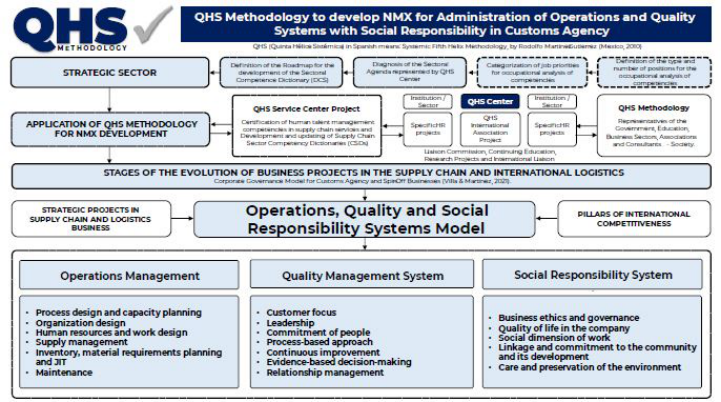
QHS Methodology as Support to Build Mexican Standards Through the instrumentalization of scaffolding and development of con- structs of the QHS Methodology (Gutierrez 2010, 2022) Figure 1 proposes the roadmap for the design of the proposal of a Mexican Standard from the referential context of Customs Agencies that pose in their administration of operations, to develop a quality management system of their commitments of the nature of business with a focus social responsibility and good practices of corporate governance (Garcia, 2021), impacting the value chain of the supply chain represented by companies specialized in foreign trade and international logistics services (Rios, 2022), companies with characteristics and profile of MSMEs and of origin of being family businesses, a common characteristic, is that managers bring the know-how in their heads, And the learning curve of the transfer of good practices is associated with delegation skills, talent management of new generations and generational change with the opening to new innovation practices in the business world of foreign trade and its strategic chains.
Figure 1: QHS methodology. (Adapted from Martinez, 2010.)
Table 1 presents the results of the Mexican standards selected as state of the art for applied research, the priority of customs agencies is the develop- ment and implementation of efficient, practical models and do not represent bureaucracy and administrative inefficiency, much less operational, under the context of MSMEs with characteristics of being family-owned compa- nies, with relay generations with innovation processes towards corporate governance practices, that is why the proposal to create an Ad Hoc model that represents a model tailored to a customs agency, and contributes to the exercise of consolidation of operations, management of human talent with certification standards of critical operations and with a sense of social responsibility.
Table 1. Analysis of Mexican standards (NMX) for its implementation.
Table available in the original PDF paper.
Code Purpose Benefits Customs Agency
Establish clear and precise technical specifications, as well as various technical recommendations for the proper and efficient use for the determination of the quality of the services provided by the Customs Broker.
NMX-R-026-SCFI-2016 Being applicable to Customs Brokers who exploit their patent through the legal constitution and operation of a customs agency in the United Mexican States Quality Management System NMX-CC-9001-IMNC-2015 Contributes to the organization to improve overall performance and provide a solid foundation for sustainable initiatives
1. Ability to regularly provide products and services that meet customer requirements and applicable legal and regulatory requirements 2. Facilitate opportunities to increase customer satisfaction 3. Address the risks and opportunities associated with your context and objectives 4. The ability to demonstrate conformity with specified Quality Management System requirements Social Responsibility
NMX-SAST-26000-IMNC- 2011 Contribute to sustainable development, considering it as development that meets the needs of the present without compromising the ability of future generations to meet their own needs
1. Competitive advantage 2. Reputation 3. Ability to attract and retain workers or members of the organization, customers, or users 4. Maintaining employee motivation, engagement, and productivity 5. Perception of investors, owners, donors, sponsors, and financial community 6. Relationship with companies, governments, media, suppliers, peer organizations, customers, and the community where it operates
Administration of Operations and Quality Systems With Social Responsibility 537
DEVELOPMENT OF INNOVATIVE PROPOSALS TO STRENGTHEN CUSTOMS AGENCY BUSINESS
Table 2 describes the core elements of the eclectic proposal the innova- tion strategy that integrates the necessary aspects for a quality management system, social responsibility and the operations of a customs agency, to cover all aspects of legal compliance as a company, and the requirements of an administrative and operational system that contributes to practices of a com- pany with formal performance indicators, Talent management, traceability and real-time monitoring of operations and services to meet customer service requirements. Maintaining continuous improvement practices as part of the business philosophy. The definition of the context of the organization, the interested parties, the static planning, the vision, mission of the business are key components of the proposal of a new Mexican Standard that is oriented to the sectoral competitiveness and innovation of businesses specialized in foreign trade and the supply chain at an international level, with management models and transgenerational vanguard.
Table 2. Comparison of requirements by Mexican standards.
Table available in the original PDF paper.
Content NMX-R-026 NMX-CC-9001 NMX-SAST-26000 NMX Name Quality of Customs Agency Services Quality Management System
Guide to Sustainable Development
Social Responsibility System Objective and field of application
Provision of customs services and foreign trade
Requirements for a Quality Management System NMX-CC-9000 NMX-SAST-26000
The proposal of a Mexican Standard as a Management System Model for the Operations, Quality and Social Responsibility of a Customs Agency, will associate requirements of the operations administration of the provision of
services of the customs agency, developing design processes and planning capabilities, design of the organizational installed capacity (Larenas, 2017)., definition of job descriptions and profiles, talent management and learning curves, definition of supply chain management processes (Perilus, between suppliers, the organization and customers, definition of performance indica- tors, for quality, service, costs and delivery times, evaluation of performance level (Munger, 2022), and customer satisfaction, inventories, infrastructure and business policies, aspects of the quality assurance system of operations carried out in the development of customs agency services, must consider leadership controls, authority and levels of responsibility in the organization, Development of continuous improvement mechanisms based on objective evidence, process-based approach and customer relationship management (Bernard, 2018). The aspect of social responsibility in a customs agency has as its purpose the analysis of the organization and its role in the eco- nomic, environmental and social ecosystem (Madrigal, 2017), highlighting its leadership of actions in favor of sustainable development actions such as the UN 2030 Goals and the Sustainable Development Goals; customs agencies contribute to society with actions to education; Recruiting talent and carrying out activities of philanthropy, social service to the community and strategic collaboration in the associations of local, regional, national and international customs agencies, contributing with innovation projects in the operations of foreign trade, customs and international logistics. Being SDG 17 Alliances for the development of the SDGs, the one with the great- est representativeness and linkage with the different sectors of society that contributes to education, the environment, the economy and culture for sus- tainable development, under a sectoral integration approach as proposed by the QHS Methodology (Martinez, 2020), unite the experience and talent of the government, academia, companies, associations and specialized consul- tants, with the purpose of generating eclectic models for generational change in the World.
REFERENCES
Bernard M. (2018) Key performance indicators. The 75 keys that the administrator must know. Trillas. DOF 2016 Declaration of validity of the Mexican Standard NMX-R-026-SCFI-2016,
Customs Services - Quality of services provided by the customs broker (quality of the customs broker) - Requirements https://www.dof.gob.mx/nota_detalle.php?co digo=5464149&fecha=06/12/2016#gsc.tab=0 Garcia, J., Gutierrez, R. (2021). Corporate Governance Model for Customs Agency in accordance with Federal Customs Law Article 167-D in Mexico. In: Walde- mar Karwowski, Tareq Ahram, Mario Milicevic, Darko Etinger and Krunoslav Zubrinic (eds) Human Systems Engineering and Design (IHSED2021): Future Trends and Applications. AHFE (2021) International Conference. AHFE Open Access, vol. 21. AHFE International, USA. Website: http://doi.org/10.54941/ahfe 1001203 Gutierrez, R. (2020) Methodology of the Fifth Helix Systemic, A Decade of Secto-
Administration of Operations and Quality Systems With Social Responsibility 539
Larenas, R. (2017) Corporate Governance for Medium Enterprises, directory for profitable and enduring companies. USA. Martinez-Gutierrez, R. (2020). Methodology of Dictionaries of Sector Competences
(DCS), to Design Standards of Professional Competences, Research and Labor. In: Nazir, S., Ahram, T., Karwowski, W. (eds) Advances in Human Factors in Training, Customs Services- Quality of services provided by customs broker (quality of customs broker) Computing, vol. 1211. Springer, Cham. Website: https://doi.org/10.1007/978-3-030-50896-8_46 Martinez-Gutierrez, R., Ibarra-Estrada, M. E., Carey-Raygoza, C. E., Hurtado- Sanchez, C., Chavez-Ceja, B. (2022). Observatory of Labor, Professional and Research Competencies of the Economic Sectors in Baja California. In: Ahram, T., Taiar, R. (eds) Human Interaction, Emerging Technologies and Future Systems V. IHIET 2021. Lecture Notes in Networks and Systems, vol. 319. Springer, Cham. Website: https://doi.org/10.1007/978-3-030-85540-6_164 Martinez-Gutierrez, R., Carey-Raygoza, C. E., Hurtado-Sanchez, C., Chavez-Ceja,
B., Lara-Chavez, A. (2021). Business Management Engineers: Profile and Compe- tencies of Generations X, Y and Z. In: Trzcielinski, S., Mrugalska, B., Karwowski, W., Rossi, E., Di Nicolantonio, M. (eds) Advances in Manufacturing, Production Management and Process Control. AHFE 2021. Lecture Notes in Networks and Systems, vol 274. Springer, Cham. Website: https://doi.org/10.1007/978-3-030- 80462-6_36 Madrigal-Torres, B. (2017) Management Skills, McGrawHill. Munger K. (2022) Generation Gap. Why the Baby Boomers Still Dominate, American politics and Culture, Columbia University Press. NMX-R-026-SCFI-2016 Customs Services- Quality of services provided by customs
broker (quality of customs broker) – Requirements. Website: https://www.dof.go b.mx/nota_detalle.php?codigo=5464149&fecha=06/12/2016#gsc.tab=0 NMX-CC-9001-IMNC-2015 Quality Management Systems - Requirements. Website: https://www.dof.gob.mx/nota_detalle.php?codigo=5435775&fecha=03/05/ 2016#gsc.tab=0 NMX-SAST-26000-IMNC-2011 Social Responsibility Guide - Requirements. Web-
site: https://www.dof.gob.mx/nota_detalle.php?codigo=5255245&fecha=19/06/ 2012#gsc.tab=0 Perilus B. (2021) Four generations under one organization’s roof. A resource for leading and managing the Baby Boomers, Generation X, The Millennials, and Generation Z. Rios Garcia, D. J., & Hernández Leal, A. (2022). Labor competencies within customs
agencies pre and post Covid 19. Vinculatégica EFAN, 8(4), 15–25. https://doi.or g/10.29105/vtga8.4-197
LISTED IN THE AHFE DIGITAL BOOKSTORE CATALOGUE
Explore the complete digital volume
Human Systems Engineering and Design (IHSED 2023): Future Trends and Applications
Read this individual research paper free through the original publisher, or explore the full digital proceedings book.
ISBN 978-1-958651-88-9
Explore this ISBN in the AHFE Bookstore ↗Listed in the July 2026 bookstore catalogue; search by ISBN to confirm current availability · Digital book purchase optional