Manuel Ignacio Garcia Rios Acero, Rodolfo Martinez Gutierrez, Jose Carlos Gonzalez Villa (2023). QHS Methodology for Business Intelligence Model, Talent Management and KPI's in the Foreign Trade Supply Chain. In: Human Interaction & Emerging Technologies (IHIET 2023): Artificial Intelligence & Future Applications. AHFE Open Access, vol. 111, pp. 743–748. https://doi.org/10.54941/ahfe1004081
The supply chain in foreign trade involves goods storage systems, with quality management systems in comprehensive service logistics, to ensure trust in the relationship with customers; the training of executives specialized in processes of opening accounts, review and storage of goods, as well as the follow-up to the suggestion of customer service become business intelligence strategies, in the face of the challenges of standardization of services where customer satisfaction becomes KPIs of Quality, Service, Cost and Delivery Time. The QHS Methodology is applied with the strategy of intervention and systemic integration of the different levels of authority and management of the learning curve to develop standards of good practices in the management of specialized talent in the different positions that make up the structure of the business axis of Warehouses and Logistics Services towards the integration of the corporate approach to operation.
In companies with a focus on the value chain that integrate the foreign trade and international logistics businesses, innovation and continuous improve- ment in administrative and operational processes is very demanding, which is why quality management systems represent the great opportunity to syste- matize Talent Management Models, KPIs, Business Intelligence, and the levels of Authority and Responsibility for the success in the development of a Cor- porate Governance in a set of companies with characteristics from StarUp to SpinOff, the Mexican Standards (NMX) have become a competitive strategy.
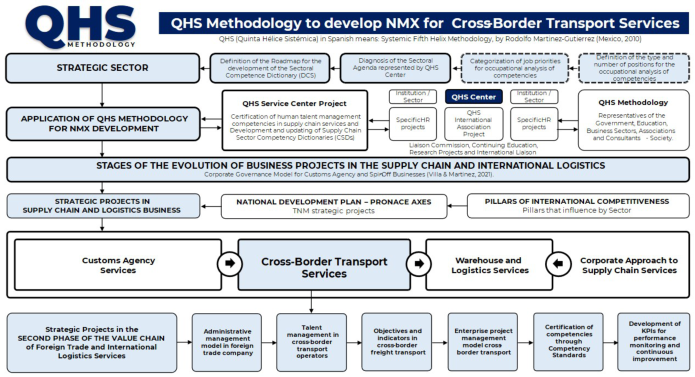
A Mexican Standard (NMX) represents an administrative structure docu- mented as a reference framework that provides recommendations for the application of good practices as a guide developed by the Fifth Systemic Helix (QHS) methodology, as presented in Table 1, a sector integration strategy to
develop an NMX for Business Intelligence, Talent Management, KPIs in the Foreign Trade Supply Chain.
The inspiration that aroused the interest in generating mechanisms to strengthen the foreign trade sector came from the publication of the Mexican Standard of Quality Services of Customs Agencies (NMX-R-026-SCFI-2016), which establishes procedures of good practices to offer services in the businesses of the Value Chain of Foreign Trade and International Logistics.
QHS Methodology as a Value Chain Integration Strategy The strategy of the QHS Methodology (Martinez 2020, 2023) to design a new NMX, is based on the Model of corporate governance practices in a Customs Agency proposed by Garcia & Martinez (2021), which integrates the different sectors of society such as representatives of the Government Sector, Academia, Companies, Associations and Consultants, specialists in the Foreign Trade and International Logistics Sector.
The project roadmap for developing a new NMX is described phase by phase in Figure 1, the focus being to establish Performance Indicators for Customer Service. Metrics to determine satisfaction levels in Quality, Service, Cost and Delivery Time. Likewise, a challenge for the Customs Agencies that integrate into their foreign trade value chain; Complementary services such as Cross-Border Transport, face the needs of designing robust management systems, to have mechanisms for monitoring efficiency and effectiveness in the traceability of the processes of the portfolio of services offered to custo- mers as an image of the commitment to the continuous improvement of the business philosophy with a corporate approach. Implicitly considering the stages of evolution and maturation of organizations with crossing of different generations working under the same organizational roof.
Table 1 presents the results of the strategies that were the product of the focus groups developed in the research working groups through in-depth
Figure 1: QHS methodology. (Adapted from Martinez, 2010.)
QHS Methodology for Business Intelligence Model, Talent Management and KPI’s 745
Table 1. QHS methodology to develop NMX for Cross-Broder transport services.
Table available in the original PDF paper.
Value Chain Objectives
Type of Business Approach of Enterprise Resource Planning (ERP) Transportation Services Authority model in a quality management system
Development of mechanisms of hierarchical levels, decision-making and responsibility
Administrative management model in foreign trade company
Enterprise project management model cross-border transport
Talent management in cross-border transport operators
Certification of competencies through Competency Standards
Objectives and indicators in cross-border freight transport
Development of KPIs for performance monitoring and continuous improvement
interviews through the QHS methodology (Gutierrez, 2010, 2021), which involved sector experts in foreign trade and logistics, with key guests from the Government. Academia, Cross-Border Crossing Transport Companies, Associations and Consultants specialized in the supply chain sector.
DEVELOPMENT OF STRATEGIC PROJECTS AS AN INNOVATION TOOL IN THE CROSS-BORDER CROSSING TRANSPORT BUSINESS The resulting findings as a product of research of Cross-Border Freight Cros- sing Transportation Businesses; has been determined under the approach of an Enterprise Resource Planning System (ERP), which integrates the compo- nents of the Supply Chain (SCM), the systematization of the learning curve and good practices through the establishment of the Knowledge Management System (KMS) and finally the component that generates reliability and with it trust between the client and the company through the mechanisms of a Mana- gement System Customer Relations (CRM), where it is evident to consider the importance and impact of the development of Authority and Responsibility Models in quality management systems; Companies in the sector of Customs Agencies and Cross-Border Transport to ensure their procedures and opera- tions in accordance with legal requirements implement systems such as OEA issued in Mexico and C-TPAT issued in the United States of America, mech- anisms to ensure the security of goods in the different phases of reception, transfers, storage of goods and transnational transport.
The Authorized Economic Operator (OEA) certification system is an accre- ditation and recognition issued by the Customs Authority in Mexico, with the main purpose of reinforcing security in the supply chain that invo- lves manufacturers, exporters, importers, warehousers and distributors. The main advantages of having the OEA system implemented is to generate; mechanisms of personal attention, preferential lane for clearance of goods,
Table 2. Comparative analysis of systems in the international supply chain.
Table available in the original PDF paper.
Security Systems ABC of Security Systems in Mexico and USA OEA Certification, Authorized Economic Operator. Accreditation in MexicoMéxico Advance electronic information on shipments destined indoors, abroad or in transit. Implementation of a strengthened risk analysis procedure to address security-related issues. High-risk cargo inspection and use of non-intrusive inspection equipment. Compliance with minimum security standards in the supply chain.
C-TPAT Certification, Customs Trade Partnership Against Terrorism. Accreditation by the Customs Trade Association Against Terrorism in the USA
Vision of safety and responsibility Risk analysis, personnel safety Business Partners Safety Ciber, safety seals, process safety, agricultural safety, personal safety Transport and security in international traffic instruments, access controls Training, education and awareness
prioritization in customs clearance, simplification and administrative facili- ties, Hand carrier, non-suspension of the register of importers and mutual recognition with other countries.
When addressing the issue of logistics chain in international trade is to refer to the components of the value chain of external trade integrated by the busi- nesses of customs broker, warehouses, and Cross-Border Transport business. In the case of the C-TPAT system, it is an anti-terrorist certification, with the purpose of providing security mechanisms for importers, transporters, customs agents, warehouses, and producers to prevent their loads from being contaminated with illegal substances or articles, such as weapons, drugs, or explosives. Having the C-TPAT certification provides a reduction in the num- ber of inspections, guarantees the supply chain is safe, represents an added value for the company, reduces the wait at the American border and prevents theft and the risk of illicit trade.
Table 2 It presents an analytical reflection of the challenges currently involved in maintaining the security systems by Laos processes and all the elements involved in the supply chain, companies that choose to maintain cer- tifications as an added value, has become almost a compliance requirement to stay in the competitive environment of the motor transport sector and pro- perly the cross-border transport. Both in Mexico and the USA attention is being paid to companies complying with security certifications, although it is not mandatory, customers opt for companies that have certification systems that guarantee the safety of their goods.
CONCLUSION
In cross-border transport businesses, strategic plans are common (Larenas, 2017) with a focus on implementing security models, maintaining them and
QHS Methodology for Business Intelligence Model, Talent Management and KPI’s 747
developing actions that strengthen the authority and responsibility in the staff of the operational and administrative structure (Bernard, 2018), to achieve indicators and goals of competitiveness in the market supported by the OEA systems in Mexico and C-TPAT in the USA. This article is part of several coordinated efforts to achieve proposals and initiatives to develop Mexican Standards in the business of the Supply Chain of Foreign Trade and logi- stics, and thereby influence the best practices of administrative management and personnel training (Perilus, 2021). Being the NMX-026-R-SCFI-2016 the key reference piece for innovation processes (Larena, 2017), as well as the approach of the mechanisms of the transition of the structures of the Customs Agencies and their complementary services (Nava, 2019). And with this generate new knowledge and systematized proposals of NMX as a syste- mic alternative of competitiveness (Hernandez, 2012), cross-border transport applies world-class practices (Madrigal, 2017), so the learning curves are good practices to strengthen Human Resources policies in the value chain of supply chain businesses (Munger, 2022).
ACKNOWLEDGMENT
Special thanks to Engineer Jorge Vicente Villa Garcia, Supply Chain Services specialists. As well as for Engineer Jose Guillermo Cardenas Lopez Director of the Tijuana Institute of Technology (ITT) for its support to the develo- pment of Specialized Talent Management projects with international scope in the Center for Research and Innovation of the ITT.
Sincerely Dr. Rodolfo Martinez Gutierrez Member of the National System of Researchers SNI Level 2 – CONACYT Mexico
REFERENCES
Bernard M. (2018) Key performance indicators. The 75 keys that the administrator must know. Trillas. Garcia, J., Gutierrez, R. (2021). Corporate Governance Model for Customs Agency
in accordance with Federal Customs Law Article 167-D in Mexico. In: Waldemar Karwowski, Tareq Ahram, Mario Milicevic, Darko Etinger and Krunoslav Zubri- nic (eds) Human Systems Engineering and Design (IHSED2021): Future Trends and Applications. AHFE (2021) International Conference. AHFE Open Access, vol. 21. AHFE International, USA. Website: http://doi.org/10.54941/ahfe1001203 Gutierrez, R. (2021) Methodology of the Fifth Helix Systemic, A Decade of Sectorial Investigations 2010-2020, IOP Conference Series: Earth and Environmental Website: https://ui.adsabs.harvard.edu/abs/2021E%26ES..690a2061M/abstract Hernández, Valentín; Daniel Jafet (2012) Analysis and requirements for the implementation of the standard NMX-R-026-SCFI-2009 (Quality Customs Brokers) in customs agency, Thesis https://repositorio.unam.mx/contenidos/ana lisis-y-requisitos-para-la-implementacion-de-la-norma-nmx-r-026-scfi-2009-qu ality-customs-brokers-en-agencia-aduanal-3536829?c=pn52Ra&d=false&q=*: *&i=1&v=1&t=search_0&as=0 Larenas, R. (2017) Corporate Governance for Medium Enterprises, directory for
profitable and enduring companies. USA.
Madrigal-Torres, B. (2017) Management Skills, McGrawHill Martinez-Gutierrez, R. (2020). Methodology of Dictionaries of Sector Competences (DCS), to Design Standards of Professional Competences, Research and Labor. In: Nazir, S., Ahram, T., Karwowski, W. (eds) Advances in Human Factors in Training, Customs Services- Quality of services provided by customs broker (quality of customs broker) Computing, vol 1211. Springer, Cham. Website: https://doi.org/10.1007/978-3-030-50896-8_46 Martinez-Gutierrez, R., Carey-Raygoza, C. E., Hurtado-Sanchez, C., Chavez-Ceja,
B., Lara-Chavez, A. (2021). Business Management Engineers: Profile and Compe- tencies of Generations X, Y and Z. In: Trzcielinski, S., Mrugalska, B., Karwowski, W., Rossi, E., Di Nicolantonio, M. (eds) Advances in Manufacturing, Production Management and Process Control. AHFE 2021. Lecture Notes in Networks and Systems, vol 274. Springer, Cham. Website: https://doi.org/10.1007/978-3-030- 80462-6_36 Martinez-Gutierrez, R., Esther Ibarra-Estrada, M., Hurtado-Sanchez, C., Galvan- Sanchez, R., & Ernesto Jimenez-Bernardino, A. (2023). Perspective Chapter: Prospective of Sectoral Competences for the Design of Dictionaries of Profes- sional Competences and Research. Education and Human Development. doi: 10.5772/intechopen.109457 https://www.intechopen.com./online-first/85569 Martinez-Gutierrez, R., Ibarra-Estrada, M. E., Carey-Raygoza, C. E., Hurtado-
Sanchez, C., Chavez-Ceja, B. (2022). Observatory of Labor, Professional and Research Competencies of the Economic Sectors in Baja California. In: Ahram, T., Taiar, R. (eds) Human Interaction, Emerging Technologies and Future Systems V. IHIET 2021. Lecture Notes in Networks and Systems, vol 319. Springer, Cham. Website: https://doi.org/10.1007/978-3-030-85540-6_164 Munger K. (2022) Generation Gap. Why the Baby Boomers Still Dominate, American politics and Culture, Columbia University Press . Nava Nieto, Nayeli (2019) The Mexican Standard NMX-R-026-SCFI-2016 applied
to the Agencia Aduanal del Valle Centro S. C. Thesis http://ri.uaemex.mx/handle/ 20.500.11799/106201?show=full NMX-R-026-SCFI-2016 Customs Services- Quality of services provided by customs broker (quality of customs broker) – Requirements. Website: https://www.dof.go b.mx/nota_detalle.php?codigo=5464149&fecha=06/12/2016#gsc.tab=0 Perilus B. (2021) Four generations under one organization’s roof. A resource for
leading and managing the Baby Boomers, Generation X, The Millennials, and Generation Z.
Read this individual research paper free through the original publisher, or explore the full digital proceedings book.
ISBN 978-1-958651-87-2
Explore this ISBN in the AHFE Bookstore ↗Listed in the July 2026 bookstore catalogue; search by ISBN to confirm current availability · Digital book purchase optional