Rodolfo Martinez Gutierrez, Sonia Moreno Cabral, Beatriz Chavez Ceja, Angel Ernesto Jimenez Bernardino, Armando Alberto Leon Lopez, Jose Daniel Padilla de la Rosa, Artemio Lara Chavez, Karina Lopez Valle, Veronica Quintero, Susana Montes Olande (2026). National Observatory of Social and Solidarity Economy Projects, Pronaces, Research Networks and 2030 Agenda. In: Social and Occupational Ergonomics. AHFE Open Access, vol. 228, pp. 166–175. https://doi.org/10.54941/ahfe1007947
The National Observatory of Social and Solidarity Economy (SSE) Projects is a strategic instrument designed to articulate applied research, public policy, and sustainable territorial development in Mexico. Its structure integrates the principles of the Social and Solidarity Economy (SSE), the National Strategic Programs (PRONACES), and the Sustainable Development Goals (SDGs) of the 2030 Agenda, through the Systemic Quintuple Helix (QHS) methodology, widely documented in recent studies (Martínez Gutiérrez, 2025; Martínez‑Gutierrez et al., 2024). This methodology brings together government, academia, enterprises, associations, and consultants to strengthen social innovation ecosystems and generate evidence for decision‑making. This article describes the conceptual, methodological, and operational structure of the Observatory, as well as the results derived from its implementation across the Northern, Central, and Southern regions of the country through the Social and Solidarity Economy Research Network (RIESS), recognized for its national reach (Martínez Gutiérrez et al., 2025). Experiences related to the consolidation of SSE Development Nodes (NODESS), the preparation of Voluntary Local Reviews (VLRs), capacity‑building programs, and the systematization of community projects are analyzed. Findings show significant progress in multilevel governance, community participation, institutional strengthening, and the generation of systemic indicators, aligned with international literature on SDG traceability (Martínez Gutiérrez & Jiménez Bernardino, 2026). The article concludes that the Observatory is a replicable and scalable model for strengthening territorial capacities, with the potential to consolidate a national ecosystem of 100 VLRs and contribute to the achievement of the 2030 Agenda.
The construction of a conceptual framework around the National Observatory of Social and Solidarity Economy Projects (Pronaces) requires starting with a broad contextualization of both the role it plays at the national level and its relationship with international agendas, especially the 2030 Agenda for Sustainable Development.
This observatory emerges as a platform aimed at connecting academic, institutional, and community actors in order to analyze, systematize, and promote practices linked to the social and solidarity economy, thus generating spaces where applied research and public policies are articulated (Gutierrez, Suarez et al., 2025).
In this sense, it is important to recognize that the social and solidarity economy involves a diverse set of organizations, including cooperatives, mutual societies, associations, and foundations, which share values such as democratic functioning and orientation towards the general interest. The purpose is not limited to economic performance but incorporates broad social and cultural objectives. This gives a differentiated character with respect to purely lucrative schemes, since there is a vocation to redistribute benefits to the community (Jiménez Bernardino, Haro Ramírez et al., 2025).
This vision is consistent with the sustainability principles contemplated by the 2030 Agenda as it is directly linked to goals related to equality, social justice and inclusive economic development. The genesis of Pronaces within the Tecnológico Nacional de México (TecNM) also responds to a strategic need: to strengthen research networks in social economy in national and international collaboration. Through this articulation, it seeks not only to produce scientific knowledge, but also to influence practical processes that can transform local realities. This initiative has been led by experienced researchers in the National System of Researchers, ensuring that the agenda developed integrates rigorous evaluation and monitoring criteria (Gutierrez, Suarez et al., 2025).
Scientific intentionality is combined here with a political concern to collect situated experiences and align them with global commitments. If we look at previous experiences in Latin America, we find a scenario characterized by social structures where historical inequalities persist. Latin America has faced structural problems such as poverty, violence, and gender inequality, thus affecting social and economic progress (Romero Ocaño et al., 2025).
Within this context, initiatives such as Pronaces offer opportunities to address such problems through collaborative approaches that include both the academic sector and the productive and governmental segments. The potential impact is amplified when these projects are directly linked to the specific targets of the Sustainable Development Goals (SDGs).
The inter-institutional nature of Pronaces is evidenced in formal agreements between different TecNM campuses. For example, some collaborations have led to conferences highlighting the links between this type of project and global guidelines such as those established by the United Nations in the 2030 Agenda (Chávez Remigio, 2025). These meetings serve to exchange empirical
data on socio-economic impact, analyse legislative challenges and specify operational mechanisms for sustainable development.
THEORETICAL FRAMEWORK In many cases, there is an effort to identify organizational or sociocultural barriers that hinder equitable participation, which also connects with critical aspects related to female leadership and labor equity documented in other regional research (Romero Ocaño et al., 2025). The integrative approach of Pronaces cannot be separated from the broader debate on critical educational models capable of generating collective awareness of social problems. The critical pedagogy inspired by Paulo Freire offers relevant clues on how to articulate community educational processes to enhance emancipatory practices (Bernardino, Gutierrez et al., 2025).
An observatory focused on the social economy can adopt horizontal communicative elements and encourage participation from different social sectors to nourish its analyses and proposals. This means breaking with traditional hierarchical logics within the academic field and promoting co-construction of knowledge between researchers, productive actors and organized civil society. The challenge is to find effective ways to measure results without reducing them only to conventional economic indicators. Instead of exclusively evaluating financial or productive variables, the cultural, social and environmental impact aligned with the SDGs should be considered.
Presenting Mexican reports to forums such as ECOSOC implies a recognition of the work carried out at the local level within internationally shared conceptual frameworks. Thus, Pronaces acts as a bridge between the specific conditions of the national territory and a global agenda marked by collective interests that transcend geographical borders. From a critical-scientific perspective, it is clear that this observatory represents something more than a database or a documentary repository: it functions as an active node within academic networks that seek to produce effective political advocacy supported by rigorous evidence. Even so, such dynamics face inherent tensions, for example between the short times of political emergencies versus the prolonged periods demanded by serious research, which could influence expected results or even rethink operational strategies according to changing contexts (Gutierrez, Suarez et al., 2025).
METHODOLOGICAL APPROACH The Social and Solidarity Economy (SSE) is based on principles of cooperation, equity and sustainability, constituting an alternative model to traditional economic systems. Its origin is linked to cooperative and community experiences that seek to respond to social needs through collective organization and social innovation (Martínez Gutiérrez et al., 2025a). In Mexico, SSE has been recognized as a strategic axis for regional development, especially within the framework of the National Strategic
National Observatory of Social and Solidarity Economy Projects 169 Programs (PRONACES) and the UN 2030 Agenda. The RIESS Network articulates these efforts through the creation of NODESS (SSE Promotion Nodes), which function as spaces for social innovation and inter-institutional linkage (Zazueta Villavicencio et al., 2025a). The conceptual framework of the SSE is complemented by the Fifth Systemic Helix (QHS), an evolution of the Triple Helix of Etzkowitz and Leydesdorff (1997), which integrates five actors: government, academia, companies, associations and consultants. This model allows sectoral ecosystems to be analyzed from an interdisciplinary perspective, favoring the generation of projects with social and environmental impact (León López et al., 2025b). Recent literature highlights that SSE not only contributes to economic growth, but also to applied social ergonomics, by improving quality of life and community cohesion. In the Southern Region, for example, economic models based on native corn and energy sustainability projects have been developed, which reinforce cultural identity and food security (Balderrabano Briones et al., 2025c).
RESULTS
In summary, the theoretical framework of this study is based on three pillars:
1. SSE as an alternative model of development. 2. QHS as a multisectoral articulation methodology. 3. The link with the SDGs as a global sustainability strategy.
This conceptual framework allows us to analyze the contributions of the RIESS Network in Mexico and position them as an international reference in the integration of research, public policy and community action.
Social and Solidarity Economy (SSE) The SSE promotes economic models based on cooperation, solidarity, and sustainability (Martínez Gutiérrez et al., 2025). Its alignment with the SDGs strengthens territorial capacities and fosters social innovation.
Systemic Quintuple Helix (QHS) The QHS is an evolution of the Triple Helix, integrating five sectors for systemic development (Martínez Gutiérrez, 2025). Its application in Mexico has enabled the articulation of innovation ecosystems and the development of sectoral diagnostics.
PRONACES and the 2030 Agenda PRONACES guide research toward national priority problems. The 2030 Agenda requires evidence-based monitoring mechanisms such as VLRs (United Nations, 2024).
RIESS Research Network RIESS brings together TecNM researchers from three regions of the country, generating projects, publications (see Table 1, Table 2 and Table 3), and social innovation ecosystems (Martínez Gutiérrez et al., 2025). The Observatory is structured through the QHS methodology, integrating four main components (Martínez Gutiérrez, 2025).
Table 1: Publications of researchers in Northern Mexico of the RIESS network.
Table available in the original PDF paper.
Title of the Project Institutions SDG 17: National Alliance NODESS TIJUANA in northern, central and southern Mexico with the 2030 Agenda
Technological Institute of Tijuana Autonomous University of Baja California Secretary of Public Education
SDG 17; Research and Development of the UN 2030 Agenda, Case: International RIESS Network
Technological Institute of Tijuana International University of La Rioja, Spain FACAM – Colleges of Campinas, Brazil Universidad de la Serena, Chile Catholic University of El Salvador, El Salvador Pontificia Universidad Javeriana de Bogotá, Colombia University of Panama National University, Costa Rica National Technical University, Costa Rica University of Costa Rica, Costa Rica History of the Tecnm Mexicali Nodess and its impact on the Date marketing Technological Institute of Mexicali
Technological Institute of Ensenada
Building knowledge networks: the Instituto Tecnológico de Ensenada and its contribution to the TecNM RIESS Network
Technological Institute of Merida
Industria 4.0 y gestión del conocimiento en Yucatán: estrategias para la Sostenibilidad desde el fortalecimiento del ecosistema de innovación
Technological Institute of Higher Studies of Los Cabos
Initiative of workshop of cooperatives for the common welfare. Case Los Cabos Institute of Technology
Technological Institute of Agua Prieta
Innovation and its relationship with business development in Agua Prieta, Sonora: key actor SDG 9
Technological Institute of Agua Prieta
Gender Equity and Women’s Leadership on the Sonoran border: legislative advances and challenges towards the 2030 Agenda
Technological Institute of Huatabampo
Quality of life in housing for the development of the Communities of Huatabampo Productive transformation and sustainability: proposal for solar drying of fruits in rural communities and the creation of a NODESS
Technological Institute of Huatabampo Center for Marine Studies 22 Yavaros Campus
Table 2: Publications of researchers in central Mexico of the RIESS network.
Table available in the original PDF paper.
Title of the Project Institutions Systemic Development (QHS). Doctoral thesis cases in administration at TecNM
Technological Institute of Tijuana University of Sonora, México Yutong Bus, China SENEAM Tijuana International Airport, Mexico
Public policies for Sustainable innovation. Cases of Doctoral Thesis in Administration at TecNM
Instituto Tecnológico de Tijuana, Mexico Secretary of Anti-Corruption and Good Government Executive Secretariat of the 2030 Agenda, Mexico Interdisciplinary Center for Research and Teaching in Technical Education (CIIDET-TecNM)
Teaching complexity to The future: social economy and solidarity, and scenarios prospects for the TecNM
University of Guadalajara Technological Institute of Tijuana Center for Research and Technological Assistance and Design of the State of Jalisco A.C.
Analysis and impact of the Energy Resources in Mexico and other countries in the social economy. Case study of a Agrivoltaic plot
University of Guadalajara, Mexico Universidad San Buenaventura, Cali, Colombia
Comparative analysis of The legal frameworks of the Social and solidarity economy: The law of the social economy and Solidarity (LESS) of Mexico and Law 454 of 1998 of Colombia Cooperative Education from School: Strategy to Strengthen Cohesion Social in Mexico
University of Guadalajara Technological Institute of Tijuana Center for Research and Technological Assistance and Design of the State of Jalisco A.C.
Critical Didactics and Social Economy: New Horizons in Upper Secondary Education
University of Guadalajara Technological Institute of Tijuana Center for Research and Technological Assistance and Design of the State of Jalisco A.C.
Technological Institute of Nogales
Education for the future: Contributions of the Institute Tecnológico de Nogales to SDGs of the 2030 Agenda Nodess, TecNM Nogales Community Support Technological Institute of Nogales
Environmental impact Technological Institute of Nogales
Table 3: Publications of researchers in the south of Mexico of the RIESS network.
Table available in the original PDF paper.
Title of the Project Institutions
Technological Institute of Tijuana
Social and solidarity economy, cooperativism and Agenda 2030; an ecosystem for Research Veins
(Continued)
Table 3: Continued.
Table available in the original PDF paper.
Title of the Project Institutions SDG 2: Zero hunger and the social economy in Zempoala: a community study based on applied statistics
Technological Institute of Tijuana Technological Institute of Cancun Technological Institute of Ursulo Galvan Higher Technological Institute of Tierra Blanca
NODESS of the south; Promotion of the Social and Solidarity Economy in the Southeast of Mexico
Technological Institute of Villahermosa Technological Institute of Tlaxiaco Technological Institute of Tluxtla Gutierrez Technological Institute of Chontalpa Technological Institute of Merida
Environmental Education in Higher education. Case Administration students
Technological Institute of Villahermosa
Teaching to change the world: the social and solidarity economy in education
Technological Institute of Tuxtepec
Community leadership and participation in the social and solidarity economy NODESS 2025 Cooperative Strengthening Circuit
CRODE Orizaba Higher Technological Institute of Tierra Blanca
Economic model for communities and their relationship with native maize (ZEA MAYS): Tlaxiaco case
Technological Institute of Tlaxiaco Technological Institute of Tluxtla Gutierrez Technological Institute of Villahermosa Tecnológico Nacional de México Technological Institute of Villahermosa Technological Institute of Tlaxiaco
Sustainability and Energy Efficiency in Agriculture: Modernizing a Livestock Barn and Native Corn Cultivation Using Solar and Wind Energy
CONCLUSION
The analysis of the case studies of the Social and Solidarity Economy Research Network (RIESS) in the North, Central and South regions of Mexico allows us to establish several relevant conclusions: SSE as an alternative model of sustainable development. The revised projects show that the social and solidarity economy is an effective way to address social, economic and environmental problems. SSE promotes community cooperation, gender equity, food security and technological innovation, directly aligning with the Sustainable Development Goals (SDGs) of the 2030 Agenda (Martínez Gutiérrez et al., 2025a; León López et al., 2025b; Balderrabano Briones et al., 2025c). The Fifth Systemic Helix (QHS) as an integrative methodology. The application of QHS has proven to be a solid methodological framework for articulating diverse actors, government, academia, companies, associations, and consultants—in social impact projects. Its use in the three volumes shows that social innovation requires a systemic and collaborative vision. Differentiated but complementary regional impact. In the North, projects
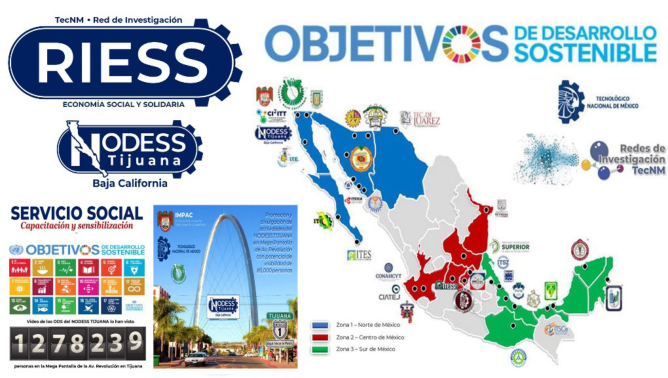
National Observatory of Social and Solidarity Economy Projects 173 focus on social innovation, gender equity, and sustainable housing. At the Central and Southern Mexico, contributions focus on cooperative education, public policy, and clean energy. Future lines of research. It is recommended to move towards the creation of homogeneous impact indicators, which allow the systematic measurement of the results of SSE in Mexico. It is also suggested to explore the integration of SSE with emerging sectors such as the digital economy and the energy transition (See Figure 1).
Figure 1: Social and solidarity economy research network (RIESS Network).
ACKNOWLEDXMENT Special thanks to the 105 Professors and Researchers from North, Central and Southern Mexico and guest countries such as Spain, El Salvador, Costa Rica, Panama, Brazil and Chile, who make up the membership of the International Research Network on Social and Solidarity Economy (RIESS Network) of the National Technological Institute of Mexico during the years 2024 and 2025).
REFERENCES
Bernardino, Á. E. J., Gutierrez, R. M., Rosa, J. D. P. de la, Cabral, S. M., & Chávez, A. L. (2025). Critical didactics and social economy: New horizons in upper secondary education (pp. 86–101). https://doi.org/10.22533/at.ed.6602518127 Bernardino, Á. E. J., Gutiérrez, R. M., Rosa, J. D. P. de la, Ceja, B. C., Ortega, M.
S., & Olalde, M. S. M. (2025). Cooperative education from school: A strategy to strengthen social cohesion in Mexico (pp. 36–52). https://doi.org/10.22533/ at.ed.6602518124 Chávez Remigio, J. E. (2025). Building knowledge networks: The Ensenada Technological Institute and its contribution to the TecNM’s RIESS network (pp. 37–54). https://doi.org/10.22533/at.ed.6532518124
Corral Morales, E., Atríp Karam, L., Rodríguez Leyva, E., & Valenzuela Alcaraz, V. (2025). Quality of life in housing for the development of the communities of Huatabampo (pp. 108–119). https://doi.org/10.22533/at.ed.6532518129 Díaz Azamar, Á., Parra Valis, D., Lira Vázquez, I., & Olguín Jácome, Z. (2025).
Leadership and community participation in the social and solidarity economy (pp. 39–43). https://doi.org/10.22533/at.ed.6912518126 Escobar, R. A. R., Huerta, V. C. M., Soqui, L. C. V., Ochoa, S. B. G., Álvarez, A. B., & Robles, A. A. Z. (2025). Education for the future: Contributions of the Nogales Institute of Technology to the SDGs of the 2030 Agenda (pp. 102–118). https:// doi.org/10.22533/at.ed.6602518128 Gómez, R. P., Lavín, J. E., Cortés, C. O. F., & Lassmann, A. A. (2025). NODESS
2025 Cooperative Strengthening Circuit (pp. 44–49). https://doi.org/10.22533/ at.ed.6912518127 Guadarrama Ramírez, J. A., López Valle, K., Quintero Rosas, V., López Pérez, M. de J., & Aguirre Suni, C. S. (2025). History of the NODESS at TecNM Mexicali and its impact on date marketing (pp. 25–36). https://doi.org/10.22533/ at.ed.6532518123 Gutierrez, R. M., Cabral, S. M., Ortega, M. S., Ceja, B. C., Chavez, A. L., Olalde, M.
S. M., Tello, E. A., Alvarez, G. A., Raygoza, C. E. C., Avila, F. E. M., & Beltran, G. T. (2025). SDG 17: National alliance of NODESS Tijuana in northern, central and southern Mexico with the 2030 Agenda (pp. 1–15). https://doi.org/10.22533/ at.ed.6532518121 Gutierrez, R. M., Canales, I. G. B., & Obrajero, M. D. (2025). Public policies for sustainable innovation: Case studies from doctoral theses in administration at TecNM (pp. 13–22). https://doi.org/10.22533/at.ed.6602518122 Gutierrez, R. M., Suarez, L. M. C., Menezes, D. F. N., Betancourt, E. W., Guerrero,
R. E. M., Rodríguez, J. F. Á., Reyes, G. Y. C. de, Cordero, G. A., Quirós, M. J., & Portugués, R. A. (2025). SDG 17; Research and Development of The Un 2030 Agenda, Case Study: Riess International Network (pp. 16–24). https://doi. org/10.22533/at.ed.6532518122 Jiménez Bernardino, Á. E., Gutierrez, R. M., Padilla de la Rosa, J. D., Chávez Ceja, B., & Serrano Ortega, M. (2025). Analysis and impact of energy resources on the social economy in Mexico and other countries. Case study of an agrivoltaic plot (pp. 67–85). https://doi.org/10.22533/at.ed.6602518126 Jiménez Bernardino, Á. E., Haro Ramírez, C., Bracamontes, P. E., Marin Maldonado,
S. L., Campos Cornejo, D. R., & García, O. F. (2025). Comparative analysis of the legal frameworks of the social and solidarity economy: Mexico’s Law of the Social and Solidarity Economy (LESS) and Colombia’s Law 454 of 1998 (pp. 53–66). https://doi.org/10.22533/at.ed.6602518125 Jiménez Márquez, O., Lucas Bravo, G., Oropeza Tosca, D. R., Rincón Rosales, R., & González Izquierdo, K. (2025). Economic model for communities and their relationship with native maize (Zea mays): The Tlaxiaco case (pp. 50–63). https:// doi.org/10.22533/at.ed.6912518128 Lacruhy Enríquez, C. C. (2025). Cooperative workshop initiative for the common
good: Case study of the Technological Institute of Higher Studies of Los Cabos (pp. 70–77). https://doi.org/10.22533/at.ed.6532518126 León-López, A. A., López Muñoz, J., & Cabrera Mendoza, E. (2025). Teaching complexity for the future: Social and solidarity economy and prospective scenarios for TecNM (pp. 23–35). https://doi.org/10.22533/at.ed.6602518123 Martinez-Gutierrez, Rodolfo. Employability Observatory for Engineering: A
Systemic Approach to National Development. Engineering Research Journal- Brasil. 2025. Vol.5, n. 9., 2025 ISSN 2764-1317 https://doi.org/10.22533/ at.ed.317592504126
National Observatory of Social and Solidarity Economy Projects 175 Oropeza Tosca, D. R., Campos Donato, E. J., González Izquierdo, K., & Jiménez
Márquez, O. (2025). Sustainability and energy efficiency in agriculture: Modernization of a livestock barn and cultivation of native corn using solar and wind energy (pp. 64–81). https://doi.org/10.22533/at.ed.6912518129 Oropeza-Tosca, D. R., Jiménez-Márquez, O., González-Izquierdo, K., Ramón- Santiago, P., & Ruiz-Valdiviezo, V. M. (2025). NODESS of the South: Boosting the social and solidarity economy in southeastern Mexico (pp. 16–27). https://doi. org/10.22533/at.ed.6912518123
LISTED IN THE AHFE DIGITAL BOOKSTORE CATALOGUE
Explore the complete digital volume
Social and Occupational Ergonomics
Read this individual research paper free through the original publisher, or explore the full digital proceedings book.
ISBN 979-8-950676-04-8
Explore this ISBN in the AHFE Bookstore ↗Listed in the July 2026 bookstore catalogue; search by ISBN to confirm current availability · Digital book purchase optional