Rodolfo Martinez, Diana Rubí Oropeza-tosca, Gaudencio Lucas Bravo, Sonia Moreno Cabral, Carmen Esther Carey Raygoza (2025). Observatory of Social and Solidarity Economy, NODESS, SDGs, and Research Networks. In: Intelligent Human Systems Integration (IHSI 2025): Integrating People and Intelligent Systems. AHFE Open Access, vol. 160, pp. 458–463. https://doi.org/10.54941/ahfe1005850
The project of the Municipal Observatory of Competencies for Sustainable Development Goals (SDGs) Mexico 2030 Agenda, is a research initiative through the Social and Solidarity Economy Research Network (RIESS Network) of national category of the TecNM, which contemplates the development of the diagnosis and training of Students and Professors of Higher Education on the Sustainable Development Goals (SDGs), as a strategy to encourage the development of research project initiatives and methodological skills; as well as to propose the bases of a model for the development of the Voluntary SDG Reports at the city level, and the variables of a Municipal Observatory of SDG Competencies of the Mexico 2030 Agenda. With the application of QHS methodology, management is promoted to achieve the skills, management and productivity of the desirable profile of Professors and Researchers, the consolidation of the Academic Bodies, through collaborative work in Network, achieving the impact and benefit on Higher Education Students, training of new cadres for generational replacement of Teachers, new Researchers, consolidating the capacities of Research, Teaching, Technological Development and Innovation with Social Responsibility.
Since the 2030 Agenda was put into action in 2015 by the United Nations, sustainable development in all its facets—social, economic, and environmental—has been actively promoted According to SDG 4 of the 2030 Agenda (Martinez et al., 2024), all parties must take certain steps in this direction to guarantee that everyone has access to high-quality education and to encourage opportunities for continuous learning throughout life. To accomplish this objective, several participants were involved are required to ensure that all individuals have equitable access to superior technological, vocational, and higher education, including formal education at universities. Consequently, gender gaps in education must be eradicated, and equitable
Observatory of Social and Solidarity Economy, NODESS, SDGs, and Research Networks 459
access to all educational and vocational training levels for marginalized individuals, including persons with disabilities, indigenous populations, and children in precarious circumstances, must be guaranteed. On March 6, 2024, the national category authorization record of the Social Economy Research Network was granted by the National Technological Institute of Mexico.
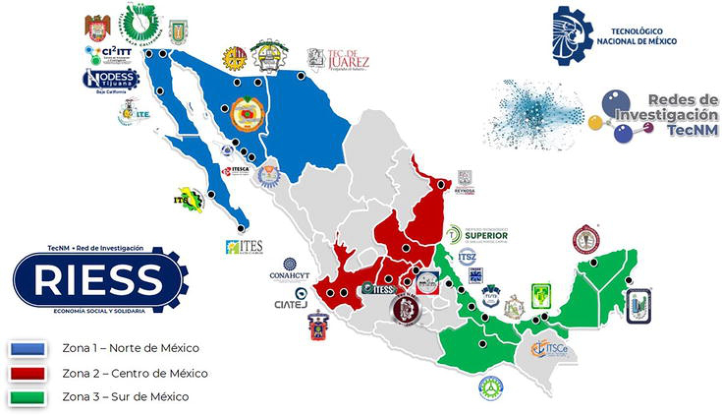
This award was issued by the Directorate of Postgraduate, Research, and Innovation in Mexico City. The RIESS Network (TecNM Cd. Juarez, 2024) has Researchers from North, Central and South Mexico, (see Figure 1, national structure of the RIESS Network) organized through a Board of Directors that integrates Regional Leaders; M.C. Blanca Esthela Zazueta Villavicencio from the Technological Institute of Agua Prieta (North Region 2), M.C.E. Adolfo Rivera Castillo from the Technological Institute of Hermosillo North Region 3), Dr. Armando Alberto León López from the Interdisciplinary Center for Research and Teaching in Technical Education - TecNM-CIIDET (Central Region), Dr. Jamín Balderrabano Briones from the Technological Institute of Úrsulo Galván (Southern Region), and as National Leader, Dr. Rodolfo Martínez Gutiérrez from the TecNM Tijuana Campus (Northern Region 1), includes NODESS Tijuana (TecNM Tijuana, 2022).
Figure 1: RIESS research network in Mexico.
RESEARCH MATERIAL AND METHODS There are components of the Mexico 2030 Agenda, as well as the Social and Solidarity Economy Projects Observatory of NODESS and the RIESS Network of TecNM (see to Table 1 for more information). A web page (RIESS Network, 2024) will document the traceability of actions undertaken, identify areas for improvement, and highlight gaps to encourage collaboration among all societal representatives in strengthening
the ecosystems that foster local development and prosperity, while seeking contributions from academia and support from local government. The RIESS Network (TecNM Huatabampo, 2024) meetings resulted in the establishment of a Strategic Plan for the Network’s three-year validity (Martinez et al., 2021, 2022). Working commissions will establish products for the remaining members through a series of meeting activities to establish lines of action for Human Resources Training, Professional Residencies, Social Service, Local, regional, national, and international liaison. In the same vein, the development of research projects, undergraduate and postgraduate theses.
Integrating the activities of the National Network of Social and Solidarity Economy Development Nodess (SINCA, 2022), the mechanisms for analysing and promoting the research lines of academic bodies, and the training and updating of educators and researchers with ties to different parts of society, this group considers interventional methodological tools like the Fifth Systemic Helix (QHS) and includes government officials, academics, business owners, organization leaders, and consultants (Martinez, 2024).
Table 1. QHS methodology strategies for environmental culture and SDGs.
Table available in the original PDF paper.
Sectoral Approach Description of Activities Formation of the expert groups Assessment and instruction in essential competencies for higher education students and teachers in relation to the social and solidarity economy and the initiatives via means of community service initiatives, towards achieving the SDGs outlined in the 2030 Agenda for Sustainable Development. Qualitative and quantitative analysis
Conducting in-depth interviews with the group of experts and utilizing the instruments used to generate statistical data mining to validate the approaches to proposed variables. Treatment of research results
Discourse analysis up to the correlation of variables, generating the construction of a database that will contribute to the state of the art, of statistical trends in the subject under research. To develop the Analysis, to provide voluntary reports at the local level of the advancements that have been achieved in the direction of the Sustainable Development Goals (SDGs), a methodology proposal is now being assessed and developed. Methodological proposal for intervention of the RIESS Network
A Subnational Report at the City Level will be generated by the Roadmap, which will contribute to the design of the Utility Model for the management of Hard Data from the various sources of official information, the results of Municipal Development Plans, and the linkage of the different sectors of society, including Government, Academia, Companies, Associations - Chambers, and Research Consultants, all with the common goal of local development, as well as the development of the region and the nation.
The RIESS National Research Network has a work plan that includes intervention methodologies in various sectors of society, such as the NODESS
Observatory of Social and Solidarity Economy, NODESS, SDGs, and Research Networks 461
(Social and Solidarity Economy Development Nodes) that are integrated in a tripartite manner. This plan includes a representative from the Academy, Local Government, and Social Sector, who are responsible for identifying the needs of the territory (TecNM CIIDET, 2024), the contexts of social development ecosystems, in terms of the examination of sectoral ecosystems in the diverse regions of the national territory. The aim of this research is to ascertain optimal practices for advancing the Sustainable Social Economy in accordance with the national development plan’s objectives to mitigate existing social inequality in Tijuana, Baja California. Additionally, it seeks to establish an observatory for the social economy that can delineate objectives for the sustainable development outlined in the 2030 agenda. Consequently, it is imperative to accurately understand the requirements of business operations and the representatives of the social, solidarity, and inclusive economy that can create developmental opportunities. It is essential to examine the intentions to collaborate cohesively among government entities, academic institutions, the social sector, civil society leaders, and the residents of Tijuana, Baja California, following a systematic development framework in alignment with the SDG Agenda. INEGI (2020) reports that Tijuana hosts 57,000 SMEs that need project execution for their support and advancement; also, the city has over 130 notable attributes, some recognized globally and others nationally. This research employs a quantitative methodology with a descriptive scope, utilizing documentary analysis to substantiate the theoretical framework, complemented by in-depth interviews with experts possessing best practices in the social economy sector. Additionally, a questionnaire is administered to a representative sample of SMEs to ascertain the relationship between critical factors influencing the degree of sustainable social economy implementation (TecNM Cd. Constitución, 2024). The results will give crucial information that could be useful for an initiative to set up NODESS, or All-around Mexico, there are nodes that are dedicated to the promotion of the social and solidarity economy. particularly with the help of the researchers from each of the RIESS there are networks throughout the state of Mexico’s north, middle, and south (TecNM Agua Prieta, 2024).
CONCLUSION
It is essential to establish a methodical, interdisciplinary team that incorporates all parts of society to pinpoint the challenges that a nation, state, or city has in achieving the SDGs. The leadership and initiative of a National or Subnational Voluntary Report brings together resources, skills, and determination to address the threats and opportunities posed by green growth and decline, which affect sustainable development in both urban and rural areas. In the VNR, the academic community and government officials work together to bring together all parts of society, including businesses, groups, researchers, and civil society, to create an inclusive space where no one is left behind. Since this is a societally relevant issue, the 2030 Agenda provides a platform for thought and action on each SDG. This research project aims to analyze the factors influencing the level of visibility and evolution of the UN 2030 Sustainable Development Goals (SDGs). It will use
a descriptive scope and rely on documentary analysis to support its theoretical framework. In Baja California, small and medium-sized enterprises (SMEs) are working toward and implementing Circular Economy goals while also engaging in social economy and innovation initiatives. The Tijuana Campus of Mexico’s National Technological Institute connects the public, through the SSE Observatory (web page), research projects and SDG actions, as a strategy for dissemination and linking academia with society in general, that serves as a database for references and industry input. It aids in detecting and evaluating the temporal changes in the SDGs, facilitating the development of opportunities, programs, and actions; assessing the essential factors that promote social innovation and sectoral integration for the benefit of society and all educational levels; and enhancing the capabilities of future generations (TecNM Mexicali, 2024).
Recommendations The global education sector has considerable challenges in cultivating global awareness among students, especially in articulating the need of environmental protection as a societal responsibility to future generations. Therefore, SGD 4 of the 2030 objectives is a crucial catalyst for getting students at all levels involved in projects that conserve resources and foster empathy for health, sports, and well-being as cornerstones of community improvement. Academic approaches and research are just as important as conceptual understanding when it comes to managing knowledge about sustainable development.
This research aims to identify the key elements within municipal governments in Mexico that represent significant areas of opportunity. A strategic emphasis on these factors might improve their efficacy in executing constitutional duties, advancing public policies that reflect the reality of their constituents and localities, and integrating actions and pledges from both national and global agendas. This strategy would provide a more proactive engagement in the international arena, sharing beneficial experiences from their institutional endeavors The involvement of the Municipal Government in research projects fosters essential initiatives that enhance management, local development, and benefit communities and their ecosystems for social advancement.
This method also highlights the critical components inside Mexican local administrations that provide the most substantial areas of potential. The execution of this strategic focus would enhance performance in fulfilling constitutional duties, advancing public policies that reflect the realities of residents and their communities, and integrating actions and commitments stemming from national and global agendas. Furthermore, the study will enhance the successful experiences acquired via its institutional actions, therefore assuming a more proactive position in the international arena.
REFERENCES
INEGI, Statistical data of the population of Baja California (September 16, 2024) Website: https://cuentame.inegi.org.mx/monografias/informacion/bc/poblacion/.
Observatory of Social and Solidarity Economy, NODESS, SDGs, and Research Networks 463
Martinez-Gutierrez R (2024) QHS Methodology Applied to Professional Growth with Impact on Society. Innovation - Research and Development for Human, Economic and Institutional Growth. IntechOpen. Available at: https://dx.doi.o rg/10.5772/intechopen.112559. Martinez-Gutierrez, R., Solis-Quinteros, M. M., Sanchez-Hurtado, C., Carey-Raygoza, C. E. (2021). Challenges for an Observatory of the 2030 Goals, SDG and Social Economy, in Northern Mexico. In: Goonetilleke, R. S., Xiong, S., Kalkis, H., Roja, Z., Karwowski, W., Murata, A. (eds) Advances in Physical, Social & Occupational Ergonomics. AHFE 2021. Lecture Notes in Networks and Systems, vol. 273. Springer, Cham. https://doi.org/10.1007/978-3-030-80713-9_24 Martinez-Gutierrez, R., Solis-Quinteros, M. M., Ibarra-Estrada, M. E., Hurtado-Sanchez, C., Carey-Raygoza, C. E., Chavez-Ceja, B. (2022). Observatory for the Development of 2030 Goals and the Circular Economy in Baja California. In: Ahram, T., Taiar, R. (eds) Human Interaction, Emerging Technologies and Future Systems V. IHIET 2021. Lecture Notes in Networks and Systems, vol. 319. Springer, Cham. https://doi.org/10.1007/978-3-030-85540-6_163 Martinez Gutierrez, R., Lucas Bravo, G., Ernesto Jimenez Bernardino, A., & Daniel
Padilla De la Rosa, J. (2024). Perspective Chapter: SDG 4, Educational Strategy and Awareness for Social Innovation in Sustainable Development. IntechOpen. doi: 10.5772/intechopen.1005252. RIESS TecNM Research Network. (October 08, 2024) Website: https://red-riess.mx. SINCA National Nodess Network. New Research Network on Social and Solidarity Economy (August 01, 2024) Website: https://sinca.gob.mx/pdf/novedadess/ SINCA_INAES_NOVEDAD_ESS_No. %2056.pdf. TecNM Agua Prieta. New Research Network on Social and Solidarity Economy
(April 24, 2024) Website: https://aguaprieta.tecnm.mx/2024/05/13/catedraticos -del-itap-forman-parte-de-la-red-nacional-de-economia-social-y-solidaria-riess/. TecNM CIIDET. New Research Network on Social and Solidarity Economy (March 20, 2024) Website: http://www.ciidet.tecnm.mx/ciidet/vistas/noticia. php?id=65fda693587d2c714f46fa22. TecNM Cd. Constitución. New Research Network on Social and Solidarity Economy
(April 23, 2024) Website: https://www.facebook.com/itscconstitucion/posts/el- d%C3%ADa-de-hoy-el-tecnol%C3%B3gico-nacional-de-m%C3%A9xicoy-la- red-de-investigaci%C3%B3n-de-econ/980492377413990/. TecNM Ciudad Juarez. New Research Network on Social and Solidarity Economy (March 06, 2024) Website: https://cdjuarez.tecnm.mx/blog/nota/1136/nueva-red- nacional-de-investigacion-en-economia-social-y-solidaria-\/-riies-\/-del-tecnm. TecNM Huatabampo. New Research Network on Social and Solidarity Economy
(March 26, 2024) Website: https://www.huatabampo.tecnm.mx/el-instituto-tec nologico-de-huatabampo-se-une-a-la-red-riess-en-colaboracion-con-el-tecnolog ico-nacional-de-mexico/. TecNM Mexicali. New Research Network on Social and Solidarity Economy (September 26, 2024) Website: ttp://www.itmexicali.edu.mx/noticias/noticiaspdf/ 2024_09_26.pdf. TecNM Tijuana. New Research Network on Social and Solidarity Economy
Intelligent Human Systems Integration (IHSI 2025): Integrating People and Intelligent Systems
Read this individual research paper free through the original publisher, or explore the full digital proceedings book.
ISBN 978-1-964867-36-6
Explore this ISBN in the AHFE Bookstore ↗Listed in the July 2026 bookstore catalogue; search by ISBN to confirm current availability · Digital book purchase optional