Rodolfo Martinez Gutierrez, Diana Rubi Oropeza-tosca, Sonia Moreno Cabral, Beatriz Chavez Ceja, Blanca Esthela Zazueta Villavicencio, Mayra Karina Galvez-Diaz, Karina Lopez Valle, Carmen Adolfo Castillo Rivera, Jazmin Balderrabano Briones, Omar Jimenez-marquez (2026). National Systematization for Voluntary Local Reports (VLR) of the 2030 Agenda; Municipalities of Mexico. In: Global Issues Challenge: Challenges in AI at the Human Level. AHFE Open Access, vol. 234, pp. 89–97. https://doi.org/10.54941/ahfe1007461
This paper presents the National Systematization of Voluntary Local Reports (VLR) of the 2030 Agenda for Sustainable Development in Mexican municipalities, developed through the collaboration of the Social and Solidarity Economy Research Network (RIESS) under the Research Networks modality. The project builds on the experience of the Municipal Observatory of Competencies for the Sustainable Development Goals (SDGs) and the preparation of the first Voluntary Local Report of Tijuana, Baja California, Mexico.The study applies a glocal and systemic approach based on the Quintuple Helix Systemic (QHS-VLR) methodology, which integrates government, academia, companies, associations, and consultants. This methodology promotes multisectoral participation and enables the articulation of local initiatives with the global framework of the 2030 Agenda. The project fostered social awareness and active engagement across sectors through the NODESS Tijuana program and the RIESS Network, generating social service activities, instructor training involving undergraduate and graduate students, and the development of applied research projects aligned with each SDG.The first VLR of Tijuana (2024) was developed under the leadership of the Technological Institute of Tijuana and the RIESS TecNM Research Network, in coordination with the Municipal Institute of Citizen Participation and with the support of the Executive Council of the 2030 Agenda of the Ministry of Economy. This report has been incorporated into United Nations databases, positioning Tijuana as the first city in Northern Mexico to present a VLR internationally.The results provide a methodological foundation for strengthening regional collaboration and advancing the national systematization of VLRs in Mexico, contributing from academia to evidence-based governance, regulatory strengthening, and systemic cooperation among societal sectors.
The territorialization of the 2030 Agenda requires that local governments have methodological frameworks and monitoring instruments capable of translating global commitments into policies, programs and indicators relevant to municipal realities. In this sense, Voluntary Local Reports (VLRs) have established themselves as a mechanism to communicate progress, challenges and priorities at the urban scale, while strengthening multi-stakeholder coordination and accountability. From this perspective, this article is inserted in the discussion on how to systematize the elaboration of VLR nationally in Mexico, recovering organizational and methodological learnings generated from academia and research networks, particularly from the development of the first VLR of Tijuana and its articulation with initiatives of municipal observatories oriented to the Sustainable Development Goals (SDGs).
The 2030 Agenda for Sustainable Development, adopted by the United Nations in 2015, constitutes a global framework that seeks to address economic, social, and environmental challenges through the achievement of 17 Sustainable Development Goals (SDGs). Although the Agenda is defined at the international level, its effective implementation depends largely on its territorialization, particularly at the local and municipal scales, where public policies, programs, and services directly interact with citizens.
THEORETICAL FRAMEWORK In Mexico, the localization of the 2030 Agenda has progressively gained relevance as municipalities seek to align local development planning with the Sustainable Development Goals (SDGs). While national reporting has traditionally been conducted through Voluntary National Reviews (VNRs), recent years have shown an increasing interest in Voluntary Local Reports (VLRs) as instruments that allow cities and municipalities to communicate their specific contributions, challenges, and priorities within the global sustainability framework.
From the perspective of sustainability, an observatory has been proposed aimed at analysing the visibility and evolution of the SDGs and their relationship with the implementation of the circular economy in SMEs, as well as with social economy and social innovation practices, through a systemic methodological application and information platforms that facilitate the detection of opportunities and the evaluation of critical factors of sectoral articulation (Martínez-Gutiérrez et al., 2021b). In a complementary way, other contributions highlight the development of models for dictionaries of sectoral competencies and professional standards as a way to strengthen the competitiveness and relevance of training in technological education, linking educational levels with the demands of the productive environment (Martínez-Gutiérrez et al., 2021c).
At the municipal level, it has been pointed out that the identification of areas of institutional opportunity within local governments can contribute to improving their performance in constitutional attributions and, simultaneously, favor the incorporation of commitments derived from national and global agendas. In this context, the proposal of dictionaries of competencies for sustainable development in municipalities in northern
National Systematization for Voluntary Local Reports (VLR) of the 2030 91 Mexico constitutes a reference for integrating local public policies with sustainability and territorial development approaches (Martínez-Gutiérrez & Salcedo Correa, 2020). Likewise, specific challenges have been documented to implement social economy observatories in cities such as Tijuana, underscoring the importance of coordinated work between government, academia, the social sector, and citizens to promote programs such as the Social and Solidarity Economy Development Nodes (NODESS) aligned with the 2030 Agenda (Martínez-Gutiérrez et al., 2021d).
METHODOLOGICAL APPROACH The development of VLRs in Mexico has been closely linked to academic leadership and interinstitutional collaboration, particularly in contexts where municipal technical capacities and standardized data systems remain heterogeneous. In this regard, higher education institutions have played a key role in providing methodological support, generating indicators, and articulating multisectoral participation aligned with the 2030 Agenda.
A central antecedent of this line of work is the methodological proposal of the Fifth Systemic Helix (QHS), developed as an instrument for policy analysis and applied research in different sectors, with an explicit integration of actors – business, education, government, organizations and consulting – and an orientation towards the traceability of its application over time (Martínez-Gutiérrez, 2021). In continuity with this approach, various studies have raised the need to consolidate observatories as platforms for analysis, generation of indicators and sectoral linkage. For example, the design of an observatory to integrate engineering careers into the economic development ecosystem of the Baja California peninsula is conceived as a strategic project to identify productive chains and entrepreneurial vocations, generating bases for linkage programs, continuing education, and academic projects (Martínez-Gutiérrez et al., 2021a).
DISCUSSION OF RESULTS A pioneering experience in this process is the preparation of the first Voluntary Local Report of Tijuana (VLR Tijuana 2024), developed under the leadership of the Technological Institute of Tijuana in collaboration with the Municipal Institute of Citizen Participation and with the support of the Executive Council of the 2030 Agenda of the Ministry of Economy. This report was incorporated into United Nations databases, positioning Tijuana as the first city in northern Mexico to present a VLR at the international level and establishing a reference for subsequent municipal initiatives.
Through the RIESS Network, the VLR has been consolidated not only as a reporting mechanism, but also as a platform for applied research, professional training, and social engagement aligned with the Social and Solidarity Economy and the SDGs. The coordinated participation of researchers, students, and municipal authorities has enabled the replication of the VLR model in diverse territorial contexts, while maintaining a common methodological structure that supports national systematization (See Table 1, Table 2 and Table 3).
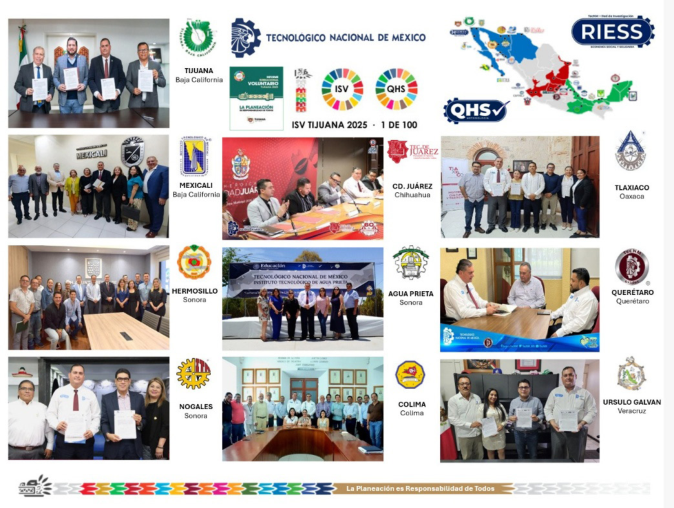
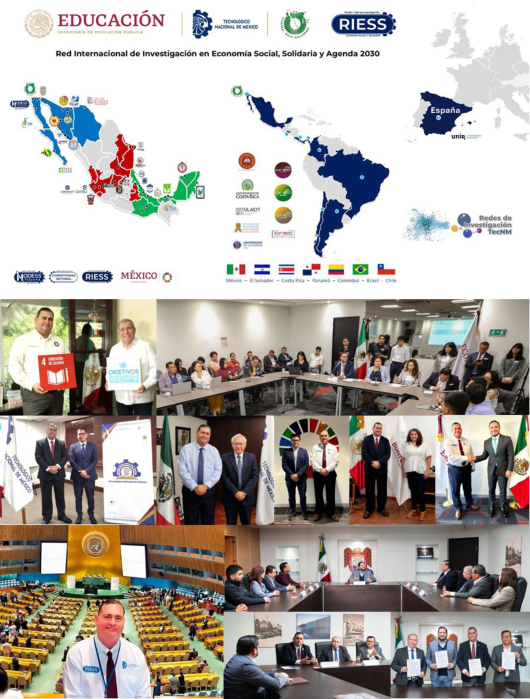
Building on this experience, the Social and Solidarity Economy Research Network (RIESS) of the Tecnológico Nacional de México (TecNM) has promoted a national project aimed at the development of 100 Voluntary Local Reports throughout Mexico. This initiative is grounded in the collaboration of researchers from technological institutes across the northern, central, and southern regions of the country, supported by the Quintuple Helix Systemic approach (QHS-VLR), which integrates government, academia, enterprises, social organizations, and consultancy actors (See Figure 1 and Figure 2).
Table 1: Publications of researchers in Northern Mexico of the RIESS network.
Table available in the original PDF paper.
Title of the Project Institutions Voluntary Local Report VLR TIJUANA 2024 State of Baja California
Tijuana City Council Tijuana Institute of Technology RIESS Network – NODESS Tijuana
Voluntary Local Report VLR TIJUANA 2025 State of Baja California
Tijuana City Council Tijuana Institute of Technology RIESS Network – NODESS Tijuana
Voluntary Local Report VLR MEXICALI 2025 State of Sonora
Mexicali City Council Mexicali Institute of Technology Tijuana Institute of Technology RIESS Network
Voluntary Local Report VLR HERMOSILLO 2025 State of Sonora
Hermosillo City Council Hermosillo Institute of Technology Tijuana Institute of Technology RIESS Network
Voluntary Local Report VLR NOGALES 2025 State of Sonora
Nogales City Council Nogales Institute of Technology Tijuana Institute of Technology RIESS Network
Voluntary Local Report VLR AGUA PRIETA 2025 State of Sonora
Agua Prieta City Council Agua Prieta Institute of Technology Tijuana Institute of Technology RIESS Network
Voluntary Local Report VLR CIUDAD JUAREZ 2025 State of Chihuahua
Ciudad Juarez City Council Ciudad Juarez Institute of Technology Tijuana Institute of Technology RIESS Network
Table 2: Publications of researchers in Central Mexico of the RIESS network.
Table available in the original PDF paper.
Title of the Project Institutions Voluntary Local Report VLR COLIMA 2025 State of Colima Colima City Council Tijuana Institute of Technology Colima Institute of Technology University of Colima RIESS Network
Voluntary Local Report VLR SAN LUIS POTOSI 2025 State of San Luis Potosi
San Luis Potosi City Council San Luis Potosi Institute of Technology Tijuana Institute of Technology RIESS Network
Table 3: Publications of researchers in the south of Mexico of the RIESS network.
Table available in the original PDF paper.
Title of the Project Institutions Voluntary Local Report VLR TLAXIACO 2025 State of Oaxaca Tlaxiaco City Council Tlaxiaco Institute of Technology Tijuana Institute of Technology RIESS Network
Voluntary Local Report VLR URSULO GALVAN 2025 State of Veracruz
Ursulo Galvan City Council Ursulo Galvan Institute of Technology Tijuana Institute of Technology RIESS Network
Figure 1: Research project to develop 100 VLRs throughout Mexico.
On this conceptual and empirical basis, the present study proposes a National Systematization of VLRs in municipalities of Mexico, built from the collaboration of the Social and Solidarity Economy Research Network (RIESS) and supported by a glocal and systemic approach. The experience of the Municipal Observatory of Competencies for SDGs and the elaboration of the first VLR of Tijuana (2024), developed with academic leadership and municipal coordination, is taken up, and the QHS-VLR methodology is adopted to integrate government, academia, companies, associations and consulting in the articulation of local initiatives with the global framework of the 2030 Agenda. Together, this work seeks to contribute to the strengthening of evidence-based governance, inter-institutional cooperation, and local capacity building to scale VLR production at the national level.
Figure 2: National and international linkage of the RIESS network TecNM.
CONCLUSION
In this sense, the RIESS-TecNM initiative represents a distinctive contribution to the institutionalization of VLRs in Mexico, positioning academia as a central actor in evidence-based local governance and in the construction of a national framework for monitoring and advancing the 2030 Agenda at the municipal level. The analysis of the case studies of the Social and Solidarity Economy Research Network (RIESS) in the North, Central and South regions of Mexico allows us to establish several relevant conclusions. They reflect the collaborative work and integration of all sectors of society, under a focus on finding solutions through uniting the experience and knowledge of the entire society, promoting the identification of actions that allow greater awareness of the 17 SDGs and the identification of gaps to achieve the goals of the 2030 Agenda.
ACKNOWLEDGMENT
The author Rodolfo Martínez Gutiérrez would like to the authorities of the Tecnológico Nacional de México (TecNM), the General Director Ramón Jiménez López; Academic Secretary, Research and Innovation of the TecNM, Gaudencio Lucas Bravo; Director of the Technological Institute of Tijuana, José Guillermo Cárdenas López, as well as the Municipal President of the City of Tijuana; Ismael Burgueño Ruiz, who facilitated the conditions to implement the QHS-VLR Methodology to initiate the research project to develop 100 VLRs throughout Mexico, with Tijuana being the 1st city of 100 VLRs. Which allowed you to be part of the Delegation of the Government of Mexico in the HLPF – Agenda 2030 in the Organization of National Unity in New York in 2025.
REFERENCES
Chávez Remigio, J. E. (2025). Construyendo redes de conocimiento: El instituto tecnológico de ensenada y su contribución a la red RIESS del TecNM (pp. 37–54). https://doi.org/10.22533/at.ed.6532518124 Enríquez-Carrillo, Juan Francisco; Martínez Gutiérrez, Rodolfo. (2026). Co-construction of community strategies for food security in Oconahua, Jalisco: A participatory approach from the solidarity economy. Journal of Agricultural Sciences Research. 2026. Vol. 6, no. 1. ISSN 2764–0973. DOI https://doi. org/10.22533/at.ed.8208112615013 Martínez Gutiérrez, R. Quinta Hélice Sistémica (QHS), A Method to Evaluate
the International Competitiveness of the Electronics Sector in Baja California, Mexico. Revista Investigación Administrativa 2012, 110, 34–48. Available online: https://iadministrativa.escasto.ipn.mx/index.php/IA/article/view/123/865 Martinez-Gutierrez, R. (2020). Methodology of Dictionaries of Sector Competences (DCS), to Design Standards of Professional Competences, Research and Labor. In: Nazir, S., Ahram, T., Karwowski, W. (eds) Advances in Human Factors in Training, Education, and Learning Sciences. AHFE 2020. Advances in Intelligent Systems and Computing, vol. 1211. Springer, Cham. https://doi.org/10.1007/978- 3-030-50896-8_46 Martinez-Gutierrez, R., Ahumada-Tello, E., Galvan-Sanchez, R., Hurtado-Sanchez,
C., Chavez-Ceja, B. (2021). Postgraduate Administration Education: Profiles and Skills Contribution to the Knowledge Society. In: Goonetilleke, R.S., Xiong, S., Kalkis, H., Roja, Z., Karwowski, W., Murata, A. (eds) Advances in Physical, Social & Occupational Ergonomics. AHFE 2021. Lecture Notes in Networks and Systems, vol. 273. Springer, Cham. https://doi.org/10.1007/978-3-030-80713- 9_26 Martinez-Gutierrez, R., Carey-Raygoza, C.E., Hurtado-Sanchez, C., Chavez- Ceja, B., Lara-Chavez, A. (2021). Business Management Engineers: Profile and Competencies of Generations X, Y and Z. In: Trzcielinski, S., Mrugalska, B., Karwowski, W., Rossi, E., Di Nicolantonio, M. (eds) Advances in Manufacturing, Production Management and Process Control. AHFE 2021. Lecture Notes in Networks and Systems, vol. 274. Springer, Cham. https://doi.org/10.1007/978-3- 030-80462-6_36
Martinez-Gutierrez, R., Carmona-Lopez, M.A., Juarez-Mendoza, M.A., Sanchez- Puga, O.J. (2020). Professional Competencies and Research to Offer Integrated Manufacturing Systems. In: Mrugalska, B., Trzcielinski, S., Karwowski, W., Di Nicolantonio, M., Rossi, E. (eds) Advances in Manufacturing, Production Management and Process Control. AHFE 2020. Advances in Intelligent Systems and Computing, vol. 1216. Springer, Cham. https://doi.org/10.1007/978-3-030- 51981-0_5 Martinez-Gutierrez, R., Correa, M.E.S. (2020). Dictionary of Competencies for
Sustainable Development in the Municipalities of Northern México. In: Kantola, J., Nazir, S., Salminen, V. (eds) Advances in Human Factors, Business Management and Leadership. AHFE 2020. Advances in Intelligent Systems and Computing, vol. 1209. Springer, Cham. https://doi.org/10.1007/978-3-030-50791-6_40 Martinez-Gutierrez, R., Cruz-Ibarra, C. (2020). Psychosocial Risk Factors at Work: The Legal Compliance Model in Mexico. In: Arezes, P., Boring, R. (eds) Advances in Safety Management and Human Performance. AHFE 2020. Advances in Intelligent Systems and Computing, vol. 1204. Springer, Cham. https://doi. org/10.1007/978-3-030-50946-0_30 Martinez-Gutierrez, R., Ibarra-Estrada, M.E., Carey-Raygoza, C.E., Hurtado-
Sanchez, C., Chavez-Ceja, B. (2022). Observatory of Labor, Professional and Research Competencies of the Economic Sectors in Baja California. In: Ahram, T., Taiar, R. (eds) Human Interaction, Emerging Technologies and Future Systems V. IHIET 2021. Lecture Notes in Networks and Systems, vol .319. Springer, Cham. https://doi.org/10.1007/978-3-030-85540-6_164 Martinez-Gutierrez, R., Ibarra-Estrada, M.E., Hurtado-Sanchez, C., Carey-Raygoza, C.E., Chavez-Ceja, B. (2022). Observatory for the Integration of Engineering in the Economic Development Ecosystem of the Baja California Peninsula. In: Ahram, T., Taiar, R. (eds) Human Interaction, Emerging Technologies and Future Systems V. IHIET 2021. Lecture Notes in Networks and Systems, vol. 319. Springer, Cham. https://doi.org/10.1007/978-3-030-85540-6_162 Martinez-Gutierrez, R., Ibarra-Estrada, M.E., Hurtado-Sanchez, C., Carey-Raygoza,
C.E., Chavez-Ceja, B., Lara-Chavez, A. (2021). Competitiveness and Innovation on the Frontier of Knowledge: 25th Anniversary Postgraduate in Administration TecNM Tijuana. In: Markopoulos, E., Goonetilleke, R.S., Ho, A.G., Luximon, Y. (eds) Advances in Creativity, Innovation, Entrepreneurship and Communication of Design. AHFE 2021. Lecture Notes in Networks and Systems, vol. 276. Springer, Cham. https://doi.org/10.1007/978-3-030-80094-9_49 Martinez-Gutierrez, R., Solis-Quinteros, M.M., Ibarra-Estrada, M.E., Hurtado- Sanchez, C., Carey-Raygoza, C.E., Chavez-Ceja, B. (2022). Observatory for the Development of 2030 Goals and the Circular Economy in Baja California. In: Ahram, T., Taiar, R. (eds) Human Interaction, Emerging Technologies and Future Systems V. IHIET 2021. Lecture Notes in Networks and Systems, vol. 319. Springer, Cham. https://doi.org/10.1007/978-3-030-85540-6_163 Martinez-Gutierrez, R., Solis-Quinteros, M.M., Sanchez-Hurtado, C., Carey-
Raygoza, C.E. (2021). Challenges for an Observatory of the 2030 Goals, SDG and Social Economy, in Northern Mexico. In: Goonetilleke, R.S., Xiong, S., Kalkis, H., Roja, Z., Karwowski, W., Murata, A. (eds) Advances in Physical, Social & Occupational Ergonomics. AHFE 2021. Lecture Notes in Networks and Systems, vol. 273. Springer, Cham. https://doi.org/10.1007/978-3-030-80713-9_24 Martinez-Gutierrez, R., “Methodology of the Fifth Helix Systemic, A Decade of Sectorial Investigations 2010-2020”, in IOP Conference Series: Earth and Environmental Science, 2021, vol. 690, no. 1, p. 012061. DOI 10.1088/1755- 1315/690/1/012061 Available online: https://ui.adsabs.harvard.edu/ abs/2021E%26ES..690a2061M/abstract
National Systematization for Voluntary Local Reports (VLR) of the 2030 97 Martinez-Gutierrez, Rodolfo. Engineering Employability Observatory: A Systemic
Approach to National Development. Engineering Research Journal-Brasil. 2025. Vol. 5, no. 9., 2025 ISSN 2764–1317 DOI https://doi.org/10.22533/ at.ed.317592504126 Martinez-Gutierrez, Rodolfo. QHS The methodology is applied to professional development that has a social impact. Open Minds Internacional Journal-Brasil. 2025. Vol. 1, no. 4., 2025 ISSN 2675-5157 DOI https://doi.org/10.22533/ at.ed.515742512123 Martínez Gutiérrez, R. (Ed.). (2022). Competency Observatory for Sustainable
Development Goals (SDGs), NODESS and Research Networks [PDF]. Atena. DOI: https://doi.org/10.22533/at.ed.769221612 Martínez Gutiérrez, R. (Ed.). (2025). Systemic development for sustainability: Case studies of the QHS methodology [PDF]. Atena. https://doi.org/10.22533/ at.ed.561252312 Martínez Gutiérrez, R. (Ed.). (2025). Competency Observatory for Sustainable
Development Goals (SDGs), NODESS and Research Networks [PDF]. Atena. DOI: https://doi.org/10.22533/at.ed.428251102 Martínez Gutiérrez, R. (Org.). (2026). Systemic development for sustainability: Case studies of QHS methodology and 2030 agenda in voluntary local reports (VLRs) [PDF]. Atena. https://doi.org/10.22533/at.ed.727261102 Martínez Gutiérrez, R., Lucas Bravo, G., Balderrabano Briones, J., Rubí Oropeza
Tosca, D., Jiménez Márquez, O., & Eliseo Dantés, H. (Orgs.). (2025). Social and solidarity economy: Case studies from the southern region of Mexico [PDF]. Atena. https://doi.org/10.22533/at.ed.691251812 Martínez Gutiérrez, R., Lucas Bravo, G., León López, A. A., Jiménez Bernardino, Á.
E., Padilla De La Rosa, J. D., & Mak Huerta, V. C. (Orgs.). (2025). Social and solidarity economy: Case studies from the central region of Mexico [PDF]. Atena. https://doi.org/10.22533/at.ed.660251812 Martínez Gutiérrez, R., Zazueta, B. E., Rivera Castillo, C. A., Galvez Díaz, M. K., Moreno Cabral, S., & Ahumada Tello, E. (Orgs.). (2025). Social and solidarity economy: Case studies from the northern region of Mexico [PDF]. Atena. https:// doi.org/10.22533/at.ed.653251812
LISTED IN THE AHFE DIGITAL BOOKSTORE CATALOGUE
Explore the complete digital volume
Global Issues Challenge: Challenges in AI at the Human Level
Read this individual research paper free through the original publisher, or explore the full digital proceedings book.
ISBN 979-8-950676-10-9
Explore this ISBN in the AHFE Bookstore ↗Listed in the July 2026 bookstore catalogue; search by ISBN to confirm current availability · Digital book purchase optional