Diana Rubi Oropeza-tosca, Rodolfo Martinez Gutierrez, Omar Jimenez-marquez, Karina González-Izquierdo, Reiner Rincón-Rosales, Luis Alberto Manzano-Gómez, Clara Ivette Rincón-Molina, Victor Manuel Ruiz-Valdiviezo, José Juan Escalante-Fernández, Roger Notario-Priego, Pedro Ramón-Santiago, Irving Bruno López-Santos, Miguel Ángel Gómez-Jiménez, Gaudencio Lucas-bravo (2026). Designing an AI-Supported Intercultural Educational Methodology for Native Maize Communities in Oaxaca. In: Training, Education, and Learning Sciences. AHFE Open Access, vol. 231, pp. 121–131. https://doi.org/10.54941/ahfe1008003
Indigenous rural communities preserve valuable biocultural knowledge associated with native maize conservation, agroecological practices, traditional gastronomy, cultural heritage, and community-based tourism. However, educational initiatives frequently address these dimensions separately, limiting their contribution to sustainable territorial development and knowledge transmission. This study presents the design of an Artificial Intelligence-supported intercultural educational methodology developed during Phase 1 of Project IH-2025-G-308 in indigenous communities of Tlaxiaco, Oaxaca, Mexico. The methodology was constructed through participatory action research and interdisciplinary process involving researchers, educators, agricultural specialists, and community stakeholders. Four interconnected educational dimensions were identified to structure the learning framework: environmental, agroecological, cultural, and economic. Based on these dimensions, four complementary diagnostic instruments were developed, including a semi-structured interview guide, a community observation protocol, a 20-item Likert-scale questionnaire, and a community participation registry. The resulting framework was organized into five learning subsystems: natural resource conservation, native maize and agroecological practices, cultural heritage and traditional knowledge, community-based tourism and regional entrepreneurship, and Artificial Intelligence-supported educational innovation. The methodology incorporates cross-sectional and longitudinal assessment strategies and establishes a structured pathway for transforming community knowledge into illustrated educational materials, bilingual audiovisual resources, training activities, and culturally adapted learning experiences. The proposed framework contributes to a human-centered and replicable methodology that integrates regional knowledge systems, participatory action research, intercultural education, and Artificial Intelligence to support biocultural heritage conservation, community learning, and sustainable rural development.
The rapid advancement of Artificial Intelligence (AI) is transforming educational systems worldwide, creating new opportunities for personalized learning, digital inclusion, and knowledge generation. International organizations such as UNESCO and the OECD have highlighted the potential of AI to improve educational access, strengthen digital competencies, and support lifelong learning while emphasizing the need for human-centered, ethical, and culturally sensitive approaches to its implementation (OECD, n.d.; UNESCO, 2023). However, significant challenges remain regarding the integration of AI into educational environments characterized by cultural diversity, limited technological infrastructure, and strong traditional knowledge systems.
Recent studies have demonstrated the growing role of AI in rural and community-based educational contexts. Research has shown that AI-supported learning environments can improve educational outcomes, facilitate knowledge transfer, and enhance digital literacy among students and educators in underserved regions (Ho, 2025; López Costa, 2025). Nevertheless, many existing initiatives prioritize technological adoption over the preservation of regional knowledge, cultural identity, and community participation, creating a gap between technological innovation and territorial sustainability (Arranz García et al., 2025).
Indigenous communities represent particularly important contexts for the development of culturally relevant educational models. These communities possess extensive ecological, agricultural, linguistic, and cultural knowledge accumulated through generations. Participatory educational approaches have increasingly been recognized as effective mechanisms for integrating regional knowledge systems into learning processes while promoting community empowerment and equitable participation (Collins et al., 2018; Cornish et al., 2023). Furthermore, recent work on relational AI suggests that educational technologies should strengthen human relationships, reciprocity, and collective learning rather than replace them (Martinez-Maldonado et al., 2026). In Mexico, native maize constitutes one of the most important elements of biocultural heritage. Beyond its agricultural value, maize is deeply connected to food systems, cultural identity, traditional ecological knowledge, and regional economies. Studies on biocultural heritage emphasize that indigenous
Designing an AI-Supported Intercultural Educational Methodology for Native 123 territories function as reservoirs of biodiversity, agrodiversity, and ancestral knowledge, contributing significantly to environmental conservation and sustainable development (Toledo & Barrera-Bassols, 2008; Boege, 2008). Agroecological practices associated with native maize cultivation also enhance resilience to climate variability and strengthen sustainable food systems (Altieri et al., 2015; FAO, 2021).
The indigenous communities of Tlaxiaco, Oaxaca, represent an important case for the development of innovative educational strategies. Previous research has identified significant opportunities for strengthening sustainable experiential tourism, agroecological production, cultural preservation, and digital capacity building through community participation and technological innovation (Jiménez-Márquez et al., 2025; Oropeza-Tosca et al., 2025). At the same time, these communities face educational and technological challenges that limit access to training opportunities capable of integrating environmental, agroecological, cultural, and economic dimensions within a single learning framework.
Despite increasing interest in AI-supported education, limited research has addressed the design of intercultural educational methodologies specifically adapted to indigenous communities that combine participatory research, biocultural heritage conservation, native maize knowledge, and sustainable territorial development. This gap is particularly evident in rural Latin American contexts where educational innovation must coexist with cultural preservation and community autonomy.
Therefore, the objective of this study is to design an AI-supported intercultural educational methodology for indigenous communities engaged in native maize conservation in Tlaxiaco, Oaxaca, Mexico. The proposed methodology integrates participatory diagnostic instruments, regional knowledge systems, and educational technologies to support future community learning processes, biocultural heritage preservation, and sustainable territorial development.
MATERIALS AND METHODS
Study Area The study was conducted in indigenous rural communities located in the municipality of Heroica Ciudad de Tlaxiaco, Oaxaca, Mexico. The research focused on communities involved in native maize production and the preservation of traditional agricultural, cultural, and gastronomic practices. These communities maintain important biocultural resources, including native maize varieties, traditional ecological knowledge, indigenous cultural expressions, regional gastronomy, biodiversity, and emerging community- based tourism initiatives.
The study was developed as part of Project IH-2025-G-308, funded through the Mexican national research program, which seeks to design a replicable educational and economic model supported by Artificial Intelligence for indigenous agricultural communities.
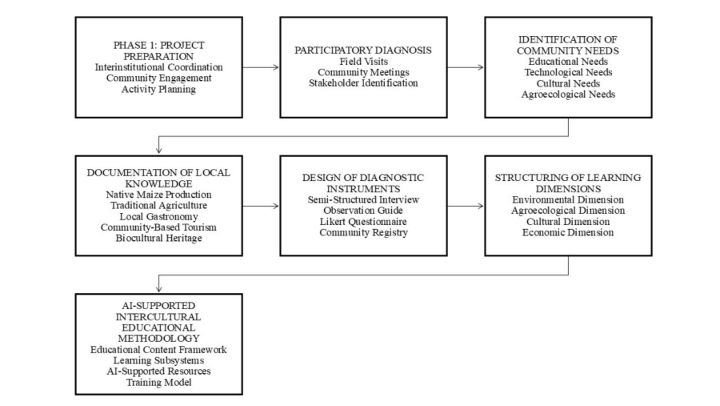
Research Design A participatory action research approach was adopted to support the collaborative construction of an intercultural educational methodology. Participatory Action Research (PAR) promotes the active involvement of community members in the identification of regional needs, knowledge systems, and development opportunities while facilitating the co-creation of educational solutions adapted to regional realities. The adoption of Participatory Action Research (PAR) was based on its recognized capacity to facilitate equitable community involvement, co-creation of knowledge, and regionally grounded decision-making processes in rural and indigenous contexts (Collins et al., 2018; Cornish et al., 2023; Briones Ponce et al., 2025). This approach is particularly relevant for educational innovation initiatives that seek to integrate traditional knowledge systems with contemporary technological tools while promoting sustainable territorial development (Shin et al., 2026). The methodological design integrated principles of intercultural education, human-centered learning, sustainable territorial development, and Artificial Intelligence-supported educational innovation. The process was organized into sequential stages including participatory diagnosis, identification of educational needs, design of research instruments, content selection, educational material development, and community validation.
Identification of Educational Needs The diagnostic framework was designed to identify educational requirements associated with four interconnected dimensions: Environmental dimension; Agroecological dimension; Cultural dimension; Economic dimension.
These dimensions were selected based on previous studies conducted in Tlaxiaco and on the importance of native maize conservation as a biocultural heritage element. The assessment considered topics related to biodiversity conservation, agroecological management, traditional knowledge transmission, indigenous language preservation, entrepreneurship, community-based tourism, and digital literacy. The selection of these dimensions was informed by studies on biocultural heritage, indigenous food systems, agroecology, and sustainable territorial development. Native maize was considered a central biocultural component because of its ecological, cultural, economic, and educational significance within indigenous communities (Toledo & Barrera-Bassols, 2008; Boege, 2008; FAO, 2021). Agroecological practices associated with native maize cultivation were also considered due to their contribution to climate resilience and biodiversity conservation (Altieri et al., 2015).
Design of Data Collection Instruments Four complementary instruments were developed to collect information from community members and support the future design of educational resources.
Semi-Structured Interview Guide. The interview guide was designed to obtain qualitative information regarding regional knowledge, traditional agricultural practices, cultural identity, tourism activities, educational needs,
Designing an AI-Supported Intercultural Educational Methodology for Native 125 and perceptions regarding the use of digital technologies and Artificial Intelligence.
Community Observation Guide. The observation protocol was developed to document environmental conditions, agricultural practices, cultural activities, regional infrastructure, educational resources, and tourism-related assets present in the communities.
Likert-Scale Questionnaire. A 20-item Likert-scale questionnaire was designed to evaluate perceptions, attitudes, and levels of agreement regarding environmental conservation, agroecological practices, cultural preservation, economic development opportunities, educational needs, and the potential use of Artificial Intelligence as a learning support tool.
Community Registry. A community participation registry was designed to document demographic information, productive activities, participation in educational processes, and regional knowledge areas relevant to the proposed educational model.
Instrument development was guided by principles of participatory research and intercultural educational assessment, allowing the identification of regional perceptions, traditional knowledge, technological readiness, and community development opportunities. The instruments were designed to support both qualitative and quantitative data collection and to facilitate future longitudinal evaluations of educational interventions.
Educational Content Selection Based on the four dimensions and the information collected through the diagnostic instruments, educational content was organized into five learning subsystems: 1. Natural resource conservation, 2. Native maize and agroecological practices, 3. Cultural heritage and traditional knowledge, 4. Community-based tourism and regional entrepreneurship, 5. Artificial Intelligence-supported educational innovation. These subsystems served as the foundation for the future development of educational resources adapted to regional cultural and territorial contexts.
The inclusion of community-based tourism as a learning subsystem was supported by recent studies highlighting its role in regional economic diversification, cultural preservation, and sustainable rural development (Cordova-Buiza et al., 2025; Abreu et al., 2024; Hariyadi et al., 2024). Similarly, the incorporation of biocultural heritage and agroecological knowledge responds to the need to preserve traditional knowledge systems while promoting community resilience and sustainability (Toledo & Barrera- Bassols, 2008; Boege, 2008).
Development of AI-Supported Educational Resources The methodological framework proposes the use of Artificial Intelligence as a support tool for generating educational resources adapted to community needs. This approach follows international recommendations that promote human-centered, ethical, and culturally responsive applications of Artificial Intelligence in education (UNESCO, 2023; UNESCO IICBA & International
Centre for Innovation in Higher Education, 2026; OECD, n.d.). The design also incorporates relational perspectives on educational AI, emphasizing reciprocity, community participation, and the strengthening of human relationships rather than technological substitution of social learning processes (Martinez-Maldonado et al., 2026).
Planned outputs include illustrated educational materials, bilingual audiovisual resources, training guides, learning activities, and community workshops. The design prioritizes cultural relevance, accessibility, knowledge preservation, and human-centered learning principles (Ho, 2025; Arranz García et al., 2025; Basantes-Andrade et al., 2025).
Community Validation The final stage of the methodology involves community review and validation of the proposed educational resources. Community members, regional leaders, producers, and stakeholders will participate in evaluating content relevance, cultural appropriateness, clarity, and practical applicability. Feedback obtained during this stage will be used to refine educational materials before implementation.
Community validation is considered a critical component of intercultural educational design because it ensures that educational resources accurately reflect regional knowledge systems, cultural values, territorial priorities, and community expectations. This process contributes to the legitimacy, relevance, and long-term sustainability of the proposed educational methodology. Figure 1 summarizes the overall research design and methodological structure adopted in this study.
Figure 1: Research design of the AI-supported intercultural educational methodology for indigenous native maize communities in Tlaxiaco, Oaxaca. Source: Authors’ elaboration.
RESULTS
The principal outcome of Phase 1 of Project IH-2025-G-308 was the design of an AI-supported intercultural educational methodology for indigenous native maize communities in Tlaxiaco, Oaxaca. Developed through a participatory diagnostic process, the framework integrates local knowledge, educational needs, and sustainable development opportunities. Four educational dimensions, environmental, agroecological, cultural, and economic, were identified as the foundation of the methodology, providing a structured approach to community learning and sustainable territorial development (Table 1).
Table 1: Educational dimensions incorporated into the proposed methodology.
Agroecological Native maize production, biofertilization, soil management, climate resilience, sustainable agriculture Cultural Indigenous language preservation, traditional knowledge, gastronomy, cultural identity, community memory
Economic Entrepreneurship, value-added products, community-based tourism, regional development, digital opportunities The participatory diagnosis also resulted in the design of four complementary research instruments intended to support future educational planning and community assessment processes. These instruments were developed to capture qualitative and quantitative information related to regional knowledge systems, educational requirements, technological capacities, cultural practices, and perceptions regarding the use of Artificial Intelligence in community learning environments. The instruments and their functions are summarized in Table 2.
Table 2: Diagnostic instruments developed during Phase 1.
Identification of regional knowledge, educational needs, cultural practices, and community perceptions
Community Observation Guide
Documentation of environmental conditions, productive activities, cultural assets, and regional infrastructure Likert-Scale Questionnaire Assessment of attitudes, perceptions, and levels of agreement regarding educational and community development topics
Community Registry Characterization of participants, productive activities, and areas of regional expertise
Based on the diagnostic framework, educational content was organized into five learning subsystems: natural resource conservation, native maize and agroecology, cultural heritage, community-based tourism and entrepreneurship, and AI-supported educational innovation. The resulting methodology provides a framework for developing educational materials, bilingual audiovisual resources, and training activities. It integrates local knowledge with digital technologies while promoting cultural relevance, biocultural heritage conservation, and sustainable territorial development in indigenous and rural communities.
DISCUSSION
The methodology contributes to research on participatory and human- centered educational innovation in rural and indigenous contexts. Unlike conventional approaches, the framework was developed from community needs, local realities, and traditional knowledge systems through participatory action research, promoting equitable collaboration between researchers and communities (Collins et al., 2018; Cornish et al., 2023). The integration of Artificial Intelligence follows international recommendations for ethical, inclusive, and human-centered educational applications (UNESCO, 2023; OECD, n.d.) and aligns with relational AI perspectives that emphasize reciprocity, participation, and social learning (Martinez-Maldonado et al., 2026). Furthermore, the methodology incorporates biocultural heritage as a core educational component, recognizing native maize as a cultural, ecological, and economic resource linked to biodiversity, agrodiversity, and traditional knowledge systems (Toledo & Barrera-Bassols, 2008; Boege, 2008). The integration of environmental, agroecological, cultural, and economic dimensions reflects the interconnected nature of indigenous territorial systems and supports culturally relevant educational innovation.
The agroecological dimension is particularly relevant because traditional practices associated with native maize cultivation contribute to biodiversity conservation, climate resilience, soil health, and food sovereignty (Altieri et al., 2015; FAO, 2021). Incorporating these elements into educational content supports the transmission of practical knowledge that remains essential for community development. Likewise, community-based tourism extends learning beyond agricultural production by linking cultural heritage, local economies, and sustainable territorial development (Cordova-Buiza et al., 2025; Abreu et al., 2024; Hariyadi et al., 2024). In Tlaxiaco, native maize, gastronomy, and traditional knowledge represent valuable educational and economic assets. The proposed methodology also builds upon previous studies on sustainable experiential tourism and AI-assisted training for native maize producers in the region (Oropeza-Tosca et al., 2025; Jiménez- Márquez et al., 2025). As such, it provides a replicable framework for strengthening local knowledge systems, promoting sustainable development, and expanding educational opportunities through culturally relevant technological approaches.
CONCLUSION
The AI-supported intercultural educational methodology developed during Phase 1 of Project IH-2025-G-308 provides a structured framework for integrating indigenous knowledge, native maize conservation, agroecological practices, cultural heritage, community-based tourism, and emerging digital technologies within a unified educational model. Through a participatory action research approach, the methodology was designed to respond to educational, technological, cultural, and economic needs identified in indigenous communities of Tlaxiaco, Oaxaca. The resulting framework combines diagnostic instruments, learning dimensions, and educational subsystems that support the future development of culturally relevant and human-centered learning resources. By positioning Artificial Intelligence as a complementary tool for knowledge preservation, educational innovation, and community empowerment, the proposed methodology contributes to sustainable territorial development while respecting regional identities and traditional knowledge systems. Furthermore, the model offers a replicable approach that can be adapted to other indigenous and rural communities seeking to strengthen biocultural heritage conservation, digital inclusion, and community learning through participatory and intercultural educational strategies.
ACKNOWLEDGMENT
This research was funded by the Secretaría de Ciencia, Humanidades, Tecnología e Innovación (SECIHTI), Mexico, under Project IH-2025-G-308. The authors also express their gratitude to the participating indigenous communities of Oaxaca for their collaboration, knowledge sharing, and active involvement in the development of the proposed educational methodology. Special thanks are extended to the researchers, students, and institutions of the Tecnológico Nacional de México who contributed to the design, planning, and implementation of Phase 1 activities.
REFERENCES
Abreu, L. A. d., Walkowski, M. d. C., Perinotto, A. R. C., & Fonseca, J. F. d.
(2024). Community-based tourism and best practices with the Sustainable Development Goals. Administrative Sciences, 14(2), 36. https://doi.org/10.3390/ admsci14020036 Altieri, M. A., Nicholls, C. I., Henao, A., & Lana, M. A. (2015). Agroecology and the design of climate change-resilient farming systems. Agronomy for Sustainable Development, 35(3), 869–890. https://doi.org/10.1007/s13593-015-0285-2 Arranz García, O., Romero García, M. del C., & Alonso-Secades, V. (2025).
Perceptions, strategies, and challenges of teachers in the integration of artificial intelligence in primary education: A systematic review. Journal of Information Technology Education: Research, 24, 1–26. https://doi.org/10.28945/5458 Basantes-Andrade, A., Bastidas-Amador, G., Ruiz-Chagna, C., et al. (2025).
Integrating digital technologies into the teaching of intercultural competences: A systematic literature mapping. F1000Research, 14, 772. https://doi.org/10.12688/ f1000research.167364.3
Boege, E. (2008). El patrimonio biocultural de los pueblos indígenas de México: Hacia la conservación in situ de la biodiversidad y agrodiversidad en los territorios indígenas. Instituto Nacional de Antropología e Historia & Comisión Nacional para el Desarrollo de los Pueblos Indígenas. https://patrimoniobiocultural.com/ archivos/publicaciones/libros/El_patrimonio_biocultural.pdf Briones Ponce, M. E., Vélez Ozaeta, Y. B., Muñoz Briones, J. L., & Sánchez Azúa, I.
M. (2025). Participatory action research (IAP) as a methodology in community projects. Salud, Ciencia y Tecnología, 5, 1722. https://doi.org/10.56294/ saludcyt20251722 Collins, S. E., Clifasefi, S. L., Stanton, J., The Leap Advisory Board, Straits, K. J. E., Gil- Kashiwabara, E., Rodriguez Espinosa, P., Nicasio, A. V., Andrasik, M. P., Hawes, S. M., Miller, K. A., Nelson, L. A., Orfaly, V. E., Duran, B. M., & Wallerstein, N. (2018). Community-based participatory research (CBPR): Towards equitable involvement of community in psychology research. American Psychologist, 73(7), 884–898. https://doi.org/10.1037/amp0000167 Cordova-Buiza, F., Medina-Viruel, M. J., & Pérez-Gálvez, J. C. (2025). Community-
based rural tourism: A mapping technique analysis study from 2005 to 2023. Humanities and Social Sciences Communications, 12, 527. https://doi. org/10.1057/s41599-025-04746-7 Cornish, F., Nyutsem Breton, N., Moreno-Tabarez, U., Rua, M., & Hodgetts, D.
(2023). Participatory action research. Nature Reviews Methods Primers, 3(1). https://doi.org/10.1038/s43586-023-00214-1 Food and Agriculture Organization of the United Nations (FAO). (2021). Indigenous peoples’ food systems: Insights on sustainability and resilience from the front line of climate change. FAO. https://www.fao.org/in-action/kore/publications/ publications-details/en/c/1414665/ Hariyadi, B. R., Rokhman, A., Rosyadi, S., Yamin, M., & Runtiko, A. G. (2024). The
role of community-based tourism in sustainable tourism villages in Indonesia. Revista de Gestão Social e Ambiental, 18(7), e05466. https://doi.org/10.24857/ rgsa.v18n7-038 Ho, C.-W. (2025). A study on integrating artificial intelligence into teaching activities in rural communities for elementary school students. International Journal of Information and Education Technology, 15(6), 1046–1052. https://doi. org/10.18178/ijiet.2025.15.6.2317 Jiménez-Márquez, O., Martínez-Gutiérrez, R., González-Izquierdo, K., Manzano-
Gómez, L. A., Rincón-Molina, C. I., Lucas-Bravo, G., Rincón-Rosales, R., & Oropeza-Tosca, D. R. (2025). A replicable rural model, integrating corn, culture, and technology for sustainable experiential tourism: Case Tlaxiaco [Preprint]. Preprints.org. https://doi.org/10.20944/preprints202509.0811.v1 López Costa, M. (2025). Artificial intelligence and data literacy in rural schools’ teaching practices: Knowledge, use, and challenges. Education Sciences, 15(3), 352. https://doi.org/10.3390/educsci15030352 Martinez-Maldonado, R., Echeverria, V., Hawes, J., Kim, Y. J., Maddigan, Z., Milesi,
M., Nelson, T., & Tsai, Y.-S. (2026). Relational AI in education: Reciprocity, participatory design, and Indigenous worldviews [Preprint]. arXiv. https://doi. org/10.48550/arXiv.2604.19099 Martinez-Gutierrez, R., & Correa, M. E. S. (2020). Dictionary of competencies for sustainable development in the municipalities of northern México. In J. Kantola, S. Nazir, & V. Salminen (Eds.), Advances in human factors, business management and leadership (Vol. 1209). Springer. https://doi.org/10.1007/978-3-030-50791- 6_40
Designing an AI-Supported Intercultural Educational Methodology for Native 131 Organisation for Economic Co-operation and Development (OECD). (n.d.).
Artificial intelligence and education and skills. OECD. https://www.oecd.org/en/ topics/artificial-intelligence-and-education-and-skills.html Oropeza-Tosca, D., Jiménez-Márquez, O., Martínez-Gutiérrez, R., Lucas-Bravo, G., & Rincón-Molina, C. I. (2025). Experiential and sustainable tourism: Teaching with artificial intelligence to native corn producers in Tlaxiaco, Oaxaca. En S. Nazir (Ed.), Training, Education, and Learning Sciences. AHFE 2025 International Conference (AHFE Open Access, Vol. 193). AHFE International. https://doi. org/10.54941/ahfe1006662 Shin, Y., To, W., Mannett, R., Melville, A., Driscoll, S. E., & Karabetsos, A.
(2026). Fostering university–community collaboration for regional community sustainability: A U.S. public university interdisciplinary sustainability initiative through participatory action research. International Journal of Sustainability in Higher Education. https://doi.org/10.1108/IJSHE-08-2025-0840 Toledo, V. M., & Barrera-Bassols, N. (2008). La memoria biocultural: La importancia ecológica de las sabidurías tradicionales. Icaria Editorial. United Nations Educational, Scientific and Cultural Organization (UNESCO)
International Institute for Capacity Building in Africa (IICBA), & International Centre for Innovation in Higher Education. (2026). Digitalization and the use of artificial intelligence in higher education in Africa: An exploratory study (Q. Wodon, Ed.). UNESCO IICBA Study 2026-1. UNESCO. https://unesdoc.unesco. org/ark:/48223/pf0000397345 United Nations Educational, Scientific and Cultural Organization (UNESCO).
(2023, September 7). Guidance for generative AI in education and research. UNESCO. https://www.unesco.org/en/articles/guidance-generative-ai-education- and-research
LISTED IN THE AHFE DIGITAL BOOKSTORE CATALOGUE
Explore the complete digital volume
Training, Education, and Learning Sciences
Read this individual research paper free through the original publisher, or explore the full digital proceedings book.
ISBN 979-8-950676-07-9
Explore this ISBN in the AHFE Bookstore ↗Listed in the July 2026 bookstore catalogue; search by ISBN to confirm current availability · Digital book purchase optional