Mika Morishima, Mari Kameda, Mina Ushiro (2026). Manual Dexterity Required for Clothing Repairs: Assessing the Influence of Thread Fineness on Evaluation Outcomes. In: Training, Education, and Learning Sciences. AHFE Open Access, vol. 231, pp. 100–106. https://doi.org/10.54941/ahfe1008000
In pursuit of a sustainable society, there is a renewed scholarly interest in traditional garment repair techniques. As individuals progress through different stages of development, does their manual dexterity enhance enough to enable them to mend clothes effectively? In Japan, sewing skills are incorporated into the "Home Economics" curriculum in educational institutions. Nonetheless, there are ongoing concerns regarding insufficient proficiency in these skills, which are attributed to a reduction in instructional hours and limited practical opportunities in daily life. This study explores the current state of manual dexterity in hand sewing and assesses the influence of thread fineness on evaluation outcomes. The study evaluated hand-sewn samples produced by 142 junior high school students, who utilized two types of cotton threads with varying fineness: #20(Ne7) and #30(Ne10), with the latter being more commonly employed. The results indicated no significant difficulties in performing basic stitches. However, concerning the presence of loops in the starting knot, the probability of loop formation was significantly lower for #20 than for #30. The odds ratio with #20 as the reference was 2.5 (95%CI:1.3–4.9). This finding was attributed to #30 being more prone to bending than #20 because of the moment of inertia of the area, leading to the formation of twists and tangles at various points along the thread. Based on the results obtained, it was considered desirable to adopt #20 or thicker thread as the practice thread for a starting knot.
In exploring sustainable societal models (Saunders et al., 2024), academic interest in traditional garment repair techniques such as Sashiko and Darning is being revisited(Singh & Singh, 2025). Sashiko is a traditional Japanese embroidery technique (Hayes, 2019). Darning is a traditional European method of mending clothing. As individuals progress through developmental phases, does their manual dexterity improve sufficiently to effectively repair garments?
In Japan, sewing skills are incorporated into the “Home Economics” curriculum in educational institutions. However, concerns persist regarding insufficient mastery of these skills, attributed to reduced instruction time and a lack of practical opportunities in daily life. Furthermore, the ease and affordability of acquiring clothing due to the global spread of the Internet may hinder motivation for clothing repair.
Manual Dexterity Required for Clothing Repairs 101 Generally, as children’s developmental phases progress, finer hand movements become possible, enabling them to perform more complex tasks (Fuelscher, Hyde, Efron, & Silk, 2021). Indicators of manual dexterity in daily life include buttoning and unbuttoning, holding scissors, and using chopsticks. Sewing skills are another indicator. Moreover, moving the hands serves practical purposes, improvement in fine motor skills, activates brain function and improves concentrationv (Sari & Sa’diah, 2025). Therefore, synergistic effects are expected from the improvement of sewing skills.
This study explores the current state of manual dexterity in hand sewing and examines the influence of thread fineness on the evaluation results. Moreover, by focusing on thread fineness among the materials used for sewing practice, we will examine the types conducive to skill mastery.
PROCEDURE Among 142 junior high school students, 73 received black cotton thread of #20 with varying fineness (Yokota Co., Ltd., 20/3, Ne7, 88.6tex), while 69 received black cotton thread of #30 (Yokota Co., Ltd., 30/3, Ne10, 59.1tex). The prepared sample fabric (cotton plain fabric) was distributed with the sample thread.
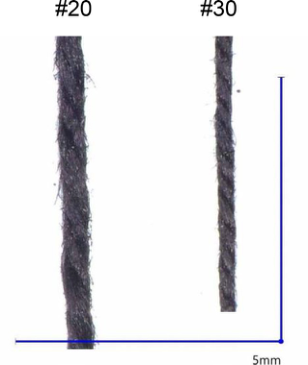
Under the guidance of home economics teachers, the students sewed the fabric using the five specified stitches (running stitch, full backstitch, half backstitch, overcast stitch, and slip stitch). The running and back stitches were instructed to be sewn with a 4 mm needle hole spacing (stitch length). A starting knot was tied at the beginning of the sewing, and a knot was tied at the end of the sewing. There are generally two methods for starting a knot. One method involves crossing the thread over the index finger, twisting the crossed section with the thumb, and pulling the thread while holding it down with the middle finger to form the knot. The other method involves wrapping the thread around the needle and pulling the needle out. Although no specific method was designated during implementation, most participants created knots using the former method. Figure 1 shows the sample threads observed using a digital microscope.
Figure 1: Sample threads observed using a digital microscope.
DATA ANALYSIS For the collected works, a digital caliper was used to measure the stitch length for each stitch and the distance between the knot and the fabric for the finishing knot. For the starting knots in the running stitch, full backstitch, and half backstitch, the presence or absence of a loop was visually observed and scored (0: no loop; 1: loop present) (Morishima & Nakashima, 2025). The loop formed at the knot requires careful attention because the knot may disappear when the thread end is pulled.
First, the length between the finishing knot and the fabric and the distribution of the stitch lengths were confirmed. Second, a t-test was performed on the data obtained between #20 and #30. The significance level was set at p < 0.05. Third, a chi-square test was performed for the presence or absence of loops in the starting knot. Additionally, the probability of problem occurrence was examined for the number of individuals who formed no loops and those who formed one or more loops. The odds ratio (OR) and 95% confidence interval (95% CI) were calculated using #20 as the reference. Statistical analysis software (IBM SPSS Statistics, version 30.0.0.0) was used for the analysis.
RESULTS AND DISCUSSION
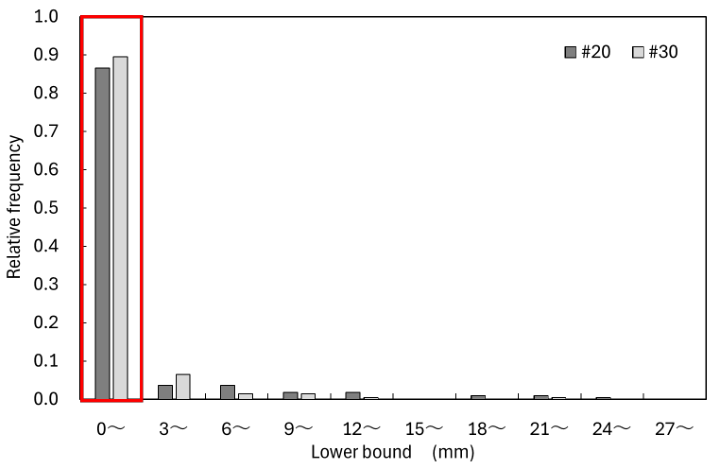
Figure 2 shows the relative frequency of the observed length between the finishing knot and fabric. The length between the finishing knot and the fabric was mostly between 0 and 3 mm for both #20 and #30. However, in both #20 and #30, 10% of the samples showed values of 3 mm or longer.
Figure 2: Length between the finishing knot and the fabric (#20: n = 217, #30: n = 201).
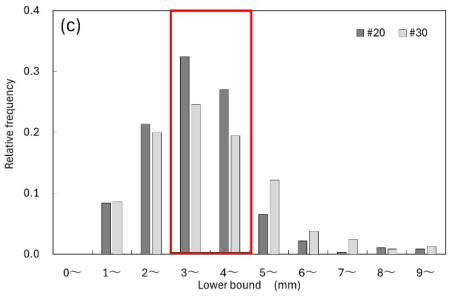
Figure 3 shows the relative frequency of the observed stitch lengths ((a) running stitch, (b) full backstitch, and (c) half backstitch). The most common stitch length for running stitches was 2–3 mm, although the ratio for #20
Manual Dexterity Required for Clothing Repairs 103 was 0.48, and the ratio for #30 was 0.42 between 3 and 5 mm. A similar trend was observed for both #20 and #30. The overall results confirmed that sewing was performed at the recommended length. However, stitches that were either too long or too short were also observed. It was confirmed that some individuals also required the acquisition of skills to control the stitch length.
Figure 3: Length between the finishing knot and the fabric ((a): running stitch, (b): full backstitch, and (c): half backstitch, #20: n = 370, #30: n = 345).
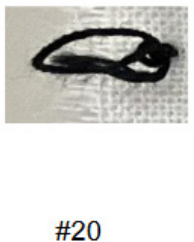
Table 1 shows the measurement results for the stitches sewn using threads of different finenesses. Figure 4 shows examples of the formed loop. Comparing differences in thread fineness, for the knot formation, the proportion of loops among the three trials was 0.20 (SD 0.29) for #20 and 0.34 (SD 0.34) for #30. The p-value was 0.01 < 0.05 (t = -2.6, df = 137), indicating a statistically significant difference in thread fineness.
Meanwhile, no significant differences were observed between the thread fineness for the other evaluation items. In this research, it was inferred that thread fineness did not affect the evaluation results of the other basic stitches concerning manual dexterity.
Table 1: Measurement results of stitches sewn with threads of different fineness.
Table available in the original PDF paper.
p-Value
Stitch Types Evaluation Items #20 Mean (SD)
#30 Mean (SD)
Degree of Freedom
t- Value Starting knot Ratio of loops formed 0.20(0.29) 0.34(0.36) 137 −2.6 0.01
1.87(2.77) 1.20(1.80) 126 1.7 0.09
Finishing knot Distance between the knot and fabric (mm) Running stitch Length of stitches (mm) 3.38(1.11) 3.51(1.38) 132 −0.6 0.52
Full backstitch Length of stitches (mm) 3.72(1.26) 3.64(1.47) 134 0.3 0.73 Half backstitch Length of stitches (mm) 3.68(1.15) 3.95(1.37) 133 −1.3 0.21
Figure 4: Example images of formed loop in starting knot.
Table 2 shows the results of counting the number of loops for three knots per piece. The adjusted residuals for the proportion of students who did not form any loops (0%) were 2.7 for #20 and -2.7 for #30, indicating a significant difference between the two groups. Therefore, the proportion of participants who could create the knot without looping was significantly larger in #20; however, 39.4% of participants could make the knot with looping. Using a thicker thread for practice was identified as a point for consideration.
Table 2: Results of counting the number of loops for the three knots per piece.
Table available in the original PDF paper.
Equation reproduced from the original PDF.
0% 33% 67% 100%
Equation reproduced from the original PDF.
OR(95%CI) was 2.50(1.27-4.91). The lower limit of the 95%CI was greater than 1, suggesting that #30 had a higher probability of loop formation than #20. The odds ratio for this contradictory event was 0.4, indicating that #20 was less likely to generate a loop than #30. This factor is presumed to be due to #30 being more prone to bending, leading to twists and tangles occurring at various points along the thread by the sectional second moment of area, compared to #20. This could foster a reluctance toward basic sewing and lead to decreased motivation to learn.
As a countermeasure, based on the obtained results, it was considered desirable to adopt #20, which is less prone to loop formation, as the practice thread for the subsequent sewing. However, 39.4% still formed loops even when using #20; therefore, a thicker gauge may be necessary. The selection of the optimal thread fineness for practical learning aimed at improving manual dexterity remains a challenge.
CONCLUSION
This study quantitatively evaluated the impact of differences in thread fineness on the results of hand-sewing skill assessments related to manual dexterity. For both thread types, the evaluation results of the observed sewing stitches confirmed no significant deviation from the recommended stitch length. The results showed that it did not significantly affect evaluation items.
However, regarding the presence or absence of loops in knot formation, #20(Ne7) thread had a significantly lower probability of loop formation than #30(Ne10). One contributing factor was the mechanical properties, such as the bending stiffness of the thread.
It was inferred that adopting a thread with a fineness of #20 or greater is desirable as a practice thread for enhancing sewing skills and finger dexterity. The selection of thread fineness remains a challenge.
ACKNOWLEDGMENT
The author would like to thank all the students who provided their work for this study. We would like to express our gratitude to Prof. L. Yumoto of Bunka Gakuen University for her guidance in observing the samples.
REFERENCES
Fuelscher, I., Hyde, C., Efron, D., & Silk, T. J. (2021). Manual dexterity in late childhood is associated with maturation of the corticospinal tract. NeuroImage, 226, 117583. doi:https://doi.org/10.1016/j.neuroimage.2020.117583. Hayes, C. (2019). Sashiko Needlework Reborn: From Functional Technology to
Decorative Art. Japanese Studies, 39(2), 263–280. doi:10.1080/10371397.2019 .1634978. Morishima, M., & Nakashima, S. (2025). Sewing Skills for Sustainable Fashion Focusing on the Starting Knot. Social and Occupational Ergonomics, AHFE (2025) International Conference, 190, 98–104. doi:10.54941/ahfe1006602. Sari, H. P., & Sa’diah, K. (2025). Efforts to Improve Children’s Fine Motor Skills
through Sewing Activities at Raudhatul Athfal ‘Aisyiyah Gontor. Journal of Indonesian Primary School, 2(1), 192–202. doi:10.62945/jips.v2i1.431. Saunders, C., Griffin, I., Hackney, F., Barbieri, A., Hill, K. J., West, J., & Willett, J.
(2024). A Social Practices Approach to Encourage Sustainable Clothing Choices. Sustainability, 16(3), 1282. Retrieved from https://www.mdpi.com/2071- 1050/16/3/1282. Singh, N., & Singh, M. (2025). Traditional embroidery revival for sustainability: A systematic literature review and bibliometric analysis. Discover Sustainability, 6(1), 180. doi:10.1007/s43621-025-00944-0.
LISTED IN THE AHFE DIGITAL BOOKSTORE CATALOGUE
Explore the complete digital volume
Training, Education, and Learning Sciences
Read this individual research paper free through the original publisher, or explore the full digital proceedings book.
ISBN 979-8-950676-07-9
Explore this ISBN in the AHFE Bookstore ↗Listed in the July 2026 bookstore catalogue; search by ISBN to confirm current availability · Digital book purchase optional